Not much has transpired since my last post. Time has continued to fly by and business has been as usual. The reality of departing from all of these new friends I think is starting to set in. We’ve played more board and card games than I ever did with my family growing up which says a lot about ship life. We have had a lot of fun and shared many jokes. We’ve consumed millions of calories from sugar while chasing a sugar high. We’ve bickered about current events. We’ve pulled all-nighters. We’ve sprawled out on the fantail on the maybe 4 days that we actually had sunny weather. We philosophized about life and the potential existence of life on other planets. This was truly a great group! I preached about always learning in my week 1 blog and that is not limited to just marine tech knowledge for this internship. In fact, I think meeting these people, learning about them and their goals, and making memories are the most important part in making the MATE internship an experience.
Author: Jacob Cooper
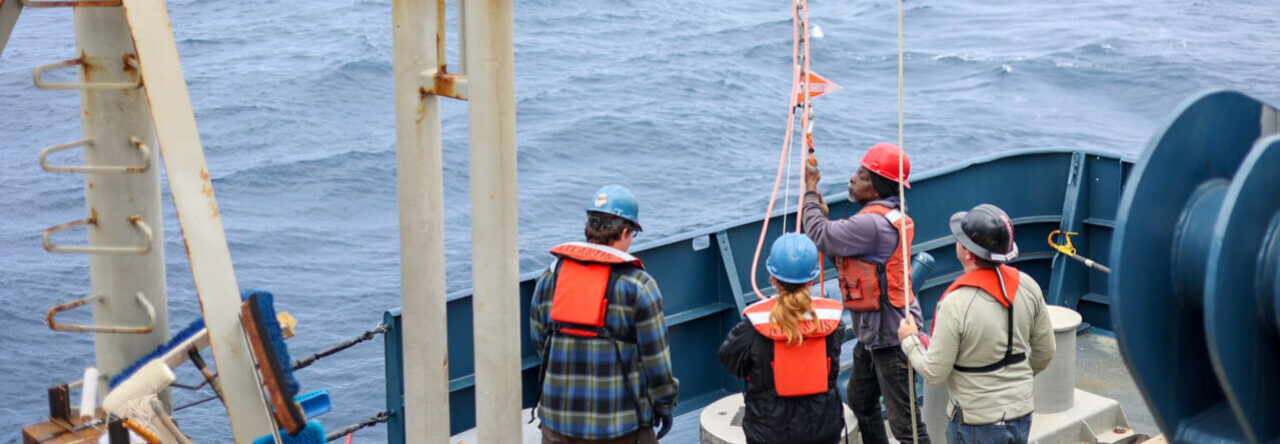
The last week has been an eventful one where time has seemed to fly by quickly. We began the week with a ship-wide fire drill where there was a fire in the main lab, our primary muster station. Luckily, common sense prevailed and all of the scientists found the secondary muster area at the CTD hangar. As the week progressed, we began tackling an issue that has been plaguing our XBT (Expendable Bathythermograph – sound speed velocity) data. Multiple XBT probe deployments were showing noisy false data before the probe reached the water so we started troubleshooting. It was noted that the data was normal when the wire for the XBT launcher was not touching the deck so we checked the wire insulation for nicks and we made some repairs. It worked! Scientists were happy and techs felt proud. Truly a terrific moment on the R/V Neil Armstrong followed by a highly entertaining scientific meeting. Arman, a visiting scientist, gave a fantastic no-BS presentation on volcanology pointing out the key ingredients for explosive eruptions which are volatiles. It is not widely known that volatiles in magma, mainly water, cause the explosive eruptions that we envision when we think of volcanoes (or see when we watch Dauntes Peak). Later in the week, we visited the engineering department and got a full tour of their spaces. We also learned how to replace bearings on a CPP (controllable pitch propeller) motor. Overall, a very educational and fun week!
In stark contrast to Sean Connery’s “one ping only” in Hunt for Red October, we’ve pinged about 150,000 times and have calculated that we will ping around 302,400 times in total. Now that I’ve mentioned it I can’t seem to tune it out once again. Should be a great night’s rest ????. We are nearing the halfway point of the cruise and it’s starting to get to the point in the cruise where people are getting bored. Luckily, I’ve managed to procrastinate all of my work for the second half of the cruise. My plan is to map each system from transducer/radar/gps to computer to display so that I can better visualize the big picture of the tech-managed equipment onboard. After I have that, I want to examine and draw in how the systems interface with one another so that our displays show large varieties of data from different sources. I think this will be useful to build intuition as a tech e.g. if we stop receiving air temperature data I’ll know exactly where to go to start troubleshooting.
So far we’ve learned a great deal of information in a short time. It’s a bit like trying to take a drink from a fire hose. But, overall it is great exposure to the Marine Tech way of life. We got the fundamental training on breaking down the CTD, cleaning all connector pins, and reassembly. The CTD has been described to us as the “bread and butter” of research cruises which is true in my experience. We also built the CTD software from scratch. This exposure will be vital in any future position as a tech. Techs are a liaison between science and crew so we also got some time in on the bridge discussing communications and load plans of scientific equipment. In general, it has been a week of life at sea where there is a lot to do and not enough time to do it. I tend to ask myself “Am I learning?” And if the answer is yes then all is well at sea! I am learning out here.
I spent some time before on the R/V Roger Revelle and it was an amazing experience. I recall thinking that the Marine Techs have a “pretty sweet gig”. I am thrilled to dust off my prior SONAR equioment knowledge from having been a SONAR Technician in the Navy and apply it to this sweet gig. Also, highly excited for 5 weeks of delicious cuisine on one of the newest research vessels. I feel like I have all of the luck right now and I’m grateful.