Author: Sebastian DiGeronimo

Week Six: The Final Week on the R/V Hugh R. Sharp

6/24/19

              Hello all,

              The last full week of being out on the R/V Hugh R. Sharp, what a wonderful time it was. This was probably the easiest time for me with mostly demobilization and remobilization for a one-day cruise with the Office of Naval Research. The plan was to deploy four bottom mounts and one line of small sensors, then finally a few days to enjoy Delaware for all its flat glory.

              For Sunday, we arrived to Lewes around 0500, but since we got in when it was low tide, we couldn’t go into the channel until 0700. We were all just waiting ducks until the tide started to rise. The final tie off for the scallop trip finally ended. Since everyone was beat from the past few weeks, everyone tried to leave early to get some actual sleep in their beds and rest up for a demobilization and remobilization for a two-day cruise working with the Office of Naval Research. The boat was tied off in an easier fashion due to the nature of having lines on the dock instead of throwing them overboard. By 1200, the majority of the crew had left. All we ended up completing was removing trash. Tomorrow will be a hard day.

              We ended up with Christian later that night where he showed us around Rehoboth, DE. WE had some food a one of the restaurants and went back to the ship for an early 0700 morning. An early day to sleep at last.

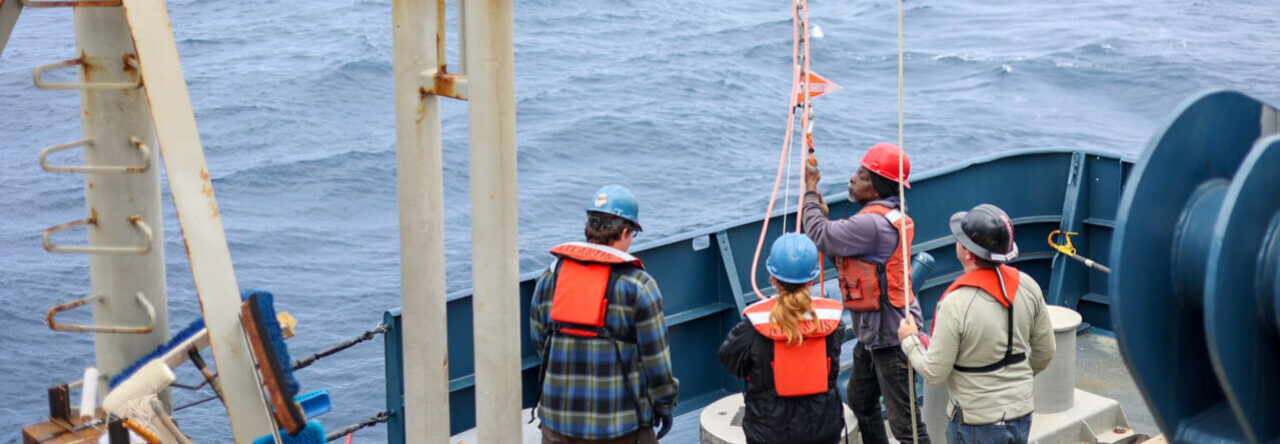
              For Monday, an early morning to get all the large equipment off the deck and a few items onto the deck. We started around 0700 where we started with removing the sorting table, dredge ramp, HABCAM ramp, and HABCAM tracks. This part was mostly easy; we just needed to hook up lifting straps to the crane and move it to the shore where one of the shore-support would get the forklift move the items back to their spots. We spend a good few hours removing these large items. The last major removal was the laboratory van which was a little bit more involved due to a rigid metal lifting harness needed to be attached to the crane and then lifted to the van. We had to get on top of the van to attach the metal harness to van and off went the van. Next was washing the deck with ‘on-off rust remover’ to remove the rust that had built up being at sea. While I was working on that, a few guys removed the port side winch block as it was not going to be used for the next cruise with the Office of Naval Research

              After everything that could be taken off was, now its time to add some gear to the deck. We added a Zodiac type boat, as they call it a NAZ (not a zodiac) back to the 01 deck where it normally is; we added a huge 7200 pound winch to the center of the deck; we added a couple of cleats near the A-frame and the rails back to the port side of the deck; and we added a few counter weights as the winch was shifting the boat a little to starboard. All was easily done with the crane, a few lifting straps, shackles, and a tag line or two. We secured all the items with either bolts or rachet straps. By this time the science team had arrived, but they were working in the low bay in the operations building to work on getting their two spider bottom mounts and two larger platform bottom mounts ready for deployment on Wednesday. This was basically the end of our day as well because we got most everything done.

              Later that day, the cook, Hunter, took Shaun, Huxley and I to Dewey Beach to show us the little beach town. It was an interesting place that reminded be of a smaller Jersey Shore. Beaches and restaurants all around. Unfortunately, it started to rain a few hours in, and we ended up leaving back to the ship. I was able to get a good night sleep to keep getting ready for tomorrow.

              For Tuesday, another early morning at 0700, a great time to wake up with so much time having to finally sleep. After breakfast, Christian gave Shaun and I news that we needed to get the multibeam set up and installed before we leave tonight as it was a last-minute addition to the cruise plan. The multibeam was stored in a cargo container, but it wasn’t clean since they removed it, so a lot of TLC was needed before it was ready to be used. We also needed to take out one of the unused pods currently in the keel to put it in its place. Christian and Tim Deering were showing me the tricks of the trade to clean it off. I was using wooden dowels to scrap off the buildup of mud and barnacles. They did this because it was a soft and wouldn’t scratch the transducers. I will tell you; it took many hours of cleaning because they were satisfied with it. We also had to replace a couple zinc plates and rinse with water. Once it was cleaned, the other trick they told me to use for anti-fouling was vacuum grease and cayenne pepper. Tim told me fishermen used to use this for anti-fouling as paint cost too much as the time. Once greased up, we were good to move it to the ship. All the while, Shaun had been removing the metal grate that holds the pod in place in the keel so that it could be removed with the crane. First, lunch with sandwiches from the local sandwich shop. As soon as got done, we got the old empty keel pod out by Christian and Shaun going in the keel and hooking up to the crane. Huxley and I were guiding it out as the crane operator rose it up. A line was tied to it and we guided it back to shore where it was placed on the forklift. Next, we lifted the multibeam pod and placed it into the keel. This time I went down to put and tighten the grate. Then we ran the cable through the passage and into the dry-lab where we hooked it up to the computer. We finally got it all hooked up and it was ready to go. Most of the crew had left at this point, but soon the science team would start loading all their gear. All we needed was a forklift driver, a crane operator and Shaun, Huxley and I. We started with the gravity corer attached to a wooden frame, then the two spider bottom mounts, an hour later the two platform bottom mounts. We talked with the science team on how to secure all them down, then we went at it. A few large containers were added, and everything was on board. The plan was to leave at 2000 and start the next day at 0500. The crew came back around 1900 and we started off. Since all the deployments were during the day, Christian, Shaun, Huxley and I went to bed shortly after.

              For Wednesday, another early morning at 0500 this morning. We were getting ourselves ready before the science team wake up. The game place was to deploy a platform, then a spider, then a platform and lastly a spider. Before each deployment we would do a corer sample to make sure we at an acceptable location and deploy. After everything is in, we will do a little multibeam over the sites and back to Lewes.

              The first deployment of the platform was pretty quick. After we had to core sample finished, we used the winch to and four tag lines to inch it close to the transom until right at station. The science team had rigged up a removal compass to adjust the direction of the platform once in the water. Ever so slightly, they inched it closer with four men on the tag lines. It went over without any problems. It did take some time to get the compass right as the current and the boat made it a bit difficult. A couple of surface floats were laid out and the first site was done. Next was a spider which was easily moved into position by five men. We had to rig up two shackles to the side of the A-frame to get a line around the spider to lower it into the water easily, this was done pretty easily with two people on the spider to stabilize it. The first one went in without a problem, we adjusted its direction and it went in without a problem. Lunch time was shortly after then the last two. Another core sample was taken and another platform was released into the water. Again pretty quick and easy. The last spider was set in as well a little while later without an issue and we were done with everything on deck. The final task was the multibeam.

              They had one of their personnel working on the multibeam, but she hadn’t used it in some time and our crew was not fully familiar with the system.  I spent much time watching her figure out how to set up the system, get a base map, plot points, and figure out what was needed for the calibration test. Roll, pitch and yaw we needed to be calibrated using flat points in the water with two lines going in opposite directions for each variable. Once she figured out good points, we get the boat driver geared up to follow transect lines and we off. It took a good three hours before getting to this point, but only one and half hours was needed to actually perform the passes. Once we made multiple passes across the transect line for the bottom mount sites and calibration, we set for Lewes. By 2000, all was said and done back at the dock and ready for bed.

              For Thursday, the demobilization was a quick one today, with mostly just the bins and corer needing to be removed from the deck. This took maybe two hours and our day was over. All the science team were quick to leave by 0900 and my time aboard the Hugh R. Sharp was basically over. No more work was going to be getting done as the crew was taking a short vacation after being out at sea for so long.

              I spend the last few days in Delaware going around with Christian to show me the sights. I saw downtown Lewes with a few restaurants, but mostly I hung out with the graduate students for the University of Delaware. I talked with them about their projects and the type of work they were doing. By Monday morning, I was back in Florida and ready to take on the next part of my life. The last few days were quick, but unfortunately not much occurred after all the work was done for. I had to prep for a cruise with the Ocean Circulation Lab at the USF College of Marine Science so much time was spent getting all my needed paperwork for that.

              This had been an amazing experience, with lost of meeting of people and learning much about being a marine technician. I think I want to pursue a master’s degree after being a part of all this from talking with the different scientist involved. Here comes my next phase!

              A bittersweet time to leave. I had too much fun and worked extremely hard to learn what it takes to be a marine technician. I found my enjoyment of all the tasks at hand, but I feel a strong pull in specializing with a master’s degree. I definitely loved doing the work, but I’m feeling very motivated from all these experiences to keep it going and get a higher education degree in oceanography. I want to be out at sea and collecting data for my own research projects. I am definitely more affective when being on deck and collecting data, so I should use this experience to continue that for whatever I get into with it. I’m super appreciate for every opportunity I got in this; I really felt like part of the crew when I was here. Time to get myself in gear and get to grad school! Thanks for everything Christian, Huxley, Tim D., Tim N, Andy, Chuck, Hunter, Pam, Chris, Casey, Jimmy, Joe, and all the science team. I will never forget this and will continue to strive for greatness.

Best,

-Sebastian D.

Week Five: The Last Week of the Scallop Survey

Hello all,

              This week had a roller coaster of ups and downs with the greatest up being the recovery of the HABCAM but getting it to work properly was harder than expected. Unfortunately, we may have got it working, we didn’t end up using it again. Not enough time was allotted to make use of the HABCAM once all the issues were corrected. We continued with a few more dredge sites, but they were mostly ones that we either skipped due to a sand wave bottom, flips or hangs. Basically, we ran out of time for HABCAM and sites for dredging. With extreme issues, comes extreme learning as I have found out.

              To bring it back, on Sunday of 6/9, we were finishing up some more dredges before steaming back to the location of the HABCAM. The divers were going to meet us there around 1300, do some sonar scanning to pinpoint the HABCAM location. My watch with Huxley had two dredges on the first watch and four on the second. These areas were added stations along the eastern side of Cape Cod. The contained many clams and mussels. The bags were very full and needed to be shoveled to dump the dredges. This made the dredge process take an extra forty-five minutes and covered the entire table before sorting. That morning, I was running into a wall. I just wanted to give up, but I came here to learn and perform tasks. My will power was tested, sleep deprived and all. I made it through until the next day, the important day of this week. The best part of the week after all we’ve been through.

              Monday was the day that we recovered the HABCAM! The morning was mostly just steaming, Huxley and I made use of our time to do regular rounds around the boat again. When I woke up, the sorting table had been rigged to pull up the HABCAM with a manual winch winder so that when the rope was pulled up, we could use the tugger to get it on board. We arrived on site around 1100, but the divers didn’t until 1300. They took their time scouting out the area with their sonars for a few hours. Then the divers went in, tied of a line at thirty-seven meters with a float. We backed down on the float, hooked her and pulled her on to the tugger. The most stressful part was over, next came the pull up on the tugger. With Tim North’s (Chief Engineer) experience, it came up without a hiccup. Once on the dredge ramp, a few adjustments were made with the trawl winch and the tugger winch. Eventually, the HABCAM was brought on board. Then, we moved it to the deck near its normal location on the port side. We found out from the divers that we hung up on a massive rock, who would have though a rock? Next, a few quick checks to see if it powered on; to everyone’s enjoyment, it did in fact power on. Now a full diagnostic was needed to see if they could re-terminate to the fiber optic cable at sea. They would give themselves eight hours to try and fix it, then we would go back to Woods Hole for their better equipped shore support. This decision was made on my off time, but the decision was made to go back.

              Tuesday was the day of traveling back; the AM watch was mostly just steaming. An easy watch after having basically a week of nonstop dredging. On my second watch, we arrived at Woods Hole around 1200. Most of the work done for this watch was tying off the boat at port. I helped Christian on shoreside by getting the boat tied off to the cleats on land. After tying off, the engineers and scientist from NOAA came aboard to diagnose issues with the HABCAM. It took until 1700 before they were confident that it would work again. The personnel that came aboard had left shortly afterwards with the termination to be done while steaming back to where we left off. It took until the next day before we one, at location and two, ready to deploy it again. Another up for us.

              Wednesday was the day where we finally put the HABCAM back into the water. It wasn’t until 0300 where the termination was completed, and a load test was initiated at 5000 pounds just like the first time it was terminated. The termination passed without a problem; it took some time though due to one of the shackle nuts not screwing in. Afterwards came the painstaking process of reattaching the termination to the HABCAM. This was only an issue because the cotter pin was not going on very easily. Once everything was together, another test was performed, and it was good to deploy. Huxley, Andy and I deployed it without a problem around 0500, so it was soon for bed. For our second watch, I found myself gearing up for more dredging. What happened? The possibility that a fuse blew on the main can caused a failure in data acquisition and could only be fixed when at port. The decision was made to do a few last stations, seven, then head back for hopefully one day on Friday. Thursday would have been a day for fixing it, but the weather would have been poor so departing was delayed. The areas that we had to dredge were left over sites, which unfortunately were the locations of where we got many rocks. Huxley and I only made it through three dredges before our off watch. We did find many rocks and scallops though, which was a nice end to our dredges. They weren’t even too heavy either.

              Thursday was an easy day for sure. The first watch was mostly just steaming back to Woods Hole to fix the HABCAM again. The weather was expected to be pretty poor so we wouldn’t have been able to leave again until Friday morning at the earliest if everything went well. It was determined that we would not be able to leave Friday so the scallop trip ended one day early. Huxley and I most relaxed for once after all the shoveling we’d been through. Finally arriving, Christian and I tied off the boat once more around 0500 on the shore side with Shaun and Huxley feeding us tag lines. A few shore side scientist came aboard around 0900 to get started on fixing the HABCAM. It was eventually fixed, but no one knew if we would be leaving again the next morning. The plan was to take it easy on all of us and get off the boat for a few hours. Around 1800, we, as in the crew and science team, made our way a few restaurants. I mingled with the different science members as per usual at this point. We all had fun as it would turn out to the last day for them to be aboard the ship.

              On Friday morning just before breakfast, it was determined that we would not be setting sail with the HABCAM. I guess the science team figured it wouldn’t be worth going out for six hours of HABCAM. It would have been a twelve-hour round-trip steam and they only had the boat until Saturday morning. The arduous task of unloading the boat was the main concern from then on. Unloading the three dredges, HABCAM, getting both ramps unbolted and securing all the deck items was everything that needed to be done for the science team to be on their way. For the crew, we would leave to go back to Lewes, DE after dinner. We set sail shortly thereafter and a thirty-one hour steam was underfoot. Since there was no science team aboard, the four of us could be on the same watch to get the major cleaning done on Saturday. With that being said, we all went to bed for an early morning of cleaning.

              Saturday, the day of cleaning! The key areas to clean are the dry-lab, vestibule, below deck state rooms, life jackets, the wet-lab fridges, and the tool room floor. Shaun and Huxley tackled the state rooms first, while Christian and I handled the dry-lab. The dry-lab was an easy clean it just took some time as the floor had tiny blue rubber mats with holes to allow dirt to get off shoes. This covered the entirety of the lab so we had to pull them up in sections, sweep and mop. Then there came the wiping of the benches which was a very easy task. The two of us then went to the fridges. The two fridges in the dry-lab contained scallop meat for continued science testing, but it left a very rank fish smell when opened. Therefore, a thorough cleaning was in order with a product called ‘Simple Green’. It took a couple times of cleaning for the smell to go mostly away. Shortly after we started cleaning the life vest. More Simple Green was used in this process and hung them up to dry. Shaun and Huxley were taking out the vestibule mats and cleaning the floor with, you guessed it, Simple Green. The last main task was the tool room. All four of us were working to clean it up. It seemed it hadn’t been cleaned in some time. All said and done, the boat was looking, Sharp. The rest of the steam for that day was mostly catching up on work or relaxing. We all could get some sleep finally and be up early to get the boat tied off in Lewes.  A bittersweet end to the scallop survey, but I at least have one more week on the Sharp with a quick turn around for a quick two-day cruise with the Office of Naval Research.

              This week has been full of ups and downs, laughs and pain. I never realized how much hard work could go in to protecting different species of economic value. I’m glad to have been a part of this even when major issues came up, that being the lost HABCAM. If anything could go wrong, it definitely did, but everyone was very professional about it and solutions were made. I hope to keep that adaptability with me as I progress myself.

Best,

-Sebastian D.

Week Four: Lost in the Abyss

Hello all,

              Back at it again with some more dredging. Back breaking, sure, rewarding, definitely. I couldn’t imagine the people that do this every year. This is Huxley’s third year; he doesn’t seem scared off as of yet. There must be something to all the hard work we are doing that makes him come back for more.

              For this week, much fog and wind were a constant theme. I never really knew were the sun was, the time of day, or how long of rest I would have. When the dredge was down, we had a max of 15 minutes before the process of bringing up the dredge and much time to shovel it all out depending on the load. It’s amazing that even during summer, we can be cold, wet and foggy. Still we had to press on until getting back to Woods Hole for a crew and science change.

              On Sunday (6/2), we continued the process of dredging again. We seem to have gotten it down to three to four dredges a watch, with a total of twelve to sixteen dredges a day. There would occasionally be flips, where the dredge would flip over and just be dragging along the bottom. We would therefore have to retow it or drop the sight all together. Another difficulty would be what we call a hang; this involves where sand waves are present on the bottom and the dredge rams into it causing it to get stuck. The boat then has to back down onto it and then pull it up. The unfortunate effect from this is its mostly a sand cast and will need to be retowed or dropped. At this point, there is a hierarchy of suck when it comes to the contents of each dredge. First comes rocks, then mud, sand, sand dollars, mussels, and everything else. They are basically a result of how heavy each shovel amount are in them.

              On 6/3, we continued to dredge. A total of four dredges for the first watch and four for the second watch. The temperature continued to be cold and foggy with a breeze; good thing we had foul weather gear on. Some of these dredges contained many mussels and barely any scallops. A total of five were found on the first dredge of the morning watch. We did have a hang dredge, which usually means sand and a lot of it. You could construct a beach volleyball court with all the sand. Somehow, many scallops were captured in it. Two CTDs were performed with me working the computer and radio.

A CTD is a useful set of instruments and equipment to acquire various at depth variables as well as water samples. The one in use on the R/V Hugh R. Sharp is the SeaBird 9 plus, a standard package for water sampling. It contains a rosette of Niskin bottles to acquire water, salinity sensor, temperature senor, depth senor using a digiquartz instrument, oxygen sensor, and fluorescence for biomass. To prep the CTD, we setup a new file on the SeaBird Seasave software, remove the caps from the sensors, open the Niskin bottles, and radio to the bridge that we are good to cast. The method for casting is unique to the Sharp due its hands-off casting. It has a mechanical arm that pulls the CTD up into it and cast it down over the starboard side. Once in the water, we start the pumps and have it set five meter from the bottom. If the science team needed a water sample, we would fire three bottles at the start of the mixed layer of all the variables. Then we would bring it up to the surface and secure it down. The last thing is to do post processing of the data and flushing the pumps and bottles. A great system to gather in-situ water quality variables for various scientific research. Many of these have been cast, and many more will continue to be cast, usually one or two a watch.

On 6/4, for the first watch, we complete a total of three dredges. The worst one was the one with the mud; mud is very stuck together making it difficult to shovel, plus when the science team sorts everything, it takes much time due to many tiny organisms that inhabit it. The last dredge had some interesting organisms, a few large female lobsters, which we promptly put back, a couple octopuses, but not many scallops. On the second watch, we were steaming back into Woods Hole for a science change a couple of crew change, mainly an engineer, chef, and a mate. I assisted with tying off the boat on the shore and getting the gangway on board. We started with the stern, then bow and lastly the spring line (middle). Tomorrow, we will be gathering food and having an easy day. My father lives near here in Falmouth, so it will be nice to see him for a few hours.

In the morning (6/5), after breakfast, the HABCAM was worked on by the science team’s technicians and engineers. I helped by getting food with the new chef Hunter, Christian, and a NOAA employee, Nancy who was on the first leg. A few hour later with a full minivan of grocery items, we head back to the ship. After unloading everything and putting all the groceries in their place, I made plans to meet with my father, his girlfriend and my sister. We had lunch a local place then went to his house for a few hours. Unfortunately, I couldn’t stay late as we were leaving again early in the morning, around 0500. A great day to see him as it was the first day that was not completely foggy and cold. Later on, we will have perfect weather for the next step of HABCAM and dredging. I will let in on some foreshadow, but the HABCAM will have a major issue tomorrow, but the weather will hold out regardless.

On 6/6, time to steam out again around 0900 due to the HABCAM being worked on to make sure everything powered up and worked properly. I assisted with the removal of the tag lines and secured the rails. The next location was a six-hour steam to Georges Banks. At this point, I switched watches with Shaun to back with Huxley. Now I’m working on the 0000-0600 and 1200-1800 shift. Now was time for bed. The second watch of the day was pretty easy, Huxley showed me how to conduct the weekly oil check looking for areas that could potentially contain leaky oil. I found multiple locations of open spaces under the deck for possible oil. We check the engine room, auxiliary room, winch and propeller room. All looked to be good. Afterwards, we finally sent the HABCAM back into the water around 1700 just in time for dinner and bed.

The major issue has sprung up right before our watch for 6/7. To the great dismay of the science team and the crew, around 2230, the HABCAM was unfortunately disconnected from the cable at 36 meters a few miles from upper Cape Cod. This being the most dreaded result from all of us. When Huxley and I awoke, we were calmly told by Christian that we had lost the HABCAM. It seemed very peculiar how calm everyone was at this. The ship was doing loops using the echosounders to locate the possible location of the HABCAM. Since the HABCAM is a very expensive set of equipment, it is most dire to locate it. When making many passes, there was a pretty good change that we found it located next to a twelve meter long by seven meter high object located at a depth of 36 meters, possibly a rock or uncharted wreck. We could see the HABCAM due to it being metal, it showed up as a high density object that is yellow as opposed to the benthic habitat being red. The HABCAM also had an acoustic pinger which we tried to locate using the Teledyme Benthos DRI-267 Dive Ranger with the ACU-266 surface attachment. Huxley held it over the starboard side next to the CTD. The ACU-266 started pinging a depth and a direction. We were not 100% certain because we wanted to make a few more passes at daylight, but a pretty good idea of its location was confirmed. For the rest of the night, the only thing Huxley and I did was do the monthly safety rounds for emergency lights. It was a bummer that the HABCAM was lost and on the first day of Leg III. There were talks of getting a commercial dive team to locate it and attach a line for us to recover it. This has not been the first time it was lost; a few years ago, it was lost in deeper water which took the use of an ROV to recover. Since this location is within diving restraints, it could be done within a few hours. The next logical step would be to continue on, but instead of HABCAM, we would do all the locations for dredging. The second watch had us start to continue dredging to my dismay. At this point everyone was getting battered by the dredging process, I was hoping for at least a couple of days break, but pushing through was all we could do. We ended up completing three dredges this time, one with mud, one with many heavy rocks, and the last being relatively light compared to the previous two. Right after the rock load was emptied, a pod of seven humpback whales were sighted. I finally had the opportunity to see whales in the wild. What a sight to see. I wish I had taken pictures of this awesome sight. Everyone on deck stopped to enjoy the sight. On the last dredge, a few dolphins were also spotted, and we acquired lots of scallops. I also got word that the dive team will be able to come on Monday to tie a line to it given that our site location is correct.

For 6/8, we somehow managed to get through ten dredges between both watches and two CTD cast. One of the dredges was even flipped, but we pushed through with five each watch. Most of the dredges were easy compared to ones with rocks. Apparently, these locations on the north east end of Georges Banks contains less rocks which is a relief. They tended to contain many sand dollars which at this point became very easy. The majority of the task for the sorting from the science team. They were slower than normal because many more small organisms like the sand lance were hard to find. Some baby cod, a few monk fish, and many small flounder were found. All in all a much easier time than the day before.

Another week completed on this adventure at sea. The toils of the sea were realized when we lost the HABCAM. Anything that can, will go wrong when in the unforgiving sea. Everyone was being professional when these issues struck. I’m seeing firsthand how being able to cope with change when at sea is a very important characteristic because we really don’t know what will happen. We don’t know everything that’s below the sea making much harder to plan for everything that could go wrong. Even the dredging has its toils when flipped or hung because of the mixture of boat speed, winch length, and benthic topography. The crew has experienced a great number of issues over their long careers so coping with them seems to be practically flawless. I hope to take this mindset with me as my future career is opened up.

Best,

-Sebastian D.

Week Three: Eat. Sleep. Dredge. Repeat

Hello all,

              Wow, what a week! I’ve definitely been put to the test with endless amounts of dredging. Who would have thought that dredging would be back breaking work. From the moment you wake up to the moment you sleep, dredge, dredge, dredge. Nothing but eat, sleep dredge, repeat. I’ve never been worked so consistently as this, with 6-on and 6-off, all you want to do it sleep. I couldn’t imagine doing 12 hours straight.

              Let’s begin where I left off. Sunday and Monday (5/26-27), more of HABCAM. I’m realizing now, I haven’t explained what the HABCAM is or does. Since, I didn’t do much on my side, I probably should explain it. The HABCAM is a metal vehicle, equipped with a multitude of sensors, such as fluorimeter, altimeter, sonar, side-scan sonar, temperature and salinity probes, two cameras, and four strobes for the cameras. This system is used to take pictures of the benthic environment, processed for color and then annotated by the science team. This is a less invasive approach to estimating scallop populations then dredging, which I’ll get to later. The science team annotates for fish, rays, skates, and scallops. Since each image has a depth from the bottom using the altimeter, the relative size of the scallop can be estimated from the field of view. Thousands of images are taken and subsequently thousands are annotated by the science team. This system is pretty sensitive due to the type of cables that are used, mainly fiber optics, meaning the ends of the cable need to not have any pinch points of the 10 micrometer glass fibers could break and no information can be transmitted from vehicle to server. Issues have been continual with the HABCAM from the sonars not working properly, to strobes going out, to even camera loss. Some issues like the cameras has been fixed on and off, but the strobes have yet to be corrected. To get decent images, the HABCAM should hover around 2.0 m off the bottom. Since the benthic topography is variable, the science team has access to wire in and wire out to keep it in the sweet spot. As they say, its like playing a delicate game of the claw from an arcade. The only difference is the vehicle is much more expensive than a one-dollar toy. Occasionally, it will crash briefly on a sand bank, but it always recovers immediately. Once the images are annotated, post processing needs to be done on land to then estimate population, in tandem with the dredging.

              Later in the day around noon on Tuesday (5/27), we arrived in Woods Hole, MA where most of the NOAA survey team are based out of. For this leg, it will be mostly a refueling mission, but work on the HABCAM will also take place. I’ve been to Woods Hole in the past as a tourist, so being on the research side here was a dream come true. We tested out two pumps, one gas powered, the other electrical. Although, I was told, if we bring on enough water to use either pump, we have bigger problems. I hope we never actually have to use them. Both worked like a charm, the electrical one, was way stronger than I expected with water shooting four feet up. Shortly thereafter, time for a needed break in Cape Cod. A few of the crew went on out to the local wing house for wings of course. We didn’t stay out very late due to needing to get out early in the morning.

              On Wednesday (5/28), we shipped out later than expected around 1500. This mainly had to due with trying to troubleshoot the issues with the HABCAM such as the strobes, sonar and fiber optics. Our next test sight was 10 hours away to dredging. We checked our surface monitoring system and echosounder, everything checks out.

              On Thursday (5/29), the day has finally come to start a mass of dredging. After breakfast, Christian and I had about an hour until all hell broke loose. We had to tie down the HABCAM with rachet straps and pull enough slack cable to not get hung up when the A-frame payed out. Then we had to reconnect the Starboard winch to the dredge with a shackle.

              Soon we were in position and ready for our first cast. On went our foul weather bibs, steel toe deck boots, gloves, work vest, and helmet. We quickly went outside for some good ol’ fashioned hard work. The dredge needed to be disconnected from the tugger and up went the dredge, then went down to the specified depth from the science team. After 15 minutes or so at the bottom it came up.

              This is the choreographed part of the dredge that takes much time. First, we need to hook the dredge on ramp with the tugger and two lifting straps. Once its on board and pulled as far as it can, we hook a lock chain to it. A scientist then removes a small device that test for pitch, roll and temperature. Then the straps come off and hook the tugger to the bungee/cable on the center winch block on the A-frame. Then we feed the tugger and pull the bungee to get the cable over and hook it to the chain on the back end of the dredge. The dredge goes up to dump its contents, in which Christian and I shake it down with rakes. Then, the end goes down and we pay in the tugger to get the bungee/cable through the winch and free up the tugger. Lastly, we remove the lock chain and the dredge goes back down the ramp where we secure it was some tag lines. All of this takes about ten minutes; quick to learn, but you should go fast. I had to keep jumping over this rock ramp to get to my station on the starboard side. I always fear of falling in at this point, but I’m secure in my abilities to keep me going.

              The fun part begins with shoveling the pile of benthic organisms to the sides of the table for sorting by the scientist. Anything from scallops (the main thing we’re looking for), rays, skates, sand dollars, crabs, hermit crabs, flounder, hake, starfish, shells and many more. Everything needs to be sorted with a majority being in the category of “trash.” All invertebrates have a separate category by species.

              Once all the species were sorted, and the science team has moved all their baskets and buckets into the science van, Christian and I would clean the deck of all excess debris. Christian on the hose and I on the brush, moving all the critters back into the sea. The first couple of dredges were very light with maybe a couple scallops. Our first watch we had enough time for three dredges. Then it was off the bed, leaving Shaun and Huxley with the CTD cast and more dredging.

              For the next couple of days, all we would do is wake, eat, dredge, repeat. Boy what a time to be alive.

              On Thursday, today was very eventful, but also very tiresome. For both watches we did nothing, but dredge, dredge, dredge. A couple of CTDs were sprinkled in, which is very simple. To cast, we would prime the Niskin bottles, take off the cap to the fluorescence, remove the syringe from the pumps filled with Milli-Q water, remove the safety chains, turn the deck box on and start recording. We would signal to the bridge that we were ready, and by using the Knudsen, explain what depth to submerge it. As it is put in the water, the pumps would start, and we would lower it to five meters to remove bubbles and back to the surface to go down again. Christian and I would watch the graphs with salinity, temperature, fluorescence, depth, and oxygen. When recovering it, the bridge would pull it from the water, with Christian and I securing the safety chains, cover the fluorescence, and fill the pumps with Milli-Q water. After the scientist got a water sample, we would re-cock the Niskin bottles and rinse with freshwater. Lastly, we processed the data from the cast using a script that gives us a smooth graph that’s adjusted for ranges and shows only the up-cast.

              After four more dredges for dredging on the first watch and three on the second, the day was over. This was a day of eat, sleep, dredge, repeat. We did see some interesting creatures along the way like a torpedo ray that has electrical discharge of 400 volts to kill fish, which is crazy. I learned how to shuck scallops, which turns out to be quite easy. You have to run a knife along the body until it pops open, then remove the skirt by pushing it up over the meat. Then cut off the meat into a pale. Boy did we have many scallops for some of these dredges. The last one before bed had six or so baskets. We only ever had enough time to do maybe one full basket. From what the other watch told us, they didn’t have very many scallops, mostly trash.

              For Friday, we finished up the last bit of dredging before a couple of days of HABCAMing. When it was pulled up, it was a crazy full. It has not yet been this full since starting. All the way to the brim full of sand dollars. Amazing how much could fit into it. Someone suggested it could hold 2000 lbs. when full. This was definitely full and difficult to get out of the bag. We had to get five guys to shovels some of the contents out to the edges of the table. Some had shovels, some had rakes. All in all it was painstaking process. We eventually got it all out and got the dredge secure. The next major thing was shoveling it all to be sorted. Christian and I were doing our best, but at some point, Christian got down to start moving baskets to the edge of the deck. We eventually got it all, washed the deck and finally were done. Next was the process of unrigging the dredge to get the HABCAM back into the water. We hooked to dredge to the tugger and pulled it on board. We hooked it to the lock chain and rachet strapped it down. We unhooked it from the starboard side winch, and it was as good in place.

              Once getting to the location, a CTD cast was in order and just like before, got it ready, cast it, captured bottles, recovered it, cleaned it, and processed the data. All was smooth moving. Now came time to drop the HABCAM. No issues in dripping, with rest of day for some relaxing time after the past few days of nonstop work. We went back to dredging on Saturday, on our second watch, with a total of three cast getting boulders, scallops, and mussels.

              A hard week has passed with a few more to come. I’m seeing the important hard work that goes into surveying. Every task has its purpose and varying level of difficulty. I’ve had to keep my mind straight for the task at hand to keep everything moving smoothly, even with little sleep. Sometimes, sleeping is very difficult with the rocking, but we all power through. We strive for the best data we can collect. I appreciate this experience, no matter how hard it may be at times. Just keep swimming, just keep swimming.

Best,

-Sebastian D.

Week Two: Endless HABCAM

Hello all,

                Another week has gone by. More HABCAM was done with problems along the way, a port stop to fuel and change crew and scientist, and back underway for more HABCAM this time with minimal problems. Soon we will be up at the NOAA port in Woods Hole for a fuel top off on Monday.

                For Saturday evening, Huxley and I started painting the sorting table as it was getting very rusty. After a few hours of being outside, we ventured in to where Huxley started to show me a few important knots that he uses the most frequently; the clove hitch, bowline, and half-hitch. I began practicing and some of the scientist were also trying to learn as well. I went over tying off the cleat and our shift was just about over.

                For Sunday morning, the HABCAM was pulled once more because power was lost. Chuck, Huxley and I recovered it with ease using the tugger and A-frame. I secured it by using two of the knots I learned. The science team then started connecting cables and seeing what they could do to get it going again. Somehow, they got the HABCAM working and Huxley, Chuck and I put it back in the water with no problems. For now, the HABCAM is working, one of the cameras stopped working and two lights stopped as well, but they could still get images. During the end of the second watch of the day, we pulled the HABCAM again. This time Christian, Huxley and I went down to the winch room to examine the slip ring and the cable box. Reinforcement to the fiber optic cable was added and a polish to the fiber itself. Not much else can be done until hitting land.

                For Monday, again issues with the camera feed of the HABCAM which resulted in recovering it. Another polish, but this time only one camera feed was present. The decision to put it back in was made even though we had little feed and no logging potential. Since it was the last day of this leg, getting the data was more important than having real-time access to it.

                Tuesday morning was met with a full steam to port to unload, refuel and have a crew and scientist change. The day was spent cleaning up, making sure the loggers were working and much waiting. We didn’t arrive to port in Lewes, Delaware until 2300. Huxley showed Shaun and I how easy it is to tag off the ship. The first leg was finally over! Bed quickly came as we all needed to be awake for 0700 for some minimal maintenance.

                Wednesday came quick and without warning. The crew was up for 0700 breakfast. A couple of tasks were needed to get done to make the quick change as easy as possible. One, tighten the bolts to the HABCAM slide; two, laundry for all the linens; three, get food; four, paint sorting table; five wait for the next batch of scientist and crew. I helped with tightening down the bolt, but the main thing was the food. I made a 5-hour run for food with the cook to feed ~20 people for the next two and a half weeks. We ended up with three carts of food and one pallet cart of drinks. Feeding this many people is a big undertaking; I appreciate the effort put in to feed us all. It took us over an hour to put everything in the car. A quick ride home and quick unload and the new scientist and volunteers arrived. Shaun, Huxley and I wee scrambling to get the linens clean, but we eventually got it. The other few tasks were completed as I was away. Also, the HABCAM was temporarily fixed by the oncoming lead scientist, which ended up lasting until the next time we hit port. Later that night, we set sail again which was just as easy the first time as this time. At this point, Shaun and I switched watches to be with the other mentor; now, Shaun with Huxley and I with Christian. I am currently on the 0600-1200 and 1800-0000 watch. Soon Christian and I started up the Surface Monitoring System (SMS) and moved the keel to the flush position. We made our round by checking the deck, milli-q station, the SMS, and the WinchDAC (measure tension, pay out and speed of all the winches). Quickly, Christian and I went to bed.

                For Thursday, we started with breakfast and checking the deck. Everything seemed to be in order. We still had a few hours until the HABCAM drop, so we started tidying up our office space. Once arriving at the first site, Tim (engineer), Christian and I dropped the HABCAM into the water. A little bit of a late start though due to the HABCAM sonar not working, but the scientist went ahead with it.  For the night watch, the only hiccup that happened was the winch controls were lost for the science team to control the height of the HABCAM. The ship sped up and Tim, Christian and I went to the winch room and restarted the winch box. The science team got controls back with the rest of the night being great.

                For Friday and Saturday, not too much happened. Mostly we monitored our systems, looked for fishing gear to avoid in the water, and completed rounds. I learned how to clean bolts with a wheel brusher and some information about the CTD setup and calibration. Some more organizing was in order, which I learned the location of more replacement gear as needed.

                I’m definitely learning a lot over the last week, the amount of work that needs to be done has decreased as the HABCAM for us is more hands off. I am able to learn about the systems on board and how to set them up if need be. Christian has helped me out with continued questions I’ve had and I’m grateful for it. I’m building up the confidence in the marine technician field. It seemed very daunting, but getting more familiar with everything, it seems completely doable given the right mentors. Another week down, four more to go!

Best,

-Sebastian D. 5/25/19 EDT 2330

Week One- The Beginning

                Hello all,

                Over the past week I spent my time aboard the R/V Hugh R. Sharp, learning about the systems, running cable, and deployment and recovery of a HABCAM system and a dredge system. I spent my time learning under two gentlemen, a pervious MATE intern and current marine technician, Christian Kernsian, and another former MATE intern and current deckhand/marine technician, Huxley. I’ve bonded with the other intern Shaun Teter over our different experiences from his time being from California Maritime Academy and mine, at the University of South Florida St. Petersburg. We seem to have had similar awe in being chosen for such a huge internship both for the experience and our careers. I will breakdown the first week by showing the best and worst parts as of yet.

                Arriving on Sunday, I spent my morning traveling to first the Philadelphia airport, where I met Shaun, then a connection to the Salisbury Airport in Maryland. The head of the marine technicians at the University of Delaware, Timothy Deering, met us at gate as soon as we arrived, which wasn’t hard as it was a single gate airport. We had quick chats about what we would be doing on board, the people we would be shadowing, and some life advice about Shaun and I’s next steps in our careers. As we traveled to the University of Delaware’s Marine Operations location, “you don’t have to know everything” really started ringing in my ears. Being that I don’t know specifically the type of work a marine technician does, reassurance that not being perfect is part of the job and learning how to adapt quickly may be just as important. When we arrived, Mr. Deering showed us the vessel from the deck, wet/dry labs, galley, 01 deck, bridge, below deck, auxiliary room and engine room. He quickly explained where our state room was and explained to us a quick overview of the ships systems that we would be responsible for, the Surface Monitoring System, cameras, CTD maintenance and any other task the science team needs as far as technology is concerned. Mr. Deering departed for a few hours leaving us with the “Dummies Guide to the R/V Hugh R. Sharp” which was a wealth of knowledge on procedures, instrument information, and general troubleshooting. After dinner, our day was officially over for an early morning tomorrow at 0645.

                On Monday, Shaun and I met the crew at their early morning meeting. We finally met Christian and Huxley who would be our main mentors for the next 6 weeks. The first day was mostly preparing everything for when we ship on Wednesday. Our first order of business was Christian showing us to the systems that we will be working with, where to look for calibrations, how the Surface Monitoring System (SMS) works, where its located in the auxiliary room and how to flush it with freshwater when flow rates get too low or once every 24 hours. We then traveled to Mr. Deering’s office where our first problem was given to us, the intake for the SMS was having issues with bubbles getting in, so he suggested that the intake for the wet lab be switched with the intake for the SMS and have a backup pump to bypass if need be. After a couple of hose clamps were removed and switched, the SMS was ready for a test. We tested it by flushing it and then pumping in seawater.

                 Next, we were asked to run a VGA connection from the winch room to dry lab that was connected to the winch room camera, a quick an easy task for us interns. Christian, Shaun and I then learned how to terminate the VGA cable with a connector to get signal going. I’m understanding the necessity for learning and adapting.

Then we moved two fridges out of the dry lab to make room for more counter space for scientist. The third was left for tomorrow as it was much heavier and required more maneuverability. I’m quickly realizing that this career will be interesting and require much work.

                The last major item to be addressed was the Knudsen (echosounder) was not transmitting data to the science team’s monitoring computer.  The issue stemmed from a previous termination of a serial cable that ended up shorting the serial splitter which caused the computer to restart and not transmit any data. Mr. Deering had to step in to test each end of the connection to find the source of the problem with it being faulty wire connectors. Once, replaced with another splitter, all systems seemed to work better. A day well done!

                For Tuesday, the splitter shorted again because of trying to secure the splitter, this time a quicker fix, but still took much time. We also finally removed the freezer and had to remove some items from the wall to make it fit on through. After that, most of the day was pretty tame. Not much was required as far as us interns. The science team was having issues with the fiber optics cable that ran to the HABCAM system, a system of taking consecutive images at depth while recording different environmental parameters such as salinity, depth, temperature, fluorescence, pitch, and roll. This was a bit beyond us so most of the day was spent with Shaun and I conversing over experiences at sea. His being very different as he was aboard training vessels and commercial vessel to learn to be maritime personnel where I spent most of my experiences as part of the science team. For dinner, we met the volunteers for the science team and had dinner at the local Irish pub, an exciting start to the week.

                For Wednesday, we finally set sail! Unfortunately, we set sail later than expected, around 0830. Before leaving, we conducted static test on the fiber optic cable at 5000 lbs. for five minutes to make sure the connection would be stable. After leaving, Christian showed us the procedure for starting the logs for the SMS, then starting the flow from the intake and making sure all values being recorded were correct. Around this time, we talked about watch schedules with Huxley and I on the 0000-0600 and 1200-1800 and Christian and Shaun on the opposite until the next leg.

The first watch was Huxley and I, where the first HABCAM cast took place. It was test to make sure all systems were running. Huxley, Chuck (engineer) and I set the first cast. Huxley showed me what to do and how to coordinate with Chuck when lowering the HABCAM into the water. Once in, our job was done, and it was up to the science team to control it from there. A few minutes later, we picked it up using the winch and tugger cable. The recovery was performed better than when deploying it for the first time. Soon thereafter, we made another deployment this time for a full 36 hours. The rest of the time was Huxley showing me the system some more and different task that need to be performed every so often such as cleaning the filter to the pump when getting clogged. Our watch was over very quickly and another day over.

For Thursday, now is time for the reality of marine technician work, when everything is going as planned, there is not too much work us to do. Huxley and I did not have much to do in regard to science, but some housekeeping task were in order for our 0000 watch. We cleaned the bathrooms, took the trash to the bow storage and drilled out some broken plugs from the deck. Our watch was quick, but more was sure to come later, so I better count my blessings. On the second watch of the night, the only notable thing was I cleaned and flushed the SMS system by myself when the flow rate was below 45 mL/s.

For Friday, the most eventful day as of yet, starting at 1100 yesterday the 17th, lunch was in order with chicken parmesan sandwiches. Very shortly afterwards, the fun began. We were finally in the midst of scallop dredge instead of the HABCAM. First, Huxley, Chuck and I retracted the HABCAM to the port side deck as always. We had the main winch drag it to the surface and the smaller winch pull it aboard. Once it was secure, we tied of the cable to the HABCAM and were ready to start getting the dredge together. A few steps were taken to get it ready. On the previous watch, I watched a POV video of Christian getting the dredge back on board from last year, which helped me figure out what to do for this dredge. First, unsecured the rolled-up metal bag from the from metal beam. This unrolled the bag to place down the ramp. Next, we secured the dredge to the winch. We had to find a shackle that fit around the ring which took a few attempts and a little hammering. Then I had to clip the metal cable on the port side winch block to the winch attached to the table and clip the other end to the metal chain on the back end of the dredge where the bag ends to unroll it. We secured the front of the dredge to a lock chain, so it didn’t move during this process. Once unrolled, we ran the cable back through the port side winch block, unclipped it from the table winch, and had the dredge raised by the center winch. Chuck let it down into the water and the first dredge was started.

                There was a miscommunication with the science team about letting the dredge into the water, a misfire of sorts being that they didn’t know we started it so their timing was off. We figured we would have to cast again once it came aboard. Now comes the fun part, as the dredge came up, Huxley and I attached two hooks to either side of the dredge and pulled it aboard using the table winch. From there we locked it in place and disconnected the dredge from the table winch. I grabbed the cable attached to the bungee on the port side winch block, then fed it to the other side where we connected it to the back side of the dredge. Raising it up it was clear that the rope bag on the inside was dislodged from the metal mesh making it difficult to empty the bag. After man attempts at dumping the bag with racks and shovels, we decided as is was good enough for the science team to sort out the pile. The dredge was pulled back onto the ramp and tied off. Huxley and I started shoveling the pile of sand dollars, star fish, fish, scallops and other marine life to the edge of the table to allow the sorting to take place. Once the table was clear, we pulled up the dredge again to finish dumping it onto the table. We repeated the process as before, but this time the bag was empty. Another sorting effort and we were able to start figuring out a solution to the bag problem.

                The first idea was to lift the metal bag on itself to possibly move the rope bag into place and secure it, but the capabilities made it difficult to get enough reach. The final solution was the get the crane and move the bag to the deck for manual reconnection. A couple of tag lines were attached, and the crane picked it up gently. We place it on the starboard side and ratcheted it down. Then the crane was used to grab the center of the metal mesh to allow movement of the rope bag. Pete (Scientist), Huxley and I started attaching the bag to the mesh with metal wire on all sides, then lifted to the table to get the underside of the bag as well. Shortly after, with three hours in, we sent another dredge out, this time much smoother. The pull up was the same, with Huxley and I hooking the dredge and pulling it up with table winch, then getting the cable on the port side winch block to hook the metal back, thus emptying the bag fully on the first try. We shovel the results to the edge of the table for sorting. As the science team was doing their procedures, out watch was over with a HABCAM pull, two dredges, and a fixed bag. Dinner was a delicious feast of ribs, mac and cheese and salad.

                As for the next watch at 2300, it started with Christian having issues with the CTD files not running in a batch scripting process properly. Errors with fluorescence and oxygen sensors were unfortunately occurring. No data seemed to have been recorded on these sensors. I tried looking at the scripts to see where possible errors were, but I couldn’t seem to find the source. I found in the Dummies Guide a manual way of getting the CTD files processed. After processing with unit conversion, wild edit, and serial plot, I may have found the issues. I looked at the **.cnv file which showed all the data points and the three sensors had corrupted data. For the fluorescence, it was reading -73, I suppose is its NaN and for oxygen large values, which again might be its NaN. I also tried files from a previous cruise with varied results, but it seems as though the cast did not record for those sensors. Since Christian was asleep at this point, I put a pin in it until he woke up. From there, not much occurred. I mostly talked with the science team about various subjects. We talked about fish species and graduate school while they were working the HABCAM (it was back in the water while asleep). Time passed relatively quickly with breakfast ending the day, sausage, bacon, eggs, toast, and French toast, my favorite. Another bedtime for me.

                Friday, another afternoon watch mostly uneventful. All systems seemed to have been running smoothly so again not much to do for the next six hours. I ended up helping Huxley do a bit of painting on the sorting table as it is very rusted from years of use. I talked more with science team about various subjects, but not much work was needed to be done.

                When I get to port, I will upload a few images.


Best,

-Sebastian D. 5/18/19 EDT 1937

Huxley and I pulling the HABCAM on 5/19/2019

The Marine Technicians Command Center

Pre-Intern

Hello all,

              Tomorrow, I am heading to Delaware for a six-week adventure aboard the R/V Hugh R. Sharp out of the University of Delaware working with scallops. After graduating from the University of South Florida (USF) St. Petersburg in May of 2018 with a degree in Environmental Science and Policy, I spent my time in two very different internships that lead me to applying to MATE. I had no experience on decks before graduating, but quickly after I’ve racked up quite a few days at sea. Both internships were part of the USF College of Marine Science, a graduate studies college focusing in oceanography. I started in the Ocean Circulation Lab, where I gained experience in mooring deployment and bottom mount recovery. I learned about various meteorological instruments and how to retrofit housings, calibrate, download data and secure to buoys for deployment. During bottom mount recovery, I learned about ADCPs and got certified for science diving. From there, I was led into a position with the Institute for Marine Remote Sensing (IMaRS), where I learned about image processing, computer networks, and biological sampling methods. I had multiple opportunities to cast CTDs aboard the R/V Walton Smith along the Florida Keys and into Florida Bay for biological samples of algae. I’ve spent one to nine days at a time aboard research vessel working hard.

              I learned about the MATE internship from my mentor, Jason Law, out of the Ocean Circulation Group. Upon hearing about it, my world changed. The more I read about marine technician work, the more I wanted to be a part of this program. It relates all my interest of the science on the ocean, working with instruments, working with scientist and crew, and gathering data. The adaptability is very enticing and working on decks is highly desirable. I’m looking very forward to the next six-weeks. I’ve never had an opportunity to work with HABCAMs or scallop dredging, but I’m willing and ready to give it all I’ve got.

              Last day of preparing, I’m finalizing all my gear and preparing for a long flight up to Delaware. The most nerve-racking part of any cruise is not having everything I need, but once out to sea, I’ll work with what I’ve got. I can’t wait for tomorrow and meet my mentors and the other intern, Shaun Teter.


Best,

-Sebastian D.

Powered by WordPress & Theme by Anders Norén