Hello all,
Back at it again with some more dredging. Back breaking, sure, rewarding, definitely. I couldn’t imagine the people that do this every year. This is Huxley’s third year; he doesn’t seem scared off as of yet. There must be something to all the hard work we are doing that makes him come back for more.
For this week, much fog and wind were a constant theme. I never really knew were the sun was, the time of day, or how long of rest I would have. When the dredge was down, we had a max of 15 minutes before the process of bringing up the dredge and much time to shovel it all out depending on the load. It’s amazing that even during summer, we can be cold, wet and foggy. Still we had to press on until getting back to Woods Hole for a crew and science change.
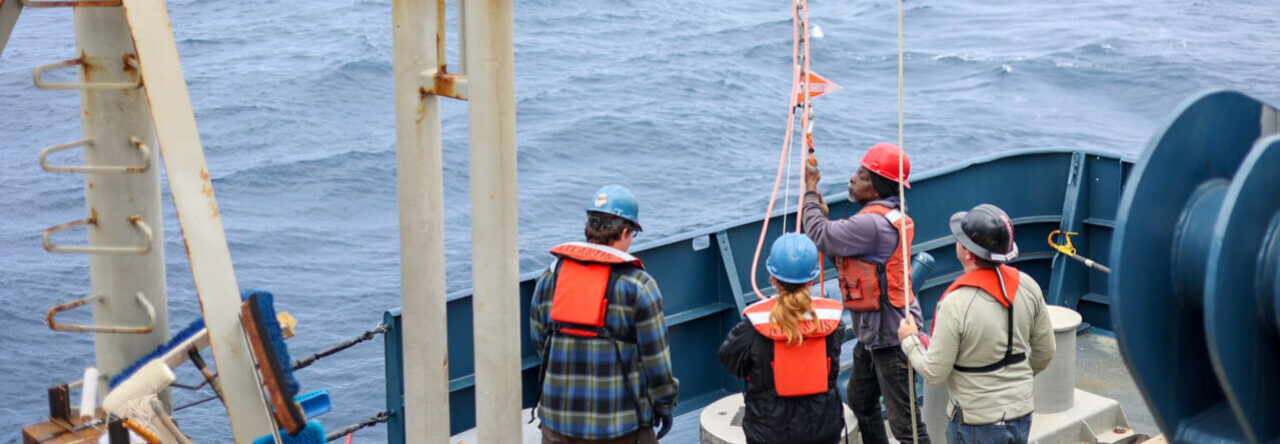
On Sunday (6/2), we continued the process of dredging again. We seem to have gotten it down to three to four dredges a watch, with a total of twelve to sixteen dredges a day. There would occasionally be flips, where the dredge would flip over and just be dragging along the bottom. We would therefore have to retow it or drop the sight all together. Another difficulty would be what we call a hang; this involves where sand waves are present on the bottom and the dredge rams into it causing it to get stuck. The boat then has to back down onto it and then pull it up. The unfortunate effect from this is its mostly a sand cast and will need to be retowed or dropped. At this point, there is a hierarchy of suck when it comes to the contents of each dredge. First comes rocks, then mud, sand, sand dollars, mussels, and everything else. They are basically a result of how heavy each shovel amount are in them.
On 6/3, we continued to dredge. A total of four dredges for the first watch and four for the second watch. The temperature continued to be cold and foggy with a breeze; good thing we had foul weather gear on. Some of these dredges contained many mussels and barely any scallops. A total of five were found on the first dredge of the morning watch. We did have a hang dredge, which usually means sand and a lot of it. You could construct a beach volleyball court with all the sand. Somehow, many scallops were captured in it. Two CTDs were performed with me working the computer and radio.
A CTD is a useful set of instruments and equipment to acquire various at depth variables as well as water samples. The one in use on the R/V Hugh R. Sharp is the SeaBird 9 plus, a standard package for water sampling. It contains a rosette of Niskin bottles to acquire water, salinity sensor, temperature senor, depth senor using a digiquartz instrument, oxygen sensor, and fluorescence for biomass. To prep the CTD, we setup a new file on the SeaBird Seasave software, remove the caps from the sensors, open the Niskin bottles, and radio to the bridge that we are good to cast. The method for casting is unique to the Sharp due its hands-off casting. It has a mechanical arm that pulls the CTD up into it and cast it down over the starboard side. Once in the water, we start the pumps and have it set five meter from the bottom. If the science team needed a water sample, we would fire three bottles at the start of the mixed layer of all the variables. Then we would bring it up to the surface and secure it down. The last thing is to do post processing of the data and flushing the pumps and bottles. A great system to gather in-situ water quality variables for various scientific research. Many of these have been cast, and many more will continue to be cast, usually one or two a watch.
On 6/4, for the first watch, we complete a total of three dredges. The worst one was the one with the mud; mud is very stuck together making it difficult to shovel, plus when the science team sorts everything, it takes much time due to many tiny organisms that inhabit it. The last dredge had some interesting organisms, a few large female lobsters, which we promptly put back, a couple octopuses, but not many scallops. On the second watch, we were steaming back into Woods Hole for a science change a couple of crew change, mainly an engineer, chef, and a mate. I assisted with tying off the boat on the shore and getting the gangway on board. We started with the stern, then bow and lastly the spring line (middle). Tomorrow, we will be gathering food and having an easy day. My father lives near here in Falmouth, so it will be nice to see him for a few hours.
In the morning (6/5), after breakfast, the HABCAM was worked on by the science team’s technicians and engineers. I helped by getting food with the new chef Hunter, Christian, and a NOAA employee, Nancy who was on the first leg. A few hour later with a full minivan of grocery items, we head back to the ship. After unloading everything and putting all the groceries in their place, I made plans to meet with my father, his girlfriend and my sister. We had lunch a local place then went to his house for a few hours. Unfortunately, I couldn’t stay late as we were leaving again early in the morning, around 0500. A great day to see him as it was the first day that was not completely foggy and cold. Later on, we will have perfect weather for the next step of HABCAM and dredging. I will let in on some foreshadow, but the HABCAM will have a major issue tomorrow, but the weather will hold out regardless.
On 6/6, time to steam out again around 0900 due to the HABCAM being worked on to make sure everything powered up and worked properly. I assisted with the removal of the tag lines and secured the rails. The next location was a six-hour steam to Georges Banks. At this point, I switched watches with Shaun to back with Huxley. Now I’m working on the 0000-0600 and 1200-1800 shift. Now was time for bed. The second watch of the day was pretty easy, Huxley showed me how to conduct the weekly oil check looking for areas that could potentially contain leaky oil. I found multiple locations of open spaces under the deck for possible oil. We check the engine room, auxiliary room, winch and propeller room. All looked to be good. Afterwards, we finally sent the HABCAM back into the water around 1700 just in time for dinner and bed.
The major issue has sprung up right before our watch for 6/7. To the great dismay of the science team and the crew, around 2230, the HABCAM was unfortunately disconnected from the cable at 36 meters a few miles from upper Cape Cod. This being the most dreaded result from all of us. When Huxley and I awoke, we were calmly told by Christian that we had lost the HABCAM. It seemed very peculiar how calm everyone was at this. The ship was doing loops using the echosounders to locate the possible location of the HABCAM. Since the HABCAM is a very expensive set of equipment, it is most dire to locate it. When making many passes, there was a pretty good change that we found it located next to a twelve meter long by seven meter high object located at a depth of 36 meters, possibly a rock or uncharted wreck. We could see the HABCAM due to it being metal, it showed up as a high density object that is yellow as opposed to the benthic habitat being red. The HABCAM also had an acoustic pinger which we tried to locate using the Teledyme Benthos DRI-267 Dive Ranger with the ACU-266 surface attachment. Huxley held it over the starboard side next to the CTD. The ACU-266 started pinging a depth and a direction. We were not 100% certain because we wanted to make a few more passes at daylight, but a pretty good idea of its location was confirmed. For the rest of the night, the only thing Huxley and I did was do the monthly safety rounds for emergency lights. It was a bummer that the HABCAM was lost and on the first day of Leg III. There were talks of getting a commercial dive team to locate it and attach a line for us to recover it. This has not been the first time it was lost; a few years ago, it was lost in deeper water which took the use of an ROV to recover. Since this location is within diving restraints, it could be done within a few hours. The next logical step would be to continue on, but instead of HABCAM, we would do all the locations for dredging. The second watch had us start to continue dredging to my dismay. At this point everyone was getting battered by the dredging process, I was hoping for at least a couple of days break, but pushing through was all we could do. We ended up completing three dredges this time, one with mud, one with many heavy rocks, and the last being relatively light compared to the previous two. Right after the rock load was emptied, a pod of seven humpback whales were sighted. I finally had the opportunity to see whales in the wild. What a sight to see. I wish I had taken pictures of this awesome sight. Everyone on deck stopped to enjoy the sight. On the last dredge, a few dolphins were also spotted, and we acquired lots of scallops. I also got word that the dive team will be able to come on Monday to tie a line to it given that our site location is correct.
For 6/8, we somehow managed to get through ten dredges between both watches and two CTD cast. One of the dredges was even flipped, but we pushed through with five each watch. Most of the dredges were easy compared to ones with rocks. Apparently, these locations on the north east end of Georges Banks contains less rocks which is a relief. They tended to contain many sand dollars which at this point became very easy. The majority of the task for the sorting from the science team. They were slower than normal because many more small organisms like the sand lance were hard to find. Some baby cod, a few monk fish, and many small flounder were found. All in all a much easier time than the day before.
Another week completed on this adventure at sea. The toils of the sea were realized when we lost the HABCAM. Anything that can, will go wrong when in the unforgiving sea. Everyone was being professional when these issues struck. I’m seeing firsthand how being able to cope with change when at sea is a very important characteristic because we really don’t know what will happen. We don’t know everything that’s below the sea making much harder to plan for everything that could go wrong. Even the dredging has its toils when flipped or hung because of the mixture of boat speed, winch length, and benthic topography. The crew has experienced a great number of issues over their long careers so coping with them seems to be practically flawless. I hope to take this mindset with me as my future career is opened up.
Best,
-Sebastian D.