Author: Lila Bellucci

So Long Reykjanes Ridge

Well folks, my MATE internship is sadly coming to a close. Aside from my routine monitoring tasks, my last week aboard the R/V Neil Armstrong consisted of studying the ADCP system in-depth as well as learning important deck rigging skills with the Captain. It also consisted of sad goodbyes and a lot of chatter about which foods we each couldn’t wait to eat first when we got back to land. Although, I must say, the Armstrong cooks have been miracle workers. Our food was delicious up until the last day (day 36!) and I have no idea how they did it.

While I’m certainly excited to be back on land, I’ve done my best this past week to appreciate life at sea. It can be easy to forget, especially on longer cruises, what a unique and beautiful experience it is to be out in the open ocean. Luckily, we had some wonderful, mild last few days at sea with perfect sunsets to enjoy being outside. It will certainly be strange not having endless expanses of water around me once back on land. It’ll also be strange not having a near-midnight sunset!

Although this voyage is coming to a close, being a MATE intern has certainly reaffirmed my love for ocean-based work and has enabled me to recognize what a great fit the marine technician career path would be for me, especially given what an exciting and variable job it can be. I know it won’t be long before I’m back out at sea again, working on another cruise and learning new skills in another part of the world!

Learning From Different Perspectives

Although I had already been at sea for three weeks, this week, I still managed to find myself in spaces on the ship that I had not yet been to. For one, I finally found myself in the engine room working on a project with the electrician to disassemble and replace the ball bearings in a hydraulic pressure pump motor running to the propellers. While down there, I got to learn from the engineers and oilers about the fascinating machinery that keeps this baby running and the many ways in which each of them interacts with and maintains it. 

I also had the chance this week to practice stick welding with one of the oilers again. This time using 60 rod and stainless steel rod, both of which are somewhat different from the 70 rod I learned with last week and slightly more challenging to weld with. Still, each is useful for different fabrication applications, and fun to work with in its own way.r

Later on in the week, while going over the basics of marine fire emergency operations with the Captain, I once again found myself being exposed to spaces and equipment on the ship that I had not previously seen or noticed. It is incredible how differently each member of our team looks at any given ship space through the lens of their responsibilities and specialties. Each of us operates within such a niche role, and although we often interact with one another, it can be easy to start looking at the ship and its operations from a narrow perspective. However, it’s always good to be reminded how much there is to be learned from the other people you share this floating home with. If there is one thing this experience has exposed me to, it is the seemingly endless pieces of equipment, feats of engineering, and unique skillsets that make the work we do possible…and how much there will always be to learn about it all!

Always Saying Yes to Learning Experiences

It’s week three and we’ve nearly completed our western survey lines, parallel to the Reykjanes Ridge, about 300 – 500 km east of Greenland. Daily work has continued to consist primarily of monitoring multibeam, sub-bottom, magnetic, and gravity data acquisition, as well as post-processing multibeam data and routinely launching XBT’s to maintain an accurate sound velocity profile. During watch, I have also been studying the installation, maintenance, and acoustic theory behind the Kongsberg EM122 echo sounder system and creating a short training document using what I’ve learned. The marine technician role encompasses diverse responsibilities, meaning that one might benefit more from a good understanding of many instruments than a specialized understanding of a few of them. However, it is certainly valuable and inevitable for a marine tech to expand upon their understanding of such instruments as they go. As I have learned more about acoustic theory and the components that make up the EM122 multibeam, I have found myself in a much better position to effectively operate this system as a tech and I’m sure the same will hold true as I move on to studying other systems in-depth. As the lead marine tech aboard the R/V Neil Armstrong has repeatedly pointed out to us, a big part of being a tech is knowing how to locate reliable resources and teach yourself more about the systems you find yourself responsible for.


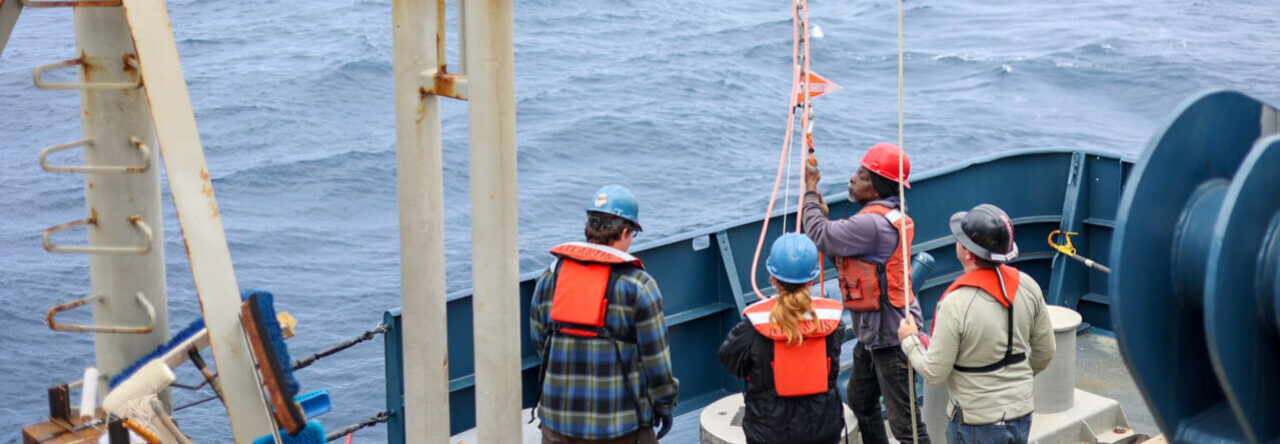
While studying your systems is a necessary and important skill as a tech, it is also valuable to expand upon the diverse niche skills that come in handy as a tech or general member of the crew. Although there hasn’t been a lot of hands-on work to be done this cruise, I got to improve multiple such skills this week. During one of our XBT casts, we experienced an issue in which the probe was sensing that it had been “launched” prior to actual launching. We decided to switch to our back-up gun, however the cable on this gun was too short to run the length of the fantail and had the wrong termination. To fix this, fellow MATE intern Ella and I spent part of the day soldering in a new section of cable and new 5-pin termination, as well as then waterproofing each joint. In one short project we were able to expand our troubleshooting and soldering skills, as well as our understanding of the XBT’s internal mechanics and cabling.


Later in the week, I learned more about magnetometer software troubleshooting when a minor issue arose, as well as practiced suturing wounds and putting in an IV with the Chief Mate using training skin and a dummy arm. Best of all, having done a lot of MIG welding in the past, I had the chance to practice stick welding with one of the Oilers. Stick welding was a different beast from MIG entirely, especially on a moving ship, but it felt great to pick up on a new welding technique! As always, I’m looking forward to seeing what next week will have in store!

Week 2, What to Do

The reality of a 35-day geophysical remote sensing cruise is that it can be quite boring. Especially when your duties are repetitive. However, it’s up to you to make the best of the time on your hands. Think to all the instances in which you wished you had had more time. To finish a project. To read a book. To learn a language. To study for something. To practice a skill. When you start to look at empty time on a ship as a long-awaited opportunity for growth rather than a void to fill with games and minor tasks, it gets so much easier to look at a calendar and realize that you still have 3 of 5 weeks left.

Everyone on the ship has been wonderful about sharing what they have, from their skills, to their art supplies, to their books in foreign languages. I have, of course, been continuing to stand watch and monitor the multibeam, sub-bottom, magnetometer, and gravimeter data, and have been learning new skills from the SSSG’s and other crew members. In fact, my time between watches, when the other MATE interns and I are introduced to new skills, is often the time of day that I look forward to most. We’ve learned to solder, climbed in the dome and learned about our satellites, learned about the EK80 and other major instruments on board, been introduced to networking, and more. Although many of these skills and instruments are not relevant aboard the current cruise, meaning there is little hands-on experience to be gained, members of the crew have been extremely generous in taking the time to teach them to us anyway.

In other news, many of the guys on the science team have taken up knitting (hats, sweaters, tiny scarves a.k.a toe cloths), taught to them by MATE intern Ella and German student Linus. In my own free time I’ve been learning Spanish, refreshing my German (by reading one of Linus’ books), water color painting on the bridge with Ella, working out (with ear muffs given to me by the electrician to drown out the multibeam), studying for the GRE (and sharing my study books with others), and doing origami (given to science by one of the mates). Each of these examples is just one instance where someone onboard offered what they had and made someone else’s day better. Perhaps a cheesy message, but truly one of the most important things I have learned to keep in mind aboard long cruises, and any cruise for that matter.

The Midnight Sun Has Set on Week 1

            It’s hard to believe it’s only been a week! It feels like both so much and so little has happened. Once offshore from Iceland and within our permitted range, the marine tech team and MATE interns (Ella, Jacob, and I) started off this week by turning on the EM710 multibeam sonar and 3.5 kHz Knudsen CHIRP sub-bottom profiler. We then launched the magnetometer, and got all associated software properly running and collecting data. Once our depth increased beyond ~1000 meters, we switched from the EM710 to the EM122 multibeam sonar system, which we have been using ever since. Our first day or so involved minor troubleshooting of these systems as we became familiar with how to properly operate and monitor them.

            As a MATE intern on a geophysical remote sensing cruise, my on-watch tasks have primarily consisted of routine monitoring of the multibeam, sub-bottom, magnetometer, and gravimeter systems. Off-watch, the other Armstrong MATE interns and I have been making a point to learn as much as we can about the diverse technology and protocols that are central to most UNOLS research cruises, despite the fact that this one is limited in scope. The majority of our instruction has been under the lead marine technician aboard this cruise, known here as the lead member of the Shipboard Scientific Support Group. However, we also learn additional relevant skills from other crew members including the Mates. This week, our training has included: 

  • Learning about the pCO­2sensor, turning it on, and properly adjusting flow rates through the system
  • Fully disassembling and reassembling the CTD and Rosette (Conductivity, Temperature, and Depth probe with other optional additional sensors and the Niskin bottle carousel)
  • Gaining an understanding of how power and data are transmitted between the CTD deck box and CTD sensors, and properly entering our CTD configuration into the associated software so as to enable this flow of power and data
  • Creating hypothetical deck plans with the Chief Mate and entering them into DELFTload, a program which enables one to calculate the effects of different loads and their positioning on the ship. We also then utilized this program to balance these loads using the ship’s various ballasts.
  • Processing and cleaning multibeam data using two common programs: Qimera and CARIS
  • How to properly launch an XBT, upload the cast data into SSM (Sound Speed Manager) for processing, and incorporate the updated sound velocity data into SIS (the EM122 software).

Other than training, I’ve been eating amazing food (including daily cheese and charcuterie at cheese o’clock), making up for it at the gym, getting other work done, and hanging out with the crew, science party, and other MATE interns. Most of our free time has been spent chatting about life, playing endless card games, enjoying the deck when it’s not too cold and wet out, watching the FIFA Women’s World Cup, playing assassin, and talking about the gnarly weather ahead. Speaking of the weather, things are looking pretty rough for Wednesday! To prepare, we’ve been steaming toward a more optimal location, securing anything we don’t want flying, taking sea sickness meds, and being dramatic. Luckily, I haven’t had any need for sea sickness meds so far, so let’s hope it stays that way!

Pre-Cruise: Preparing for a Month Under the Icelandic Midnight Sun

MATE Test Blog 


After a wonderful, but hectic few days of visiting family and packing, I am certainly looking forward to the next month at sea aboard the R/V Neil Armstrong. Although not always calm, weather-wise or work-wise, I enjoy the simplicity of shipboard life. Since graduating from Eckerd College in May of 2018 with a degree in Marine Science, I’ve been fortunate enough to partake in three cruises aboard the E/V Nautilus as a member of the Science Management team. As a member of this team, I was able to gain familiarity with diverse marine technological equipment, but was not responsible for operating or maintaining it. 


During this cruise aboard the Armstrong, we will be focused on acquiring geophysical data along the Reykjanes Ridge, a tectonic feature extending about 1000 km southwest of Iceland. We will primarily be utilizing multibeam sonar, sub-bottom profiler, gravitometer, and magnetometer equipment. So while not new to working aboard research vessels, I’m excited for the opportunity my time aboard the Armstrong will provide me to further diversify and expand my experience with marine technology. I’m also looking forward to sailing in the Atlantic for the first time and experiencing the midnight sun!


Wish me safe seas and black-out curtains!

After a wonderful, but hectic few days of visiting family and packing at home in NYC, I am certainly looking forward to the next month at sea aboard the R/V Neil Armstrong. Although not always calm, weather-wise or work-wise, I enjoy the simplicity of shipboard life. Since graduating from Eckerd College in May of 2018 with a degree in Marine Science, I’ve been fortunate enough to partake in three cruises aboard the E/V Nautilus as a member of the Science Management team. As a member of this team, I was able to gain familiarity with diverse marine technological equipment, but was not responsible for operating or maintaining it. 

During this cruise aboard the Armstrong, we will be focused on acquiring geophysical data along the Reykjanes Ridge, a tectonic feature extending approximately 1000 km southwest of Iceland. We will primarily be utilizing multibeam sonar, sub-bottom profiler, gravitometer, and magnetometer equipment. So while not new to working aboard research vessels, I’m excited for this opportunity to further diversify and expand my experience managing and operating marine technology aboard the Armstrong. I’m also looking forward to sailing in the Atlantic for the first time and experiencing the midnight sun.

Wish me safe seas and good black-out curtains!

Powered by WordPress & Theme by Anders Norén