Category: Vessel/Laboratory Page 19 of 89

Duva Week 1: Departure and First Station

Week One on the Langseth!

We had a busy start to the week as we prepared to depart from the Brooklyn Navy Yard. We faced some potential delays (engine parts, science gear), but ultimately decided to make our first, near-shore station (which was initially intended as a test site for our gear) a full research station. After completing work there, it was decided to proceed to the next station (rather than returning to NY to pick-up parts). So, the next land we see will be Iceland!

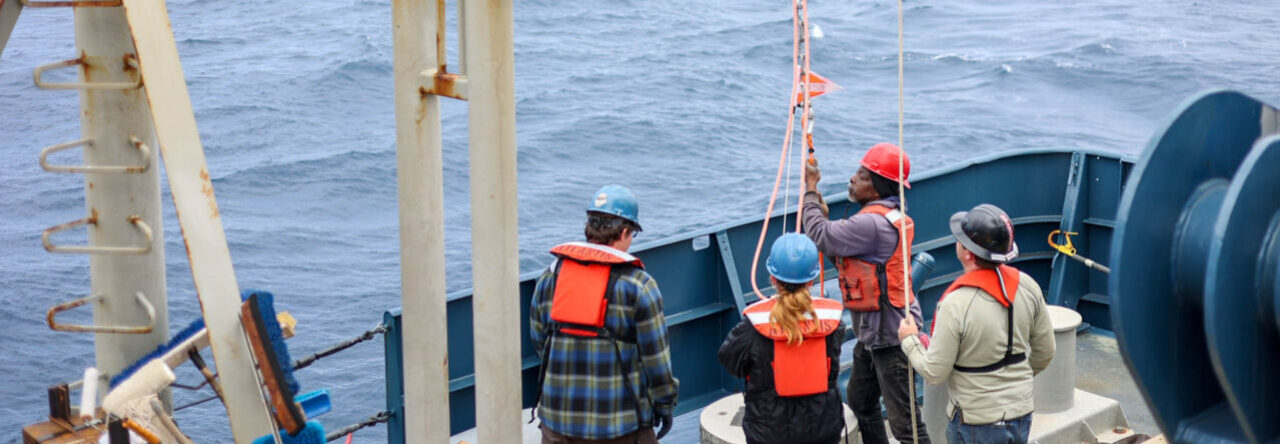
The new Okeanus winch passed its stress test, and we made a valiant effort at calibrating the Rugged Controls winch sensor as best we could. We finished rigging up the multi-corer and CTD/Niskin Rosette, then proceeded to make our first cast for cores! This site was relatively shallow at 2240m, and it takes about 45 minutes for the corer to reach the ocean floor at this depth.

The collection of the cores is controlled by the winch operator; once the corer’s feet land on the seabed, more cable is paid out to release the plastic core tubes into the sediment and gather the sample. We spent several days coring, with the science crew also working long hours to get all the samples processed appropriately. All of their work needs to be done in oxygen-free environments (nitrogen-filled glove boxes) so as not to alter the chemistry of the sediment.

After the science crew was happy with the amount mud/pore water we collected, we switched the winch cable to the CTD/Rosette and sent that over. It was cool to watch the CTD take a profile on the descent and then to fire the Niskin bottles to close at various depths on the way back up.

Driving the winch to land the multicorer on the seabed and assembling the CTD and using its software program (SeaSave) were some of my favorite tasks this week.

Since being in transit, I have also spent some time in the bridge standing watches. I learned a lot about the systems on board and the maritime field in general by talking with the deck crew and officers.

Today (Monday 6/17) we set our clocks forward by an hour to -3 UTC…the cities of Halifax and Buenos Aires both work as a correct time zones.

I am feeling very grateful that the ship has an awesome kitchen and steward team. We have been eating well, thanks to John and Insuk. In addition to the science party, the marine techs, and the kitchen and steward crew, the engine room and deck crews have also been working hard. It has been exciting to see how all these teams come together to make for a successful day.

Also, basking sharks and dolphins!

Thanks,

Eddy

Introduction Ayse Macknight

Hey Y’all! My name is Ayse (“I-Sha”). Right now I am gearing up for my upcoming internship on the R/V Marcus Langseth, and I couldn’t be more excited! A little information about myself, I studied Oceanography and Scientific Diving at Cal Poly Humboldt. I have been very fortunate to experience many different jobs and I like to keep busy. I have worked on the R/V Coral Sea since 2019 and have loved every minute of it. I have had many different positions on the vessel but my main ones would be, the Student Research Assistant for Zooplankton Ecology Lab,  NOAA Cruise Assistant, Class Teaching Assistant, and Deckhand.

In my free time, I enjoy being outside and reading. 

Introduction Kristen Carroll

Hi my name is Kristen Carroll and I will be interning on USCGC Healy. I am from New York and am currently studying Maritime Technology. I’m very excited to start this internship! I can’t wait to expand my knowledge on marine equipment and technology

. 

Introduction – Chaii Layne-Neubauer

Hello Everyone,

My name is Chaii Layne-Neubauer and I am one of the interns about to sail with the R/V Marcus G. Langseth on its next voyage from New York to Iceland! To introduce myself, I grew up on the beaches of California and in the deserts of Arizona. I got my Bachelor’s in Mechanical Engineering from the University of Arizona and then worked as a test engineer for Caterpillar for a time. Recently, I’ve been pursuing working in the marine research world so this opportunity has been a dream for me. This will be my second research cruise, the first being aboard the R/V Sally Ride working with a water sampling team for Scripps where I learned the ropes of CTD deployment and fluorometer readings. In my freetime I enjoy cooking, fishing, taking apart (and sometimes putting back together) cars and a good horror flick. I cant wait to begin this new adventure so keep an eye out for updates from me on the weekly!

Week 4: Stinky Seeps and Robots

Howdy everyone,

Since my last update, a lot has happened. I’ve just finished the first leg of my 6-month MATE Internship!

When I last checked in, the R/V Hugh Sharp was waiting near Nantucket for a break in the weather in the sea scallop survey area to redeploy the (now fully operational) HabCam. After patiently waiting for days, we finally saw a potential break in the weather. We took the chance to head into the survey area to collect data. However, on the way, one of our seasick researchers helping with scallop annotations had a little run in with a desk and ended up with a rib injury. We were concerned about the severity of their injury, and with the realization that it was too rough to deploy the HabCam, we decided to head back to Woods Hole to get the researcher medical attention and wait for the weather to improve.

After dropping off our injured researcher, the weather finally cleared up. We safely returned to the survey area and managed to collect a full day’s worth of data, covering approximately 50 out of the 53 stations! By the end of the cruise, we had made up for the time lost waiting near Nantucket and gathered almost all the data the WHOI and NOAA researchers needed. I’m also happy to report that the injured researcher saw a doctor and is doing fine with just minor bruising. Despite the setbacks, including a broken HabCam, bad weather, and injuries, the crew and science team pulled through and made the scallop survey cruise a success! It goes to show that resilience and adaptability are crucial when working on research vessels and facing challenges head-on.

– The HabCam 30 minutes after it was deployed managed to catch some fishing gear (green rope connected at the shackle) which we had to cut off.

After wrapping up the HabCam cruise and enjoying a few days of well-deserved rest and celebration, the Sharp crew began preparing for our next adventure!

– A picture from inside the Sharp’s keel. The keel has removable “pods” that can hold a variety of scientific equipment. Right before this photo was taken we replaced one of the ships pods.

The focus of our next cruise was to deploy equipment and collect samples to help scientists gain a better understanding of seafloor methane seeps. For those who may not know, methane is a ridiculously potent greenhouse gas, and high concentrations of it in our atmosphere contribute to global climate change. It’s crucial to determine if these methane seeps impact atmospheric concentrations and whether oceans act as a source or sink for the gas. Understanding the range, oxidation rates, and quantity of methane released from these seeps is essential, and the data collected from these cruises plays a vital role in answering these questions.

The first task of this cruise was to recover a lander from a previous expedition that failed to release its sacrificial weight and float to the surface. We attached a small ROV to a weight and sent it over 300 meters deep to the ocean floor to search for the lost equipment, and fortunately, we were able to retrieve it. The next priority was to deploy landers near known methane seeps. We successfully managed to deploy two out of the three landers we brought, as one decided to act up. The last order of business was to collect sediment samples from the seeps using a weighted multicorer. This corer was lowered to the seabed to gather sediment samples for later analysis. 

– One of the “landers” which measures methane oxidation rates near the seafloor methane seeps. Notice the steel plate on the left side. This plate detaches after sampling is complete and the lander receives a signal. The lander then floats to the surface and awaits recovery. 

– The “Mission Specialist Defender” ROV that was used to tag and recover the lost lander.

In just four weeks I gained experience with all of the following:

  • Knudsen Echosounder troubleshooting
  • LCI90i winch controller troubleshooting
  • Fiber optic troubleshooting and splicing
  • CTD maintenance and confile setup
  • Shipboard data acquisition system management and data backup 
  • Shipboard network architecture introduction
  • Instrument calibration record management 
  • A whole lotta different launch and retrieval deck operations (e.g. HabCam, AUV, Lander, multicorer, ROV)
  • Radio communication
  • Rigging techniques
  • Using USBL systems and recording their data
  • Cruise mobilization and demobilization experience
  • Troubleshooting one Sirius XM radio
  • Eating too much ice cream
  • Entertaining/distracting injured researchers with music and memes

Overall, working with R/V Hugh Sharp’s team was a fantastic opportunity to gain lots of hands-on experience and learn a ton of new technical skills. While learning these new skills was great, I think the real value of this internship comes from gaining familiarity with the work that marine technicians get to do. This familiarity promotes confidence and comfort with handling the many unknowns and stressors of this job.

So thanks to everyone at UDEL for the incredible opportunity! Now, I am enjoying two weeks off before I begin the next leg of my internship in Bermuda with the BIOS team! I look forward to writing the next post and updating you all in a few weeks.

Until then keep it cool and stay curious. 

All the best,

Hunter

– The last sunrise I got to see aboard the Sharp
Duva Week 0: Introduction

Hi!

My name is Eleanor “Eddy” Duva and I will be joining the R/V Langseth crew as a UNOLS MATE intern next week for a research cruise in the North Atlantic.

I graduated from the University of Vermont (UVM) and then spent some time working and living aboard sailboats. In the past year, I began working as a fisheries technician and vessel crew on UVM’s R/V Marcelle Melosira. I am looking forward to learning from all the folks on the Langseth crew, and particularly interested in learning about sediment coring gear and how they manage CTD data.

Outside of work, I like to be outside, read, and make stained glass pieces.

Week 5: Land and the End of an Adventure in Site

5/25/2024 – 5/28/2024


At the time this blog was posted I had already been home for a couple of days, but I realized even though only three days were left between my last blog post and our arrival in New York City I still needed to finish telling my story. 


Saturday 5/25, was spent putting my carpentry skills to work. I had to fix a sliding door with a bad roller and ceiling tiles that fell out of the ceiling in the Tech Shack.


Monday 5/27, we arrived in Long Island Sound and spotted land for the first time since Cape Town. Although it was very foggy all day, we could barely see the land and eventually it started to rain. We spent the day cleaning the Gun Shop, Tech Shack, Rack Room, and cleaned an air gun for display. Visitors will be coming to the ship a few days after we dock so everything needed to look polished and clean.


The morning of Tuesday 5/28, the fog finally lifted and we were able to see the magnificent New York City skyline in the distance. That morning we rendezvoused with the pilot boat and began making our way to the Hudson River. As we passed under the Verrazano Bridge, connecting Brooklyn to Staten Island, and were able to see Manhattan’s imposing skyscrapers and the beautiful Statue of Liberty in the distance getting ever closer I started to get emotional. At that moment, I found myself thinking about the countless number of people who have made this same journey up the Hudson River in search of a better life in the United States of America to include some of my ancestors. After passing the Statue of Liberty and Ellis Island, we went under the Brooklyn Bridge and Manhattan Bridge to finally arrive at our destination, the Brooklyn Navy Yard. 


I am grateful for the opportunity to be aboard the R/V Marcus G. Langseth during this transit and would like to thank all of my mentors and crew who were able to teach me about being a marine technician and about life at sea. To anyone that has been following my journey and may be interested in this line of work, I encourage you to look into and apply for the UNOLS-MATE at Sea Technical Internship Program.


Thank you so much for following my UNOLS-MATE experience!


Week 2: Seep Searching

Hello again, everyone!

It’s Norman again with my second and final update from the R/V Roger Revelle after two weeks at sea. Last time, I talked a lot about my work on preparing the AUV Sentry for its seafloor survey. This time, I’ll talk about how the data collected by Sentry has guided the ROV Jason’s dives as well as the work I’ve done after Sentry’s dive.

While underwater, Sentry collected multibeam data, which the Sentry team used to generate a bathymetric map of the topography in the area where Sentry completed its mission. Simply put, multibeam sensors emit sonar waves underwater and collect two pieces of data to generate the maps: the time it takes for the sound wave to return to the sensor, and the intensity of the sound at the time of its arrival at the sensor. The arrival time tells us how far away the seafloor is, and the intensity tells us about the seafloor material where the sound wave reflects back. Just so you can visualize this, here’s an image created using the ship’s multibeam sonar. The vertical, orange feature there is a seep.

By “sweeping” the seafloor with multibeam sound waves, Sentry generated maps of the seafloor and picked out the seafloor seeps we wanted to find. 

And seeps we did find! Sentry found signs of seeps at certain locations, and it was then up to the Jason team to send Jason down to those seeps and get a closer look at them. The Jason team’s operations astounded me. A few hours after watching Jason go into the ocean, I entered Jason’s control van and was reminded in many ways of a NASA mission control center. I loved looking at the seafloor through Jason’s cameras and watching the delicate movements of Jason’s robotic arms slowly but surely performing scientific experiments at the seafloor. The many aquatic animals that came to watch Jason work were fascinating in their own right. Finally, I was simply in awe watching scientists and engineers come together that night to learn something new about the ocean.

I enjoyed watching Sentry and Jason in action over the last week, though I am a little bummed I only got to see Sentry go into the water once. Regardless, the resulting spare time taught me a lot about all the important work that gets done even when Sentry isn’t in the water. Over the past week, I’ve cleaned out and refilled old oil containers, de-rusted multiple tools in the Sentry van, organized a bunch of components in Sentry’s van, and helped out with the end-of-cruise cleaning aboard the Revelle. I’ve also helped get seawater out of Sentry’s thrusters and prepare a spare sea bladder for Sentry for future cruises. Even when Sentry’s out of the water, there’s always some way to help ensure that future Sentry missions go as smoothly as possible.

I’ve had fun working on Sentry aboard the Revelle for the past two weeks! I learned a lot, and yet I feel like there’s still a lot I have to learn about marine field work. Hopefully, I’ll get to go out to sea and meet the wonderful people I met again one day. With that, this internship comes to an end.

Thanks for reading!

Norman

Week 4

Hey everyone, Ray here giving you my final blog post about my transit across the Atlantic Ocean on the R/V Marcus G. Langseth. This past week has been a time of deep reflection as I consider the next steps of my career. I feel that it is important to convey just how much of an experience this internship as been, and how many doors it really opens up for me in the future. Today around 9:30 A.M, our ship anchored 10 nautical miles off the coast of New York. Tomorrow we will set sail into Brooklyn Navy Yard after the harbor pilot boards our boat, and directs us through the channels. After that, International Customs will come on board to verify our passports and we are then free to hit the gangway. Along this journey I have came across a lot of mentors who are smart, hardworking, and genuinly great people. One of these mentors I met is Khalif. Khalif is an intelligent muslim, I call him Habeeb. Khalif wasted no time in acquainting me with life at sea and opening my eyes to various offshore career paths. Khalif taught me about valuable life lessons and principles, and he portrayed a role of the big brother I never had. I also found out he lives about 2 miles away from me. With how big the ocean is, the world is still so small.

Thank you for tuning into my blog posts on this adventure! 


Week 4: Land on the Horizon

5/18/2024 – 5/24/2024


When this blog is posted we will be 3 days away from NYC. This adventure so far has been one of the hardest and most rewarding educational experiences of my life. But, with our final destination looming over the horizon the consensus is the same amongst the entire crew, we are ready to see land!


The morning of Saturday 5/18, was spent inventing all of the bad air gun parts and securing them on pallets. These parts will be either repaired and used on future seismic missions or sold for scrap.


The highlight of Sunday 5/19, was that it was the calmest day that we have had the entire transit thus far. To be far, we have been very fortunate to have not much bad weather on our transit, but that day the water was like glass. The water was so clear and so calm that I was able to see Atlantic flying fish before they leap out of the water and the shimmering pillars of sunlight that faded away into the seemingly endless void that is the Atlantic Ocean’s depths.


The morning of Monday 5/20, was filled with the science team working together and cleaning the entire Main Lab space. The lab was in need of a “spring cleaning” and we were all able to make the lab look better than it has looked in a long time.

Believe it or not, Monday was also my birthday! I still went to work and had all of my daily duties to perform, but I don’t think I could have asked for a better gift than the incredible sunset that night.


Tuesday 5/22 was spent working in the Rack Room. This is where all of the computer systems scientific, navigational, networking, ect are stored. I was tasked with stripping wires, attaching connectors, and connecting them to their respective terminals. I also attempted to organize the maze of networking cables. That was a real challenge!


Stay tooned for my final blog as we get closer to NYC.

Page 19 of 89

Powered by WordPress & Theme by Anders Norén