Author: Ayse Macknight

Week 6 Ayse M. On the Langseth

The cruise is nearing its end, having completed six weeks of travel. On July 18, around 8 am, the crew received a radio call from the Icelandic Coast Guard about a distress signal from a vessel with a broken mast and low fuel. The Marcus G. Langseth, being the closest ship, backtracked to assist. After about five hours, the sailboat was spotted. The crew deployed a small boat to deliver multiple cans of fuel to the stranded vessel, successfully enabling it to return home safely. It appears the boat had not been ready for the harsh weather, as their sails were shredded.

Continuing on, we passed Iceland on the west and entered the Arctic Circle, where the sun never sets. However, operations were suspended for several days due to poor weather. Upon resuming, we completed work at Station 6 east of Greenland, where we observed pilot whales and retrieved a core sample containing a piece of sponge. We then headed to Station 7, the final station.

We also experienced power disruptions due to engine issues; I believe the starboard main overheated and shut down, likely due to a procedure missed as we slowed down to deploy our last Argo float. Fortunately, the engineering team resolved the issue within a couple of hours.

Week 5 Ayse M. On the Langseth

Daylight is lasting a lot longer than I’ve ever experienced. Sunrise starts almost the moment I’m on shift (midnight). It’s hard to claim I’m on night shift when most of my work is still being done during the day. Overall, it seems like we’re all falling into a good rhythm. Usually, around 5 am, myself and the other tech on night duty start prepping the deck and the equipment for the day. Eddy, another MATE intern, writes us notes letting us know what work was done and what work we can do.

I finally had time to hang out with the science crew while they processed their samples. Before now, all I really got to see of their work was them taking the shuttles off the multicorer and into the vans (essentially, a shipping container kept at 33-36 degrees Fahrenheit) and then coming out with the mud in small bottles. I am really thankful that they took the time to show me their work. Inside the van, they have quite a bit of dedicated equipment that allows them to remove the mud from the shuttles without the mud being exposed to air.

I also had the joy of seeing an XBT (its Nicholas name is “Expendable Bathythermograph”) deployment. It is shaped a little like a toy rocket and essentially, it is a probe that measures the temperature as it falls through the water. There is a very thin copper wire connecting the probe to the equipment on the ship. When it reports that it has reached depth, we break the wire and leave the XBT in the ocean. It is something I’ve learned about in my studies but had heard they were not used most days as they are a bit wasteful, and there are other ways to get the same data.

week 4 Ayse M. On the Langseth

Week Four 6/30-7/6

The team began the week traveling to station 03 at Orphan Knoll, 320 nautical miles off northern Newfoundland. Upon arrival on Tuesday, they successfully obtained 6 usable cores from the first cast. However, the sediment from the second cast was unsuitable for their project due to its coarse-grained. The team then moved to a new site, station 4, just east of Orphan Knoll. This location had deeper waters, resulting in longer days. On Wednesday and Thursday, they performed four casts per day. By Friday, they had collected enough mud after the third cast and deployed an Argo float. 

This week the weather took a noticeable change. The days were longer, colder and with frequent fog. We’re planning to head further north along the eastern coast of Greenland. I also spent a good chunk of time on our transit, relabeling all shuttles for the multicorer. I did this because many of the shuttles had different numbers from old attempts at labeling. And the inner plastic tube had no label. This made it difficult to track which shuttles were actually collecting usable cores. Additionally, I made a data sheet to record the sampling data that allowed us to see if the location on the multiorder had any impact on sample success. I was a bit nervous about showing the data sheet to the science crew because no one had actually asked me to do any of this but I had asked one of the senior techs if I could do this in my off time but I am happy to say that my efforts seem to be a appreciated! 

week 3 Ayse M. On the Langseth

6/23-6/29

The days are really blending together now. I feel like I was just in New York a week ago but I also feel like I’ve been working on the boat for a year.  Overall, I’m still having a blast, and everyday I’m excited to be on shift. Deployments have been going well, but we are having difficulties with the samples. At one point we were all really really excited that 5 out of 8 samples were usable. The ocean conditions were not the best but we were also dealing with issues with the shuttles. There’s a lot of discussion on how we can improve them. We’ve been adding wooden blocks to the bottom to help the shuttles not penetrate the bottom too deeply. 

One of the days, the main block (the pulley that the winch wire is run through) on the A-frame was making an awful sound. Turns out the bolts used were too small and some had snapped. It was a really great example of how amazing the engineers on the ship are because they erected scaffolding and had it fixed within the hour. I wish I knew his last name but Sam, the Chief Engineer, has literally fixed every problem that comes up in record time. I am beyond amazed by him and his team. 

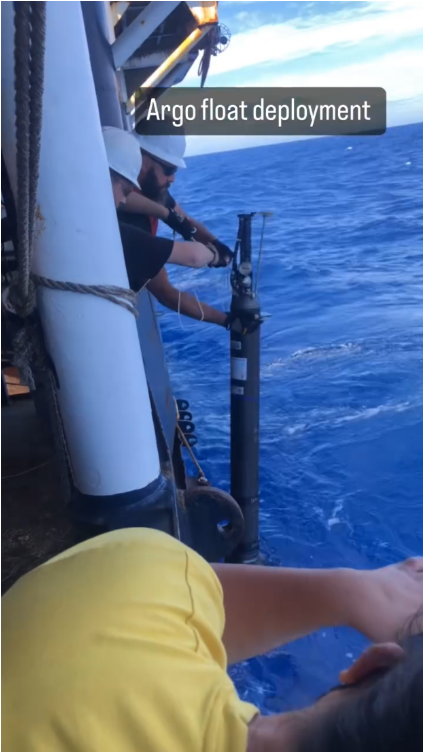
I also got to see an ARGO float! Which is something I’ve learned about in college and have used their data for projects. The deployment was pretty straight forward but it was amazing to have that hands-on experience with something i’ve only read about. 


week 2 Ayse M. On the Langseth

06/18/2024:

  • New rules for winch booth: one person at a time, max 1-hour stay.
  • Minor issues adjusting winch during deployment rotation.

06/19/2024:

  • Deployed corer at 6 am after prep with Joe at 5 am.
  • Assisted with taglines and bottle replacement, each deployment takes 4 hours.
  • Noticed winch operator error during shift change.
  • Experienced sudden vision changes; eyesight issues noted.

06/20/2024:

  • general deployment day.

06/21/2024:

  • transit to next station

06/22/2024:

  • Day spent seasick, rested in theater room and cabin.
  • Tested negative for COVID after some of the crews positive results.

06/23/2024:

  • Reapplied patch, feeling better.
  • Five onboard tested positive for COVID.
  • Anticipated arrival at station tomorrow morning.

06/24/2024:

  • Winch line on first cast was angled significantly, had to call all stop and work with the captain to get the boat to drift with the current
  • last cast yielded only one usable sample.

06/25/2024:

  • First cast nearing completion by 9:30 am.
  • Helped Arron on the fly bridge with setting up some stuff for an O2 sensor.
  • Switched from hour long shift rotations to half hour.

06/26/2024:

  • Took off weight from the corer and crew added wood blocks on the bottom so that the tubes wouldn’t sink so low into the mud.


IN CONCLUSION:

A bit more downtime this week, but I am beginning to feel settled down with living and working on a boat. Im honestly shocked that it’s only been a little over two weeks.  The most notable event this week is that we were able to get 5 (out of 8) good samples on one of the casts. Which is way better then usual! We also changed our shift rotations to 30mins instead of an hour. That was no one has to hold the winch joystick for a whole hour.

Week 1: June 9th to June 17th

June 9, 2024:

  • Flew from SF to NY, arriving at 3pm (about 5:30 hours)

  • Journeyed to the boatyard near 168 Flushing Ave, NY.

  • Settled into a boat, toured, and met crew members.

  • Went to Walgreens for last minute purchases and slept very well.

Flew from SF to NY, arriving at 3pm (about 5:30 hours)

Journeyed to the boatyard near 168 Flushing Ave, NY.

Settled into a boat, toured, and met crew members.

Went to Walgreens for last minute purchases and slept very well.

June 10, 2024:

  • Met in the supervisor’s office at 7am.

  • Assisted in stress testing a new winch cable wire.

  • Had downtime and enjoyed really good food.

  • Spent evening onboard, contacting family.

Met in the supervisor’s office at 7am.

Assisted in stress testing a new winch cable wire.

Had downtime and enjoyed really good food.

Spent evening onboard, contacting family.

June 11, 2024:

  • Departed dock at 1am for anchorage and fueling.

  • Attended 7am meeting; 

  • Volunteered to take the night shift (12am-12pm).

  • Worked with roommate Eddie (other mate intern) on securing crates and boxes.

  • Met with the science crew and learned about their work and what exactly they are trying to prove with the data they are collecting.

  • Prepared ship for departure from fueling barge;

  • Was concerned about seasickness.

Departed dock at 1am for anchorage and fueling.

Attended 7am meeting; 

Volunteered to take the night shift (12am-12pm).

Worked with roommate Eddie (other mate intern) on securing crates and boxes.

Met with the science crew and learned about their work and what exactly they are trying to prove with the data they are collecting.

Prepared ship for departure from fueling barge;

Was concerned about seasickness.

June 12, 2024:

  • Worked from 7am to 12pm on pCO2 monitor.

  • Participated in ship-wide drills for fire and abandon ship procedures.

  • Only worked about 6 hours since I was switching to night shift. 

  • Rested in the cabin after; prepared for night shift.

Worked from 7am to 12pm on pCO2 monitor.

Participated in ship-wide drills for fire and abandon ship procedures.

Only worked about 6 hours since I was switching to night shift. 

Rested in the cabin after; prepared for night shift.

June 13, 2024:

  • Started night shift at 12am.

  • Assisted with CTD trigger test and monitored computer screens.

  • Assisted senior technicians with adding more weight to the multicorer and primed it for deployment.

  • Controlled winch operations and assisted with retrieval.

  • Worked on drafting protocols for working on the new winch with Joseph (another tech).

Started night shift at 12am.

Assisted with CTD trigger test and monitored computer screens.

Assisted senior technicians with adding more weight to the multicorer and primed it for deployment.

Controlled winch operations and assisted with retrieval.

Worked on drafting protocols for working on the new winch with Joseph (another tech).

June 14, 2024:

  • Night shift activities included rounds on the vessel and ensuring equipment security.

  • Spotted basking sharks near the boat in the early morning!! 

  • Participated in deploying multi corners; experienced a minor incident with equipment.

  • Successfully retrieved samples, including a brittle star.

Night shift activities included rounds on the vessel and ensuring equipment security.

Spotted basking sharks near the boat in the early morning!! 

Participated in deploying multi corners; experienced a minor incident with equipment.

Successfully retrieved samples, including a brittle star.

June 15, 2024  –   June 16, 2024:

  • Lots of downtime working a night shift and while heading to the new station.

  • Spent most of time monitoring computer screens.

  • Spent a couple hours with the the 2 and 3 mate in the bridge while they stood night watch  

Lots of downtime working a night shift and while heading to the new station.

Spent most of time monitoring computer screens.

Spent a couple hours with the the 2 and 3 mate in the bridge while they stood night watch  

June 17, 2024:

  • The night was not very eventful but in the morning we noticed the sea floor had a lot of seamounts so it was decided to pause the transit and start a back and forth grid search for flatter ground.

  • Technical difficulties popped up so a lot of time was spent on that. 

The night was not very eventful but in the morning we noticed the sea floor had a lot of seamounts so it was decided to pause the transit and start a back and forth grid search for flatter ground.

Technical difficulties popped up so a lot of time was spent on that. 

IN CONCLUSION:

I am having a wonderful time.! The food is delicious and the beds are really comfortable. Everyone is super nice and the work is very enjoyable and fulfilling. I’m excited to get to the next station to do more work!


Introduction Ayse Macknight

Hey Y’all! My name is Ayse (“I-Sha”). Right now I am gearing up for my upcoming internship on the R/V Marcus Langseth, and I couldn’t be more excited! A little information about myself, I studied Oceanography and Scientific Diving at Cal Poly Humboldt. I have been very fortunate to experience many different jobs and I like to keep busy. I have worked on the R/V Coral Sea since 2019 and have loved every minute of it. I have had many different positions on the vessel but my main ones would be, the Student Research Assistant for Zooplankton Ecology Lab,  NOAA Cruise Assistant, Class Teaching Assistant, and Deckhand.

In my free time, I enjoy being outside and reading. 

Powered by WordPress & Theme by Anders Norén