Author: Raymond Barrett

Week 4

Hey everyone, Ray here giving you my final blog post about my transit across the Atlantic Ocean on the R/V Marcus G. Langseth. This past week has been a time of deep reflection as I consider the next steps of my career. I feel that it is important to convey just how much of an experience this internship as been, and how many doors it really opens up for me in the future. Today around 9:30 A.M, our ship anchored 10 nautical miles off the coast of New York. Tomorrow we will set sail into Brooklyn Navy Yard after the harbor pilot boards our boat, and directs us through the channels. After that, International Customs will come on board to verify our passports and we are then free to hit the gangway. Along this journey I have came across a lot of mentors who are smart, hardworking, and genuinly great people. One of these mentors I met is Khalif. Khalif is an intelligent muslim, I call him Habeeb. Khalif wasted no time in acquainting me with life at sea and opening my eyes to various offshore career paths. Khalif taught me about valuable life lessons and principles, and he portrayed a role of the big brother I never had. I also found out he lives about 2 miles away from me. With how big the ocean is, the world is still so small.

Thank you for tuning into my blog posts on this adventure! 


Week 3 “Seas the Day”

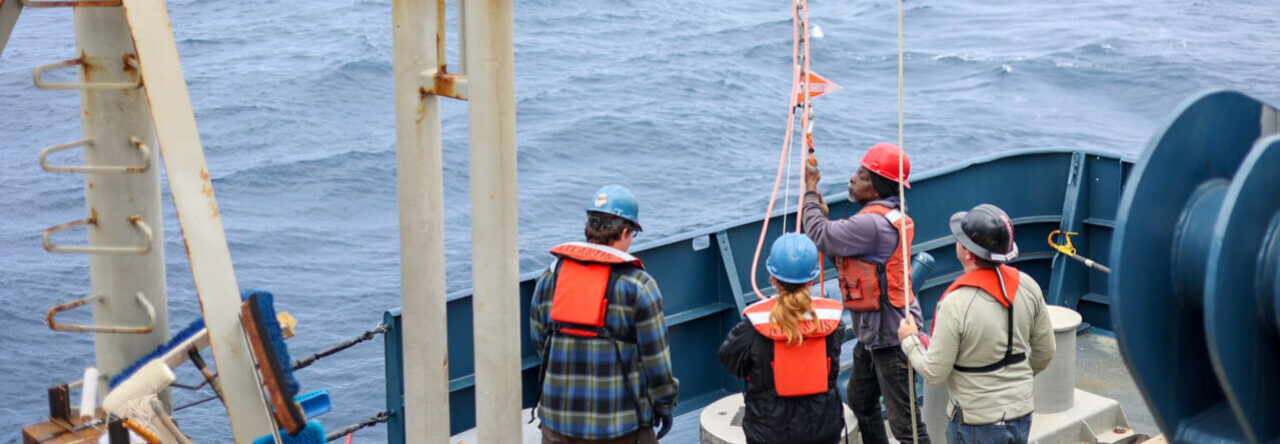
Hey everyone, Ray here, giving you an update on my third week across the Atlantic Ocean on the R/V Marcus G. Langseth. As we move farther away from the equator and closer to New York, the temperature and humidity have dropped dramatically. For my third week, I have been assigned a multitude of tasks. One of my tasks this week was to work with Josh, our chief source mechanic, to test the continuity of the wires within the octoblocks of the arrays and trace them back to our junction box while verifying our resistance with a multimeter. Our vessel has four arrays that trail hundreds of meters off the stern via large cables, (streamers).These arrays consist of various components that transmit the data collected by the hydrophones from the sound waves emitted by the air guns, which reflect off the ocean floor. Within the arrays, there are components called octoblocks. Essentially, an octoblock acts as a sensor placed along the array to receive different signals such as DI/PI (Depth Indication and Pressure Indication), GPS signals, NFHS (Near Field Hydrophone Signals), and other types of data being collected.
Another task I have been assigned is testing the strength and continuity of our large collection of Ethernet cables, which seem to have accumulated into the thousands over time. I used a network and cable tester that also measures the length of the cables by measuring their resistance. After a long workday, we are always exhausted but are still eager to enjoy the sunsets every evening on the bow of the vessel. Almost every sunset on the ocean is a humbling experience, to say the least.

Here are some pictures of my week; stay tuned for my final blog post in 7 days!


Week 2 Across the Equator!

Hey everybody, Ray here giving you an update on my second week across the Atlantic Ocean on the R/V Marcus G. Langseth. This week has been extremely hot, with humidity ranging from 80%-90%, very sticky! As an intern I’ve been assigned to multiple tasks to complete this week. One of my tasks was to troubleshoot and calibrate these semi-autonomous devices called “digibirds” or digital birds. These digibirds are placed in the water which are being guided by a long rope connected to a big winch called streamers. In between the digibirds, there are devices called hydrophones that are also attached to the streamers. The hydrophones main job is to receive soundwaves from the air guns that are being fired and reflected off the ocean floor, or even layers beneath the crust. The digibirds are in charge of making sure the hydrophones are at the correct depth to interpret the sound waves being emitted. The data is then transmitted back to our ship in order to create maps and undergo further analyzations. Some of the features that can be determined from this data include subsurface structures, seabed composition, and other types of geological formations. However, overtime these birds can become misaligned or may require maintenance such as replacing batteries, motors, or compasses. This is one reason why calibrating and troubleshooting is so important! Another task I have been assigned to is collecting data on our gravimeter and entering it into our historical data spreadsheet. A gravimeter is a device used to measure variations in Earth’s gravitational field, also providing information on subsurface features and geological structures beneath the ocean floor. Every day we are using the gravimeter to precisely map these gravitational fluctuations across the Atlantic Ocean. By using a multimeter to verify amps and voltage values, we can guarantee the reliability and accuracy of our data so we can then draw conclusions on the ocean’s geological characteristics and even potential hidden features beneath its surface! 
One last thing I’d like to add is that everyone on this vessel are hardworking people. Especially in this heat and humidity, the fact that we can complete so many jobs and tasks is truly remarkable.

Stay tuned for my next update on our transit!


Josh, our Cheif Source Mechanic is also a great welder!

Week 1 Across the Atlantic!

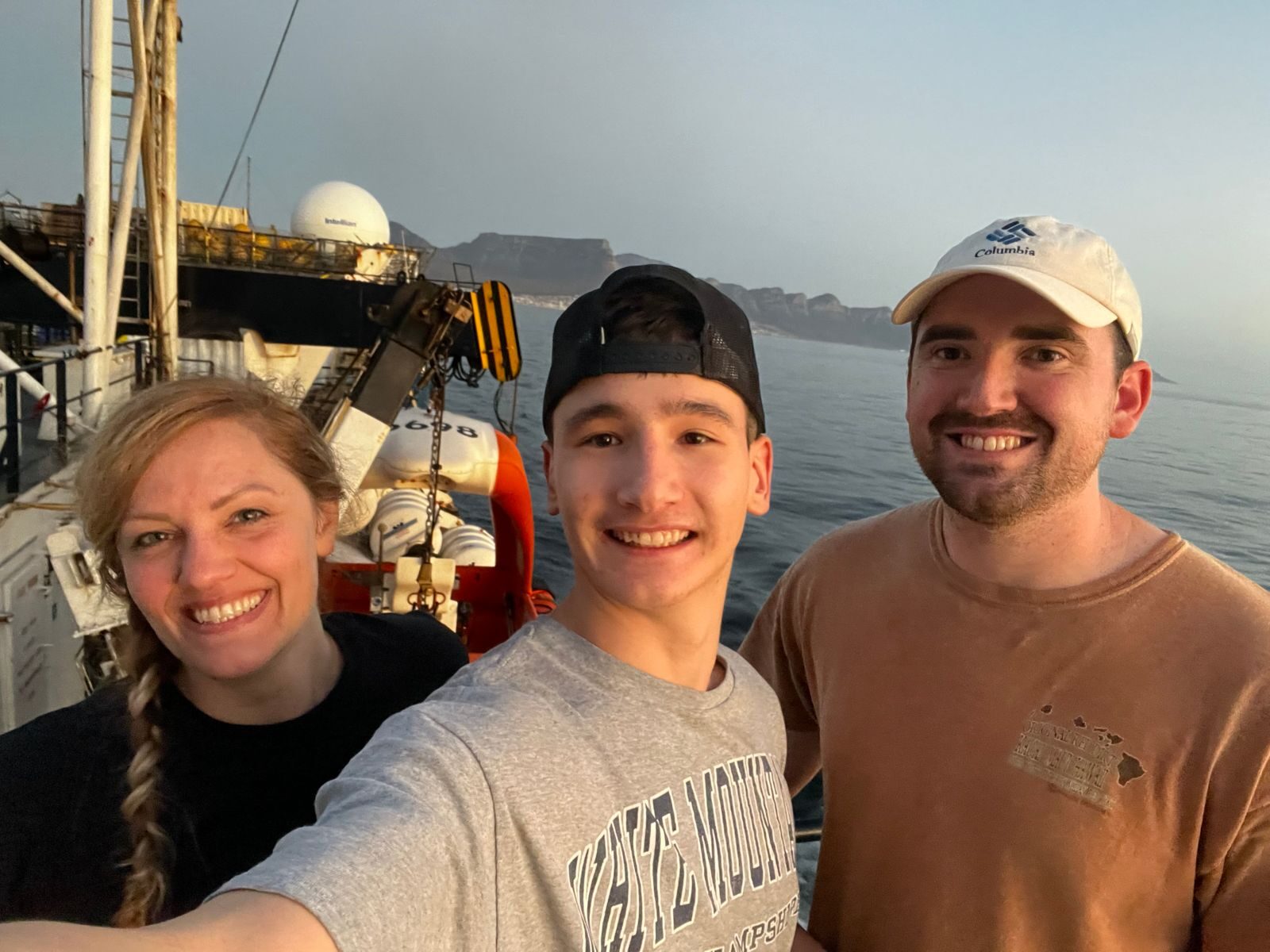
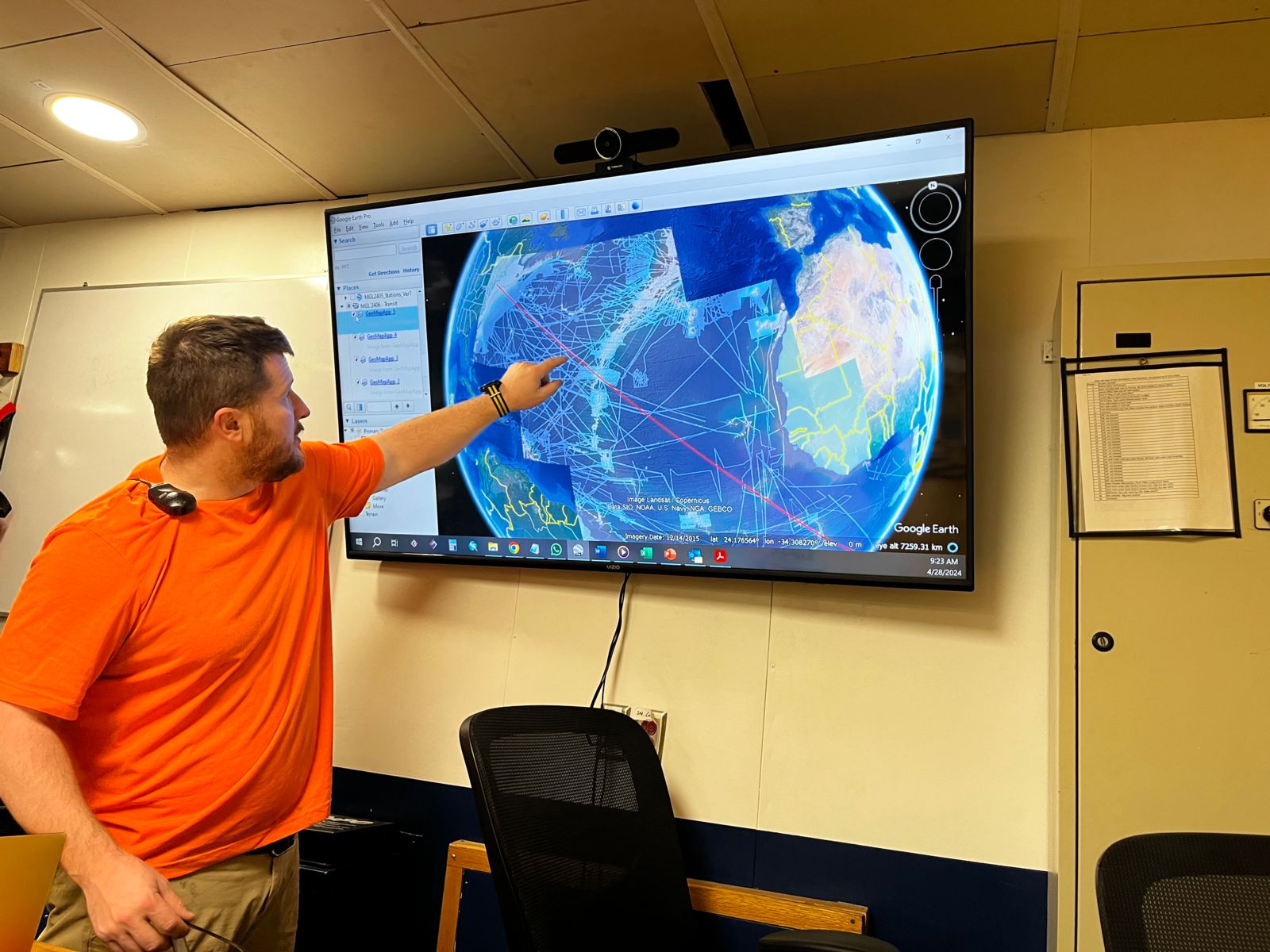
Hi everyone, Ray here with an update about my first week as an intern on the Marcus G. Langseth research vessel. Colton, Rachael, and I arrived in Capetown, South Africa on April 27th around 5:00 P.M. The following day we had an orientation of the vessel. Our mentor Cody, gave us a brief introduction to the ship and a thorough summary of the different tasks and assignments that will be given to us on our transit. We expected to set sail the following day (4/29/24), so we actually had time to explore Capetown for the rest of the day! Colton, Rachael, and I eagerly explored as much of the city as possible, and the culture was astounding! We finished our evening eating Ostrich Filets and fancy assorted seafood appetizers, all of which was paid for by Cody for which we are extremely grateful! The next day our vessel started to set sail across the Atlantic towards NYC at 5:00 P.M. The past six days aboard this vessel have been incredibly productive, with a multitude of tasks that have been completed. Among these tasks was the disassembly, cleaning, and reassembly of the air guns. These instruments fire at 2k psi, sending signals to the ocean floor, which then bounce back for collection by the hydrophones. This data is essential for creating detailed 2D and 3D images of the ocean floor beneath us. My plan is to continue making blog posts with more updates on our tasks as we approach NYC! 

Stay tuned!

!                                                     

Introduction – Ray Barrett

Hi Everyone,

My name is Raymond Barrett. I am a 22 year old college student from Tiverton, Rhode Island. I am in school for Offshore Wind Power Engineering and Technology and have just completed my Offshore Wind Power Maintenance Technician Certification. I will be traveling from Cape Town, South Africa to New York on the R/V Marcus G. Langseth. Math and science are two of my favorite subjects and I love learning new things. I also love to work on cars, it is one of my favorite hobbies. I also like skiing, sailing, and going on adventures. Stay tuned for updates on my journey across the Atlantic Ocean! 

Powered by WordPress & Theme by Anders Norén