Category: Host Page 60 of 85

Cruisin’ to the Big City

Following our weekend return from BATS/HYDRO station, we demobilized on Monday and prepared for our next upcoming cruise- an oceanography trip with students from Oxford.

The cruise follows the same routine of any regular BATS/HYDRO cruise, so, many of our operations were repetitive. The only difference? – I held my own shift again. After our short stint with Oxford, we transited back to BIOS, just in time for a BBQ and my intern talk. As per regulation of BIOS, every intern is required to give an introduction and final talk. My talk was multi-functional, as I will also be presenting at RVTEC this year. A crowded room full of potential job seekers is a little more intimating than speaking to students- nonetheless, the talk was good practice for what is to come.

Now, the crux of my story: Hamilton, the big city of Bermuda

After months of preparation, we set sail to Hamilton for a PR event. The event’s main purpose was to broadcast our research vessel to donors, trustees and board members, as well as the BATS program. The day was full of tours (lead by mwah) introducing the vessel, its research technology, and crew. After a long day of tours, we made our way to the hotel for a viewing of the PBS documentary “The Fate of Carbon” featuring the AE, BATS program, and recent MATE intern Mason Schettig. Seriously, check it out- I know you want to. Walking through the capital of Bermuda was magical, and as soon as it began, we transited back.


We have lots of preparation for our upcoming cruise in Puerto Rico- which has been a little chaotic. For anyone, for is reading: My post is following hurricane Maria- so, it will be interesting to see how our cruise to Puerto Rico goes…

Everyone’s grows up sometimes: Holding my own shift

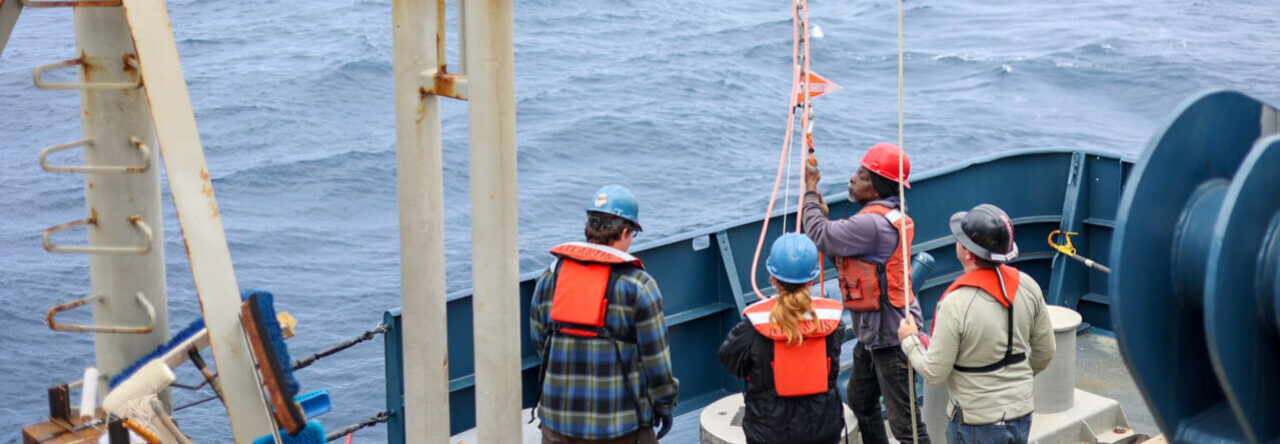
After our morning safety brief, abandon ship drill, and fire drill, we set sail to our first station. Similarly to the last cruise, I will be holding my own shift again and leading all deck operations. The feeling is liberating, stressful and necessary…and, I must say, I feel much more confident now in my abilities to lead. We arrived on Hydrostation S before evening and due to foul weather, we retrieved the glider, “Minnie” right away…and Woah, what a trip! For starters, we all made it out untouched, but not before we all learned a very important lesson in retrieving equipment in foul conditions. We pulled up to the station in very rough seas and made the quick call to retrieve our glider. As I waited and assisted on the back deck with my co-workers, our lead technician and several other BATS technicians deployed and rode our small boat to the glider. Aside from the massive waves, all started off OK… before they met us at the back of the boat to hand-off the glider. The waves were too large to safely pass the glider from the small boat to our back deck, and as a swell hit, the nose of the small boat made its way to our deck. As exhilarating as it was, in a Tom Cruise kind of way, other options should have been deployed. After fumbling to hold the glider over the edge for several moments, and after pushing the small boat off our vessel, we made it back in one piece.

For the rest of my shift, I lead several back-to-back CTD casts- one of which was a deep cast. It is important to be aware of varying depths the CTD sensors are rated for. For example, some sensors can withstand a great amount of pressure and depths up to 7,000m, while others can only withstand a couple thousand meters. Our bottom cast went down to 4500 m and lasted several hours. Beforehand, I removed our PAR sensor, which is only rated to less than 2,000m. If the PAR sensor had been left on, the sensor could suffer from electrical issues or even implode under pressure. While in Louisiana, a tech holding a shift opposite to mine forgot to remove an oxygen sensor. While the cast was being pulled up, the oxygen sensor was found in pieces. Luckily, we learn from our worst mistakes and this is a lesson that will always stick with me.

The following morning began with a 1200m CTD cast. After the cast, we began deploying our sediment traps off our back winch. The sediment traps are deployed before sunrise and are left with a buoy for several days during our cruise. For a majority of the rest of our trip, we will be in very close proximity to the buoy, and in some cases, can even see it. Like any standard BATS cruise, after our sediment trap deployment, we began our plankton tows around noon. We began with our zooplankton tows. We cast a total of three tows to 250m, descending at 50m/min. In total, each tow is about half an hour. After our zooplankton operations, we towed to phytoplankton nets from our a-frame and winch. The net mesh is 30um and contains a 0.5m hoop. These nets were towed to 175m, at approximately the same amount of time. After our tows, we segued into the UPRO MULTI-RADIOMETER (SPMR- explain). I ended the day on a deep CTD cast.

By the middle of my cruise,  a large majority of my days were spent leading upro-multi-radiometer, or SPMR, operations. As the marine technician, accompanied by many trained scientists, most of my work was communication between the back deck and bridge. The wire attached to the SPMR is spooled, let off the back deck and free-falls for about 100m. Once the SPMR hits a 100m, it is recorded and dragged back up.

On our way home, a buoy from Maine broke lose and evidently,  found our path. Unfortunately, the conditions were too dangerous to retrieve the buoy. However, we did lead a deep water CTD cast. The information from the CTD profiles will help NOAA researchers calibrate their buoy while it is underway. All in all, I am very proud of myself for leading my own shift. It was not easy, and believe me, I had a few people give me very constructive criticism about leading deck operations- which sometimes hurt. But at the end of the day, I came out stronger and with more experience- and for that, I am thankful.

Jason and I pretending like we aren’t posing…
Preparing to go meet USCGC Healy

I am sitting in the pinestead reef hotel on Grand Traverse Bay on Lake Michigan nervously waiting for when it’s time to head to the airport.  I’m so excited I cannot sleep.  I’ve waited for this all summer.  I’ve always wanted to see Alaska and am chomping at the bit to start working with all that glorious gear.  I’ve been reviewing notes sent via email from Brett Hemborough and am attempting to become as familiar with the goals of this cruise.

I also recieved some great advise from Royhan, the current MATE intern aboard.  Thank you so much.  I guess I will see them both tomorrow afternoon.  So excited!

Week 3 Aboard the USCGC Healy

Currently, the ship is positioned on the last Distributed Biological Observatory (DBO) line southwest of St Lawrence Island. This will be the last area where science sampling will take place and the cruise will come to an end after we arrive in Dutch Harbor on the 15th. We have been transiting for the past few days after completing the “wheel spokes” shaped sampling sites. This past week, I have been staying busy finishing up my manuals relating to the Niskin Bottle lanyards and ICE Imagery. I also created a graphical manual on deploying the CTD aboard the USCGC Healy for future reference during different cruises. I have finished my tool in ArcMap, it can be used to help future navigational operations allowing the user to convert multiple satellite images of sea ice into a single blended image.

Also this week I learned how to use a Micro scanner which is used to map out network connections. An Ethernet cable can be connected to the Micro scanner and then a wand like device creates a tone if touched to the connected Ethernet cable allowing me to identify cables by sound. I used this device to trace out network connections of cables in Aft Con (the aft bridge) as well as the scoreboard cables. The Micro scanner also displays the length of the connected Ethernet cable.

Earlier this week, I continued to assist with science operations on deck, helping collect sediment and zooplankton samples. I also disassembled the magnetic carousel, which triggers the Niskin bottles to close, on the back up CTD rosette. After disassembling, I cleaned different components of the carousel. In addition, I learned about the components of a Benthos Pinger which was used on the multi-Haps core in the deep sampling sites which were over 1000m deep. I disassembled one of the pingers, to clean the parts and check the batteries. The Benthos Pinger creates a sound, similar to sonar, which bounces off the ocean floor. Using a transducer, we can listen to the sound and calculate the distance from the seafloor to the location of the package (deployed equipment). The Knudsen echo sounder is normally used during equipment deployment to determine the distance from the ship’s location to the bottom. If the winch operator were to wire out too much, in compensation for the ocean’s current which angles the package, then the possibility of entanglement between the cable and package increases. Between monitoring the Benthos Pinger and the wire tension, we successfully retrieved multiple cores from the depths of the Arctic ocean.

On the deepest CTD cast of the cruise, around 3000m, we sent down pillow cases full of Styrofoam cups to be shrunk under the pressure. We decorated them before sending them down, and now I have a cool souvenir from this trip. With less than a week left of my internship I am wishing it was longer. I have gained a lot of experience and have made professional connections which will hopefully lead to a career.

Photo Credit: Amanda Norcross

Storms, Cruise Prep and my First Milli-Q Installation

We have now been at BIOS for about half a week, and are preparing to leave for our next HYDRO/BATS cruise. (For those of you who are not familiar with the ocean-data time series: Hydro station S and BATS, check out my other blogs for more information!)

It is officially hurricane season and our recent weather has proven that statement true. We are currently waiting out Hurricane Jose in Bermuda. Tomorrow afternoon we plan to transit to Hydrostation S and BATS for a five-day cruise. During the duration of our cruise, which will involve the same deck operations as prior cruises, we will be picking up a glider for Ruth Curry- director of the glider program MAGIC.

The Mid-Atlantic Glider Initiative and Collaboration (MAGIC) was launched at BIOS in 2014 to enhance  BIOS’s long-standing ocean measurement programs in Bermuda, using autonomous underwater vehicles. The goal of MAGIC is to gain new measurements from underwater gliders to assess the contribution of small-scale processes that sustain the ocean’s biological productivity. Each sensor is equipped with a variety of sensors such as a conductivity, temperature, depth and several optical sensors that measure oxygen and fluorescence. One of Ruth’s gliders, Jack, is outfitted with an Acoustic Doppler Current Profiler (ADCP) which provides detailed profiles of ocean currents. To check out more information, see the site here: http://magic.bios.edu/about/

I will be accompanied on this upcoming cruise with a technician from the tech exchange program. I will be holding my own shift during this cruise, but it will be interesting to learn from a new and experienced technician.

Upon his arrival Friday, he helped me sanitize our RO 100L tanks. Prior to his arrival, we were having issues with our Milli-q system. Our elix, an RO water maker, has been working excellently.


However, our Milli-Q system, which is attached to our Elix RO maker and RO tanks, was not performing at the quality it should.


The system works together to sanitize our water on the ship. Water is fed through our water system, sent through two prefilters to remove heavy metals, through several filters and cartridges on the Elix, into our tanks and then is pumped into our Milli-q system which gives the water a final sanitization. In order for the water to classify as purified “Milli-q” water, it must read 18.2 mega ohms on our machine. Our milli-q was running low, an indicator that the water quality is not high. After speaking to a Millipore technician Friday, I changed out our two pre-filters, replaced our Milli-q q-guard and quantum ex-filters and performed a tank sanitization. Our tank has been accruing gunk for some time, so the process was much needed.


In order to sanitize the tanks, Jason and I drained clean milli-q water into several carboys, removed the tanks from their water feeds and cleaned them outside with a diluted bleach solution. Afraid the bleach would possibly contaminate science samples, we opted to clean the inside of the tank with 5% HCl solution. Once the tanks were cleaned, we hooked them back up and began making new RO water.


So far so good, let’s hope the weather holds up!

Week 2 Aboard the USCGC Healy

With the cruise under full swing there has been science 24/7 around the clock, I have drifted towards the noon to midnight or later shift. Most people have 12 hour or 8 hour shifts, the weather was much colder and more windy earlier this week, currently it has been foggy and less cold as we are northwest of Barrow. As shifts rotate, I am constantly seeing new coast guard faces. Most of my time recently has been consumed with GIS related projects. I have been collaborating with the sediment scientists to create a map of past cruises, comparing past sampled site’s biomass in grams per carbon and overlaying the current cruise sites. I have been assisting with the sediment scientists helping sample sediment from the Van Veen grabs, and collecting live specimen from them as well. In addition, I have continued to assist with the bongo net toes, seeing some interesting specimens such as copepods, arctic cod, prickleback, other fish larvae and jellyfish.

This week I aided in repairing the Salinometer; removing, cleaning, and replacing the conductivity cell as well as calibrating the system. I also disassembled and reassembled a Benthos Pinger, making sure it is in working condition for deeper water Haps Core samples. On average, most of the area we have been in has been no deeper that 100 meters. Today we have been in waters over 1000m deep. For the deep-water core sampling Brett and I securely attached the Benthos Pinger allowing for a more accurate depth reading to help successfully retrieve cores.

I have also been monitoring the CTD casts and ensuring the casts go smoothly. I have learned how to clean fiber optic cables and create fiber optic connections thanks to STARC’s fiber optic crash course. Currently, I am optimizing some of the niskin bottles and writing a manual on the proper specifications. In addition, I have some GIS manuals to write up on how to mosaic and import ICE imagery into the QPS system so they can be overlaid with the live location of the ship. I have been attending the nightly planning meetings with the head of the departments, usually nothing interesting happens but it is nice to be involved and see how the operations are planned.

It looks like no ice will be seen on this trip, global warming is very visible compared to previous summers. Scientists have shown me pictures of walruses and polar bears with plenty of ice around from previous years at the same location we are currently at. In addition, earlier this week we rendezvoused with the two sail drones, there is a picture going around with a seal catching a ride aboard one of them. One of the Coasties convinced me to hit the gym with him earlier this week and I am still sore. I am still learning a lot every day, my mentor is a great teacher and my co-workers are always willing to explain present issues to me.

They filled the ice cream freezer with ice cream bars, it’s hard for me to stay away from all the Blue Bunny treats! For Labor Day yesterday, I attended the celebration in the hangar, enjoying some snacks and games with both scientists and crew. The northern lights were visible a few nights ago, but sadly I was not awake to see them, I am hoping I will get to see them before the end of the cruise. Time seems to be flying by with only about 10 days until we return to Dutch Harbor.

Photo Credit: Amanda Norcross

Week 5.286 Aboard the Armstrong

Hi all,

It’s been 0.286 weeks since my last blog and since I’ve completed another cruise. AR22 was super short but super intense at the same time.

We pulled away from WHOI around 0830 Saturday morning and we docked at WHOI at 1400 Sunday afternoon.

AR22 was an MIT – WHOI Joint Program student orientation cruise. A handful of 3rd year graduate students planned the cruise while the 1st and 2nd year students experienced sailing/oceanographic research with WHOI, some even for the first time.

My job was to supervise deployment and recovery of the CTD and make sure they didn’t hit the bottom during the cast. It was different and a bit more complicated than normal casts because one of the instruments the science party brought on board was strapped to the CTD. The VPR is a video plankton recorder and it is really heavy – that meant we had to closely monitor deployment and recovery of the CTD.

Because of the short nature of the trip, Joe and I didn’t do typical SSSG on call hours. We alternated casts at the beginning so that we both got used to deployments and recovery with the VPR,  we took cat naps throughout the cruise, and were mostly both available to the students because with it being so short we wanted to optimize our presence to them.

Right when we pulled up to Station 9 it turned midnight – which meant it became my birthday!  My birthday day continued on like the previous, and we worked until ~0600 when we finished all 12 stations. I then proceeded to sleep like a rock.

It was an intense and exhausting 30 hrs, but it was an amazing learning experience!

This about wraps up my internship. I want to thank everyone who followed me on this adventure; I gained a lot of experience. This internship definitely solidified my drive to be a marine technician in the future.

Thanks again!


~Lauren


I’ve been suspended from a crane!

After returning and demobilizing from our mooring cruise, we set sail for an overnight trip on Hydrostaion. For anyone who is not familiar with Hydro station in Bermuda, it is an ocean data time-series established in 1954,  which provides long-term data for the open ocean of Bermuda. For decades, Hydrostation and BATS (a sister station) have been a pinnacle research program in Bermuda.The cruise was short and involved only a few CTD casts.

After our overnight trip, we docked off station at Penos in St. Georges, Bermuda. We remained off station for five days. During our stay at the docks, we received fall and safety training. The training covered the varying marine hazards, safety procedures, equipment, and field training. During field training, we dressed in our ship’s harnesses and practiced being suspended from cranes and climbing the mast. The experience was a blast and another training I can put under my belt!


During training, we were suspended. Using our pulley system on our crane, we attached a rope to the harness back D-ring and were suspended several times for practice.


Using lanyards, the yellow attachment device on the mast rung, we practiced climbing our mast-  a job I may be required to do as a marine tech.


After fall and safety training, we made our way back to the BIOS docks where we met with IT supervisor, Mark Jolly, to troubleshoot our shore-ship wi-fi connection. For several weeks now, our shore to ship connection has been down. Weeks prior, I spent days terminating all our wifi cables, reconnecting, tracing cables and shore-boxes with no luck. After working with Mark, we realized a cable on our ship’s wifi switch had gone bad and was not receiving sufficient signals. After swapping it out, and connecting our switch, we regained our shore wifi- which was very happy news for all the crew who was having difficulty getting internet access. While shore connection is down, or rather- we go out to sea, we rely on satellite internet. And while our satellite internet is good quality, high internet traffic can easily clutter it up.

All in all, I had a great experience docking at Penos in St. Georges. The area is beautiful and only a two minute walk into town! I am very thankful to be in a place as beautiful as Bermuda.


Week 4: Adieu Atlantis

Wow.  What an amazing opportunity this has been, I can’t believe that it is coming to a close. We pulled into shore earlier today and I am already on a bus to school.  


Last night, I was up till 2am finishing up a project, and I went up to the bridge and watched as the 2nd mate and an OS steered us into the harbor to wait for the tide to change in the morning.  It was a beautiful and peaceful site.  I could hear the haunting clangs of the bells on the buoys in the night, and watch the rhythmic turning of the light houses on shore.  I had never expected how peaceful sea would be, but every night for the past week we have had the most beautiful sunsets.  Whenever people ask me about my time, I think one of the first things I mention will be the sunsets, as they are breath-taking.  I have always been impressed by their beauty, but seeing them every night with no obstructions was incredible.


It felt natural to be back on shore, with the exception of walking out of the ET lab to be greeted with a tour group staring at me rather than the open sea.  Being back at WHOI felt so normal, and we were able to get everything done with enough time to chill with the interns before I got on the bus to head back.


The past week I worked on the standard maintenance as well as inventorying all the ET cables in the hold. 


Last night almost all of the interns and Bruce played a board game all together, it was a really nice way to decompress and to bond before we all headed our separate ways.


I feel so accomplished and amazed at all that I’ve done, this feels like it was a once in a life time opportunity, but I so hope that its not.  The community of scientists, pilots, and engineers that I got to work with was so incredible and confirmed for me that this is the place where I want to end up.

Again, thank you, thank you, thank you

Week 5 Aboard the Armstrong

Hi all,

This past week aboard the Armstrong was spent in port while we prepped for our next cruise and did some routine maintenance.

Monday, I reviewed instrument instruction sheets for the instruments that we will be primarily using during the Labor Day Weekend cruise. We’re doing a whole bunch of CTDs, but during transits between stations the science party is planning on using acoustic instruments, like the ADCP, EK80, Knudsen depth sounder, or the multibeam.

On Tuesday, I had the pleasure of doing routine maintenance on the -80°C freezer in the main lab where while cleaning it out the inside I accumulated a bucket full of snow.  My other focus that day was completing the data disc (which I did!). Joe and I notified the chief scientist from AR21, so that he knew the disc was ready.

Wednesday morning, the R/V Atlantis departed WHOI to chase storms in the Atlantic Ocean. It was a unique experience to see the boat off because typically I’m the one who is on the boat sailing away.

The R/V Atlantis departing WHOI. Photo credit, me.

Since the data disc was finished, I started the new cruise process by running a newcruise command in our servers which mounts all of our instruments to the server and makes sure that data for this next cruise is collected in the appropriate locations on our servers. I set up the science Elog for the new cruise and Joe and I completed and sent in our SSSG cruise report from AR21.

Science started loading their equipment aboard for this weekend’s cruise on Thursday. This proved to be a busy day for me. I created packets of the updated instrument instruction sheets for the science party to reference throughout the cruise. The end of the day was hectic because I was the primary contact for the science party so I was running around making sure they had everything they needed, etc. This short cruise is going to force me to learn at a wicked fast pace.

And lastly, today is full of final cruise prep. I started off Monday with a to-do list that was barely half a page long however, now it is spilling over a page, so my goal is to have everything checked off today (its about 95% checked off already).

Stay tuned on Monday for a post about the Labor Weekend Cruise which departs early tomorrow.


~Lauren

Page 60 of 85

Powered by WordPress & Theme by Anders Norén