Such an incredible first week to this internship. I got the VIP tour of the R/V Atlantic Explorer from my mentor Nick Mathews the moment I arrived at BIOS (Bermuda Institute of Ocean Science), I got to meet the crew, my bunkmate Mason (who is level two technician that works for BIOS), and all the responsibilities a marine technician are supposed to oversee. Immediately starting the work day, I was helping scientists get gear placed on the R/V Explorer, and I helped with the pre-launch protocol for a cruise we were shipping out for in the next 18 hours. The research cruise was funded by a group of scientists called BIOSCOPE, compiled with scientists from six different research institutions. After pretesting all of our equipment and going through some safety briefings, we were off to explore the Atlantic!
Our transit to BATS (Bermuda Atlantic Time-series Study) took only five-ish hours to reach. Once we reached our way-point (GPS specific location), on the Atlantic, we immediately began operations. Marine Technicians have 12-hour shifts. I was scheduled to shadow Jillon (a level one technician) from 12:00 to 00:00 hours, while Mason handled the “night shift” which was 00:00 to 12:00 hours. So once we arrived at our desired location around 12:30, Jillon and I went to work.
Our 12-hour shifts were always filled with tasks. If we weren’t conducting a major operation, we were either helping out a scientist with a lab issue, or assisting the bridge with GPS connection issues, or just organizing our equipment in preparations for the next major operation.
My first operation was a CTD deployment/recovery at 14:30. A CTD is an instrument used to measure conductivity, temperature, and depth with various other devices connected to it. After deploying this behemoth of a tool, Jillon and I went up to the bridge to analyze and monitor the data. Our job was to make sure the data stream contained a good connection with the vessel so the scientists could use that data for their experiments. Seems simple enough, but when you have to send an instrument full of water sensitive devices and have to send them down to 1000 meters (roughly 3,000 feet) things can go wrong really fast.
Overall, my role as a Marine Technician on the Explorer was to assist with operations and fix/maintain instruments as the research cruise was underway. We were also responsible for Wifi, seawater flow, instrument success, transporting the data to the scientists, safely deploying/recovering VERY expensive instruments, and not contaminating any samples gathered at extreme depths.
By day seven, I was feeling extremely confident in my deck skills and getting familiar with the ship operations. The ship works as one unit, but within that unit contains more units that handle various responsibilities. Everyone is incredibly supportive of one another, and if someone is struggling, there is someone else there either trying to assist or just trying to help in whatever way they can. Several significant problems popped up on this research cruise that Mason or Jillon struggled to handle. But with the support from the crew and other personnel, they managed to complete the cruise with excellent results.
A special shout-out to the ships cooks SUCH INCREDIBLE FOOD! I could not believe the food Dexter, and Reggie made for the ship. Sushi, steak, lasagna (maybe the best I have ever had), perfectly crisped bacon, unbelievably fresh cookies, the list goes on and on. They really made every meal count and bolstered everyone’s spirits. The crew on the R/V Atlantic Explorer is a solid one. Given some hardship in the past, they are making some excellent strides in what they are doing.
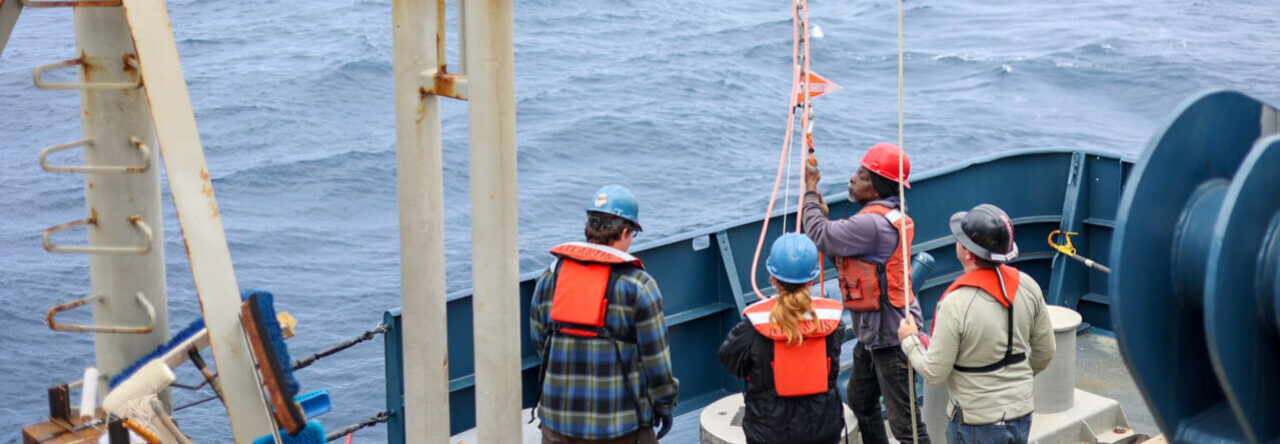
That’s all I got for this week. Unfortunately, I couldn’t attach any pictures because the site is buggy, but I will try to upload some in the near future! So I’ll attach a picture of me in action and try to upload later! Until next time everyone!