Category: Host Page 59 of 85

USCGC Healy – Slide into Seward

Now that science operations are over, there was time this week for some interesting events before we docked in Seward. The Healy’s engineers gave everyone a tour of the ship’s engineering spaces. This included the engines/generators, motors, cycloconverters, and the control center. We started off in one of the two engine rooms. The scale of the engines was immense. They were so big, they needed catwalks to access all sides of them. Each diesel engine had twelve cylinders in a V configuration, and the valve boxes on each one looked large enough to sit in. These engines drive massive generators, providing power for the electric propulsion motors as well as the rest of the ship. The engineers then led us to the control center, where they spent a few minutes answering questions and showing us how they monitor the ship’s workings. From there, we went down to the motor room, where the two huge AC propulsion motors turned the Healy’s propellers.

Next up, the science party gave a presentation on what they had been studying on this cruise. Much of their talk centered around the moorings that had been recovered in the past few weeks. Some of the moorings recorded sound, temperature, and salinity for an entire year underwater. Others emitted sounds that were recorded by the other moorings. The data collected will allow the scientists to model the acoustic environment of the area. Although I had read about the experiment and its objectives, getting an explanation from the brains behind the project helped tie everything together.

The day after the presentation, the Healy docked in Seward. The science party left while the ship was in port. We had several days to pack up sensors, work on diagrams, and solve a few electronic issues that had come up on earlier cruises. It was good to spend time on solid ground and take a break from eating the ship’s food. The STARC technicians for the transit back to Seattle arrived from Anchorage, and the techs who I had worked with departed. This afternoon, the ship left Seward. We will be making one more stop in Juneau before Seattle, our final destination. It’s strange to think that my internship is ending in a little over a week.

USCGC Healy – Happy Healy-ween!

At the beginning of the week, the ship moved north of the operating area so that the scientists could take measurements of sea ice. I woke up on Halloween to see pancake ice in every direction. The surface was covered in pieces of sea ice about one to two feet across. It was very strange to look at. Up close, the pancakes looked like bacteria under a microscope. From far away, the surface looked solid enough to walk on. The ice tamped down the short-period waves, so it was very smooth. However, there were still long-period waves that made the surface look like flowing cloth. One of the STARC technicians put it best when he said, “It looks like a Super Mario level”. We spent the entire day in the ice while some of the scientists went out on a small boat to take measurements. Once they were done, the ship turned around and went back to the operating area the way we came.

We spent another day in the operating area wrapping up some unfinished tasks, including more mooring retrievals. I was back at it with the deck box getting range values with a member of the science party. We had an interesting conversation about acoustics and underwater noise pollution laws. While we were waiting for the ship to get in position, the Healy’s bow thruster decided that it was a great time to break down. Violently. It looks like we won’t be using it for the rest of the cruise. The crew engineers are giving us a tour of the engine room tomorrow, so we might get to see its remains.

After wrapping up in the operating area, we put the Arctic Ocean behind us for good, and we are now on our way to Seward. As we moved south, the snow and ice that had accumulated on every surface began to melt. It’s nice being able to walk outside again without worrying about slipping. With nobody hanging around the CTD hangar, I managed to finish up the CTD lanyard project started by the previous two interns. We did it, guys!

It’s getting close to the end of the season for the Coast Guard crew, who have been out at sea for five months. They got to let off some steam on Halloween, when many of them dressed up in costumes for the day. There were superheroes, animals, and crew members impersonating each other. Spiderman tried to sneak up on me after dinner, but I noticed him before he could fire off a web. That night, everyone participated in a “Healy-ween” costume contest. The categories were “funniest”, “scariest”, and “most cobbled together”. We got to vote for our favorites by cheering. The impostor crew got the most cheers by far, in every category.

Trivia update: we didn’t win this week. Our team was missing a member and we came in second to last. All of the questions came from Snapple caps, so I’m boycotting Snapple in protest. We have two chances left to win, so I’ll keep you posted.

We’ll be arriving in Seward in a couple of days, and the current STARC technicians will be leaving then. I’m looking forward to being on solid ground again, but it will be sad to say goodbye to them.

USCGC Healy – Science and Seinfeld

There are only a few days left of science operations in this cruise. Mooring recoveries took up the first half of the week, and CTD casts filled the rest. I got to operate the mooring release deck box again for some of the recoveries. This time, we released the moorings from their anchors after establishing contact with them. The first release did not operate as smoothly as we would have liked. It didn’t respond to the release code, which was concerning. Turning up the deck box’s transmission power didn’t help. Fortunately, the mooring released after resetting the deck box and turning the transmission power down instead of up. Rather than help, the increased transmission power may have been causing echoes and confusing the release. Live and learn. With this experience, the remaining releases functioned much more smoothly. They all responded and released after just one or two tries, and the bridge spotted them soon after.

Some of the moorings didn’t have working releases, so they couldn’t be brought to the surface with an acoustic signal for retrieval. Instead, the deck crew lowered a grappling hook off the stern of the ship to drag for the mooring’s cable. As the ship was dragging, all eyes were on the winch’s tension display, waiting for the spike in the graph that would indicate we had caught the mooring. It took a few tries, but soon enough the hook was back on deck with the mooring cable attached to it.

On Wednesday, there was a holiday trivia night on the mess deck as a morale event. I was on a team with three Coast Guard crew members. A pair of socks, a trick-or-treat bag, superhero capes, and a plastic frog were the prizes for the winning team. There were Halloween, Thanksgiving, and Christmas question rounds, along with more general ones. For most of the game, our team led by a significant margin. We were already talking about how we would split up the winnings. Unfortunately, we lost by one point in the final round. I’m still kicking myself for forgetting about the traditional Festivus Feats of Strength from Seinfeld, which was the answer to one of the questions we missed. Hopefully, we can get the team back together to redeem ourselves next week. There’s still time for a Festivus miracle.

Other than the next trivia night, there’s a lot to look forward to. Once the CTD casts are complete, we are scheduled to head north of the operating area to take measurements on sea ice! When the cruise began, the ice was still far away from our planned course. Satellite images show that it’s moved up significantly since then, and is now only a few hours’ journey from where we are. I’m excited to see the ice, but it also means the end of science operations and the beginning of the transit back south. There’s still a few weeks left in the cruise, but we’ll soon be leaving the Arctic.

USCGC Healy – Getting Started

My first week aboard Healy has come and gone, and a lot has happened. Our departure from Dutch Harbor was delayed by a day due to bad weather, but it soon passed and we could leave port. The STARC technicians showed me around Healy, and after a few days I could confidently navigate around the ship. After leaving port, Healy headed north towards the operations area, where we would be recovering submerged moorings and performing surveys. There was plenty to do in the days leading up to our arrival in the operations area. I spent the time reading up on the ship’s installed equipment, continuing the Niskin bottle lanyard project started by the previous interns, and taking pictures outside the ship. I even snapped a photo of Big Diomede, a Russian island, in the distance as we transited through the Bering Strait. Considering the time of year, the weather has not been too bad. However, it has been very cold since we left Dutch Harbor, and at several points there was snow collecting on the deck. Interestingly, the ship’s time was shifted back by two hours to better align normal working hours with the limited daylight. I’m not going to complain, since this effectively gave me two extra hours of sleep.

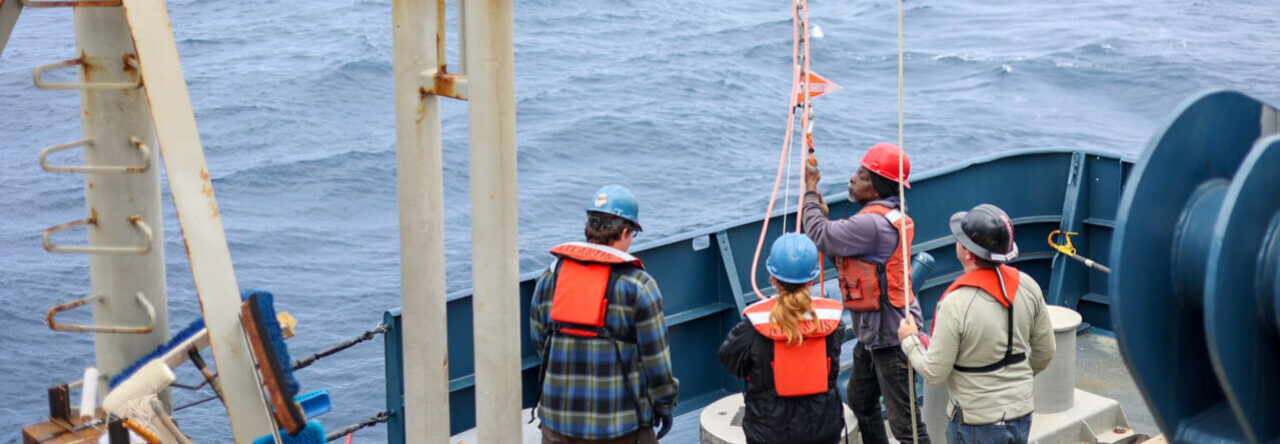
Early this morning, we reached our operating area for this cruise, and the scientists could begin their operations. They started the day by triangulating the location of some of their moorings. The scientists needed to take multiple range measurements at several points around each mooring, and I was given the opportunity to help. I operated the deck box used to interrogate the moorings’ acoustic releases. We used the box to send acoustic signals through one of the Healy’s transducers, and the mooring would respond with its own signal. The box would measure the time between these signals and use the known speed of sound through the water to calculate a range to the mooring. Although the deck box amplified the response signals, it wasn’t necessary for us to be able to hear them. The box’s transmissions and the moorings’ responses came clearly through the hull. It was very strange to hear what sounded like a giant telephone being dialed somewhere in the ocean. Although this system worked very well for multiple moorings, one of them gave us trouble. Unlike the others, this mooring would not send the correct response when interrogated, so the deck box could not provide a range value. However, we found that we began to receive return pings from “something” near that mooring’s expected location when we tried again from farther away. There may be hope for this mooring yet. 

My first week as an intern has been very enjoyable. I am fascinated by what I have seen so far on this cruise, and I’m looking forward to the next week aboard Healy.

Photo credit: Kristin Beem

Saying Goodbye

I’m going to name my dog, Niskin!

As week two finished with the Healy wrapping up the science for cruise 1703, week three ended similarly with the extra objectives we picked up for 1704 coming to completion.   Apparently the next cruise (1704) is looking at extremely rough weather and a heavy work load to boot.  So the Woods Hole science party used the extra time to recover some of 1704’s shallow moorings as well as some mapping survey work too.  This actually turned out to be quite fortuitous as I’ve always wanted to learn more about bathymetry and the multi-beam sonar.

The mission parameters had us navigating a grid of swaths we were to survey.  Using the Knudsen echo sounder to map and delineate the sub-bottom and the EM-122 multi-beam sonar to render a topographical 3-D model of the ocean floor, we began tracing the gridlines from waypoint to waypoint.  One of my supervising techs, Mike Coons had some extra time and kindly gave me a tutorial on the operation of the Knudsen.   I had never seen this instrument before arriving on the Healy, and had only developed a basic understanding of it.  After a couple of hours and some frenetic note taking, I now had acquired a working fundamental ability to operate and adjust the echo sounder to bottom conditions as they change.  This instrument works like what is most commonly referred to as “ground-penetrating-radar (though it’s sonar).  Drawing a distinct line at the seabed’s surface as well as shapes and layers of sentiment and rock beneath it, the Knudsen determines what the underlying matter is by the strength of the echo return. 

Mike repeated this one-on-one lesson with the multi-beam a day later.  The multi-beam is fascinating.  For those unfamiliar, a multi-beam sonar works just as it sounds (not a pun, really!).  Multiple single sonar pings working in concert with each other, focused at slightly different angles, render a swath that actually gets wider with depth.  It then composes a 3 dimensional model of the features of the seabed.  Boulders, seamounts, shelves all appear in a color-coded video model.  (If you’re still confused just watch the movie, “Tron” [either the original or Legacy]).  Our major hurdle was that the EM-122 was designed for great, abysmal depths, using lower frequencies so it did not always function optimally in these relatively shallow (200-300 meters) waters.  However, we were able to get great results most of the time.  We were even able to possibly locate a mooring that was considered missing.  The science party knew its approximate location and had even communicated with it.  We then found an image in this general area that gave strong indication that this was indeed the wayward, misfired mooring.  This would aid the next cruise should they attempt to rescue it from the bottom.

Anyone familiar with my previous blog (or who even glanced at the title!) would have to admit that I’m beginning to sound like a broken record or at the very least that a theme of “things getting stuck” is taking shape on this voyage.  I must wearily concur.  For the other morning, I awoke to my alarm as always, with a troubling exception.  Where was this electronic clanging coming from?  It seemed my phone had slid from my bunk down into a half-inch wide gap between the steel (attached to the wall) bedframe and the ships bulkhead!  Yes, dear readers.  Once again I had managed to get something inexplicably stuck in a tiny portal of doom!!!  Luckily, I spend my days surrounded by the most talented troubleshooters I’ve ever witnessed.  The theories of rescue were many and varied and all destined to fail.  However, just when I was about to dismantle the entire steel bunkbed, a very McGuyver-esque hybrid of many of the plans took shape.  And using a very long screwdriver, a plastic wedge and (of course) the obligatory coat hanger – all of them mummified in duct tape- I was able to first lift it to where I could see it.   Then with a desperate jerk- I popped it up into the air where it fell unceremoniously onto the waiting box spring.   Phone rescued!  Cue the triumphant music (Wagner or something)!

I did also mention in a previous blog that I was assigned two projects at the outset of this mission, the first of which I detailed in my last offering.  The second project was related to this installments title.  The Niskin project.  A Niskin bottle is a container used to collect samples of water as it rides upon the rosette (or the cage containing the CTD).  They come in 12 and 10 liter varieties and are open at both ends.  Located at each end is a spring-loaded cap and when fired, the bottle closes, trapping the collected water inside.   This apparatus is all held together and manipulated by a series spring-torqued lanyards fashioned from heavy monofilament line and even string trimmer refill line.  My assignment was to optimize and standardize these lanyards for both versions of the Niskin bottles.

Royhon Agostine (hope I spelled that correctly, my friend), the MATE intern before me (cruise 1702) had worked on this as well and had left an excellent manual on the top, bottom and middle lanyards construction.  He had pretty much laid out a standard for their lengths and construction, even going so far as to leave templates for the 12 liter bottles.  This was an extremely important precedent in light of the fact that, standardizing anything is difficult with a vessel where different techs constantly rotate in and out.  So many people with divergent backgrounds lends itself to 24 bottles rigged 24 dissimilar ways.  The goal was a single recognizable, efficient, effective lanyard system.  Royhon had done a great job.  My task was to test and improve if possible, any portion of this bridle of line and springs.  And then apply this to the 10 liter bottles as well.

After a great deal of testing, very few changes were made.  The bottom lanyard received the most redesign due simply to the fear of losing the attached hook.  It was hoped that tying the hook in with a strap hitch would make for a swift hook change out should a malfunction occur.  However, after some trials, Mike Coons and I concluded the hook could actually work itself free and be lost.  In the end we basically shortened the lanyard and formed a simple loop with no tail to trim from crimping.  This made for a much quicker change-out based on simplicity alone.

So, the project continued in that fashion with minor tweaks to lengths here and there.  Once I had outfitted the entire compliment (24 with 7 back-ups) of 12 L Niskin bottles we sent them down on several CTD casts with perfect results.   The Niskin bottles are now standardized and optimized.  I tangled with a generous amount of string trimmer line and worked and re-worked an army of Niskin bottles so now I’ve no doubt, you understand why I entitled this tome thus.

Life on the Healy remains fun-filled as well.  Saturday night the crew staged a Sumo wrestling tournament in the helicopter hanger.  They had those huge inflatable suits that simulated a typical mammoth Japanese grappler and no matter who donned it, they looked hysterical.  Some of the crew could barely get their hands to stick out of the arm holes!  Some of the most historic mismatches of all time transpired in that hanger.  One particular bout that comes to mind involved an absolute tree trunk of a man vs. this tiny petite female sailor.  She bounced around him like a balloon in a tornado and he stoically stood, unflinching in the middle of the ring.  It was the old comic formula of the toy poodle savagely barking at a bear.  He even went as far as to pratfall and concede the middle round.  In the final round, she charged at him and with barely a shrug, he sent her glancing off him into the out-of-bounds.  Handily one of the funniest moments of this whole trip!

It has just begun to sink in that this journey is nearing its end.  As sad as that makes me, I am so grateful I had this opportunity.  It has been a fantastic immersion into a world where I hope to thrive.   One more week remains and I’m going to squeeze every last drop out of it.  

USCGC Healy – Internship Starting Next Week!

Next week, I will be heading to Alaska to meet up with the USCGC Healy. For five weeks, I will be living onboard the ship and working as an intern! This will be my third experience this far north, and my second time in Alaska, but this will be first time being there this close to winter. I am excited to work on such an impressive ship, and reading about the experiences of the past interns has made me even more eager to get started. I anticipate gaining a lot of hands-on time in the next few weeks, and I hope you will follow along with me on this cruise though my upcoming blog posts.

Don’t tell the bears, I’m stuck!

My second week on the USCGC Healy has drawn to a close with even more great learning experiences and moments of awe!

It began with us on-station and hard at work with the mooring retrievals.  The Woods Hole science party had now fallen into a rhythm and began to really crank through the long days of deck work recovering and deftly securing the instrumentation of the deep sea moorings.  We in turn continued with our twice daily CTD casts, also finding our own swing.   With each cast, I became more and more comfortable with the software and the routines involved with prepping, cleaning and storing the rosette.  We did receive word from the Scripps Institute that because we were not firing any of the Niskin bottles (used for collecting water samples) we should remove them from the carousel.  This would save any needless stress and strain placed upon them when descending to significant depth.   Since most of our casts were done in 3500 to 4000 meters, we complied and removed them.   We then had to place three 100 pound weights on the cage to compensate for the missing Niskin bottles.   Sending it down too light could cause it to tumble and tangle in the winch wire, so the addition of these weights would avert any such calamity.

This was also were I encountered the fantastic sense of humor of my coastguard shipmates!  During a certain evening CTD cast, they secured a rubber chicken (we named him, Steve…., I don’t know why) to the cage and sent him down 3900 meters.  Steve happily came back to us unharmed.  It made for a fantastic photo that I will forever treasure.  The whole CTD crew are an awesome group of people and have really added loads of laughter to all of the learning that I have done.  Apparently, another tradition I was able to participate in, was the “cup cast”.   This occurs when the entire crew decorates 20 oz. cups and then secures them in a dive bag to be sent down to the depths.  Cups colored with names, hand drawn flags, messages, you name it, become compressed at those depths.  Reduced to the size of a shot glass is how the once-20 oz. cups emerged from the dark ocean floor.  With all their glorious artwork intact and unmarred.  I guess they make fine Christmas tree ornaments.  It easily made for the most colorful CTD cast I’d ever worked on.  Like I said, a truly great group of people.

Week two also saw my first project come to full fruition.  I did vaguely mention these projects in my previous blog installment, but allow me to elaborate on the first of these.  The week past, Mike Coons (one of my supervising techs) had assigned me a project where I would install a float switch/alarm in the overflow sink of the ships Flow Through system.  The Flow Through system is common on many ships and is basically (so my mom will be able to read this) where a ship intakes sea water and pipes it through a series of sensor instrumentation, such as: a Fluorometer (measures chlorophyll and phosphorus), an air-seawater equilibrator (a holding tank for the PCO2 system), a dissolved O2 sensor (oxygen) and a flowmeter.   These all provide real-time water condition data constantly to the lab.  Water flows through these sensors and spills into a large 6 foot trough, which resembles an elongated industrial wash sink.

The problem with this set up is that water is constantly running through the system at a relatively high volume and once the ship enters the arctic, there is a potential for it to turn into slurry.  Even though it is running swiftly, as it cycles through, it often slows down enough in a section called the de-bubbler where it may quickly solidify.  This in turn can clog the system causing the slurry to build up in the sink and eventually leading to a spill-over into the hallway.  The float switch, by design, will trigger an alarm far before it ever reaches the point of flood and give the technician time to remedy the impediment.

I wish to note that when installing the termination strip into the control box some considerable modification to the plastic had to be performed.  This required the use of a Dremel which is, next to a soldering iron, my favorite tool of all time!

So after wiring in a converter to step the voltage down from 10 to 5 volts and also adding a pull-down resistor to the original circuit design, it was time to permanently install the float switch into the sink.  Now, for the layman, this could best be described as taking a small version of the float you would see in your own toilet tank and bolting it to the side of the wash sink in your basement.  (Providing you have a basement.  But I think you know what I mean.)  This was easier said than done.  This part of the project fought me every step of the way.  The cordless drill I grabbed did not have the proper bit or the power to penetrate the aluminum sheet splashboard that attached to the wall.  After swapping out for the proper drill and bit, I easily punched holes in it and was able to fit the bolts.  However, securing the bolts was a completely different story.  If I had any moments of this internship on video, this would definitely be in the comedy section.  After carefully choosing the materials and meticulously measuring everything, I somehow managed to get my arm stuck in between the aluminum sheet backboard and the unistrut of the bulkhead!!!   Yes.  It was a very tight fit and I had cleverly worked my arm back there and had no trouble securing the bolts.  However, during this, I had unwittingly wriggled my arm in there so far that neither my elbow nor wrist could seem to remember which way to bend in reverse.  Removing it was going to be quite a trick.   Now, it was only stuck for a couple of minutes but with that section of hallway being the main thoroughfare from the labs to the galley and cabin ladders, it seemed like an eternity.   I was very visible.  The last thing I wanted was everyone strolling by snickering at the intern!  I actually played it very cool and made it look like it was part of the task, but inside my head, I wanted to crawl in a hole.  As the clock ticked, I patiently, covertly choreographed it free of it’s entrapment.  And with that, the USCGC Healy had a new float switch.   The next day, Mike received the coding from STARC and our display in the lab had a new warning light!!  Project successfully completed!  Leaving only a tiny dent in my ego.  And this is how we learn, right?  Absolutely.

Last Wednesday morning, I had just rolled out of my rack when the ship piped, “Two polar bears off the port rail!!”   I excitedly grabbed my boots and threw them on.  I started out the door and realized I forgot my phone (for pictures), so I retrieved it.  I started out the door and realized, I wasn’t wearing pants, so I kicked off my boots and threw on some pants.  With boots back on, I headed out to the rail and there, swimming beside the ship were a mother and her cub!  Incredible!!!  I could not believe my eyes.  Breakfast had just been served so I am assuming they smelled food and approached the ship.  I’ve seen so many new and astounding things on this cruise but this took the cake.  Polar bears in the wild.  I’ve only seen them on television.  They were now moving away from the Healy but apparently somewhere between my phone retrieval and my pants they were once right beside the ship!!  I snapped so many pictures and then just watched them in awe.  Everyone was.  In all the surrounding conversation I suddenly heard someone say, “They won’t make it.”  My elation immediately crashed into an awful gut twist when I realized we were out almost 250 miles from any land and about 150 from the ice.  What were they doing out here so far?  I sadly watched them turn and head away from the vessel.  Like a somber parting glance, the mother looked over her shoulder one more time and swam away.  Cub in tow.  It impacted me heavily.  In all my life I’ve never watched a creature so resolutely turn and head for impending doom.  All day long I had the worst feeling.  Until at dinner, I spoke with one of the science party who obviously knew a lot more about polar bears than I and he assured me that not only are they incredibly buoyant but they’re also known to swim hundreds of miles.  I do know that bears are formidable, stout creatures.  And being who I am, I simply chose to believe that they made it and are enjoying a meal of seal meat and doing what makes polar bears happy.   The gift of seeing them in their element was just too amazing for me to think otherwise.

A truly profound week indeed.

Leaving for Puerto Rico- Did I mention Hurricane Maria JUST passed?

Nature’s Discotech

My first week on the Healy has concluded and WHAT a week it was!  I realize this post has an unusual title, however as you read on, it’s meaning will reveal itself.

Having only spoken to Brett Hembrough on the phone twice, I was a little nervous to meet everyone as I arrived in Dutch Harbor.  However, the second I met everyone on the STARC team, I began to relax.  All the outgoing and incoming techs had just wrapped up their daily meeting and took me out to dinner.  It was so interesting to learn how each of them, with their varying levels of experience and expertise had found their ways into this career.  Standing around a bonfire pit fashioned from an old crab pot was just the kind of meet and greet I enjoy.  As a fan of the television show, Deadliest Catch, I also found no small amount of humor in it.  After the bonfire, they showed me around the ship and the lab that would serve as home base throughout the cruise.  We also managed to get in a little sight-seeing.  The entire island is littered with bunkers, gun mounts and pill boxes still intact from WWII.  Being a huge WWII buff, I was completely thrilled to explore them as well as, walk right up to some of the crab boats that are featured on Deadliest Catch!!  The most powerful event of this day was a trip up into the mountainous area of Dutch.  There, with my brand new friends, I was able to scatter some of my father’s ashes over this breath-taking view of the ocean.  My dad was stationed in Alaska during the Korean War and forever commented on how it was one of his favorite places he had ever seen.  It completely defies words what this meant.  Simply put.  It was an amazing day!

We then departed Dutch Harbor and set about prepping all the gear and instrumentation for the cruise.  Activating the many systems that we use for data collection suddenly made the lab come alive.  Starting the echosounder, ADCP, multi-beam sonar, the MET (which displays all pertinent navigational data and much more).  We began the task of readying the lab.  We had barely made the turn northward at Priest Rock when suddenly the ADCP went absolutely haywire!

ADCP stands for acoustic Doppler current profiler and it, for the layman, basically provides data for the currents up and down the water column.  In other words if you had a tower made of water and each floor had a current, it would report data on the currents of each floor.  It’s important for many reasons, however, as explained by tech Liz Ricci, our most exigent need was that it also works in concert with the multi-beam sonar, in respect to fine-tuning it.  It aids the sonar by better focusing the pings.  In other words, it works like the focus feature on a camera, making the sonar image far more accurate.  So, its absence was a huge problem.

Though I knew what it was, I had never worked with an ADCP before but was so pleased when the first task was to check the fiber connections and boxes.  You see, after several days of acronyms and terminology pretty much overwhelming me, they mentioned fiber optics!!!  Finally!!!  Something I know.  So I dug right in, checking and cleaning ST connectors and checking the serial to fiber converter boxes.  However, no matter what combination of swapping cables and power cycling and re-routing we tried,  nothing seemed to eliminate the check sum errors that were printing on the display.  It was one of those strange moments, where you walk into the room and everyone is staring at the display screen scratching their heads in puzzlement.  Not wanting to be left out, I started scratching my head too.  Just to fit in.

(if that joke didn’t play, I promise to fire my writers upon returning to Dutch!).  It took several shifts (two days worth), with a new updated report at each shift change and all three techs plus myself to finally solve this mystery.  At one point, so many different things had been tried at different times, by different technicians that we went to a white dry-erase marker board and just laid it out.  When trouble-shooting, you begin with what actually IS working and whittle it down until you find the culprit.  As it turned out, technician Mike Coons, during the midnight shift, took a guess that although the fiber to serial converters were shown to work, perhaps that particular brand didn’t function well with the ADCP’s baud rate (rate of data transfer) so he swapped them out with another brand.   And VIOLA!!!!  It worked and the Healy once again was sailing with a functioning ADCP.  It was one of the finest examples of problem-solving and teamwork I’ve ever witnessed.  These techs are rock stars.  I’m going to learn so much!!

Now with that dilemma past, we settled in and I was assigned several projects: 1. Continue the improvement of the lanyards for the Niskin water sampling bottles and 2, Develop, rig, test and install a float switch overflow alarm on the sink for the ships Flo-Thru system.  I was excited to do both.  The previous intern had developed a great manual for the specs on the Niskin lanyards and I found it massively helpful.  I began experimenting with them on extra Niskin bottles as time permitted.

Once on station, the Woods Hole Institute scientists began the recovery of several deep sea moorings that had been submerged as deep as 4000 meters for an entire year.   These are terribly impressive feats of science.  They sent a single acoustic ping signal down to a release and a buoy appeared within minutes.  The buoy was recovered by the coastguard in a zodiac small boat and winched aboard.  This is a slow process as these moorings are almost 2 miles in length and contain almost 50 hydrophones, current sensor packs and many other types of oceanographic equipment.  An incredible amount of data to retrieve.  It was truly a sight to see, watching them run that deck with amazing precision and care.

We also began the CTD casts, which I’ve been chomping at the bit to get started.  In an attempt to become more familiar with what I discovered to be an extremely prevalent aspect of the marine tech field, I built a very small, inexpensive (by comparison) CTD my final semester at school.  Since boarding Healy, I’ve been anticipating these operations with a great deal of excitement.  Crawling all over the rosette, taping it up and checking the harness and bottles was the very thing I had been waiting for all summer.  Now the time was here and the first casts went perfectly.  Actually learning the software for it filled a hole in my experience that simply building one couldn’t do.

Now to the title of this post!  It must be said, that the Arctic is a magical place.  In our transit this far north, adding to the thrill of crossing the Arctic Circle for the first time, I observed a handful of events that were brand new to me.  From passing a remote island with an eerie ghost town on it, to seeing the tail of a whale slap the water with a crack!!  We also passed two islands, one belonging to the U.S. and the other to Russia!!!  All this and a walrus in the same day!   But it was that night that wrote the title to this post.  That night shift, I stayed late working on lanyards when Croy Carlin (the tech on duty) told me the auroras were out.  We went out onto the helo deck and what I saw in the sky was the most amazing display of light I can ever remember witnessing.  Being from northern Michigan, I had seen auroras before but nowhere near as brilliant!!  I just stood there completely speechless as clouds moved in and out, enhancing the effect.  I then went down to the ships rail and noticed bio-luminescent diatoms glowing like little dancing spots along the side of the ship.  Like a dancefloor with a disco ball spinning, these green spots swirled and the sky just flashed and flashed to the music of Healy’s whistling ventilation fans and ever-constant rumbling power plant.  It painted this incredibly stunning, living portrait that froze time itself.  Nature’s discotech.
Page 59 of 85

Powered by WordPress & Theme by Anders Norén