Author: Amanda Dostie Page 1 of 3

Saying Goodbye

Leaving for Puerto Rico- Did I mention Hurricane Maria JUST passed?

Cruisin’ to the Big City

Following our weekend return from BATS/HYDRO station, we demobilized on Monday and prepared for our next upcoming cruise- an oceanography trip with students from Oxford.

The cruise follows the same routine of any regular BATS/HYDRO cruise, so, many of our operations were repetitive. The only difference? – I held my own shift again. After our short stint with Oxford, we transited back to BIOS, just in time for a BBQ and my intern talk. As per regulation of BIOS, every intern is required to give an introduction and final talk. My talk was multi-functional, as I will also be presenting at RVTEC this year. A crowded room full of potential job seekers is a little more intimating than speaking to students- nonetheless, the talk was good practice for what is to come.

Now, the crux of my story: Hamilton, the big city of Bermuda

After months of preparation, we set sail to Hamilton for a PR event. The event’s main purpose was to broadcast our research vessel to donors, trustees and board members, as well as the BATS program. The day was full of tours (lead by mwah) introducing the vessel, its research technology, and crew. After a long day of tours, we made our way to the hotel for a viewing of the PBS documentary “The Fate of Carbon” featuring the AE, BATS program, and recent MATE intern Mason Schettig. Seriously, check it out- I know you want to. Walking through the capital of Bermuda was magical, and as soon as it began, we transited back.


We have lots of preparation for our upcoming cruise in Puerto Rico- which has been a little chaotic. For anyone, for is reading: My post is following hurricane Maria- so, it will be interesting to see how our cruise to Puerto Rico goes…

Everyone’s grows up sometimes: Holding my own shift

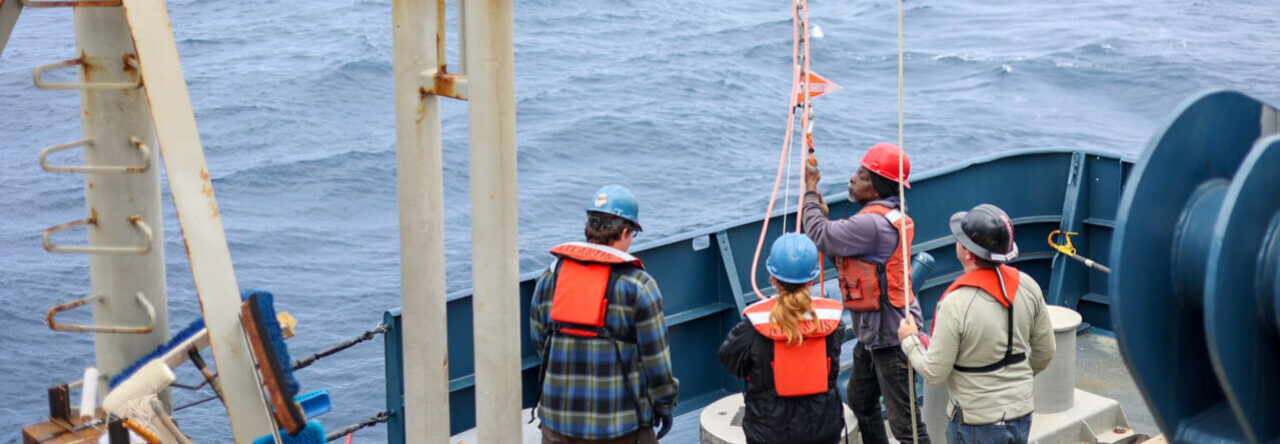
After our morning safety brief, abandon ship drill, and fire drill, we set sail to our first station. Similarly to the last cruise, I will be holding my own shift again and leading all deck operations. The feeling is liberating, stressful and necessary…and, I must say, I feel much more confident now in my abilities to lead. We arrived on Hydrostation S before evening and due to foul weather, we retrieved the glider, “Minnie” right away…and Woah, what a trip! For starters, we all made it out untouched, but not before we all learned a very important lesson in retrieving equipment in foul conditions. We pulled up to the station in very rough seas and made the quick call to retrieve our glider. As I waited and assisted on the back deck with my co-workers, our lead technician and several other BATS technicians deployed and rode our small boat to the glider. Aside from the massive waves, all started off OK… before they met us at the back of the boat to hand-off the glider. The waves were too large to safely pass the glider from the small boat to our back deck, and as a swell hit, the nose of the small boat made its way to our deck. As exhilarating as it was, in a Tom Cruise kind of way, other options should have been deployed. After fumbling to hold the glider over the edge for several moments, and after pushing the small boat off our vessel, we made it back in one piece.

For the rest of my shift, I lead several back-to-back CTD casts- one of which was a deep cast. It is important to be aware of varying depths the CTD sensors are rated for. For example, some sensors can withstand a great amount of pressure and depths up to 7,000m, while others can only withstand a couple thousand meters. Our bottom cast went down to 4500 m and lasted several hours. Beforehand, I removed our PAR sensor, which is only rated to less than 2,000m. If the PAR sensor had been left on, the sensor could suffer from electrical issues or even implode under pressure. While in Louisiana, a tech holding a shift opposite to mine forgot to remove an oxygen sensor. While the cast was being pulled up, the oxygen sensor was found in pieces. Luckily, we learn from our worst mistakes and this is a lesson that will always stick with me.

The following morning began with a 1200m CTD cast. After the cast, we began deploying our sediment traps off our back winch. The sediment traps are deployed before sunrise and are left with a buoy for several days during our cruise. For a majority of the rest of our trip, we will be in very close proximity to the buoy, and in some cases, can even see it. Like any standard BATS cruise, after our sediment trap deployment, we began our plankton tows around noon. We began with our zooplankton tows. We cast a total of three tows to 250m, descending at 50m/min. In total, each tow is about half an hour. After our zooplankton operations, we towed to phytoplankton nets from our a-frame and winch. The net mesh is 30um and contains a 0.5m hoop. These nets were towed to 175m, at approximately the same amount of time. After our tows, we segued into the UPRO MULTI-RADIOMETER (SPMR- explain). I ended the day on a deep CTD cast.

By the middle of my cruise,  a large majority of my days were spent leading upro-multi-radiometer, or SPMR, operations. As the marine technician, accompanied by many trained scientists, most of my work was communication between the back deck and bridge. The wire attached to the SPMR is spooled, let off the back deck and free-falls for about 100m. Once the SPMR hits a 100m, it is recorded and dragged back up.

On our way home, a buoy from Maine broke lose and evidently,  found our path. Unfortunately, the conditions were too dangerous to retrieve the buoy. However, we did lead a deep water CTD cast. The information from the CTD profiles will help NOAA researchers calibrate their buoy while it is underway. All in all, I am very proud of myself for leading my own shift. It was not easy, and believe me, I had a few people give me very constructive criticism about leading deck operations- which sometimes hurt. But at the end of the day, I came out stronger and with more experience- and for that, I am thankful.

Jason and I pretending like we aren’t posing…
Storms, Cruise Prep and my First Milli-Q Installation

We have now been at BIOS for about half a week, and are preparing to leave for our next HYDRO/BATS cruise. (For those of you who are not familiar with the ocean-data time series: Hydro station S and BATS, check out my other blogs for more information!)

It is officially hurricane season and our recent weather has proven that statement true. We are currently waiting out Hurricane Jose in Bermuda. Tomorrow afternoon we plan to transit to Hydrostation S and BATS for a five-day cruise. During the duration of our cruise, which will involve the same deck operations as prior cruises, we will be picking up a glider for Ruth Curry- director of the glider program MAGIC.

The Mid-Atlantic Glider Initiative and Collaboration (MAGIC) was launched at BIOS in 2014 to enhance  BIOS’s long-standing ocean measurement programs in Bermuda, using autonomous underwater vehicles. The goal of MAGIC is to gain new measurements from underwater gliders to assess the contribution of small-scale processes that sustain the ocean’s biological productivity. Each sensor is equipped with a variety of sensors such as a conductivity, temperature, depth and several optical sensors that measure oxygen and fluorescence. One of Ruth’s gliders, Jack, is outfitted with an Acoustic Doppler Current Profiler (ADCP) which provides detailed profiles of ocean currents. To check out more information, see the site here: http://magic.bios.edu/about/

I will be accompanied on this upcoming cruise with a technician from the tech exchange program. I will be holding my own shift during this cruise, but it will be interesting to learn from a new and experienced technician.

Upon his arrival Friday, he helped me sanitize our RO 100L tanks. Prior to his arrival, we were having issues with our Milli-q system. Our elix, an RO water maker, has been working excellently.


However, our Milli-Q system, which is attached to our Elix RO maker and RO tanks, was not performing at the quality it should.


The system works together to sanitize our water on the ship. Water is fed through our water system, sent through two prefilters to remove heavy metals, through several filters and cartridges on the Elix, into our tanks and then is pumped into our Milli-q system which gives the water a final sanitization. In order for the water to classify as purified “Milli-q” water, it must read 18.2 mega ohms on our machine. Our milli-q was running low, an indicator that the water quality is not high. After speaking to a Millipore technician Friday, I changed out our two pre-filters, replaced our Milli-q q-guard and quantum ex-filters and performed a tank sanitization. Our tank has been accruing gunk for some time, so the process was much needed.


In order to sanitize the tanks, Jason and I drained clean milli-q water into several carboys, removed the tanks from their water feeds and cleaned them outside with a diluted bleach solution. Afraid the bleach would possibly contaminate science samples, we opted to clean the inside of the tank with 5% HCl solution. Once the tanks were cleaned, we hooked them back up and began making new RO water.


So far so good, let’s hope the weather holds up!

I’ve been suspended from a crane!

After returning and demobilizing from our mooring cruise, we set sail for an overnight trip on Hydrostaion. For anyone who is not familiar with Hydro station in Bermuda, it is an ocean data time-series established in 1954,  which provides long-term data for the open ocean of Bermuda. For decades, Hydrostation and BATS (a sister station) have been a pinnacle research program in Bermuda.The cruise was short and involved only a few CTD casts.

After our overnight trip, we docked off station at Penos in St. Georges, Bermuda. We remained off station for five days. During our stay at the docks, we received fall and safety training. The training covered the varying marine hazards, safety procedures, equipment, and field training. During field training, we dressed in our ship’s harnesses and practiced being suspended from cranes and climbing the mast. The experience was a blast and another training I can put under my belt!


During training, we were suspended. Using our pulley system on our crane, we attached a rope to the harness back D-ring and were suspended several times for practice.


Using lanyards, the yellow attachment device on the mast rung, we practiced climbing our mast-  a job I may be required to do as a marine tech.


After fall and safety training, we made our way back to the BIOS docks where we met with IT supervisor, Mark Jolly, to troubleshoot our shore-ship wi-fi connection. For several weeks now, our shore to ship connection has been down. Weeks prior, I spent days terminating all our wifi cables, reconnecting, tracing cables and shore-boxes with no luck. After working with Mark, we realized a cable on our ship’s wifi switch had gone bad and was not receiving sufficient signals. After swapping it out, and connecting our switch, we regained our shore wifi- which was very happy news for all the crew who was having difficulty getting internet access. While shore connection is down, or rather- we go out to sea, we rely on satellite internet. And while our satellite internet is good quality, high internet traffic can easily clutter it up.

All in all, I had a great experience docking at Penos in St. Georges. The area is beautiful and only a two minute walk into town! I am very thankful to be in a place as beautiful as Bermuda.


Surprise Mooring Cruise

We made it in early Friday, and after a long and relaxing weekend, demobilized Monday. The beginning of the week was spent catching up on tech duties, our first priority: installing our new milli-q system. While the process was a good learning experience, it was prematurely retired when a mooring broke loose off of Bermuda.

Two days later, scientists from Woods Hole (WHOI) flew in for a surprise cruise. We left mid-week and arrived on site early evening. Once we arrived on location, we lowered our transducer to the haul of the boat and sent out several acoustic pings from a benthos release box. Using acoustics, the device triggers a release- causing the mooring to float to the surface. Once the mooring was spotted, we spooled several hundred meters of mooring wire, which was later used during the reassembling process. The mooring is several thousand meters- consisting of sediment traps, transducers, pumps, and sensors. The process was an all-day operation.    


We spent the morning reassembling the mooring, re-terminating connections, replacing the line and releasing the mooring. The process is tricky because you have to be very careful which terminations you disconnect while the mooring is overboard, or you can lose thousands of meters of cable and instruments. Overall, the trip was a success and a great learning experience.      


BATS: Round Two!

After a week well-spent at the docks, we set out early Monday afternoon for another BATS cruise. As briefly aforementioned in my previous blog post, BATS is an ocean data time-series established in 1988,  which provides long-term data for the open ocean of Bermuda. Similarly, a nearby relative HYDRO is another data-time series established in 1954. Together, these two regions have been supplying innumerable data, insight, and measurements within the field of oceanography. Every month we go to these stations to conduct work with a BATS crew and other scientists from BIOS.

A standard BATS cruise involves CTD work, PITS sediment traps, in-situ pumps, primary production arrays, as well as, zooplankton and phytoplankton net tows. Every trip entails 24-hour operations, specialized BATS techs and a very tight schedule. I will briefly describe each process, but for greater details, visit my prior blog posts!

Because this is my second BATS cruise, and we have much more in the foreseeable future, I took on a greater amount of responsibility. Over the duration of our cruise, I led several CTD casts, pump casts, and other associated deck operations. In addition to BATS work, I programmed and configured our R2R event logger- a system which “logs event” during the cruise as a means of electrical back-up- and ran cruise start-up and shut-down processes. Experience is the best way to learn, and I have gained a great amount of knowledge, experience, and confidence in leading several operations.

While CTD casts and profiles are an all day operation, some are time sensitive. For example, our PITS sediment traps and primary production arrays must be deployed before the sun and retrieved during dusk or before dawn. Our pumps and net tows may occur during the day.


A Welcome Return from Canada

To give some added background to my summary- we have spent this week preparing for our upcoming BATS cruise- BATS, an ocean data time-series established in 1988, provides long-term data for the open ocean of Bermuda. Similarly, a nearby relative HYDRO is another data-time series established in 1954. Together, these two regions have been supplying innumerable data, insight, and measurements within the field of oceanography. Every month we go to these stations to conduct work with a BATS crew and other scientists from BIOS.The cruise and team are called BATS because we spend a majority of our time around this particular sight.

After arriving back to land, we spent two days demobilizing: removing our fish-tow from the crane, recovering its tubing and pumps, removing chemical waste, backing up cruise data and documenting additional paperwork.

Following the demobilization process, a majority of our time has been dedicated to preparing for our very important BATS cruise. The director of BATS, Rod Johnson, and our Port Captain will be accompanying us during our travels, so it is very important to be in tip-top shape. I spent the beginning of the week changing out all our CTD sensors, with freshly calibrated ones: 2 O2 sensors, 2 conductivity sensors, and 2 temperature sensors. The process was long and tedious- involving the removal of several Niskin bottles- but was a very helpful learning process as I changed them all out myself- with limited assistance. After swapping out the sensors, I made a new configuration file in sea save and printed out several cast and SCS sheets for our casts (a paper back-up method we use). In addition to CTD prep, chemical disposal, and other duties, I set up an event logger for future cruises. An event logger will help us log and back up data electronically- eliminating our some of our paper methods. This week has been very hectic and busy, but I am very excited to go on another BATS cruise, as the repetitive and similar work will help me learn well!

From Bermuda to Halifax, Canada


                                      All photos provided by me during this blogpost

Our first and most important order of business during our last cruise was our fish-tow device. So, what is a fish-tow? It is important to first state the mission statement of our research aboard this cruise- the nitrogen cycle and trace metal uptake in the coastal ocean. The picture posted above, is an overly complicated pump system towed off our crane. The system’s purpose is to collect uncontaminated sea water for trace metal studies, using tygon tubing. The excess lines are attached to lift the fish-tow in and out of the water during morning CTD casts. In addition to collecting uncontaminated sea water, the system offers insight into chemical processes during a time series- in other words, we can see the whole picture of what is occuring in the water- not just at the given time of a sample.

Aside from the fish-tow, which was carefully tended to the whole cruise, we deployed and recovered several CTDs throughout the trip. This trip, and for many more to come, I have been leading many back deck projects and will continue to try new roles and positions until I am comfortable with all technical operations.


Speaking of technical work, I had several opportunities during this previous cruise to perfect and learn new termination skills- more specifically, how to pin-out and terminate a serial RS232 DB9 cable. A serial RS232 DB9 cable can be used for many computer feeds, but in our specific case, we wired the cable to our GPS box/feed and into a scientist’s computer.


Terminating a DB9 cable can be tricky, as the back pins are very tiny and hard to solder. In addition to hard to reach places, every cable is different and it is important to find the correct pin-out before soldering and terminating. After soldering the correct wires, I added heat shrink and a quick cover to finalize my cable. I also stripped and cut the opposite end to wire into our GPS box. Overall, it has been a very productive and busy busy cruise- with many laughs and sights included. Until next time!


Page 1 of 3

Powered by WordPress & Theme by Anders Norén