Author: Amanda Dostie Page 2 of 3

On shore in Bermuda

With a little more than a week until my next cruise, I will be spending my time on-shore in Bermuda, aboard the vessel. While I have the option to stay within a dorm, I am becoming quite fond of this living space- the largest vessel (170′) that I have been on yet! As we came in early Friday morning, we were fortunate enough to have the weekend to ourselves. I spent the weekend exploring Bermuda, snorkeling its shores and catching up on several tech duties. Start Monday, we began mobilization.


Off of Fort St. Catherines, near Tobacco Bay in St. Georges parish, I found a socluded snorkel spot where I spent most of my weekend.

Come Monday, we began our demobilization process. The process was fast and efficient, as the BATS crew are a “well-greased machine” and well accustomed to the Atlantic Explorer. The main order of business- aside from the usual post-cruise data collection, clean-up and upcoming cruise preparations- was to transfer our gyro compass (used for heading and navigation information) to back-up battery power.


                                            Photo credit: Nick Mathews


                                      Photo credit: Nick Mathews

The process was a little bit nerve racking, as the UPS system is very powerful, and hasty decisions can lead to mistakes or electrical shock. We turned off our UPS power, and then wired our GYRO to a battery pack. We closed the circuit- with a small spark- and have been receiving accurate headings since. So far, so good!


A Welcoming Arrival and First Cruise in Bermuda


After a short jaunt home, followed by several cancellations and delays, I have finally made it to Bermuda! Unfortunately, I arrived late-so while I was unable to meet the crew upon my arrival, I was welcomed with my first Bermudian sunset. After meeting the crew and my two mentors the following morning, I took a short walk around the BIOS station and familiarized myself with the boat. Around 14:30 this afternoon, we made a short transit to the other side of St. George to load up our science party- and to avoid issues with low tide. The rest of the day consisted of safety briefs, drills and a little bit of exploration. Bermuda is breathtaking and I am beyond elated to explore its beauty!

Cruise:

My first cruise will last less than a week and will consist primarily of BATS and Hydrostations. BATS, an ocean data time-series established in 1988, provides long-term data for the open ocean of Bermuda. Similiarly, a nearby relative HYDRO, is another data-time series established in 1954. Together, these two regoins have been supplying inumberable data, insight and measurements within the field of oceanography.

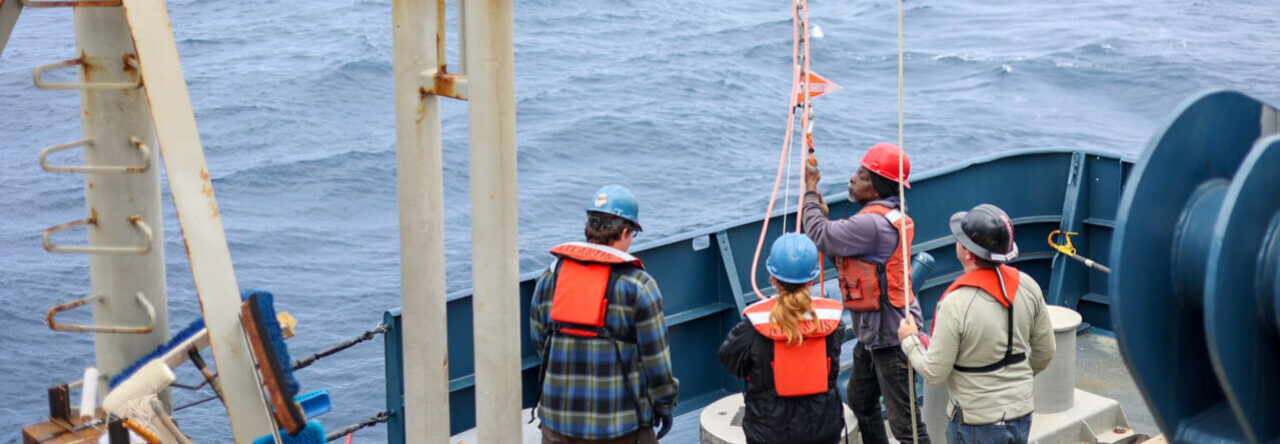
My first cruise consisted primarily of CTD work, along with a few PITS sediment traps, primary production arrays, zooplankton and phytoplankton tows. Additionally, we dragged a few in-situ pumps off the back deck. While I am familar with both the CTD and net tows, the PITS sediment traps and the primary production array were new to me. PITS stands for particle intercept trap system and is essentially a line towed off the back deck with flask at varying depth, which catch sediment onto a filter. The production array is a long winch rope line, fed through our a-frame wheely, and consists of a tray of erlenmeyer flasks filled with water. The flasks are set spatially along the line and sent deep down past the photsysnthetic zone. The array line is deployed early morning before the sun rises and retrieved after dark.


                                              Photo Credit: Nick Mathews

Aside from similiar work, I was happy to find many familiarities between the technology of the Atlantic Explorer and prior boats I have spent time on- the Pelican and Point Sur. The CTD station is within the wheelhouse and is centered along a large flat screen TV – capable of changing its view to our navigation, ADCP and Knudsen- along with a winch monitor displaying tension, payout and speed.  The system setup is reminiscent to a CTD movie theater and is an effective display method for scientists and techs alike. Additionally, the winch operator- also located in the wheelhouse- is no more than two feet from our stations, making communication very easy and effective. To make matters more coveninent, a CTD depth sensor is mounted to the winch station for optimal use. Aside from the CTD station, and the wide living plan of the Atlantic Explorer, the principle of technology and work is very similiar. Today, we made our way to several BATS stations, completed several CTD casts, along with several zooplankton and phytoplankton tows. The tows were dragged off our back deck, 250m below the surface at 1.5 knots for half an hour each.


Home and an Awaiting Adventure in Bermuda

Now,

I have spent almost two weeks home- though, it feels like no time at all. After more than three months at sea, I have been very grateful towards the amenities of home- personal bedrooms, bathrooms and mum’s homecooked meals. Being home has involved a whirl wind of family, friends, and lots and lots of hiking.

Though it has been incredible to visit loved ones, walk the local trolley tracks behind my house and go camping, much of my time at home has dealt with my preparation for Bermuda. I will spend three months total in Bermuda, and because it is not attached to the mainland like Louisiana, I must pack sufficiently and fully. In classic Amanda fashion, I was adding last minute items the night before. My most beloved items- aside from sunblock- is my ukulele and journal.

Of course, I did not forget the important ammenities- which is heavily, heavily packed- paperwork included. The idea is to last three months, if need be, from all my packed goods.

My flight has been pushed back a day and I will leave tomorrow. I am full of awe, adventure, meloncholy, and gratefulness for my adventure.


– Until Bermuda!

Reflections and my Final Trip on the Pelican

I am approaching my final weeks at LUMCON and I cannot help but to feel melancholy. While it is exciting to move on to new endeavors, it is sad to leave a crew and ship I have grown so fondly of. I will be riding my last cruise solo, and will be the only technician on board. I am excited to work independently, but even more excited to spend time with the crew before I leave.

On my final cruise, we worked with an organization named fugro- whose mission was to retreive, service and deploy a weather buoy. In addition to assisting with deck duties, I spent a majority of my time assissting in the deep CTD casts.

Fortunately no major issues, that I could not problem solve, occured- aside from some small monitor and electrical failures. During buoy operations, our aft driving station monitor blew out. Luckily our captain was able to drive without them, but the issue proved to be an exercise in futilty because after reterminating all the RJ-45 cables and rewiring our VGA cables, I found the monitor had simply gone bad.

Prior to the screens going out, our gfi outlet tripped when both our hydraulic crane and winch were powered on. The outlet tripping resulted in several computers and breakers down. The problem was easily fixed by resetting our systems, but the monitor was not completed until after the cruise. Aside from a few scratches, it was exciting to solve issues independently and I felt proud when I finally conquered an issue. 

Leaving LUMCON is a bittersweet experience. I am happy to move onto new endeavors, but saddened to leave friends who taught me so much. During my internship I have learned and grown immensely. I say with a chuckle- I did not know how to properly fasten a ratchet strap prior to my internship. Now, I have a well-rounded knowledge of tools, scientific instruments, practical engineering, computer softwares and I can even terminate most cables. I am very proud of myself and to this program, for the accomplishments I have achieved. I am excited to see what Bermuda holds for me!

Final Two Weeks: Hurricane Season


A picture of our group from Dr. Leila Hamdan’s multi-coring cruise! Though it was my first time using the multi-core, I learned a lot through troubleshooting and working with both the science and boat crew alike.


Before our incliment weather abruptly hit, I spent the weekend on the boat getting some side projects done. Our hold in the tech lab was severely rusted and corroded. I hit it with a needle gun for the day, removed a majority of the rust and painted it over with an anti-rusting paint enamel. I also serviced the CTD, fixed a mast light and several of our AIS speakers along the boat.


Monday into Tuesday is when our weather and flooding began to hit. LUMCON, as a result, has been shut down for several days as I, and a small crew, watches over the boat and premises. Fingers crossed that we will get out soon!

A New Vessel in Mississippi

We made it back to port, after a very long transit from Mississippi Canyon to LUMCON. Due to the sheer size and amount of our equipment, we spent two days demobilizing. A crane and sixteen wheeler was ordered for the removal of the ROV and ROV tech van. The following days consisted of unloading equipment and preparing for our following cruise. Because our CTD was not used on our prior cruise, we had to reload and prepare our CTD with adequate sensors, reterminate our two CTD wires and regrip our hanging cable. In addition to  CTD work, I flushed our MIDAS flow through system using pumps and a 10% bleach bath. I let the pipes sit over night and by the time we were finished demobilizing, the pipes were well-cleaned. The usual office duties and sensor inventory was also completed.

After a long few days, I made my way over to Gulfport Mississippi to board another research vessel- the R/V Point Sur. In between my time on the Pelican and Point Sur, I made a detour to Texas. The trip was very enjoyable and it was nice to stop and smell the roses after a long cruise. Feeling well rested and high in spirits, I docked the Point Sur.

Point Sur Endeavors:

I am admist my first Point Sur cruise: the mission is multi-coring and CTD work.

Our first day came with some variability with the multi-core system. Specifically, we had difficulty getting the MC800 trigger mechnisms to fire at depth. All the parts are functioning as they should- after some refitting, regreasing and some serious TLC- but we continued to perfect our bottom method throughout the week. With the multi-core, it is important to drive the core- with the winch- into the sediment properly, but depending on the sediment, you may not want to linger for too long or too little on the bottom. Attached to our multi-core system is a transducer- so we used HYPACK and the Tracklink software once again- a skill I am now more increasingly familiar with. Throughout the trip I learned a lot about multi-coring, its trigger mechanisms and how it works. The device can be finicy and it is important to test, test, test before deploying down to 2000+m.

In addition to multi-coring, I learned a lot on the mechnical and tech side of things. Mechnically, I began operating the a-frame, j-frame and crane on the boat throughout the entirity of the cruise. The experience was a good confidence builder, and while it requires a great amount of responsibility, I am happy to reach a point where I am capable of taking that responsibility on. In addition to a few wire terminations on the multi-core winch wire, I fixed a few CTD landyard bottles and even got to shrink another cup! I will post photos below.

On the tech side of things, this cruise enabled me to better my CTD software skills- specifically in using its data processing hardware and converting cnv, dat and text files! I also installed several VGA monitors, hooked them up with ethernet jacks, ran several cables throughout the walls and terminated a ADU800 (heading, pitch and roll system) connector. I am very thankful for the extreme welcome I was given on the Point Sur- they made my time away from my home ship more than comforting!


Beautiful Deep Sea Discoveries- Photos Galor, A MUST Read!


The back of our computer control panel       Can you spy Wilma? She made it and was set free!

-or as I like to think- my wire castle.

PC: Jason Bradley


Brittle Star                                 Sea Cucumber- ventral view                 Glass Sponge


  Stone Coral                               Translucent Sea Cucumber                     Flat Worm


   Stalk Anenome                       Translucent  Sea Cucumber                Squat Lobster

Deep Water Horizon, Shipwrecks and ROVS

After completing our event in Baton Rouge we made our way to Morgan City, where we met several workers at the Oceaneering facility. For many years, Oceaneering has centered its ROV work in the Gulf of Mexico, laying pipelines for oil rigs. However, due to a dying industry, they have shifted their energy towards research endeavors. We will be working alongside oceaneering workers, scientists and LUMCON’s director- no pressure! The Mississippi Canyon is a region located wtihn the Gulf of Mexico-where the Deep Water Horizon tragedy occurred only several years ago. The mission of our ROV cruise is focused on deep-sea biodiversity. We will explore many sites, including the Deep Water Horizon region and several other shipwrecks. In addition to ROV footage and collection, our scientists onboard will be conducting several “woodfall” stations using a basket rigged to our side winch (see top description).

Our first day in transit set the tone for the rest of our cruise- full of problems and excitement! We spent a majority of the first day refueling and rewatering, while also fixing and ordering a port navigation light that went out during the night. During our cruise, we deployed both the ROV and a steel basket filled with logs off our side winch. However, the memo that we would be using a basket did not make it up the chain of command, and many crew members found themselves dumbfounded and flustered by the event. Because Oceaneering made our floating tether for our basket too long, we spent a majority of our trip retooling a method for disconnecting and reconnecting the basket at the bottom. The idea is to deploy the basket and ROV to the bottom with transducers on the basket, ROV and site mooring. The mooring will be dropped at our log location and the ROV then must open the basket with a robotic arm and insert logs into the sediment for later recovery. The mooring will stay down below for later return.

In short, the basket caused much more trouble before it became better. Deploying both a basket and ROV off our boat- which is not a DP vessel- is very dangerous as wires can become tangled in our wheels. Because of this, the Captain held position manually our whole trip. After a few days of refitting, and very very long nights, we found several issues wrong with our side winch. Our side winch has not been used this deep (2000m+) in a very long time. While deploying our basket, our chief engineer found several kinks at 1800m of line. We had to immediately pull and address the winch issue, which could not be fixed. Luckily, we reterminated our basket wire and fitted it to our other side winch- which worked swimmingly! Posted below is a photo of the infamous basket! Which I may add a small ancetdote- we found a lizard in there! The lizard must have came from LUMCON and got stuck in a log pile. She (which we originally thought was a he, before she laid an egg) swam all the way back to the boat when the basket was deployed. I took care of “Wilma” for several days and she made it back to LUMCON safely! I will post a photo in my later blog, when the cruise ends!


PC: Jason Bradley- an extremely talented photographer who accompanied us during our cruise! He has many more pictures coming- so stay tuned for more 🙂

In addtion to our basket and winch, I learned so much during this fun- yet extremely stressful cruise! For starters, I learned about transponders- an acoustic location system which uses pings and beeps to locate objects for later deployment. As stated, we used these devices on our ROV, basket and moorings and tracked them on a program called Tracklink 5000. It is very important to know where our equipment is while on the vessel- to ascertain nothing is under the boat or tangled (which almost happened a few times). Perhaps my favorite part of the cruise was all the amazing ROV technology! It is incredible that we can set an instrument under water and see what is happening in real time- and do scientific sampling and work! I learned how to tagline, deploy, recover and “fly” an ROV. All very dangerous- yet exciting. Posted below is a photo of my flying for the first time! The cruise is not yet over, but I am so extremely grateful for this experience, the science party and the crew I’ve grown to love with all my heart.


PC: James Aldridg from Oceaneering


And the rest! (more to come) All from Jason Bradley!

A deep sea isopod we collected!

Dreaming of beer and hamburgers.


STAY TUNED!
Big Wigs and Boat Celebrations in Baton Rouge

Our short cruise is now officially over and we spent the following late evening in transit to Baton Rouge. The trip was much longer as expected as we had several locks and bridges to go through, which never ceases to tickle my excitement! We took on board our chief scientist for our upcoming ROV cruise- along with two other scientists conducting work on micro-plastics. The Mississippi River is a huge sink for most of the United States pollution, and a large amount of that pollution is composed of micro-plastics. During a selected number of stations, along our transit to Baton Rouge, we slowed down periodically to deploy net tows. The net tows are put over the side deck and slowly drifted until sufficient plastic is accumulated. A scientist on board informed me that it’s not a matter of if fish will be filled with plastic, but a matter of how much. The information was saddening to hear, and holds greater weight knowing a very large majority of US fish bought originates in Lousiana and the Mississippi River. We arrived around 7pm to Baton Rouge, set up our gangways for our event tomorrow, demobilized and called it a night. We have a long few days ahead of us- full of legislative talks and public boat tours.

The following day marked the start of our massive ‘Meet the Fleet’ event. Over the next few days, thousands of people swarmed the boat for tours, info sessions and rides. I worked at our environmental monitoring booth today. The system Amanda and I worked on was placed in a spare lab on board, along with several posters, sensors, artifacts and informational pieces. Though the subject is not as interesting- in lieu to our 5 million USD dollar ROV on display (see picture posted below)- the subject is extremely important and I enjoyed educating the public about its place in society. I tried my best to make it fun and relatable to the public. I believe I was able to reach a large audience-which makes me very happy.


The next few days went as planned, with a premature cancellation on Sunday, due to poor weather. Unfortunately, the call was made too early and we did not receive our storms until the following day. Evidently, the following day was our most important as all Louisiana legislative would be touring the boat..

Big Wigs in Baton Rouge

Today was our last, and most important, day in Baton Rouge. This afternoon, several members of the state legislative department came aboard our vessel. Shortly after the event ended, we made our way to the state capitol for a ceremony service of LUMCON. The service, and several days of boat touring, was meant to educate the public of the importance of LUMCON, its research, educational outreach and vessels. We are hopeful that this event will help fuel funding for a new vessel, which has been extremely beneficial- physically and economically- to the state of Louisiana and Gulf of Mexico region.


Docks and Landers in the Gulf

For the remainder of the week, I worked on environmental monitoring with our instrumentalist Amanda. We have a “Meet the Fleet” event coming up in Baton Rouge soon- a large PR event that broadcasts our boats, instruments and different areas of research and education within the LUMCON facility. We are currently working on a weather monitoring station for the event, to rig on board within one of our labs. Amanda spent the week picking up the last of our supplies: PVC piping, and a mounting block that we will attach our sensors to for display. We spent the day rigging our display, and adding last minute aesthetic touches such as blue spray paint. The boat will return tomorrow afternoon- in the meantime, I am swinging by New Orleans to pick up my mentor John at the airport after work. All in all, I am very excited to be back on the boat with the crew!

Back at it again:

Back on the boat for demobilization and loading: We have a short three-day cruise coming up tonight until the 16th. During my very first cruise on the Pelican, a group of scientists dropped a lander at the bottom of the Gulf of Mexico. This particular lab group has now returned and will be joining us on a cruise to retrieve their deployed sensors. Several CTD and MIDAS flow-through samples will be taken on the way, to maximize additional research on our transit to our lander station. I am excited to return, and this three-day cruise should be a relaxing transition back onto the boat!

We spent the first day in transit, and picked up several CTDs along the way. I spent some of the morning driving, testing our boat’s alarm systems and learned more about our navigation and anchor lights. By mid afternoon we made our way to our lander station and retrieved our device using a transducer and hydrophone system, which brought our lander afloat. We were able to pick the device up with our back a-frame and did not need to deploy our small boat. Unfortunately, upon arrival on deck, we had the discovery that the lander was fried in several spots and only recorded about ten days of data. Our chief scientist ruled out several possibilities and believes there is an issue with the stepper motor, which draws samples and data. A new part was ordered and will be delivered tomorrow morning at C6C- a common station within the Gulf of Mexico only 3 hours from LUMCON.

Following day:

Our new stepper motor was delivered around 11am, hooked up around lunchtime and tested several times. However, while the stepper motor is fixed, the issue lies in several fried wires. After a long few days of troubleshooting- to no prevail- we had to turn around and are hopeful that we can send a small boat out tomorrow to get our lander back in the water. Heading back now, we should be arriving at dock around 7pm. We will quickly mobilize, bring items on the boat for Meet the Fleet and our scientists will stay on board until our small boat trip tomorrow.

We are leaving late tonight for Meet the Fleet in Baton Rouge. Most of the boat is packed up and our scientists are planning to leave soon to deploy the lander. The wires are fixed and our boat’s MATE will be leaving soon to deploy.

 But, I am very excited for our PR event!


Page 2 of 3

Powered by WordPress & Theme by Anders Norén