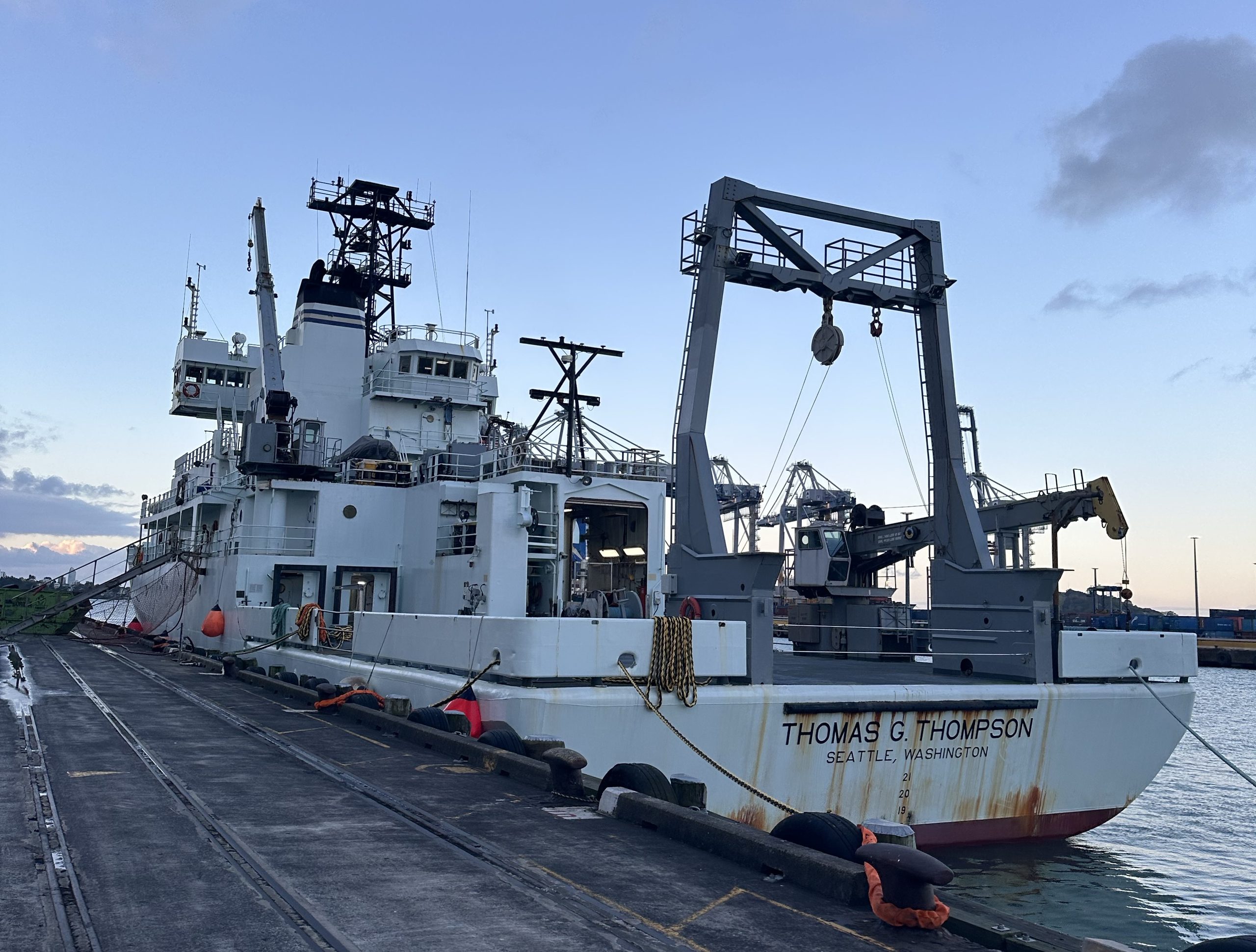
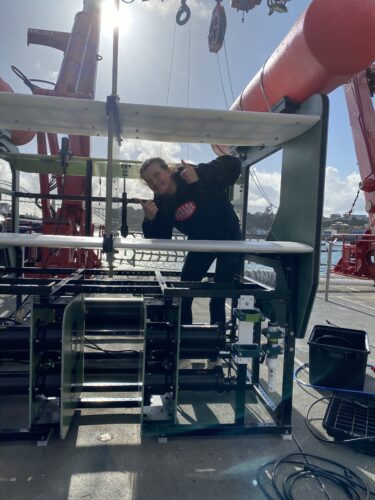
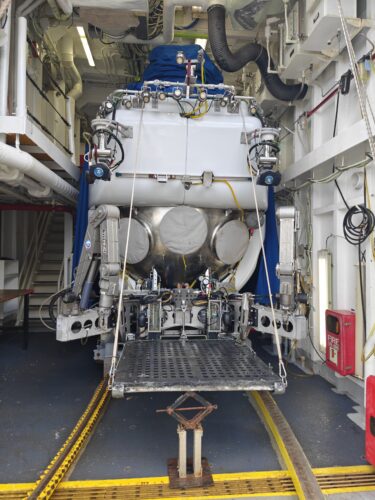
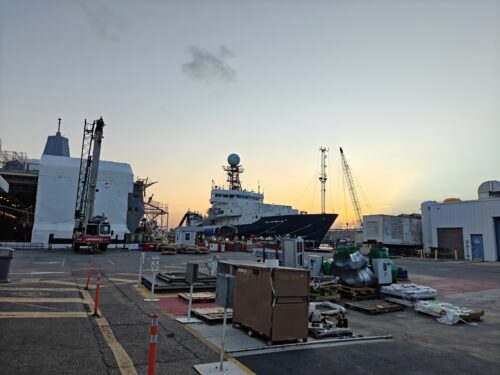
After flight cancelations and hours on the phone with United’s customer service, I am in Auckland, New Zealand experiencing the Southern Hemisphere to the fullest aboard the R/V Thomas G. Thompson. We have been in port running pre-cruise preparation, welcoming on the science party, and getting ready to set sail tomorrow.
Following some jet lag napping (8hr time difference from the East Coast!), I have gotten into a groove following around the SSSGs and learning everything I can.
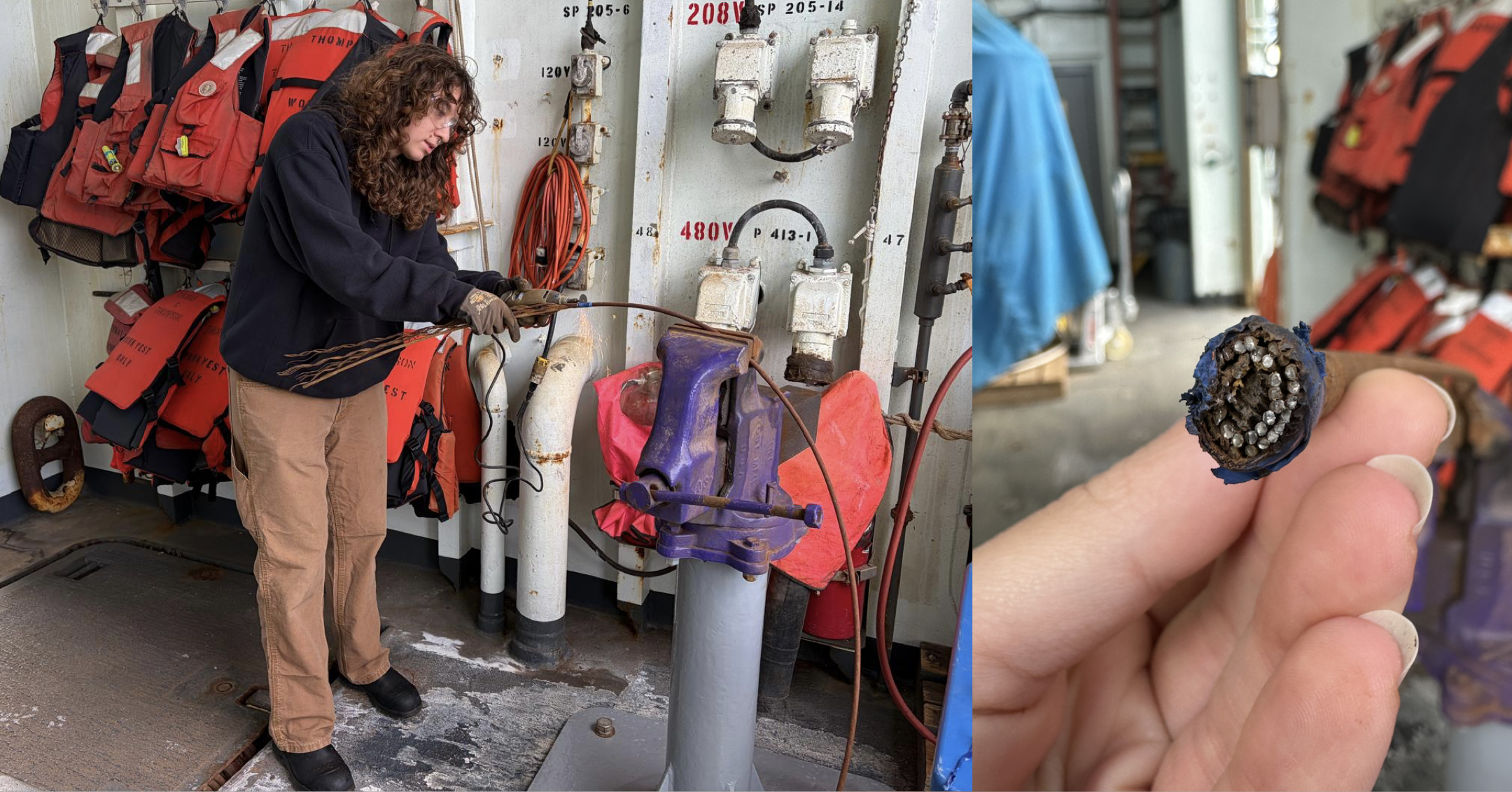
We replaced the slip disk on the winch which will be used for CTD operations and terminated the CTD cable both electronically and mechanically. This was a delicate task that the science party heavily relies on so because of that, Liz (SSSG) did the real termination, and I did my own termination on some spare wire on the side. After running some wire tests, we did a load test on the deck and calibrated the winch readout.
Left: Using a Dremel to cut through the outer layer of steel on the conducting cable used for the CTD. Right: Cross section of the conducting cable.
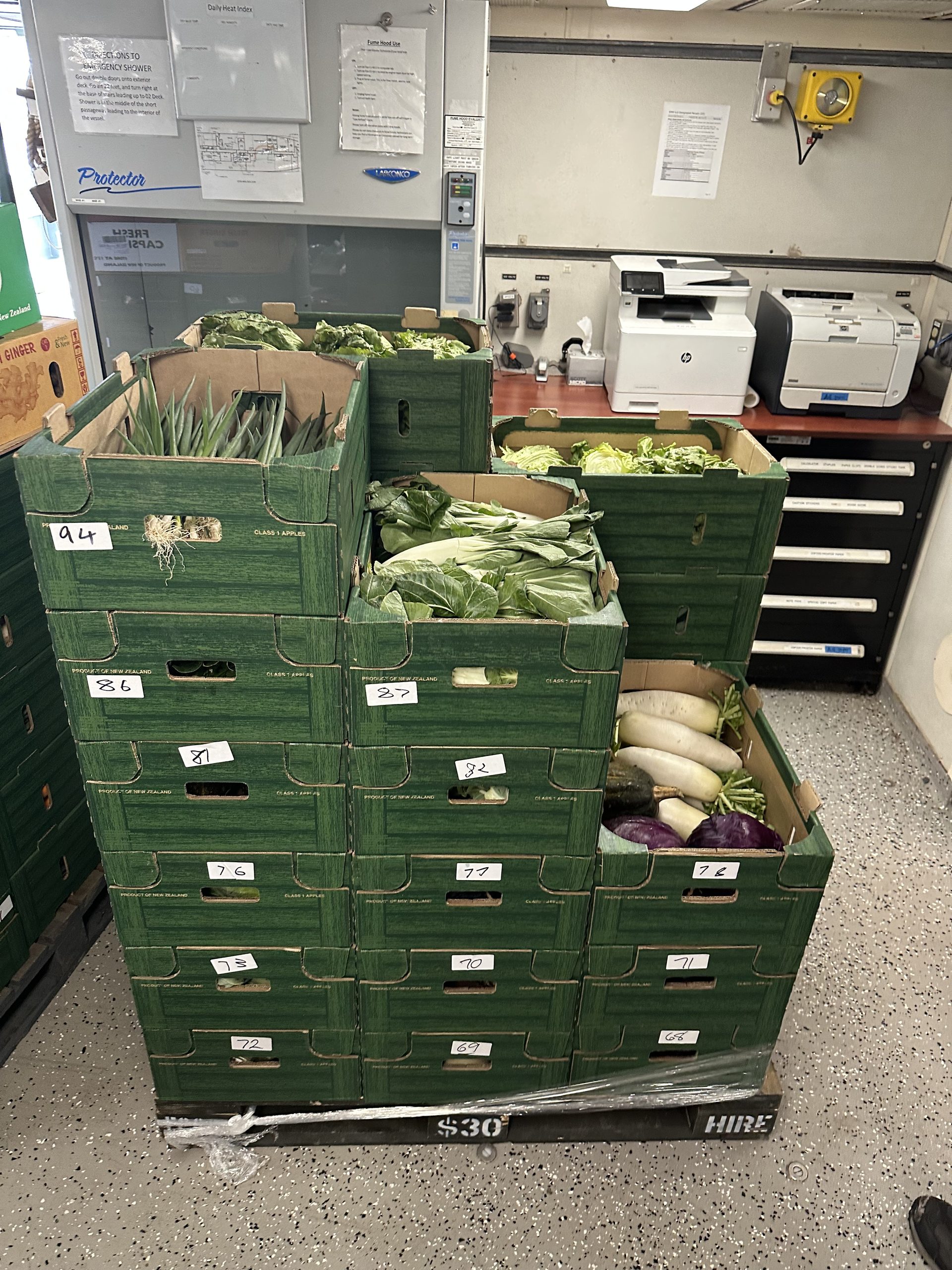
For the 24 hours before we set sail, I have been aiding the scientists in whatever they need to get going once underway which has consisted of moving tables, lending tools, and acting as an extra hand when needed. On the crew side, I helped unload stores (food for the cruise!) and shadowed the safety meeting.
One of many pallets of food for the cruise. We have roughly 45 people onboard sailing for 45 days making for over 6,000 meals total
Tomorrow we will be out of here at 1000 and on our way for 45 days at sea!
Hello! I’m Hannah, a soon-to-be UNOLS MATE intern joining the team at BIOS from mid-October to mid-November. I’ll be heading out on two cruises aboard the RV Atlantic Explorer, supporting the Oceanic Flux Program and Hydrostation S projects (two long-running time-series in the Sargasso Sea).
I’m originally from Georgia, where I studied biology before moving to Alaska to study oceanography at the University of Alaska Fairbanks. My graduate research was part of the Northern Gulf of Alaska LTER, which provided the opportunity to spend quite a bit of time at sea aboard the RV Sikuliaq and a few other UNOLS vessels. Working with the Sikuliaq marine technicians is what motivated me to look into the MATE program.
These days, I’m working as a technical analyst on a few zooplankton imaging projects. I’m excited to step away from my laptop for a bit and get back into hands-on fieldwork. I’ve worked a lot with zooplankton sampling gear, so I’m looking forward to getting more experience with other operations like CTD deployments and mooring turnovers during this internship.
Outside of work, I’m usually backpacking, climbing, biking, knitting, or doing ceramics. I’m excited to spend the next month with the BIOS and RV AE team… stay tuned!
My name is Drake, and I’m very excited to be joining the Hawai’i Ocean Time-series for their upcoming projects KM26-13 HOT 5 and KM26-14 HOT 6 cruises onboard the R/V Kilo Moana.
Currently, I work as a research technician in the Georgia Tech McGrath Lab, where we study the inheritance of physical traits and behaviors in Lake Malawi cichlid fishes using behavioral monitoring video tied to genomic and transcriptomic pipelines. Still, I’m excited to be getting back out to sea to look at geochemical features and learn more about oceanographic and marine technology endeavors.
Follow along this next month to see what all we get up to!
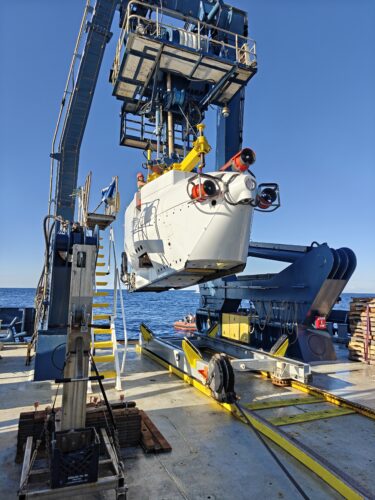
Last week was the last week of my internship and it was an absolute blast! We completed the last of our Alvin dives, saw some more dolphins, and I got to go in the small boat again. The small boat trips were probably the highlight of my internship since it was so remarkable to feel so small on such a large ocean.
We did miss one of our dives last week due to weather that was supposed to come in after 9 a.m. but only came in briefly to ruin the cookout that was planned that day. Funnily enough, that was also the day a whole bunch of things broke and the Electrical Technicians were working super hard on fixing Alvin. The rest of the dives went without issue though.
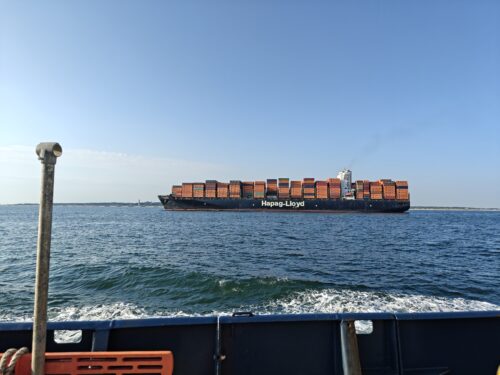
On the way into port, we passed by some gigantic container ships and the naval base again.
oplus_3145760
Once in port, the Alvin team and I had a lot of final work to do since this was the last Alvin cruise of the year. We had to take the motors off to send them back to WHOI, as well as clean up the Hydro lab, mech shop, and hangar. Everything had to be packed into boxes and then lifted off the ship with the onboard crane. It was a lot of work, but having a lot of hands made it easier and we were able to finish earlier than expected.
oplus_3145760oplus_3145728
Working with the Alvin team over the last few weeks has been a truly exceptional experience! I got to see and learn so much, as well as meet so many talented and unique people. This is definitely an internship I will never forget, and one I hope to come back to!
Hi! I’m Mimi, the UNOLS MATE intern for the September 2026 transit on board the R/V Atlantis. I’ll be in collaboration with STEMSEAS, both as a near-peer mentor for the student cohort, and assisting ChOP fellows and mentors. The goal of this cruise is to train upcoming chief scientists while also giving undergrad students first-hand experience at sea.
I’m a North Carolina native, and studied marine technology at Cape Fear Community College in Wilmington. I grew up in the mountains before moving to the coast for school. Growing up in western NC gave me a love for nature and an interest in conservation and sustainability, which I have continued on outside of academia. While in school, I spent many days on the Cape Fear river as a work study student on our research cat, the R/V Martech, learning how to collect and process data with different equipment. I also spent some time offshore on our floating classroom, the R/V Cape Hatteras I’m deeply interested in marine technology as a whole, and I’m excited for this opportunity to be on board this vessel!
I absolutely love the ocean, especially being offshore. In Wilmington, I worked as a sailing instructor and charter mate, which grew my interest in the sea and marine life. I have spent the past year sailing up and down the Atlantic, from Martinique to Halifax, Nova Scotia on various sailing vessels! In my spare time, I’m an avid bookreader, wannabe historian, bird enthusiast, casual hiker and skiier. I love exploring the world and I’m looking forward to this experience!
Hey everybody, I’m Jess, and I’m joining the R/V Thomas G. Thompson working with the SSSGs on a 6 week research cruise departing out of Auckland, New Zealand September 28th surveying ventilation in the Kermadec Trench.
This will be my 4th time at sea and my 4th vessel! While I have historically been a member of the science party, I am excited to bring my technical skills crew side and learn from some of the best expanding my skillset and working knowledge.
Writing about my work and experience is nothing new for me as I maintain an Instagram highlighting what it’s like to be in the field and what goes on behind the scenes. For those interested it can be found at: @thatoceanographytech
Aside from work, I enjoy traveling, swimming, cooking, fiber arts, and curating music. While at sea, I hope to use my time off shift to enjoy these hobbies as well.
This past week has mostly followed the same routine of the week before. I’ve continued helping with pre and post-dive, as well as assisting during basket changes. Two days ago, a dive was cancelled due to weather, but conditions have improved and are looking good for the rest of the cruise.
oplus_3145760
Yesterday, after Alvin submerged, we had to build weight stacks again. Even with seven people helping, it still took us a long time. Doing the math, together we moved a total of about 4,500 lbs. of weight from the hold to the deck to build the stacks.
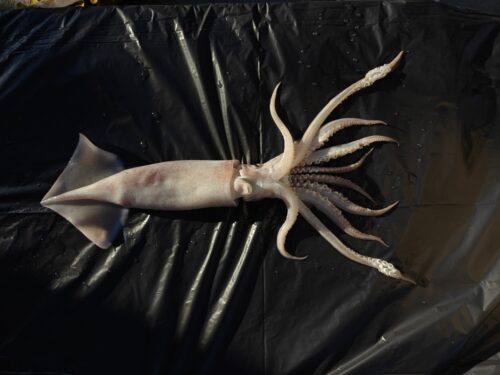
One of the more exciting experiences was watching Molly dissect a squid. Two squid had gotten stuck in Alvin during one of Molly’s dives and she wanted to save their beaks. It was fascinating to watch her cut open random organs and everyone trying to identify what was what.
oplus_3145728
Over the past few days, Bruce has been explaining the different systems of the sub to me, including the Variable Ballast System. Coincidentally, we ended up resetting the system later that same day because of a weight issue during a dive. Being able to watch the system being filled while receiving explanations from both Bruce and Nick, the mechanical lead, gave me a much better understanding of how it works and its role in Alvin’s operations.
The Atlantis left Norfolk last Saturday morning, and we have now been at sea for roughly one week. So far, it has been an incredible experience, and I have already learned a tremendous amount!
Before leaving port, the Alvin team and I had the opportunity to tour the USS New Jersey, a Virginia class nuclear submarine. Unfortunately, we were not allowed to take any photos, but it was one of the most impressive pieces of engineering I have ever seen.
While still in Norfolk, I was able to observe the mechanical team assembling two Alvin motors that had recently arrived from the shore-based engineering crew. They also showed me the oil compensation system and explained how it prevents electrical housings from collapsing under the immense pressure. Nick, the mechanical lead, gave me a tour of both Alvin and the Atlantis, and everyone on board was incredibly welcoming and eager to help me understand the vehicle and its systems.
oplus_137363488
As we departed port, we got to see a pod of dolphins following the ship. We also passed Naval Station Norfolk and saw several impressive Navy vessels, including the USS Nimitz and USS Harry S. Truman.
oplus_3145728
Since departing, I have spent most of my time assisting with Alvin launch and recovery operations. I’ve helped prepare the tool basket, clean the submarine, and load and unload equipment from the sub. Scott and Janna also taught me how to prepare, install, and remove the MISO cameras, so I have been helping with that every day as well.
A few days ago, I had the opportunity to ride in the small boat with Esteban during a launch. Being in the small boat really put into perspective just how far from shore we are. The experience felt surreal.
oplus_3145760
Molly has also been teaching me various sailor’s knots, and Catfish showed me how to handle the stern line during small boat deployments. It made me feel like a pirate.
Post recovery, I have started helping the science team assemble and set up push cores. It has been a good time to talk to various scientists and learn what they are doing and why. There is an artist onboard who has been making interpretative paintings of the science going on and I’ve been able talk to her about her work and how she is turning hardcore science into something palatable for a general audience.
oplus_3145760
Other than that, I’ve been hanging out in Top Lab with Nick, Bruce, and Kaitlyn since it’s quiet up there and has a nice view. It gives me the opportunity to ask them questions and learn more about everything that is going on.
The food is extremely tasty on board, and the crew have been watching old school Star Trek during meals, which has also been entertaining. The sunrises and sunsets are beautiful, and a few people have mentioned that the stars at night are really pretty, so I will go out tonight to take a look, and the results will be in next week’s blog, so come back for that.
My name is Aarav Shah and I am the UNOLS intern aboard the R/V Atlantis for the Joye Cruise! I am scheduled to be sailing out of Norfolk this Wednesday (8/26) to study methane seepage in the Atlantic with HOV Alvin for about 3 weeks.
I’m a rising sophomore at the University of Washington studying Electrical Engineering and have an interest in marine sciences and technology. At UW, I am part of the Underwater Remotely Operated Vehicle Team that competes in the MATE ROV competition which also grew my interest in underwater vehicles and research.
This will be my first time aboard a research vessel but I’m really looking forward to the experience and meeting everyone on board!
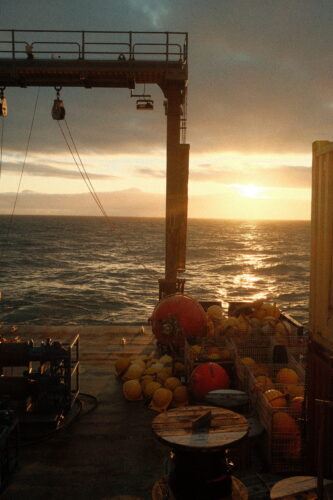
After a productive start to the cruise, the weather finally caught up with us early last week, so we stopped mooring operations. We continued with CTD casts for a while longer, but eventually the seas become too rough for those as well. We steamed away from the area and were able to avoid the worst of the storm.
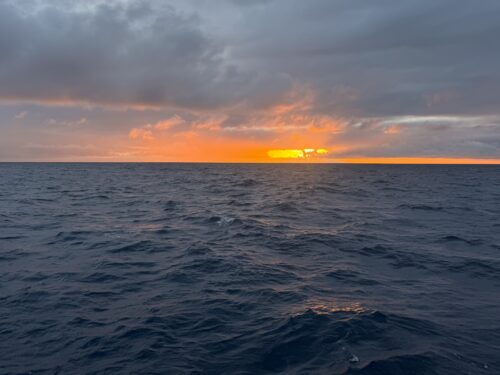
One final sunrise before the storm
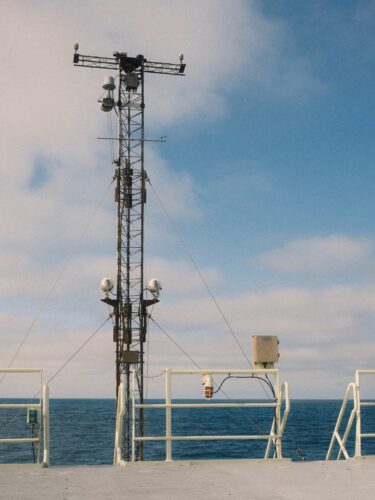
For the next few days, I kept busy with computer work and learning. I watched videos about various SeaBird sensors, started learning Python, and put together a poster advertising our 3D printing capabilities in case any of the scientists need parts. Emily also took some time to show me a few things around the ship. One day we exercised the HiPAP pole and gate valve to help prevent biological growth, and another day she walked me through the meteorological sensors on the mast (pictured below).
By Thursday evening, the weather had improved enough for us to resume CTD casts, and by Friday morning we were back to mooring operations. We still had two more NIOZ moorings to recover and redeploy, so I spent most of my time helping on the back deck. It’s been a great way to learn more about line handling and safety on deck. Once we wrapped up with the NIOZ moorings we moved onto the University of Miami moorings. It’s been interesting to see how each group builds and deploys their moorings since everyone has their own way of doing things. Just one more week at sea before we tie up in Reykjavik.