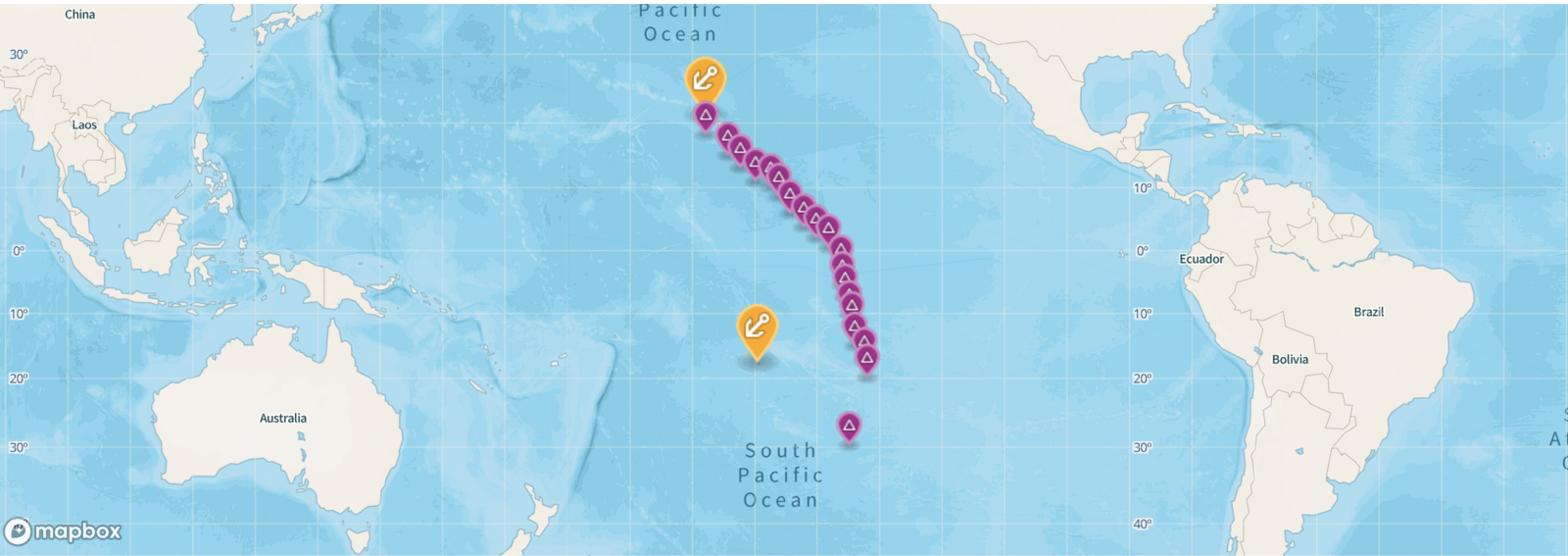
Apologies for the later post, but the good news is there’s a lot to catch up on! We’re two weeks into the SPOC cruise and currently en route to 20° S Latitude. Since the start, we’ve been conducting various operations, including underway CTD (uCTD) deployments, ARGO float deployments, “short station” CTD casts, and “long station” array/CTD deployments. Our ultimate goal is to collect diverse data in the South Pacific, a critically understudied region, as we steam to 30° S. This data will primarily focus on understanding the rates and mechanisms of primary production and respiration in this area.
During transit between our five long stations, we’ve been using the uCTD to survey the surface 400 meters of ocean. This operation involves deploying a probe from the ship’s stern, equipped with sensors measuring dissolved oxygen, fluorescence, conductivity, temperature, and depth. The beauty of the uCTD is that we can continue cruising at 8 knots while collecting data on both the downcast and upcast. We’ve also been utilizing the Kilo Moana’s underway seawater flowthrough system to sample and analyze surface ocean water. Sprinkled in with these activities are Argo float deployments, contributing to an international ocean monitoring initiative that uses autonomous floats to create hydrographic profiles of the upper 2000 meters of the world’s oceans.
When not transiting, we’re on station performing CTD casts and free-floating array deployments. Before crossing the equator, we focused on performing short station CTD casts as weather was too variable and currents too strong to deploy the arrays necessary for a long station. These short stations lasted about an hour, and after we finished collecting our samples/data, we were underway again, so these stations were fast and furious.
We officially crossed the equator on Halloween, which was a happy surprise! Of course, everyone dressed up in costumes (yours truly was a hero in a half shell), and we had a full equator crossing ceremony for the “polliwogs,” aka sailors who are crossing the equator for the first time. My given wog name was Richard Simmons’ Baby goes to sea. This ceremony involved proving our skill to the Court of Neptune in the form of a talent show (I did a skit with two of my fellow wogs) and if we displeased the court with our skills we were forced to fight the spirit of a sea monster (a pinata). Overall, it was a blast of a Halloween full of karaoke, candy, and dancing.
Shortly after crossing the equator the real work of the cruise began as we started to hit our first long stations. When we arrive at these stations, we deploy multiple arrays and run 24-hour operations for the next two and a half days. We deploy a sediment trap array, a primary production/gas fixation array, and a wirewalker array with each long station. The sediment trap array uses a series of tubes with formalin/brine in the bottom to capture and hold marine snow particles, aka sediments, that sink from the surface ocean. The primary production/gas fixation array uses C-14 enrinched seawater samples (collected on station) to determine the rate of primary production. The wirewalker array uses an ingenious design involving locking cams, positive buoyancy, and wave action to collect multiple sensor profiles from the surface ocean. Our latest wirewalker casts have produced ~120 profiles from each station (which is a lot). Array deployments and recoveries are some of the most exciting operations we’re doing on this cruise, as they involve a lot of coordinated deck work, and recoveries are conducted by grappling the arrays with grappling hooks! In addition to assisting with array deployments and recoveries, one of my responsibilities is managing CTD operations. This involves maintaining the senor suite aboard the rosette, downloading/processing data, and working with OTG techs/ship crew to collect water samples from different depths. Some of the new sensors I’ve been able to work with include a Underwater Vision Profiler (UVP) and a Laser In-Situ Scattering and Transmissometry (LISST) instrument. The UVP photographs small particles within a set volume of water and the LISST uses lazer diffraction to measure the size and quantitiy of suspeneded particles!
So far, we’ve hit long stations at 5°, 10°, and 15°, and besides minor issues with equipment and sample collection, the cruise has been going smoothly. This has been one of the most involved cruises I’ve ever participated in with nonstop ~80 hour work weeks but its been incredibly rewarding and I’ve had the oppourtinity to learn a lot. I’m now appreciating the importance of time management on long cruises like this, as it can be challenging to get enough sleep, eat well, exercise, and still have a strong attention to detail for 12-hour shifts. We have two more stations to hit before we can begin heading to Tahitit and the OTG techs, ships crew, and science team have all been working hard to collect this one of a kind data! By the time we finish up our last long station I’ll have my next blog post up so stay tuned!
Until then,
Hunter
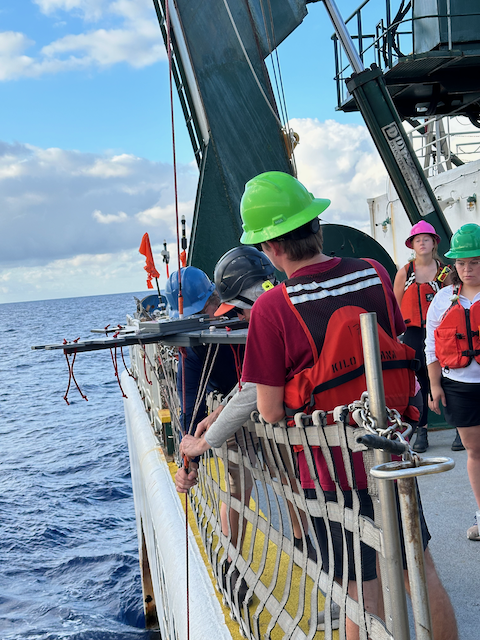
– The underwater CTD and its “reel”
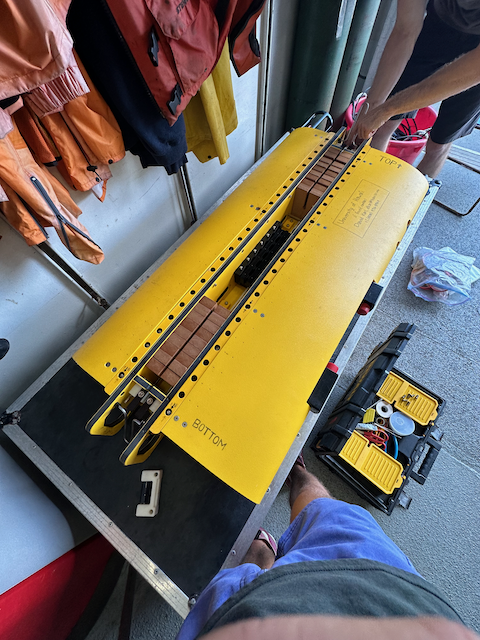
– The wirewalker. Inside the yellow covers there is a suite of sensors that measures the physical and optical properties of the water column.
– The sediment trap holder being added to the array line
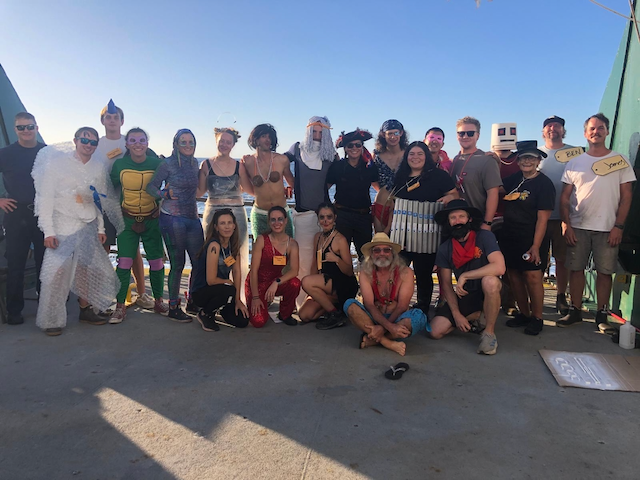
– Crossing the equator on Halloween!
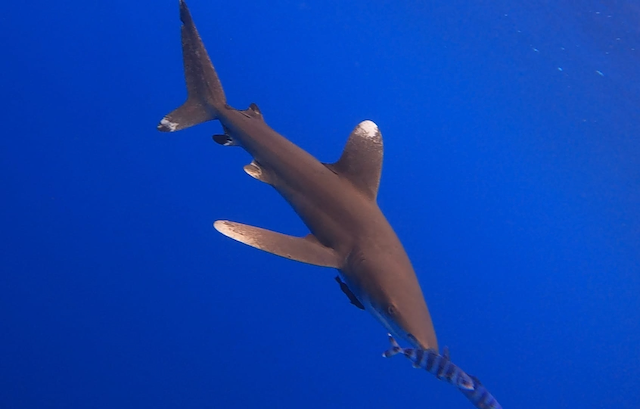
– One of many oceanic white tip sharks we’ve seen since stopping at long stations. Photo credit to one of the Kilo Moana’s ABs Stephanie for capturing this image with a GoPro on a string!
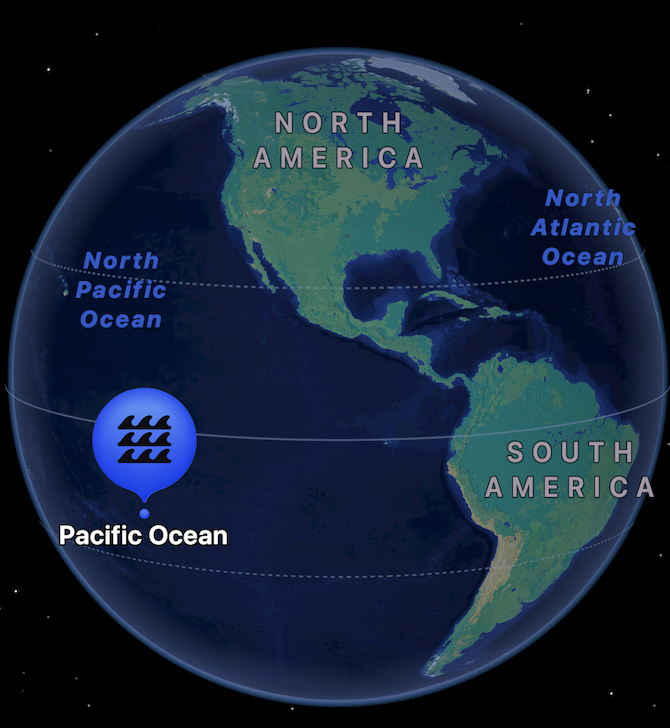
– General idea of where the R/V Kilo Moana is currently in the Pacific ocean
We arrived at our first long station on Nov 2nd around 3 pm and arrived at our second long station on Nov 6th. The long stations are the meat and potatoes of the Ocean Carbon biological cruise as that is where scientists will be performing incubations, collecting water from depth, and conducting in situ experiments using arrays. Each long station is a 60-hour sampling storm with Conductivity Temperature and Depth (CTD) profiles taking place every 3 hours, sediment traps, primary productivity arrays, float deployments, and more!
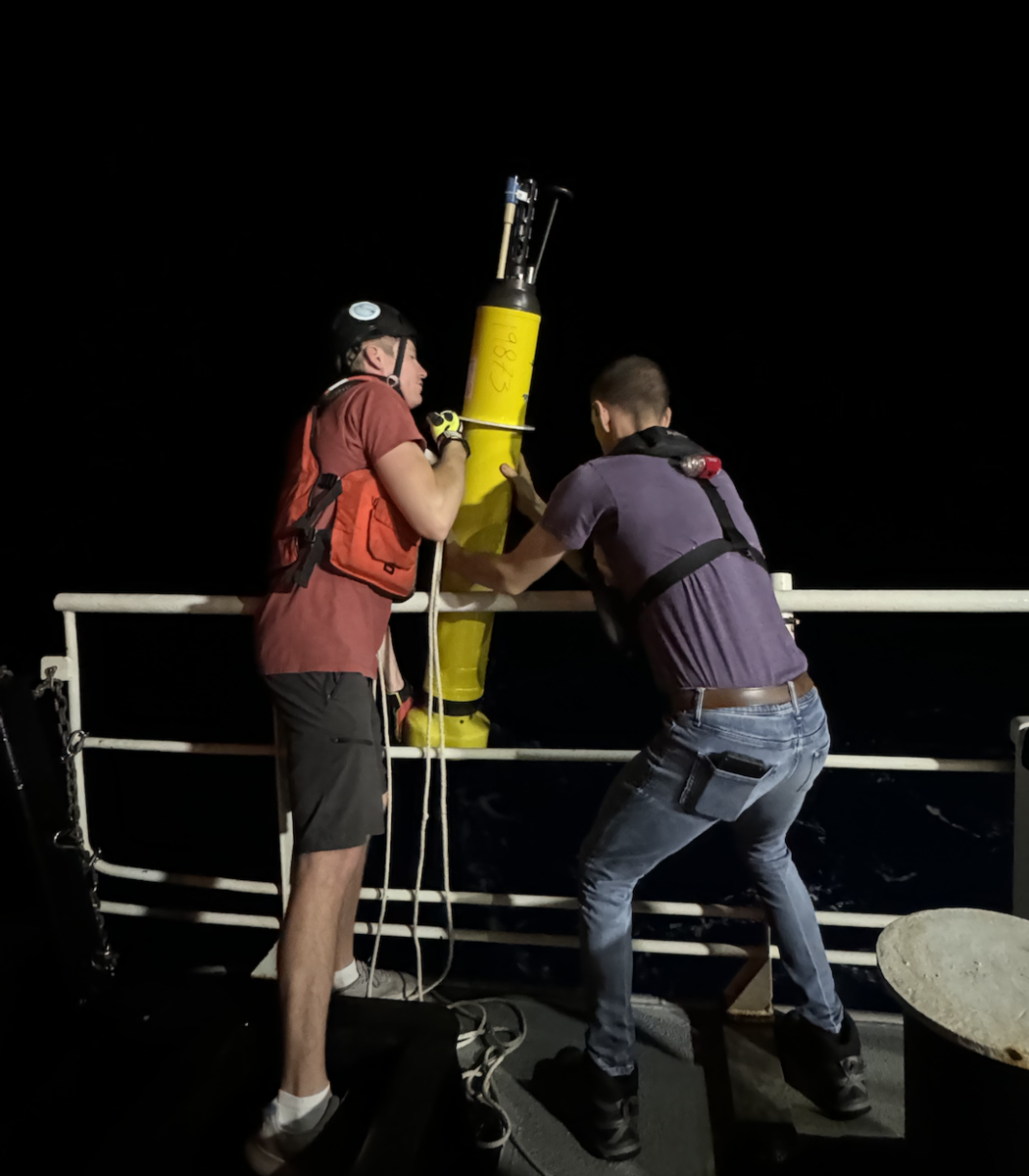
Immediately upon arriving at each long stratton, we deploy one of Dr. Henderikx’s floats. This float will be released into the water for the rest of its life where it will be conducting CTD profiles of the water column a couple times a day and then relaying that information to a satellite at least twice a month. This information will then be used to calibrate data collected from satellites hovering on Earth to what is happening in the water column.
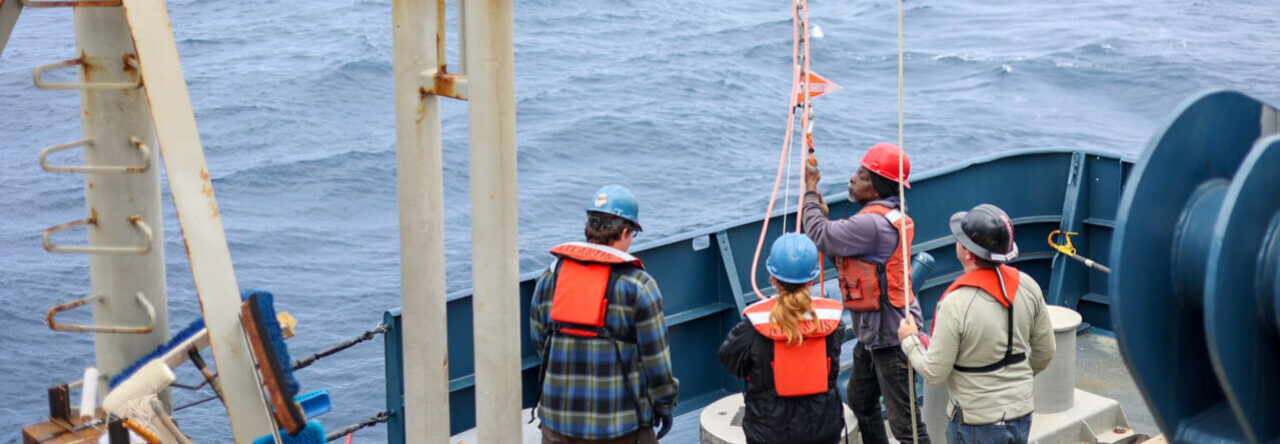
– Dr. Daniel Muratore and Tully Rohrer Deploying a Float upon arriving to a long station
The second and third orders of business are to deploy sediment traps and the wirewalker to collect the most data while we are at the station. Unlike the float, these will be retrieved at the end of the long station. To make our delicate samples and wirewalker visible and retrievable, we attach the samples to buoys that are bright yellow and have flashing lights, GPS, and a radio transmitter on them. The buoy is also connected to a string of floats that help counteract the weight of the samples, optodes, and weight at the end of the line.
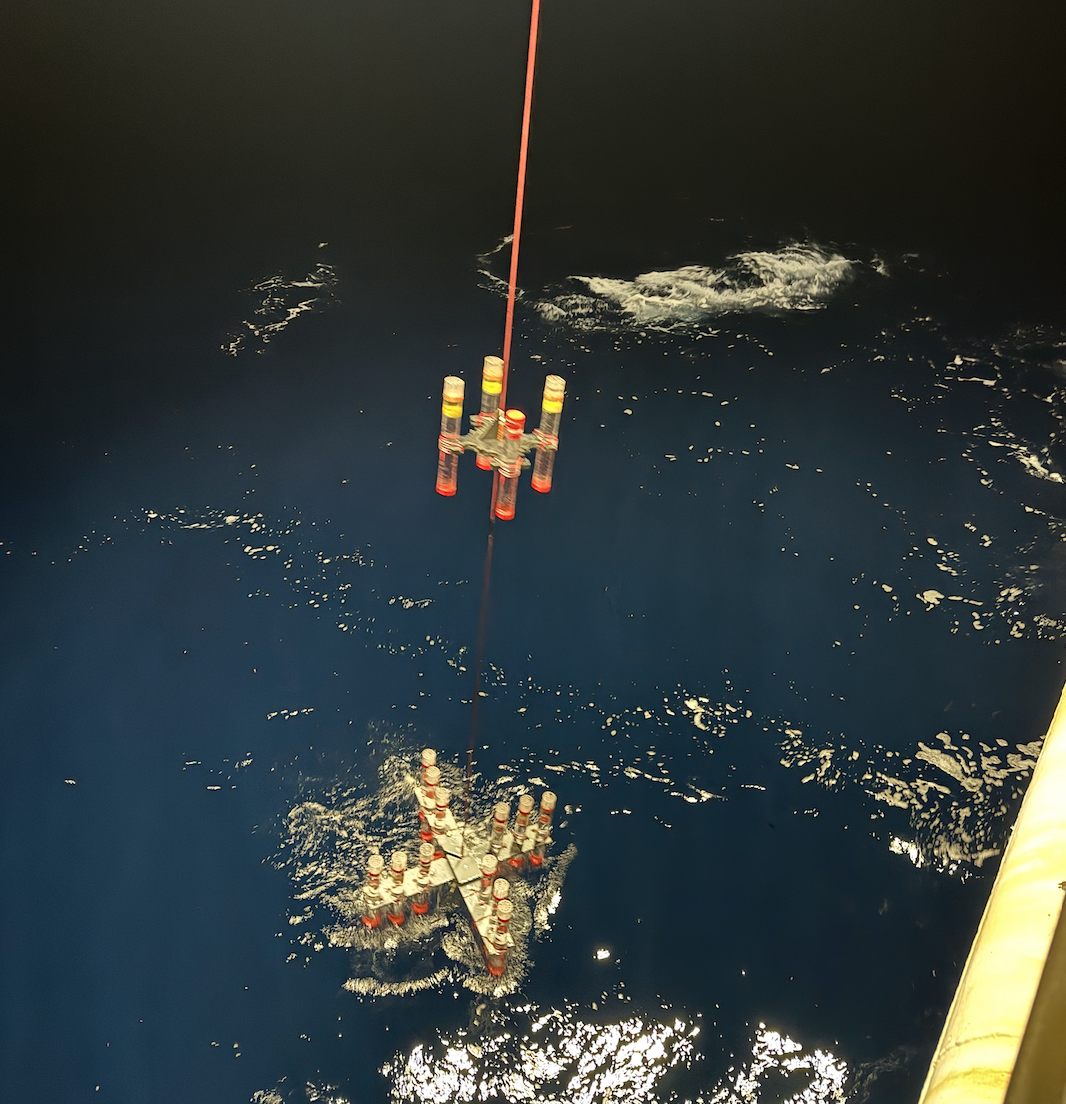
The sediment traps contain two sets of traps, one for trace metal analysis that uses brine as its trapping material and the other for overall organic matter exports outside of the photic zone that uses formaldehyde to preserve the samples. These traps are placed at a depth of about 150 meters, right under the photic zone and its goal is to trap as many of the particles that sink out of the surface. Most often it tends to be dying phytoplankton or bits and pieces of things that get stuck together and it represents carbon exiting the photic zone and beginning its slow descent into the bottom of the ocean…
– Deploying Sediment traps into the water. Top are trace metal clean sediment traps filled with brine. The bottom set of sediment traps are filled with formalyn to preserve particulates that have fallen in.
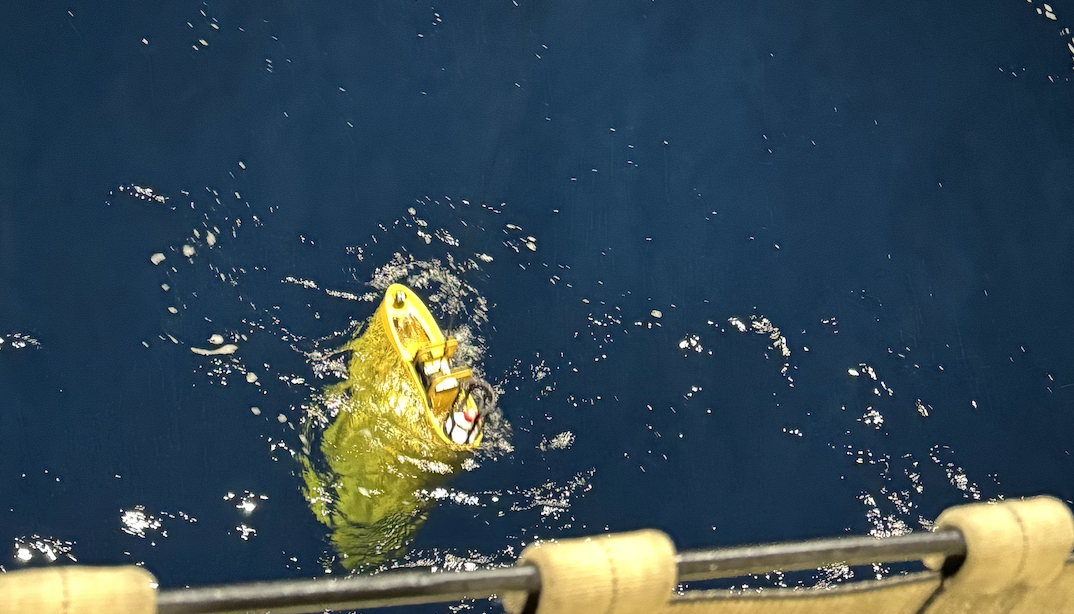
The third order of business is the wirewalker. The wirewalker is like a float in that it takes CTD profiles; however, it is attached to a buoy and it can take over 70 water column profiles a day. It utilizes wave energy and can be described as a pong brick moving up and down the wire up to depths of 400 meters in less than 30 minutes. This is an important instrument as it provides the oceanographic context to which we are sampling over the 60 hours.
– Wire walker being deployed into the water
Once those are all deployed we can finally deploy the CTD rosette to start collecting water and generating a water column profile and the scientist can start doing their water incubations for upcoming experiments. There is an assortment of things that the science team samples for. Sometimes the team takes water to sample oxygen concentrations and particulate organic carbon. This cast is used to calibrate the oxygen sensor on the CTD. Then there is another cast where the scientist takes water to measure chlorophyll and uses the results of that to calibrate instrumentation.
My favorite cast is the Primary Productivity and Gas Array (PP Array). This cast is for collecting samples that will be used to test the rate of Nitrogen Fixation using N15, dissolved inorganic carbon consumption using C14 and oxygen production using O18.
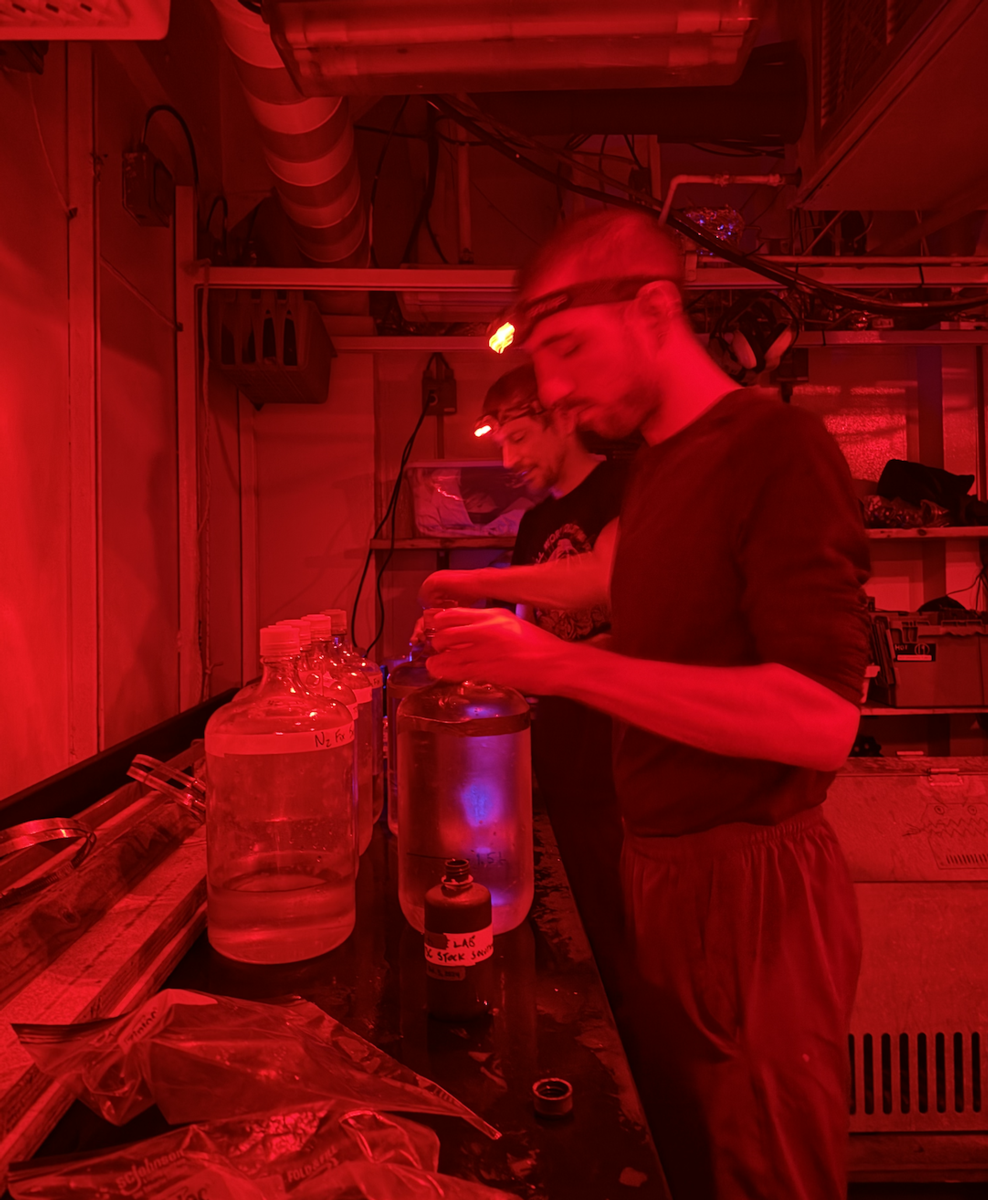
– Dr. Daniel Muratore and Tully Rohrer spiking their incubations with N15 in preparation for the insitu PP/Gas Array deployment
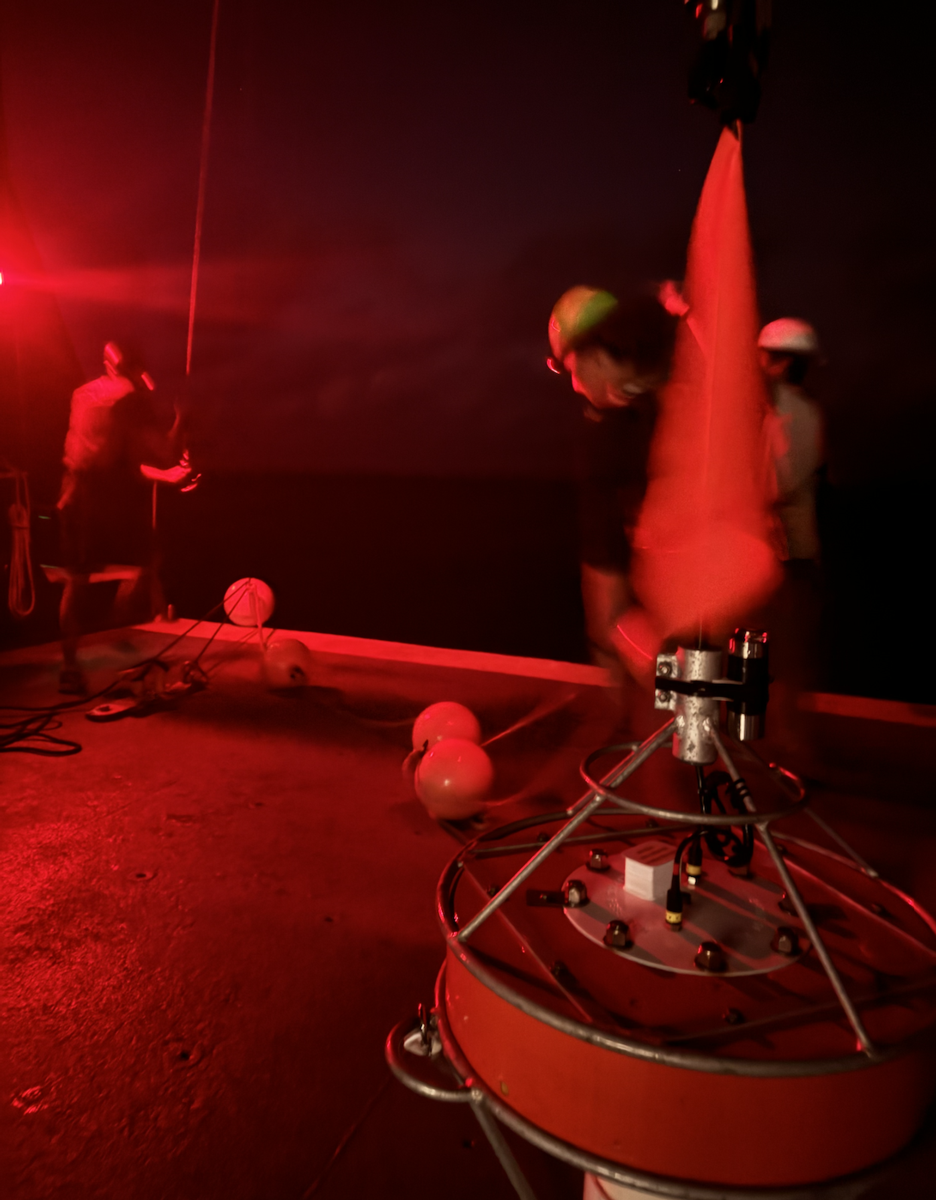
During the CTD cast we “fire” bottles at 6 specific depths; 125m, 100m, 75m, 50m 25m, and 5m. These samples will then be placed back into the water at their respective depths, where they will sit in the water column for 24 hours replicating conditions that they were collected in. This cast always takes place at least 3 hours before sunrise, approximately ~1am in our current location. The CTD samples are typically back on deck 30 minutes later and then put back in the water hopefully no later than 3 am – which is about when the sun is starting to rise in our current part of the world. It’s a bit of a scramble to get everything spiked with N15, C14 and O18 respectively before the samples are supposed to be in the water but it sure is exciting. While deploying this specific array, all lights have to be turned off and only red lights are allowed to prevent the phytoplankton from photosynthesizing too early, which adds to vibe ~
– Primary Productivity and Gas Array being deployed at 3am using red lights
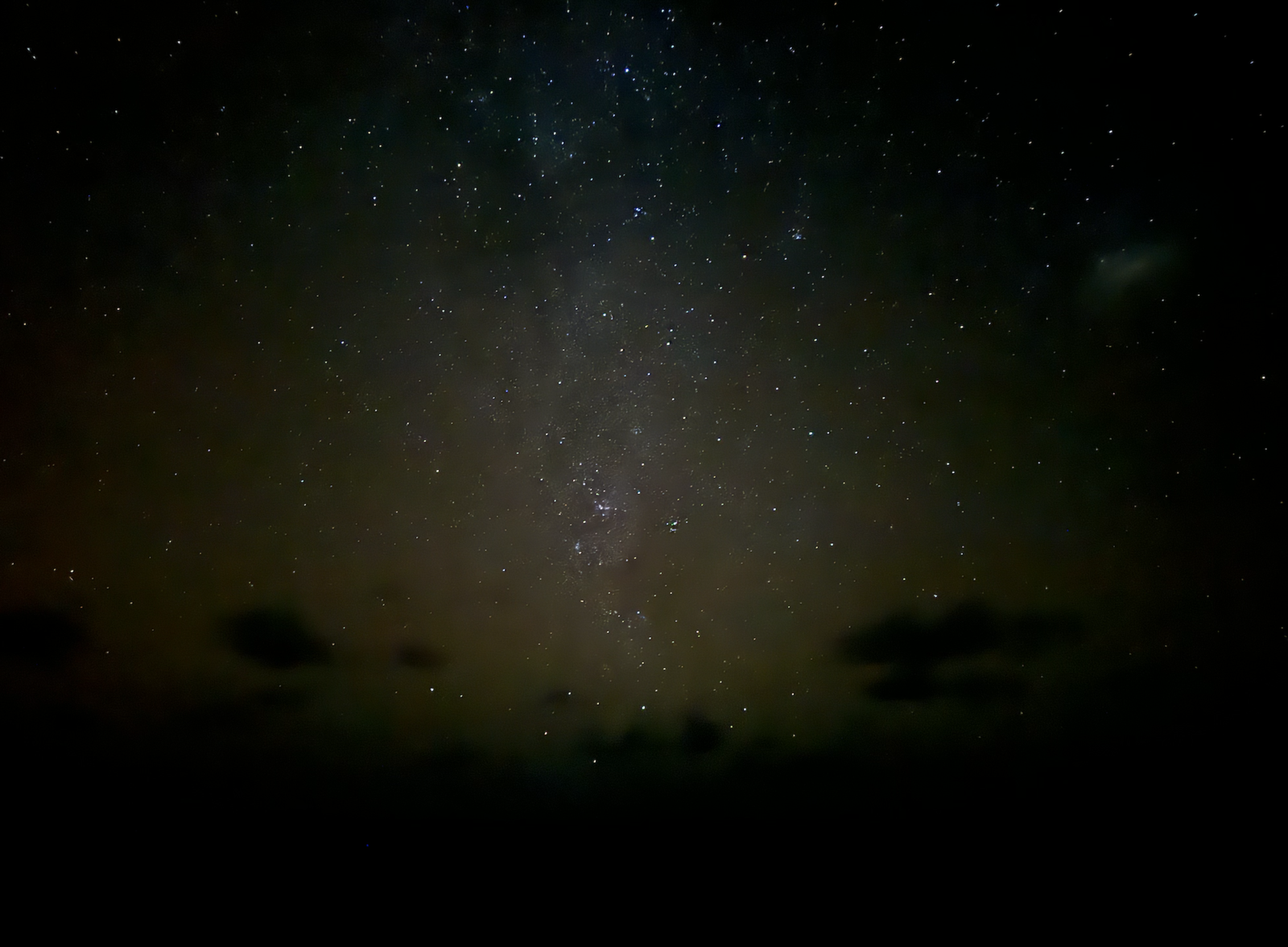
This ALSO provides the perfect opportunity to get a peak of the milky way and stars. There are definitly more stars in one corner of the sky than there were in the whole sky where I grew up in suburban San Diego. It take my breath away every-time!
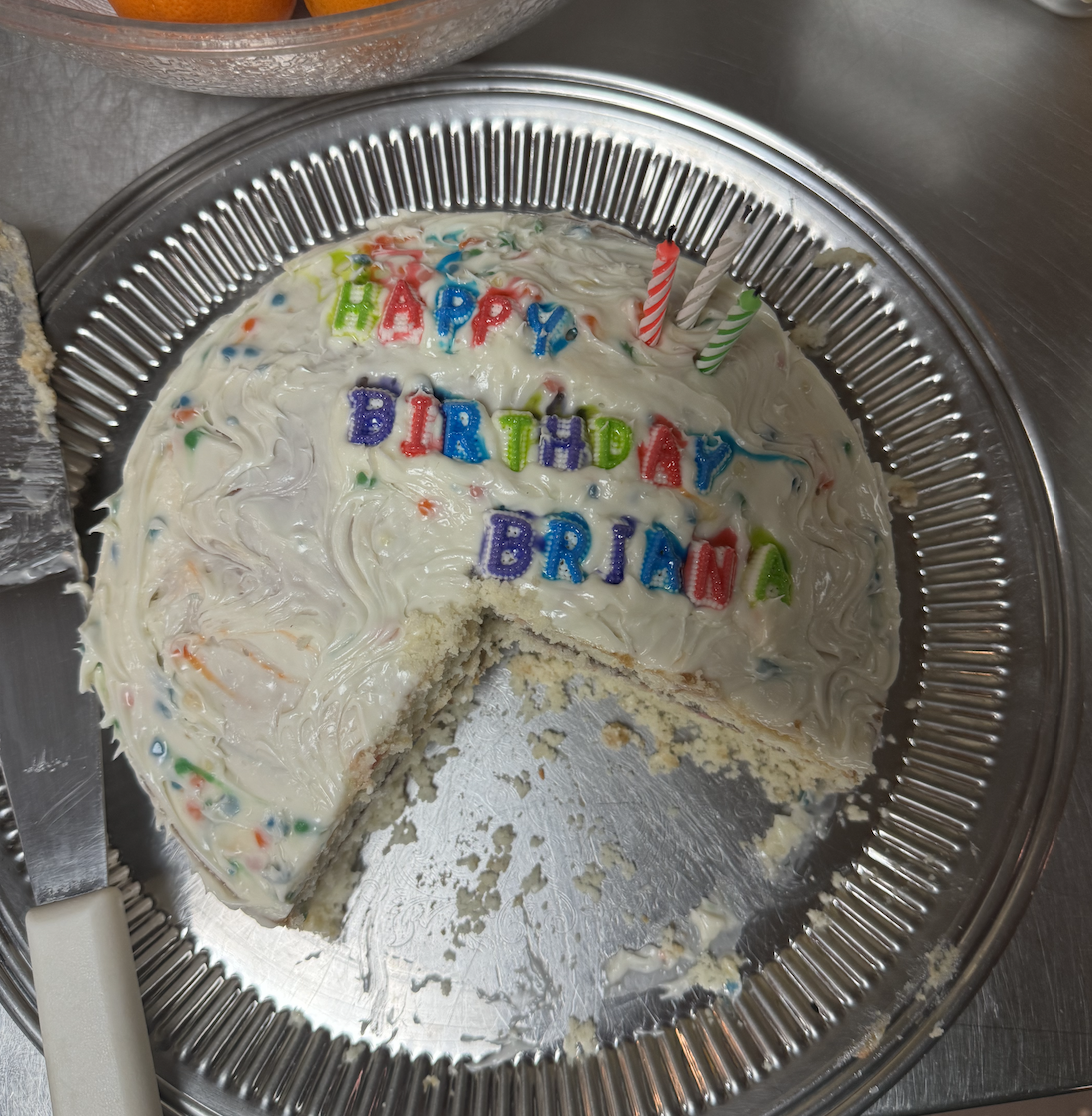
This week I also celebrated my birthday! The galley staff were really kind and baked me a cake! It was delicious!
Hey there! Things are well underway! When we are not conducting underway CTDs (uCTDs) or performing our daily grabs using the regular CTD Rosette 3 a.m. grab, we are cruising at a solid 9 to 10.5 knots!
Our cruise plan has changed a bit since the start of the journey due to challenges presented by weather and field conditions. Unfortunately, we were unable to conduct a long station in the northern hemisphere, but new opportunities to sample at 5, 10, 15, 20, and 25 degrees south have emerged. Therefore, the updated plan is to steamhead to 5 degrees south to begin the first long station and get underway with the bulk of our work.
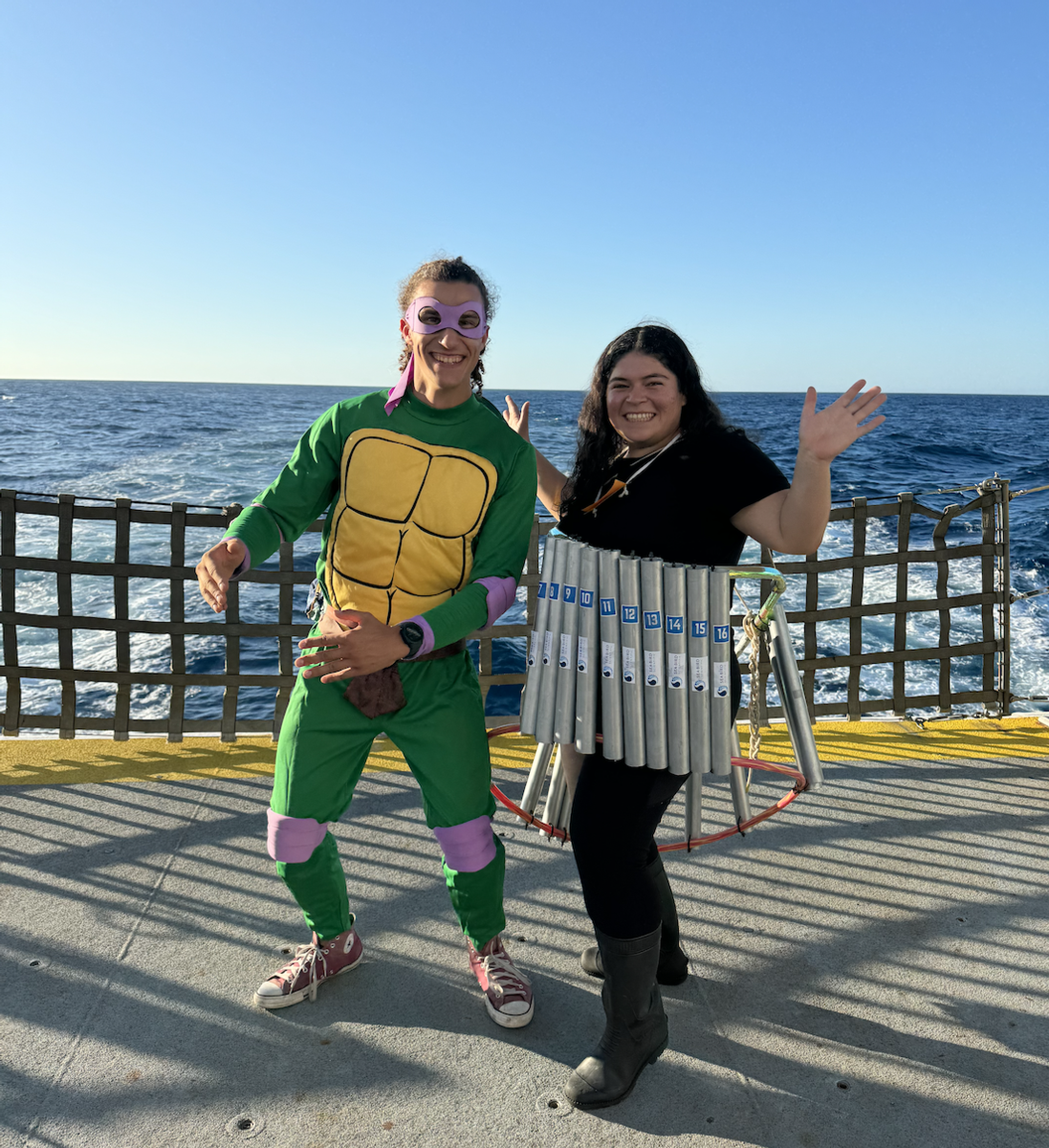
While in transit, we crossed the equator on Halloween, which was highly anticipated! It was soooo anticipated that I even made a CTD Rosette costume while we were still in port, largely because I was inspired by the CTD, and I had heard that the equator crossing would be a pretty big deal, especially because it was on Halloween!
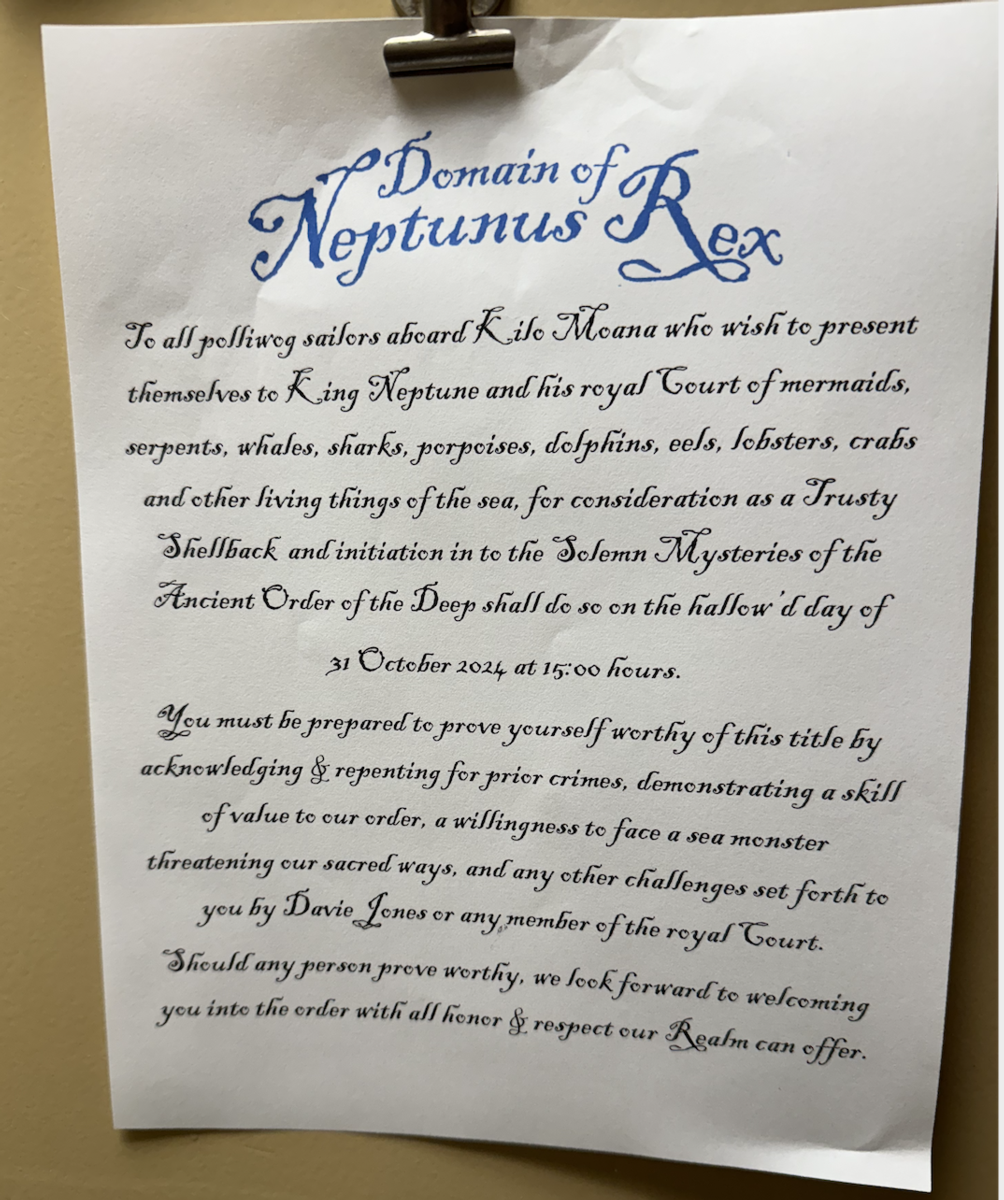
– The subpeona inviting us to present ourselves before King Neptunes Court
Since the 1600s, crossing the equator (0°00.00) has been seen as a rite of passage, a good opportunity to boost morale and prove your seaworthiness. Despite its many variations, this seafaring tradition has persisted into modern times. The celebration typically involves a series of dares that Pollywogs, those who have never crossed the equator must complete to prove their seaworthiness. The Court of King Neptune and Davy Jones, along with his Committee of Shellbacks (those who have crossed the equator before), then judge your performance and decide whether to welcome you to the Kingdom of Neptune. In the past, they might have asked you to do some gnarly things, like crawl through chutes of rubbish, drink a “truth serum,” and eat uncooked eggs. Luckily, the Court of King Neptune aboard the Kilo Moana are much nicer and asked us humble Pollywogs to either perform a talent or sing karaoke while reading out the “crimes” we’d committed during our time on the ship. The “crimes” are not really crimes but more like hilarious superlatives. I was accused of enjoying the solitude of the night shift, hiding Hi-Chew candy, and being obsessed with the CTD, which they are not wrong… To repent for my “crimes,” I chose to sing karaoke to “Rich Girl” by Hall and Oates. Some of my fellow crewmates performed skits, told stories and jokes, and even did a whole dance routine! It was so cool to see everyone let loose and have a little fun on the back deck as the sun went down!
-Fellow Mate Intern, Hunter Adam and I in our Halloween Costumes
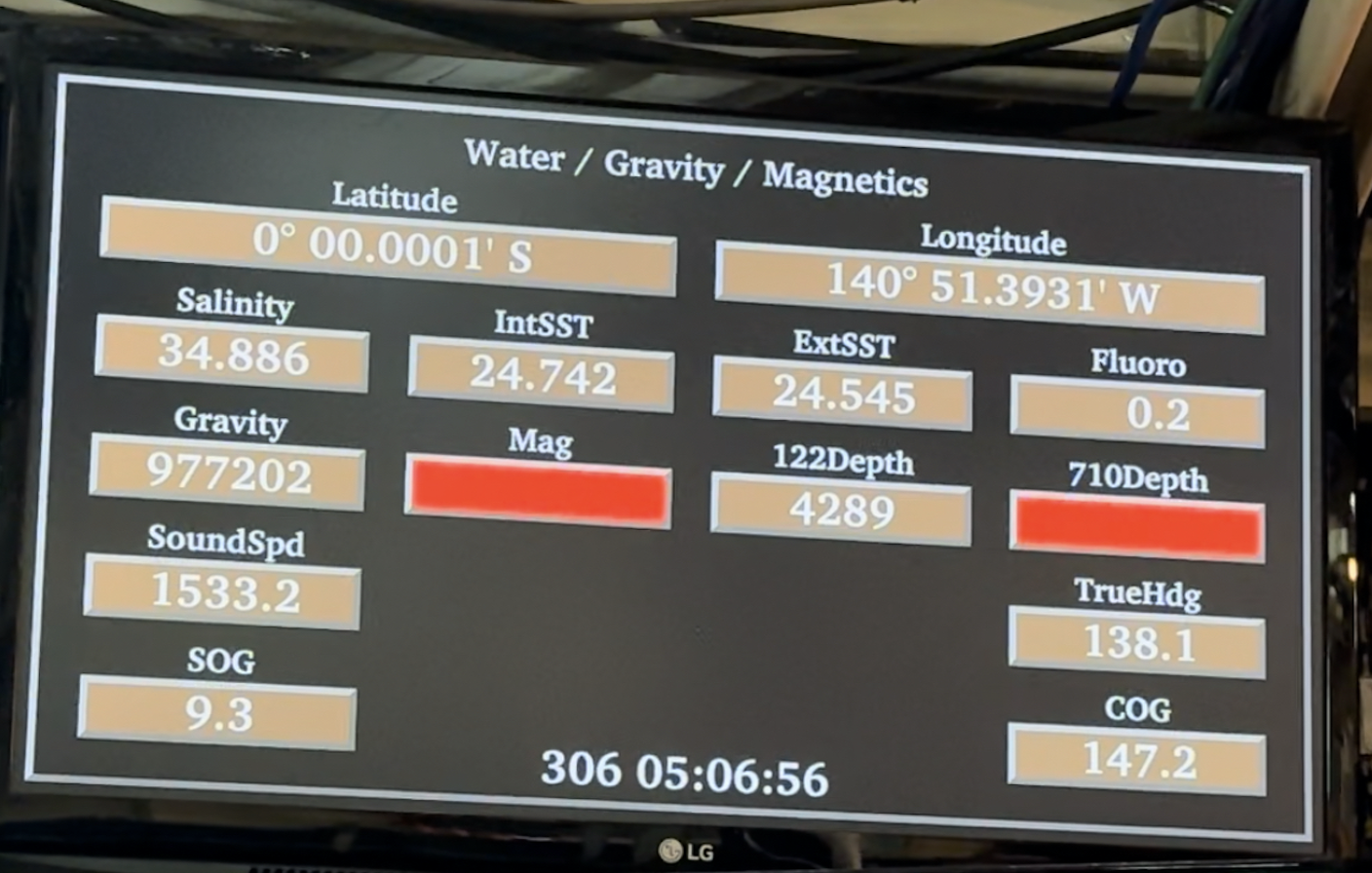
We ended up crossing the equator later that day at around 05:06:56 UTC. My friend and I crouched by one of the consoles for a few minutes, counting down every second until 0°00.0000. The console only delivered 0°00.0001, which was a bit disappointing but still neat nonetheless.
–
With one day away from our first long station, the Halloween/Equator Crossing was a nice “rest day” or, like its original intention, a good morale booster—a calm before the sampling science storm!
Cheers,
Briana
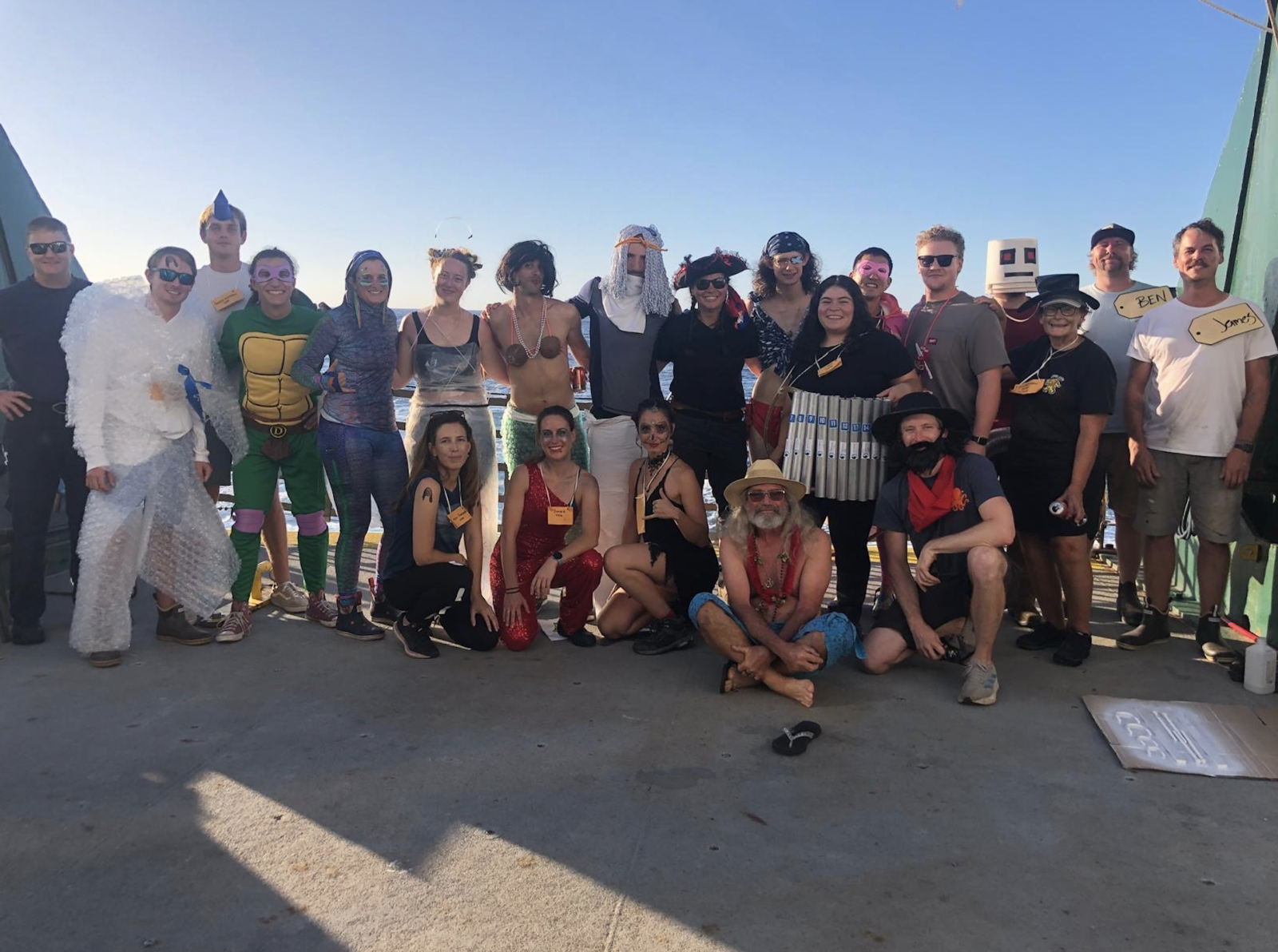
– Kilo Moana crew dressed for Halloween and Equator Crossing
WEEK #3 (10/21 – 10/28)
Underway to Tahiti and Befriending the Underway CTD
– The proposed Kilo Moana’s SPOC 2418 expedition cruise track.
Unfortunetly, per my last blog post, within the first few hours of the South Pacific Cruise, the Kilo Moana had to return to dock to address some repairs in the generator room and wait for a component to come to the island.
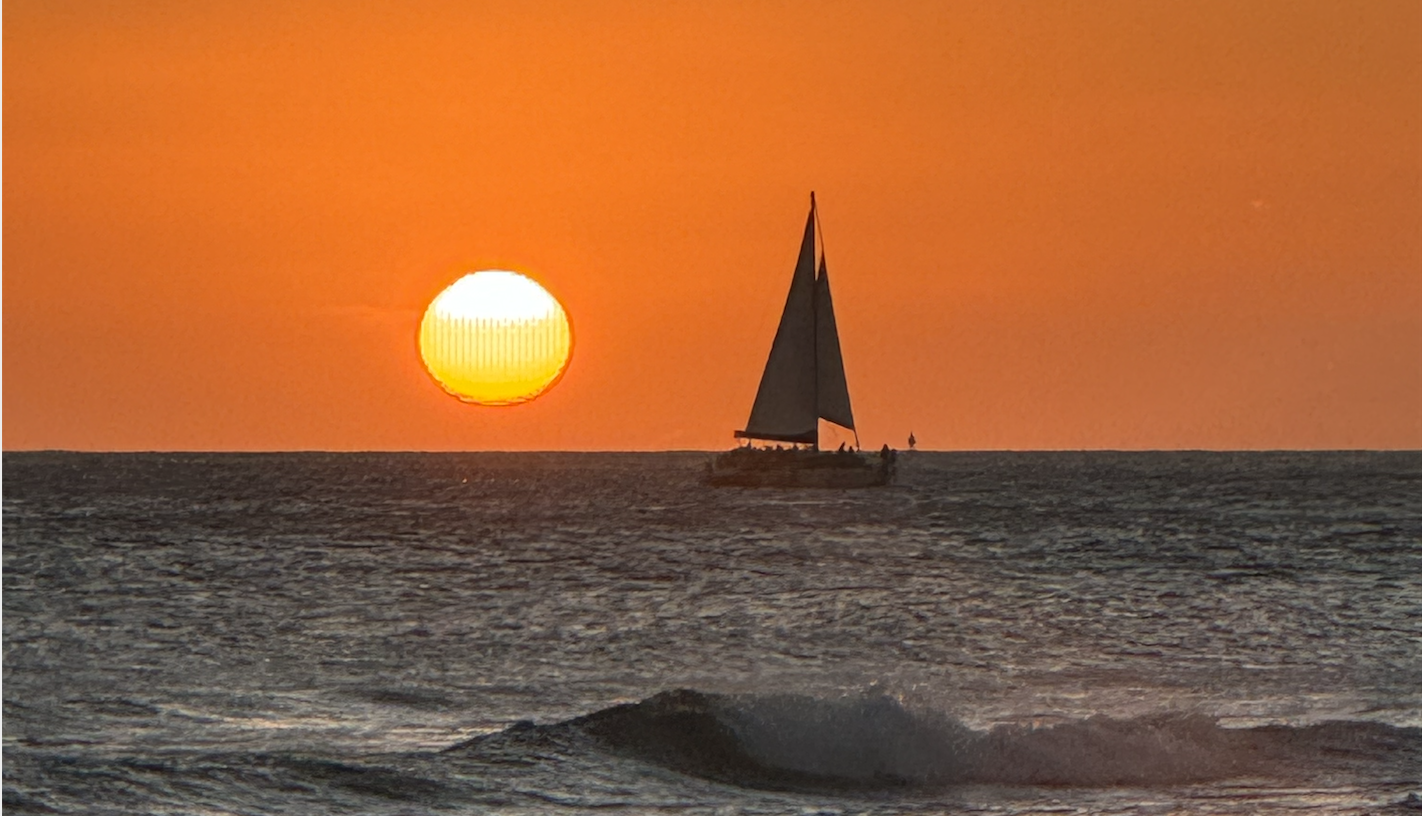
Sailing day couldn’t come soon enough! The Kilo Moana left Pier 35 on Oct 23 at 1730 Hawaii time into a gorgeous sunset. The goal of this mission is to characterize oceanic primary production and metabolic rates to further understand the carbon cycle along a transit of about 15° N to 30° S. This is done by collecting oxygen and optical proxies for carbon on a daily basis. This involves conducting in situ (on-site) incubation experiments using gas arrays, primary productivity arrays, and sediment traps that look at the rate at which organisms are growing in the water column (arrays) at depth or what is floating out of the photic zone (sediment traps). Additionally, we use profiling methods such as a CTD-Rosette cast every 3 hours (to varying depths), Hyperpro (which measures the optical properties of the ocean), an Underwater Vision Profiler (UVP) (which measures the size and abundance of particles and zooplankton in the water column), zooplankton net tows, and a wire walker (a CTD-like instrument that is attached to a buoy and can take up to 70 water column profiles a day)! Not to mention a wide suite of underway/continuous data like the Acoustic Doppler Current Profiler, which uses sound waves to measure the speed and direction of currents throughout the water column, the Imaging Flow Cytobot, which takes images of the phytoplankton that get sucked into the ship’s underway seawater system, meteorology, and the underway CTD!
The expedition will consist of a combination of long and short stations that last 2.5 days and 3 hours, respectively. When we are not at station, we will be doing daily water grabs for nutrient analysis as well as deploying an underway CTD (uCTD) every 2 hours.
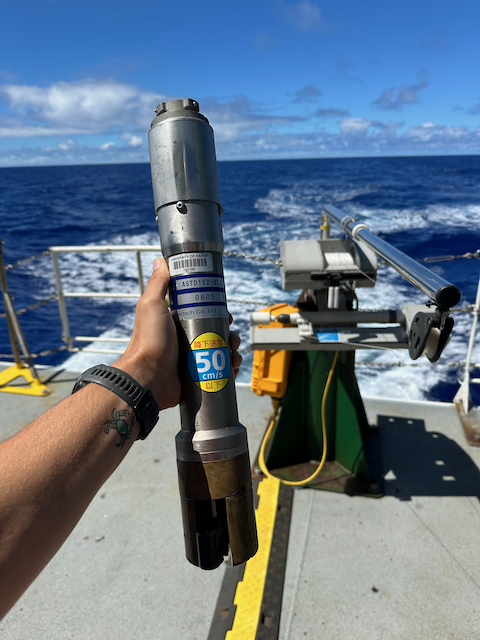
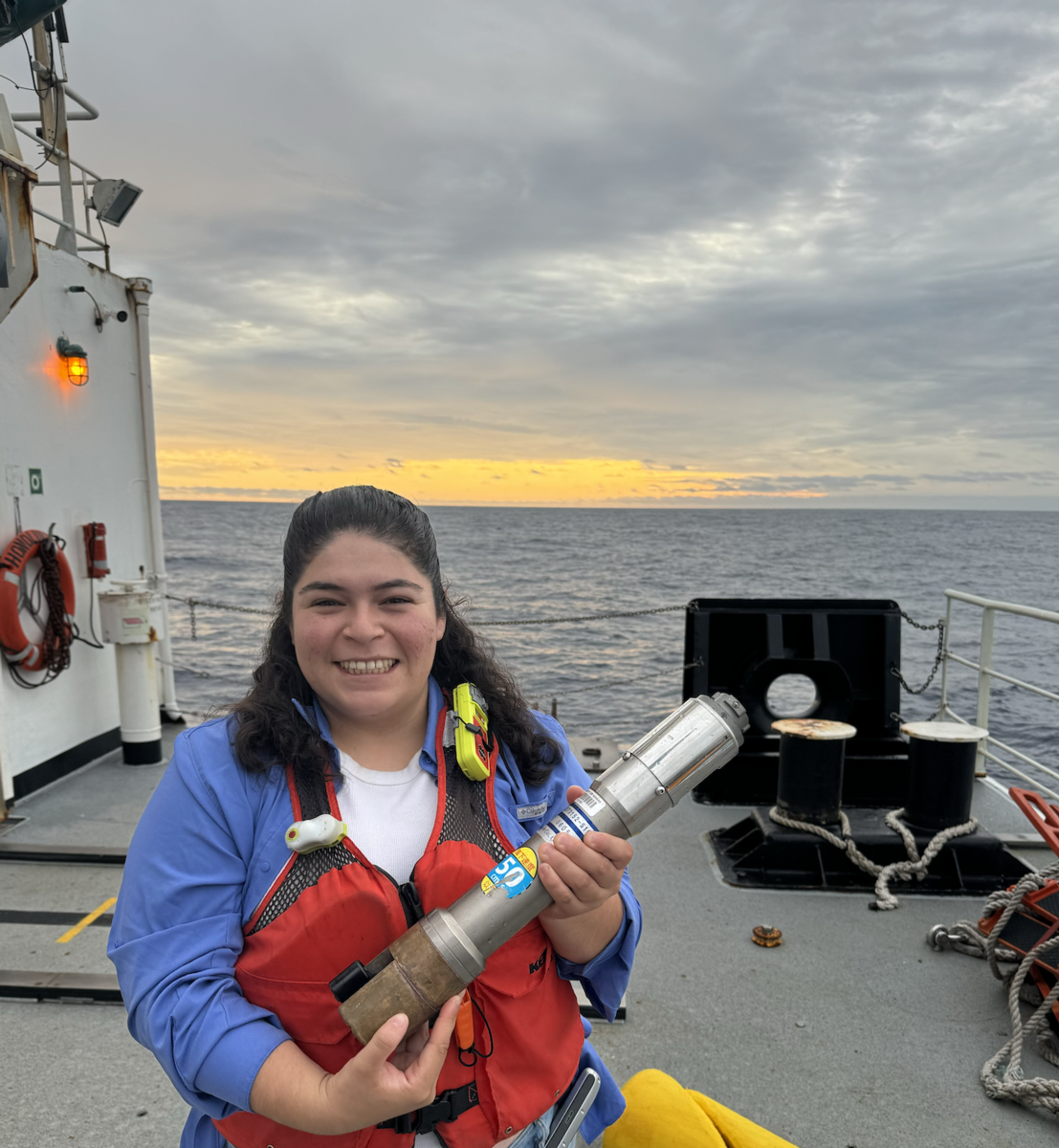
– Briana Prado holding the underway CTD
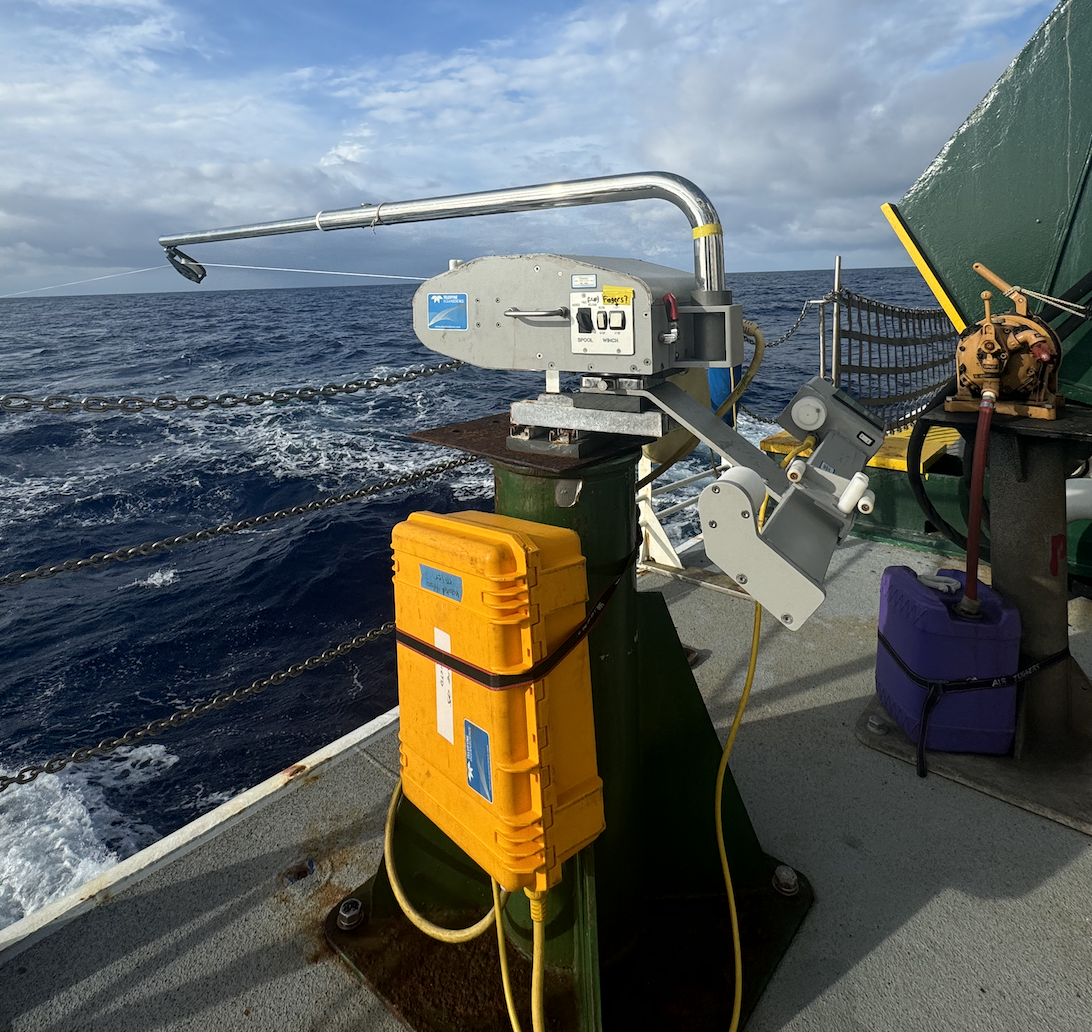
I’ve learned to love the underway CTD. It’s so cute! The sensor is a titanium pellet-looking thing that contains conductivity, temperature, and depth sensors; it also contains a fluorometer, turbidity, and dissolved oxygen sensors. It sits on the starboard side of the boat and can be deployed while the ship is in motion as long as the ship is going under 8 knots. Unlike a regular CTD-rosette, the uCTD does not collect water and does not need the ship to stop, therefore making it a great way to efficiently get an idea of what the water column looks like below. Plus, it provides the perfect excuse to go watch the waves for at least 20 minutes every 2 hours.
To deploy it, you detach the spindle from the overboard handling system (OHS), set the instrument to free, and then you just drop the uCTD in the water. We’re largely interested in what’s happening at the surface, so we set a timer for 100 seconds to only collect the top 400 meters of the water column. Once we reach 100 seconds, we apply the brakes to the feeder line, change the setting to rewind, and wait until the CTD is close to the surface. Once we can spot it on the surface, we get a cushion foam ready to slide through the line so we can reel the line in without banging the uCTD on the stern of the ship.
– The Underway CTD overboard handling system.
Due to the high frequency with which we are deploying the underway CTD, issues can arise quickly. During the 12th cast of the cruise, while returning the line back into the spool, the power on the OHS stopped working, and the line kept spooling out until I finally realized to pull the brakes. We were startled that it had already stopped working so early in the cruise but also not surprised given the high frequency with which we use the instrument.
Tully, Ben and I were about to reel in over 400 meters of wire by HAND when we remembered that we could insert a bolt into the winch drum and use a powered tool to reel it in! Phew, that just saved us a couple of hours!
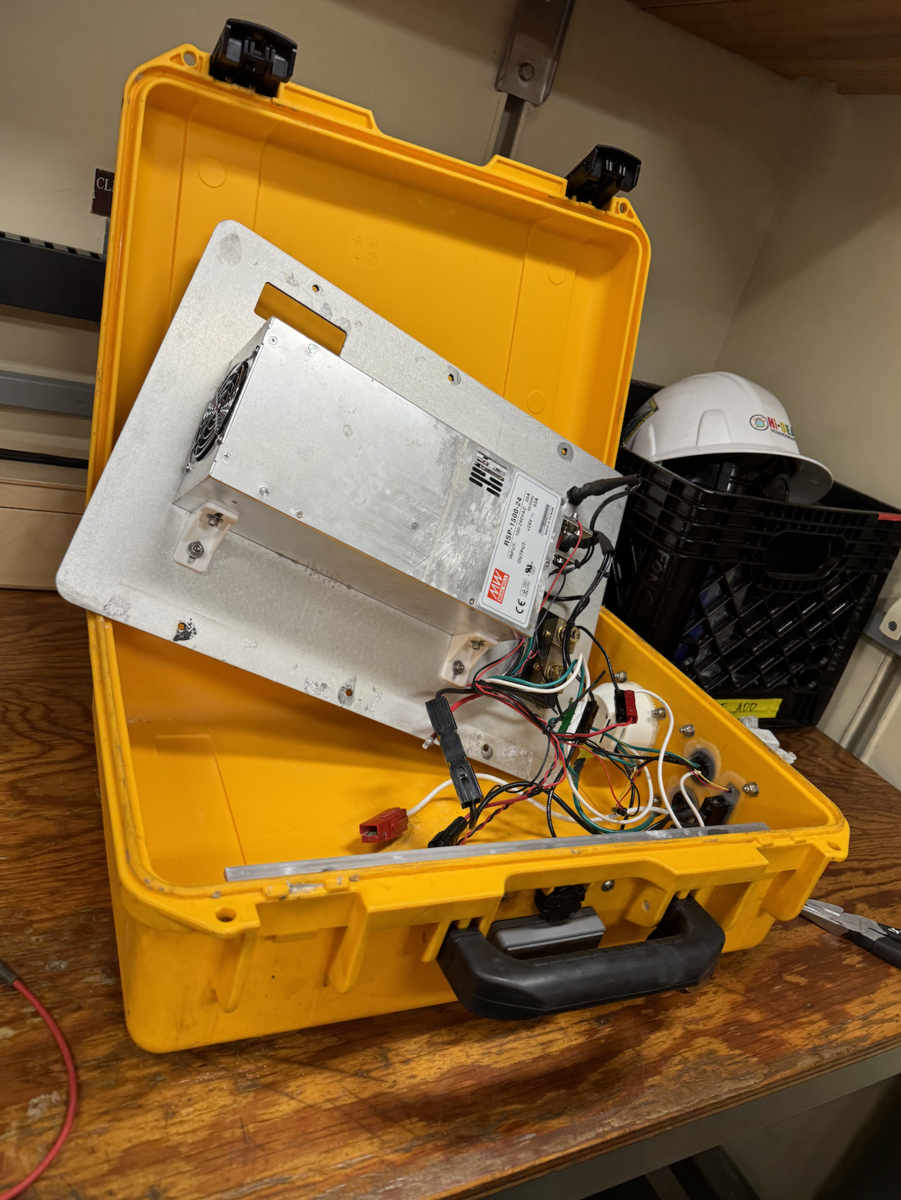
Once we reeled all of the line, we finally got to investigating what went wrong. Originally, we thought that maybe the motor on the uCTD had gone bad, but with a voltmeter in hand, we realized that the issue lay in the Pelican Power Junction box since it was not reading out any voltage.
– Taking a peak inside the underway CTD pelican box.
After a quick dinner, Tully and I took a look at the inside of the box and realized that the positive lead in the power box had come undone, most likely due to how corroded it was. Phew, this is a workable issue! Now we just need to cut back some of the wire, attach a butt connector, and heat it into place. Once we put the box together, we double-checked with the voltmeter, and it was reading a value, so we had fixed it and could now re-install it back into the OHS and proceed with our routine underway CTD. We did it, lo hicimos! I now cross my fingers and hope that we can continue doing uCTDs throughout the cruise and that any issues that arise have workable solutions!
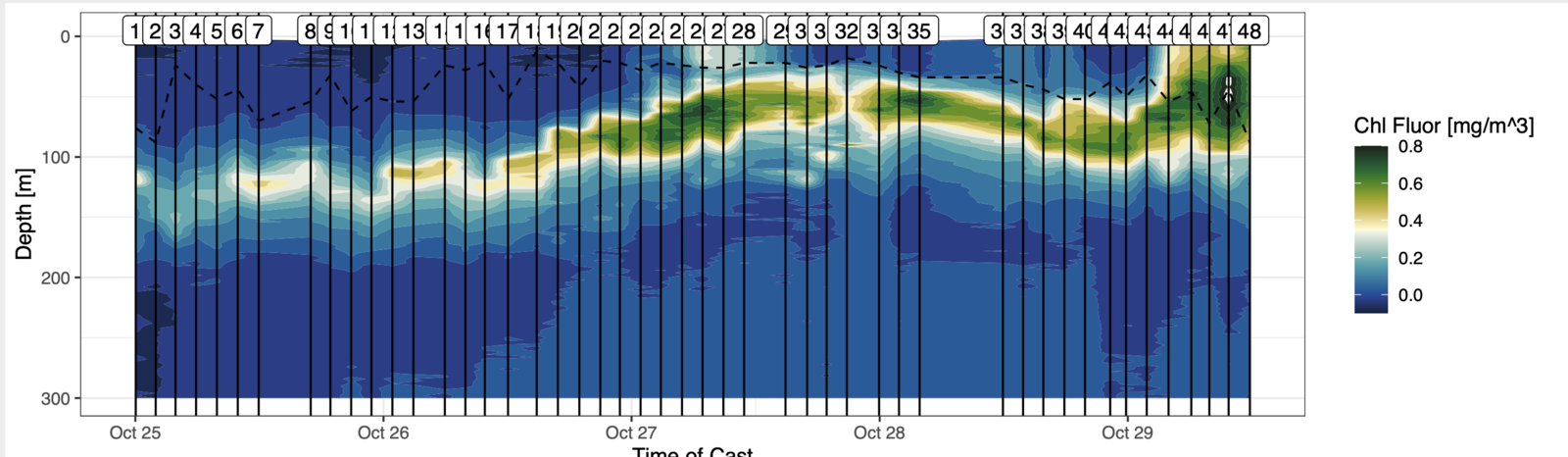
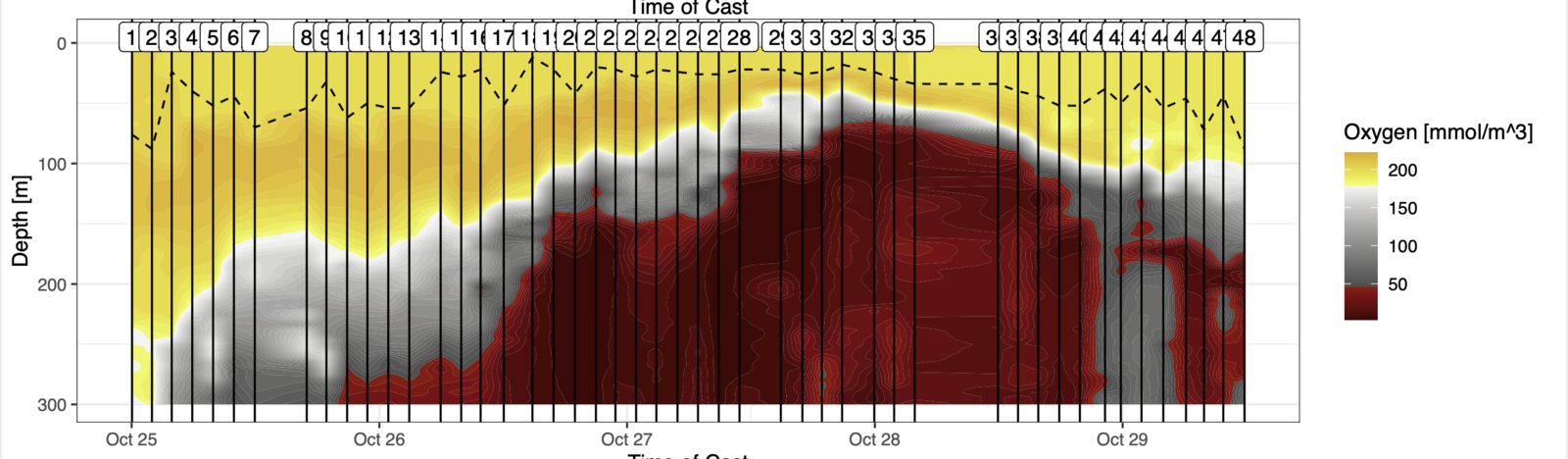
We’ve done a number of these so far; take a look at our data! These profiles help inform the team on areas of interest to sample as we are underway! Gaps in the data are often a result in fixing the instrument or bad weather.
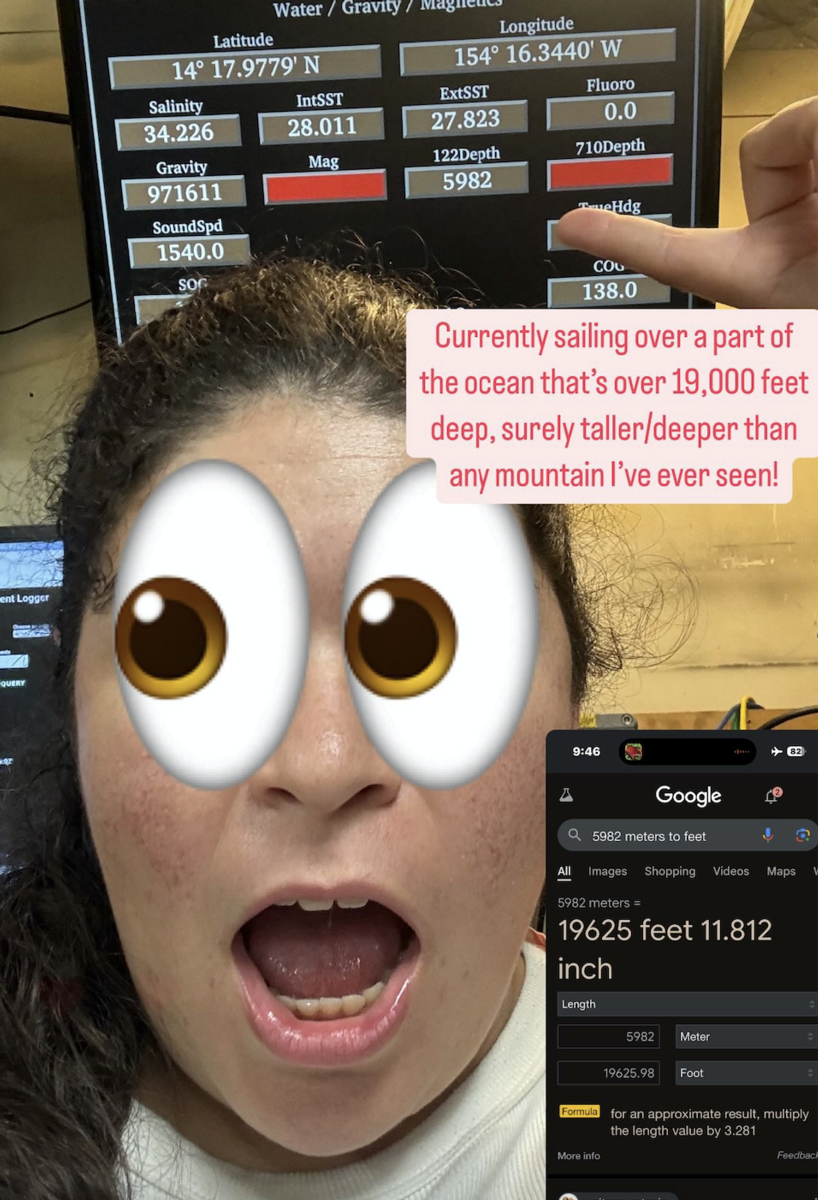
Amongst other things, we got to sail over a part of the ocean that is over 19,000 ft deep (5,982 m), which really blew my mind! Wish us happy sailing! <3
Alohowdy, everyone! Welcome back to another blog post!
We’re officially one month into the third leg of my 6-month internship with the HOT and OTG teams aboard the R/V Kilo Moana. The past two weeks have been packed with excitement, including a fantastic HOT 354 research cruise, sightings of comets, whale sharks, falcons, and even an abandon ship scare. So, there’s plenty to chat about!
For those unfamiliar with the Hawaii Ocean Time-series (HOT) or who haven’t caught up on my previous posts (shoutout to my long-term subscribers), here’s a quick refresher. The Hawaii Ocean Time-series is a long-term study focused on the North Pacific Ocean at Station ALOHA, about 60 miles north of Oahu. Since 1988, this program has been working to create a comprehensive picture of the physical and biogeochemical properties of the North Pacific subtropical gyre by collecting and analyzing various data samples. This is neato because researchers worldwide use this data to understand long-term ocean changes due to factors like climate change. If this sounds familiar, it’s similar to what I wrote about BATS a few months ago. It’s been amazing to see how HOT and BATS compare from both research and operational perspectives.
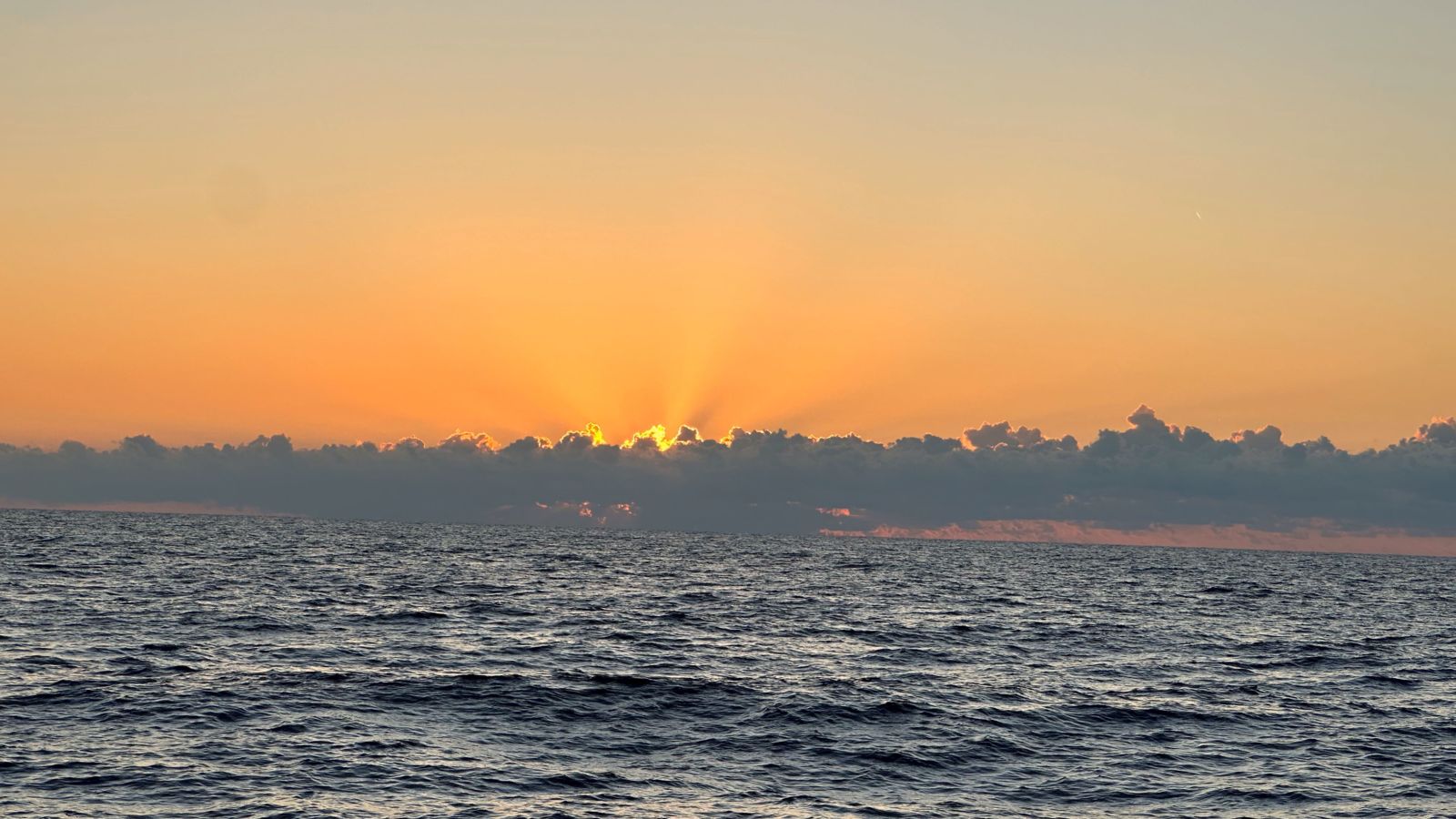
– Sunrise from Station Aloha
Now, onto the 354th HOT research cruise! This four-day adventure focused on CTD casts, array deployments, and net tows. I had the freedom to roam without a set schedule (at large), which allowed me to observe all array recoveries and deployments—a major operation I’ll be assisting with on the upcoming SPOC cruise. I even got to try grappling an array for recovery for the first time (and almost got it first try)! I also helped with CTD deployments and recoveries, as well as sample collection and processing.
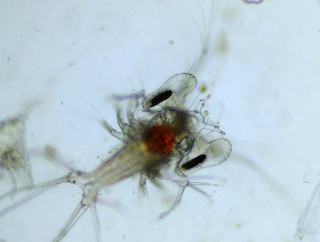
– A Lil Zooplankton we picked up from a net tow
Here’s a full list of what we deployed and recovered on HOT 354:
– Sediment trap array
– Primary production array
– Gas array
– CTD
– HyperPro
– Underwater Vision Profiler (UVP)
– Zooplankton net tows
– Video Plankton Recorder (VPR)
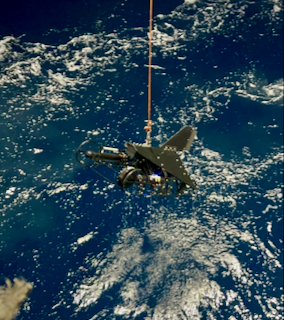
– The Video Plankton Recorder (VPR) being recovered
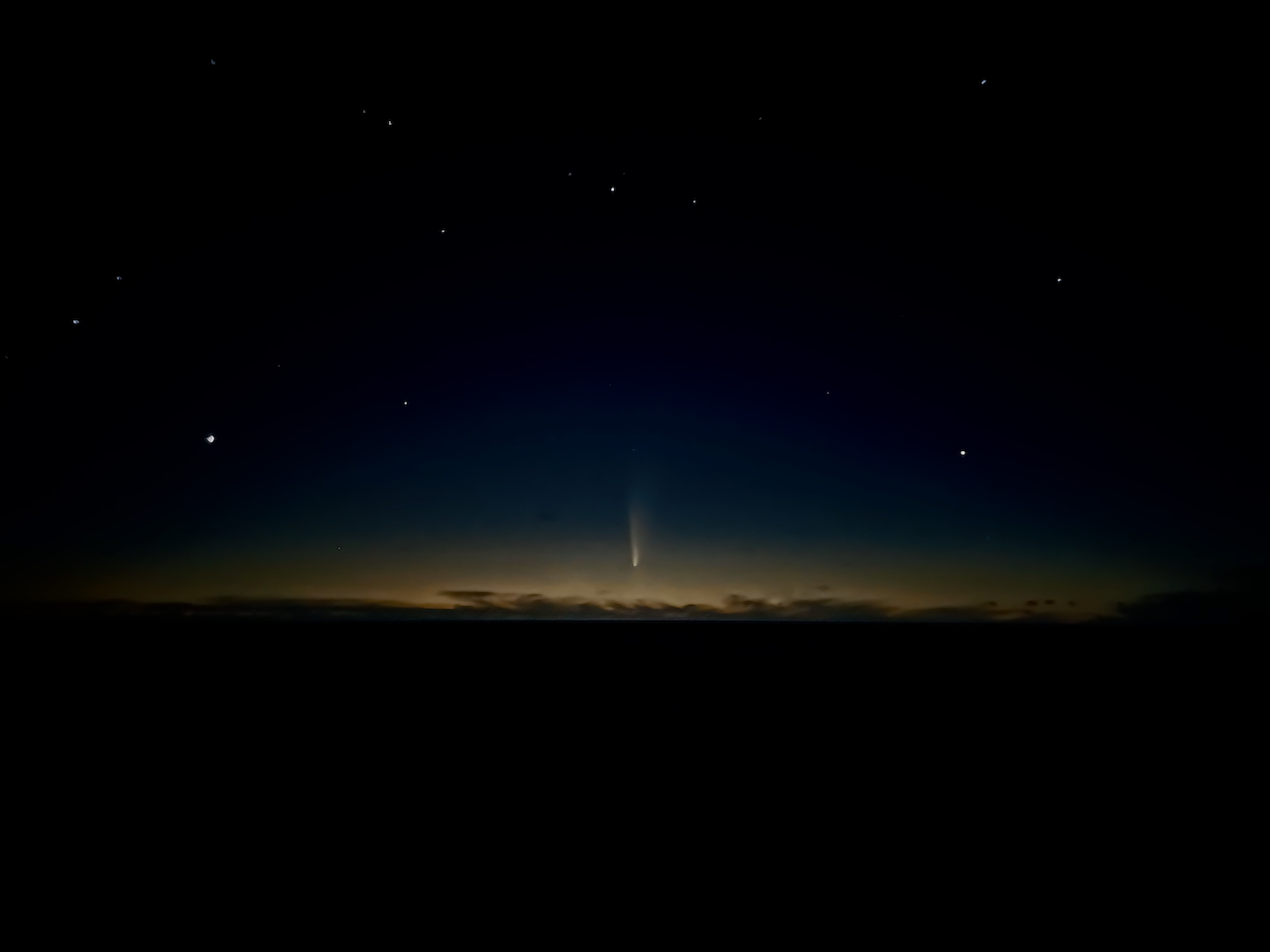
Besides all the exciting science operations, we were treated to some incredible wildlife sightings: oceanic white tip sharks, petrels, boobies, a whale shark (my first), a peregrine falcon (also my first), and even the Tsuchinshan–ATLAS comet (a first and last for all of us). It was a wonderful cruise filled with great people—thanks to all the volunteers, crew, techs, and scientists for making HOT 354 such a blast! I can’t wait for the next one.
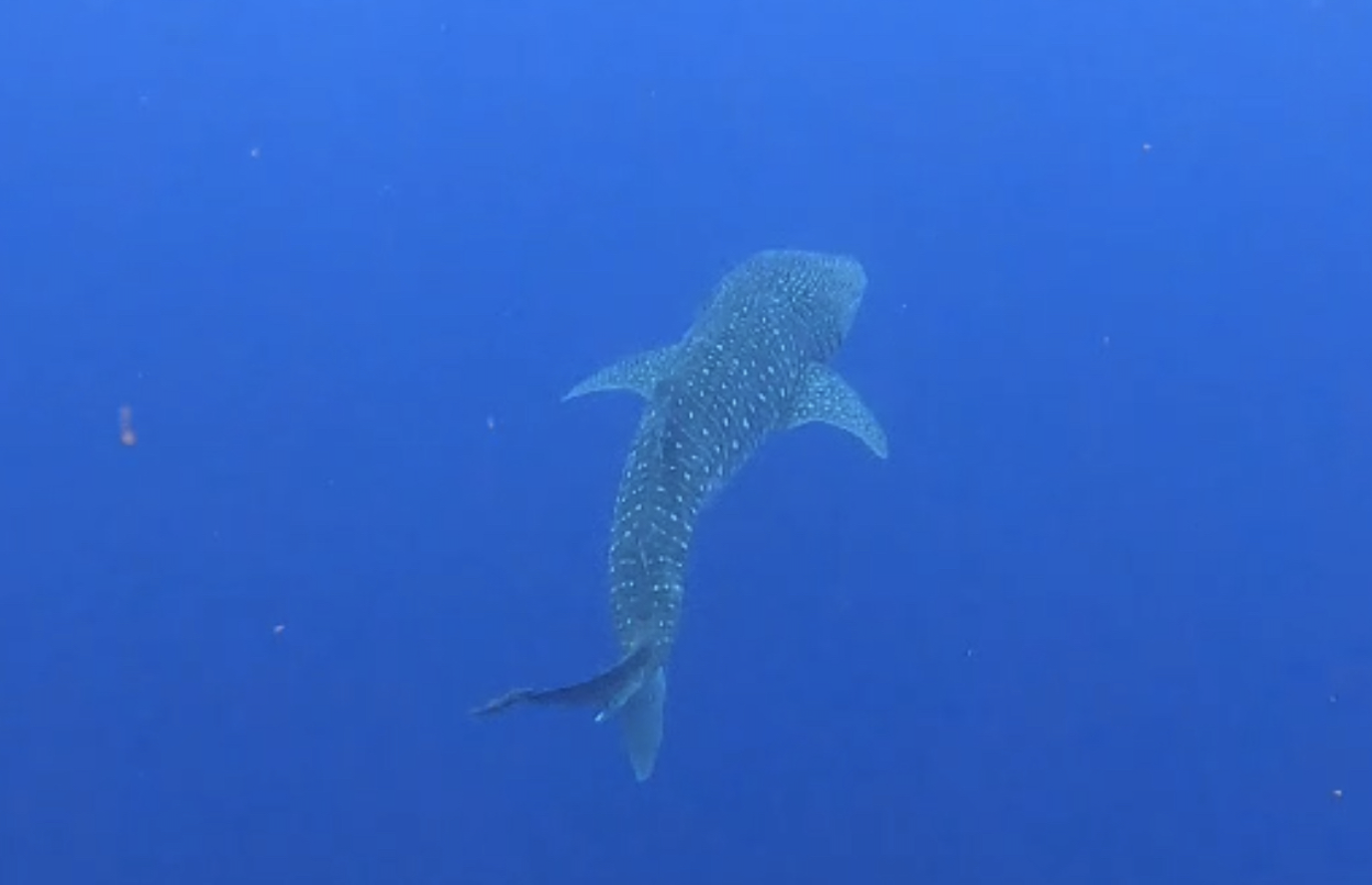
– Our whale shark friend off the bow of the Kilo Moana. He ended up hanging out with us for around an hour or two!
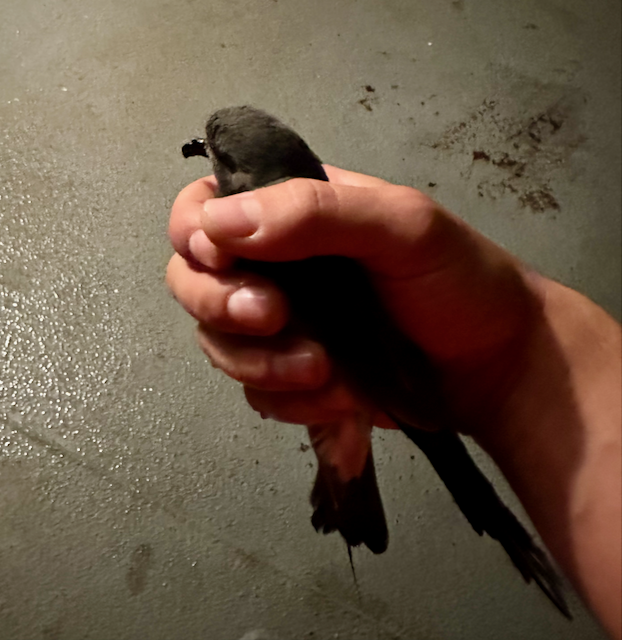
– Tom Petty the storm petrel (if you know you know)
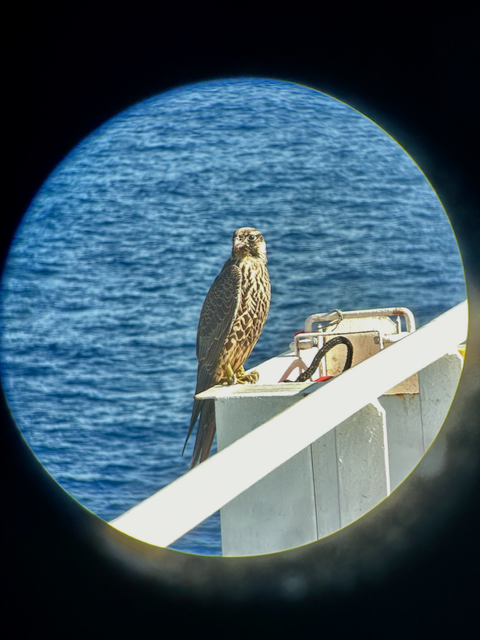
– A peregrine falcon who decided to hang around the boat for a few days (if you know you know)
– Tsuchinshan–ATLAS from the back deck of the Kilo Moana at Station Aloha
After returning to Honolulu and unpacking, we enjoyed a few days of downtime before embarking on one of my longest scheduled cruises aka the South Pacific Ocean Cruise (SPOC). The purpose of this two month trip to Tahiti and back is to expand the measurments of oxygen- and carbon- based production and respiration rates across multiple biomes, throughout the euphotic zone, and over the full seasonal cycle. New technology has made big leaps in how we’re able to observe these rates and this cruise will be an excellent opportunity to expand the number of measurments made in the open ocean and also help validate satellite-based production estimates. The cruise will cover 18 stations between Honolulu and Papeete French Polynesia whith a mix of long (~2.5 day) and short (~0.5 hours) stations.
This is a very exciting cruise to be on in terms of the science it aims to do and the operations it will conduct. I’ll learn how to use instruments like the underway CTD, wire-walker, and various floats. Plus, I’ll be running CTD casts with Briana on the opposite shift. We left port Saturday morning after completing our safety drills and successfully conducted the CTD test station near Oahu. However, shortly after that, the ship’s general alarm sounded—we had a “oh this is not a drill” moment as water was discovered in the starboard generator room. Thankfully, it was only a loose coolant hose, but we did have to return to Honolulu for repairs.
With everything fixed and checked over, we’re back at sea at the start of the SPOC cruise! My next post will be in two weeks once I’m more settled into my routine. I’m excited to share my experiences and everything I’ve learned!
We arrived at port early on 10/14 after an exciting and pretty well running cruise. The scientists were quick in offloading boxes and materials, and we were off to the University of Hawaii at Manoa by about 9:00. Dan, Hunter, and I offloaded the boxes in Dan’s office, and we were done with the day by 10 a.m! Again, the HOT team has got these routine field work sampling campaigns down to a ” T”, so the rest of the day was ours!
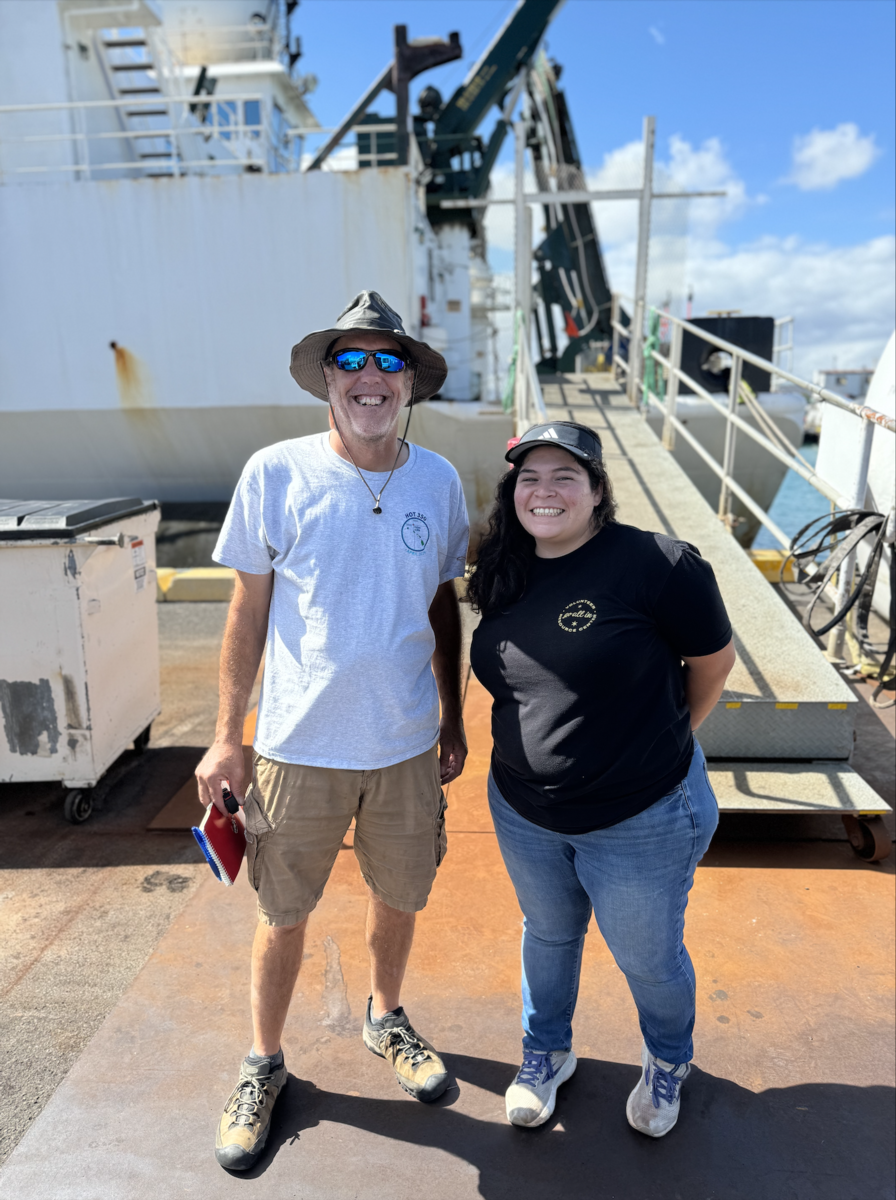
– Dan Fitzgerald and I cheesing it up after a succesful HOT Cruise 🙂
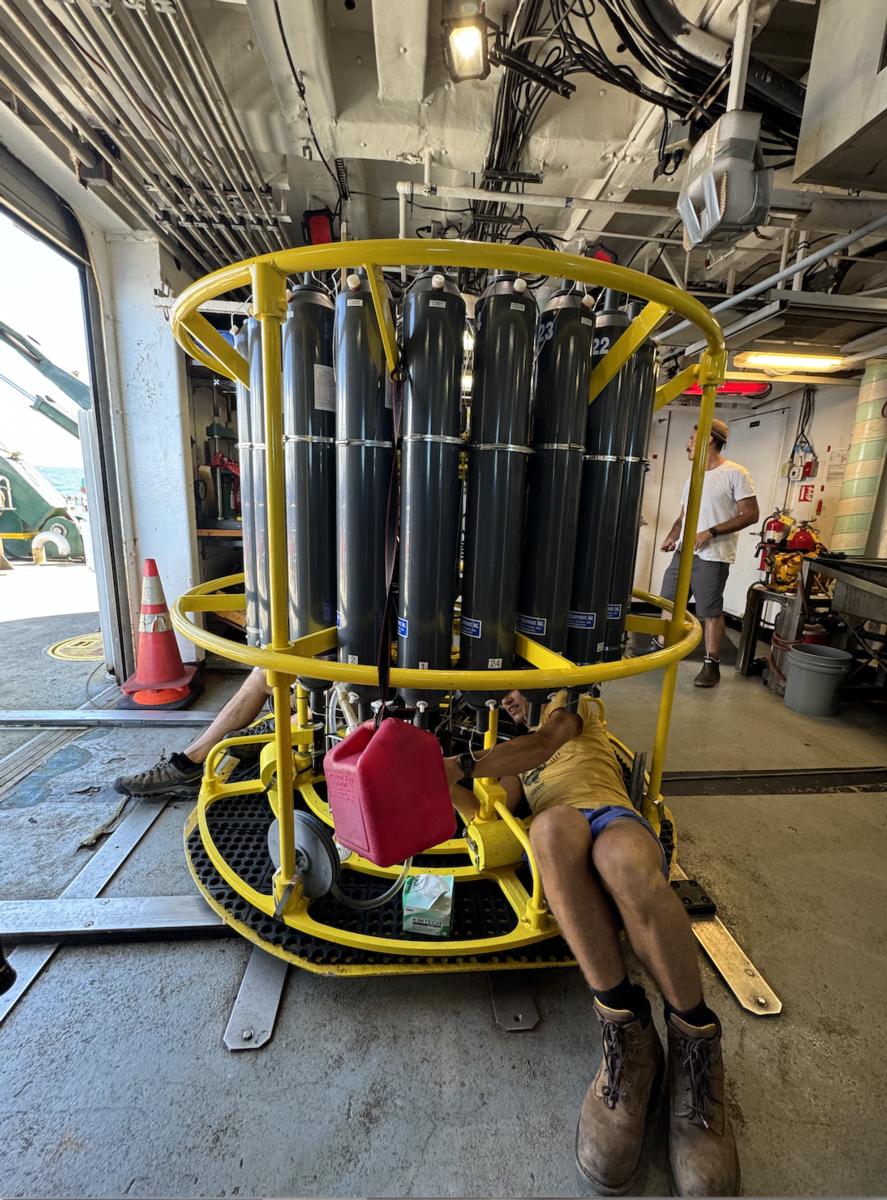
The following day (10/15), I got a ride from Dan to the UH Marine Center to help the Ocean Technology Group, Ben and James set up a Connectivity, Temperature, and Depth (CTD) sensor in preparation for the Tahiti cruise. Since this is not a HOT Cruise the Ocean Technology Group (OTG) crew needs to set up a new CTD Rosette (which they have 2 of!). This is also in the best interest of the HOT Team since those cruises happen so frequently and are so short, that nothing must mess up with the instrumentation that HOT uses.
To prepare the CTD, we replaced three different types of sensors (Oxygen, connectivity, and temperature) and their duplicates. The CTD contains duplicates of each sensor as a way to verify that the data is sound and to limit the amount of sensor drift, a phenomenon where the data slowly gets skewed as it progresses through the cast. Marine Technicians or OTG observe the CTD data on the computer console inside the ship as the CTD-Rosette travels to depth, to make sure that we are not getting any drastic results that would tell us that the sensor is not working.
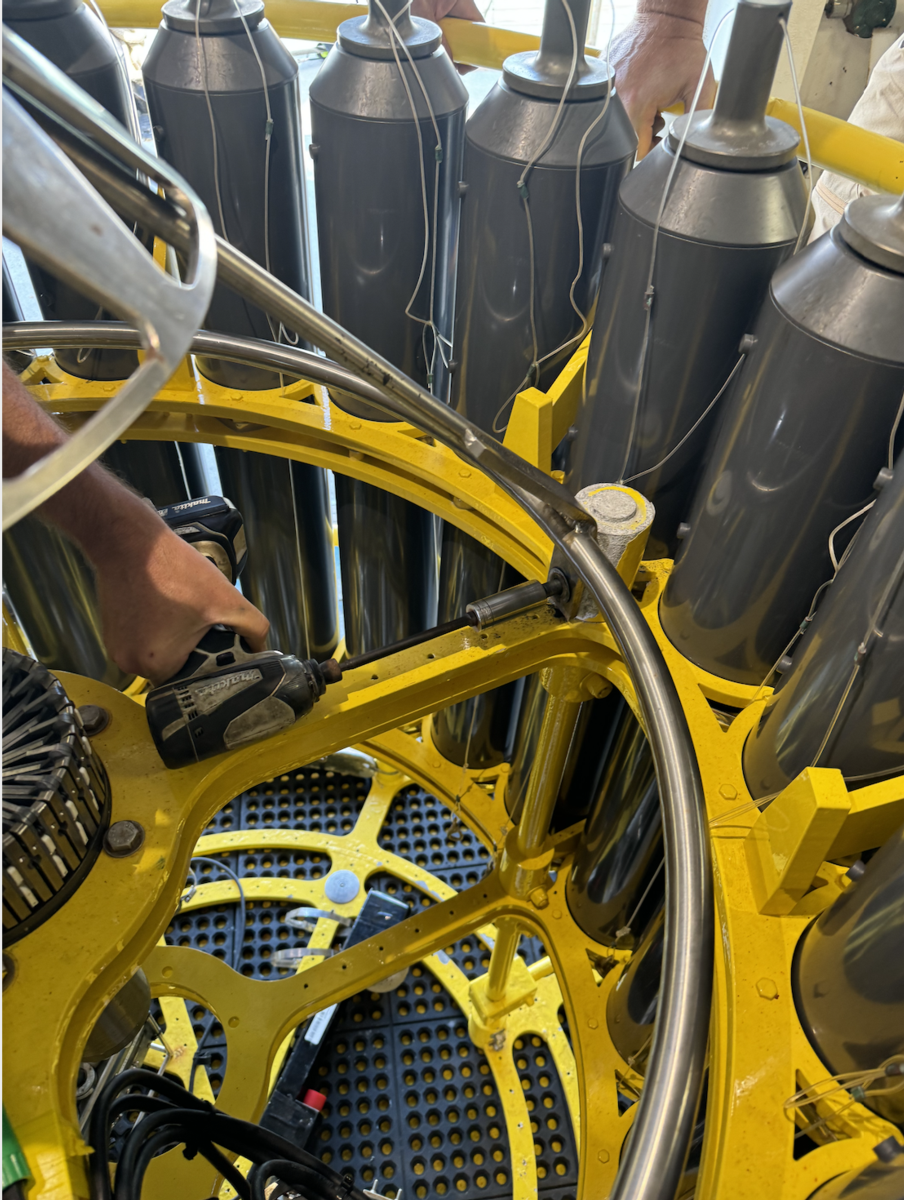
Once the CTD sensors are replaced and calibrated, we lodge the CTD head back into the frame of the rosette and start strapping the CTD with zip ties and electrical tape ensuring that we don’t cross any wires or cause unnecessary rubbing on metal-to-metal or chords directly on metal that could cause bends in the wires that could damage communication from the CTD to the ship. We also strapped in other auxiliary sensors like the Photosynthetically Active Radiation (PAR), Video Plankton Recorder (VPR), Transitometer and a Radiometer that give us other information that enhances our understanding of what the water column looks like.
– Drilling in the CTD Bridal that helps hold the CTD up while its being casted.
On Wednesday 10/16, we began loading for the South Pacific Cruise that was to set sail on Saturday 10/19. This looked like moving a lot of boxes containing incubators, filters, and bottles onto a UH van and then transporting them onto the ship, sorting them into their respective rooms and labs, and starting to unpack. This process feels a bit chaotic but it definitely builds excitement. In this process of moving in, it finally dawned on me that I was going to be at sea for 37 days, which simultaneously felt really long and very short and kinda intimidating. We are going to be so far and isolated from the rest of the world that if anything were to happen, we’d be a couple days away from your typical medical amenities which is totally not scary at all right, right?
Thursday was a bit of a rest day as the ship was on sea trial. Sea trial describes the process of taking the ship out to sea under realistic conditions to make sure that the ship’s machinery is operating properly, that equipment is working well, and getting a realistic view of the ship’s speed, maneuverability, and safety features. Due to this being ship-focused, the science team was not needed that day, which I used to catch up on some reading and emails.
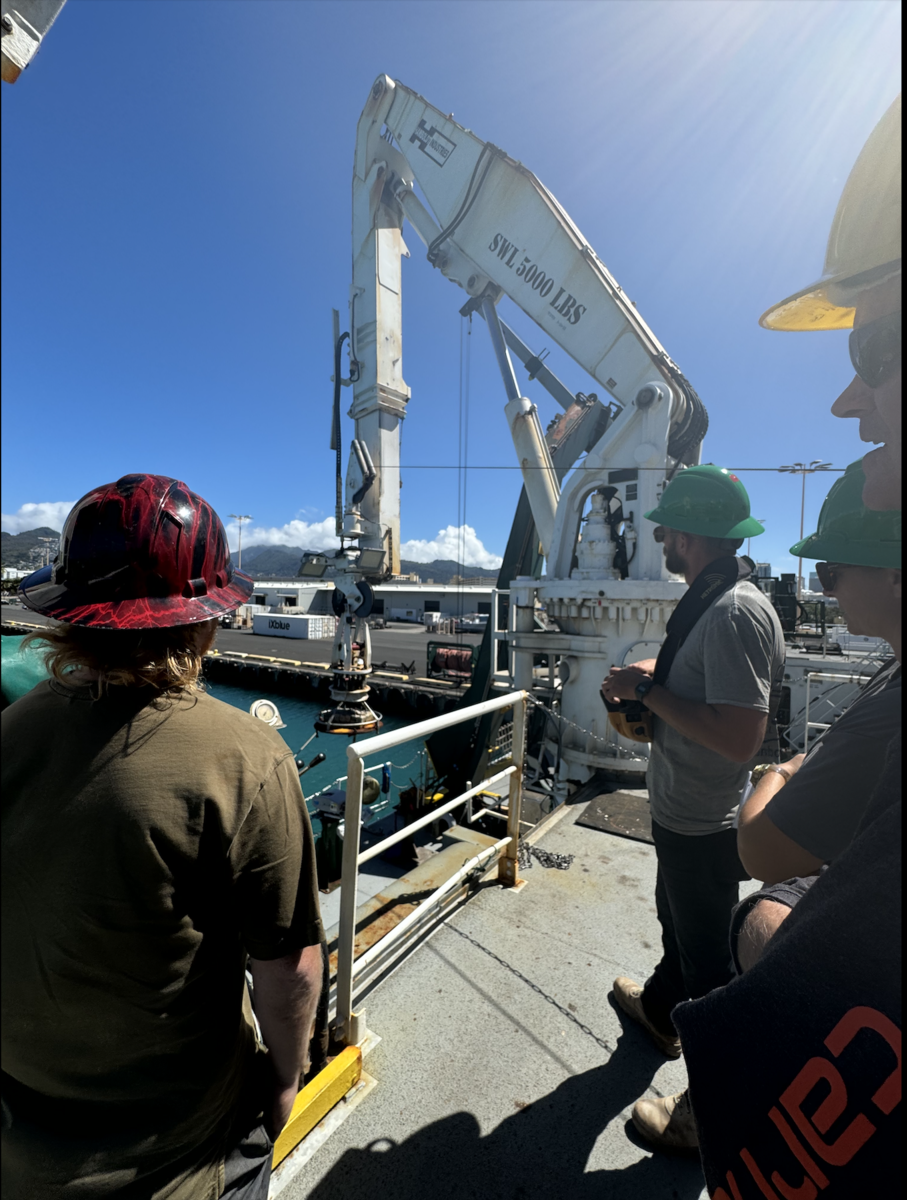
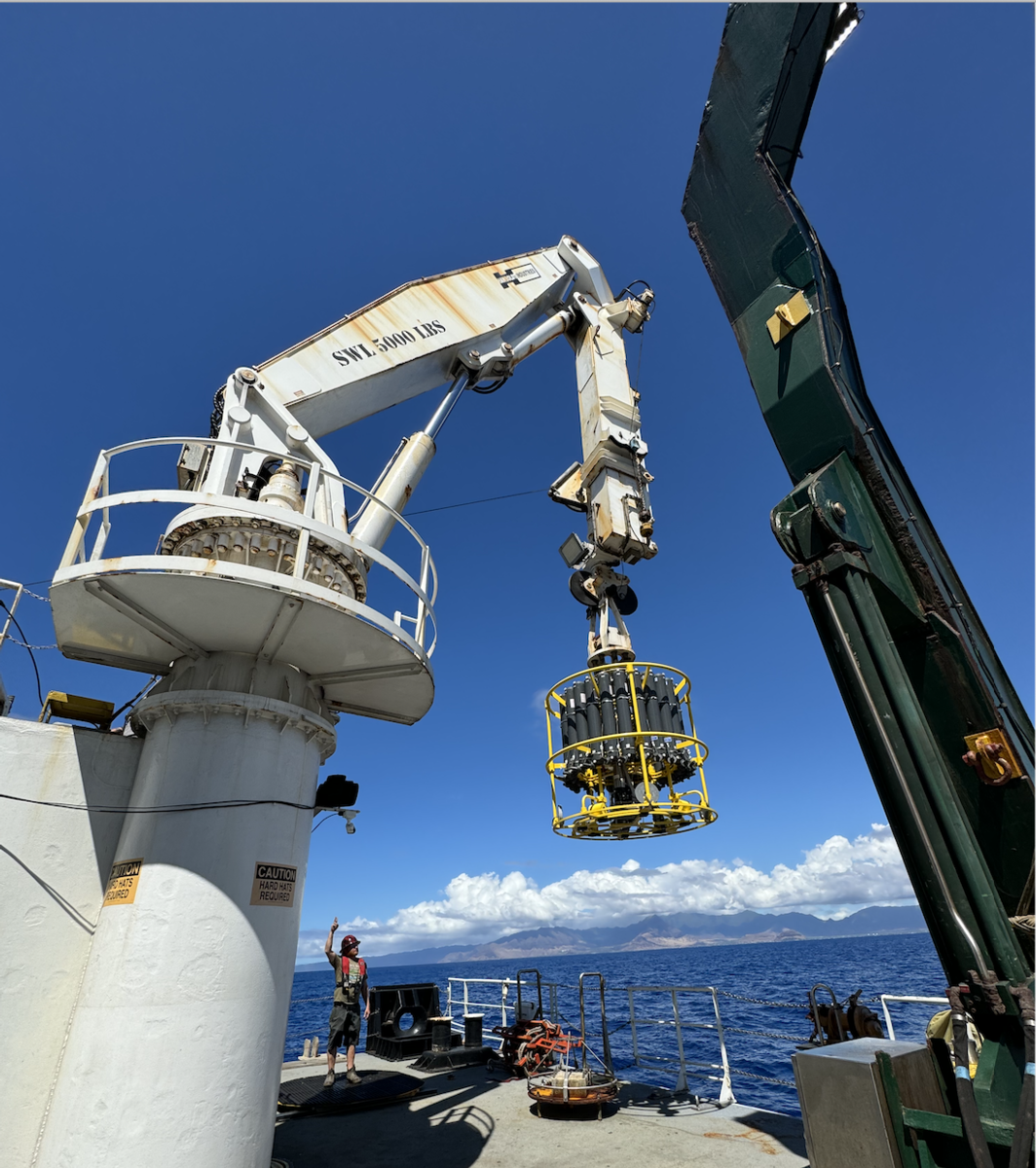
On Friday (10/18) however, I got pretty cool training on how to utilize the Hawboldt Winch. A Hawboldt winch is the machinery that pays out or retracts coil to the Launch and Retrieval System (LARS) , a mechanical looking arm that transports the CTD Rosette on and off the boat. The Hawboldt winch is largely specific to Kilo Moana, as most other research vessels typically deploy their CTD-Rosette using an A-frame or from the side of the ship. Although I will not be using the Hawboldt winch, the OTG figured it would be good for me to know how it operates and to understand what the operator is seeing when we are deploying the rosette. It’s definitely helpful when maybe there is a miscommunication or just understanding what the winch is capable of and I could help the operator or they can help me, best handle the situation.
– Learning all about the Hawbolt Crane from one of the OTG techs aboard the KM!
On Saturday 10/19 we arrived at Kilo Moana at 0800 am to set sail at 0900. On sailing day there are a few orders of business…
Safety Meeting – understand what the ship’s safety measures are, typically hosted by the captain and the chief mate.
Safety Drills – where we learn about the different drills and practice one. When we are dismissed from the safety meeting we go to our rooms to pick up our life vest and GUMBY suits and meet in the staging bay.
Test our instrumentation (CTD and Trace Metal CTD) in our underway station.
We had just finished with both of our test casts when we heard a call that sounded like a dog yelping but actually turned out to be an abandoned ship siren! There had been a failure of the cooling hose which resulted in some flooding in the generator. Thankfully the crew responded to the situation swiftly, but it did result in the ship having to return to port to assess the damage, let things dry out, and get any new parts that may be needed. Not surprisingly this really dampened our spirits but we were thankful that everyone was safe and that we could make it back to port.
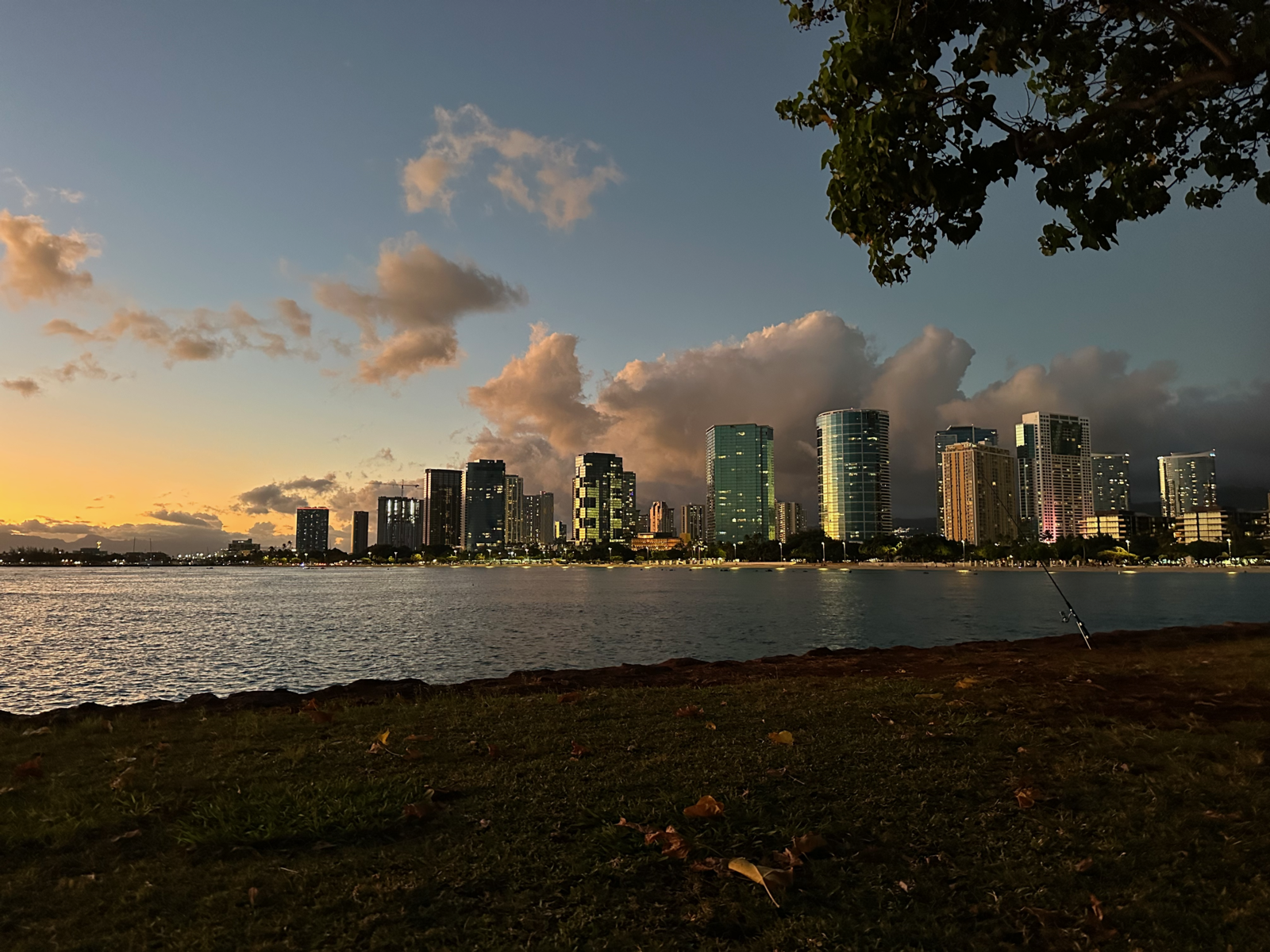
I stayed back on the ship to finish unpacking and to decompress. And finally got to visit Ala Moana- Magic Island to watch a nice sunset and catch a glimpse of what’s left of the comet.
Week #1 with the Hawaiin Oceanographic Time Series (HOTs), expedition #354 proved to be a HOT dive into the wide variety of science that takes place at Station A.L.O.H.A (A Long-Term Oligotrophic Habitat Assessment)! This is an area of the ocean that is about 60 miles north of Oahu that has been routinely sampled since 1988 and is one of the longest oceanographic time series in the world! I am very thankful to been given the opportunity to work with them this week as this short cruise was a really nice training ground for all things CTD and working at sea!
My internship started on October 7th, 2024 with a mini symposium held by Schmidt Sciences and University of Hawaii at Manoa (UH) oceanogrpahy professors and scientists. They presented on the work that they were working on and could potentially collaborate with the larger and developing Ocean Biogeochemistry Virtual Institute (OBVI) that is supported by Schmidt Sciences.
This symposium was really insightful as it introduced to me a lot of the researchers and the science that they do and I might be supporting in the next 10 weeks. The symposium also drove home the impact and importance of the Hawaiian Oceanographic Time Series (HOTS) is to the larger scientific community which gave me a lot of context into the spirit of this mission. Models have demonstrated that it takes about 42 +/- 7 years for climate change signatures to appear in models, but unfortunately many time series don’t get enough funding to reach that length, thus it is essential for long standing scientific endeavors to get the consistent funding and resources they need to continue.
On Wednesday 10/9 I assisted in “Loading Day” and got to meet members of the science party, ship crew and one of my mentors, Dan Fitzgerald . After we loaded boxes onto the ship, I got to observe Dan create a termination on the sensor cable on the CTD, a HOT cruise monthly tradition. The sensor cable is responsible for relaying all the information to the ship in live time, without it can be really difficult to know where you are in the water column, or observe areas of interest that you might want to take a water sample from.
– Hunter Adam and Dan Fitsgerald working on the CTD Rosette
Conducting a new termination (the process of exposing new wire from the cable, splicing, crimping and soldering wires together) is essential to maintaining and repairing any issues caused from things like corrosion and rusting. Conducting new terminations monthly is essential for ensuring signal integrity from the CTD and keeping things running smoothyl given that HOT cruises are short (anywhere from 4-5 days) and ship time is expensive.
Once we set sail the following day, we got to check the integrity of the CTD termination with a test deployment of a set of weights with the bridal attached in Station Kahe (an underway practice station), before deploying it later that evening at Station A.L.O.H.A. During these troubleshooting trials we observe that there was a mechanical issue with one of the oxygen sensors on the CTD so I also observed how Dan swapped out sensors while in the rosette frame, which is quite tricky! Once we left Station Kahe, I went straight to bed to get ready for my 12 hr shift starting at 3am the following morning.
– The CTD Rosette being transported by a Hawbolt Whinch crane overboard in preparation for a cast
In the following days I helped with the deployment of atleast 8 CTD Rosette Cast. I learned how to caulk the bottles and reel it in and out of our CTD shed and general CTD Rosette handling. As well as learned how to communicate with the wrench crew when firing bottles over walkie talkies. Additionally It was really interesting to learn about the wide varieties of cast to be done and how the water is used based on the researchers’ different water needs. For example some scientist are looking at oxygen, or dissolved inorganic carbon (DIC), dissolved organic carbon (DOC), nutrients (Nut), salinity, ATP, particulate carbon (PC), particualte Nitrogen (PN) all of which contribute to the great collection of data that is the Hawaiin Oceanographic time series.
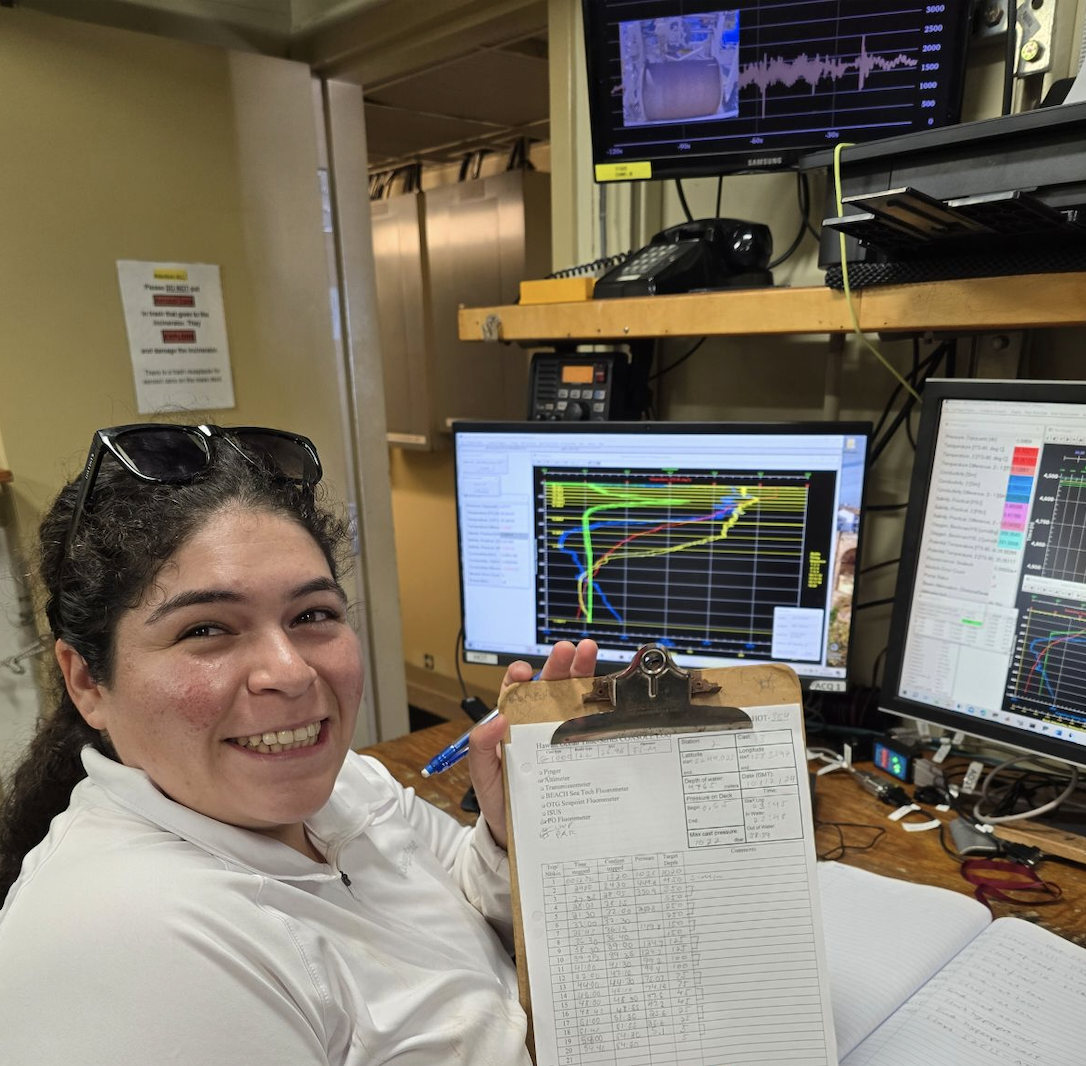
– Cast sheet and schedule posted showing what depth the CTD is being sent to and what depths the bottles will be fired at.
– I got to sit at the CTD console and fire some bottles, this is me holding my cast sheet.
There were a lot of moments that blew my mind this week (like seeing a whale shark in the wild!), but I’d say one of the most impactful things I observed on the cruise was a Gas Array experiment take place from start to finish, a true testiment to the rigors of doing science at sea! By the time my shift started at 3am on 10/12 the CTD had already been brought up and was ready for water sampling. Mattias (an undergrad researcher) and Dan Sandler (HOT Cruise OG) invited me to collect the water in jars and enrich it with N15, a stable isotope that can help track the net production of Nitrogen by Nitrogen fixing plankton. Once those water jugs were filled, they were attached to metal rods and then attached to a line and then deployed on a buoy using the A-frame. These water samples are to sit in the water column at the depth that they were collected for 24 hours before being retrieved. The retrieval process however, is quite dramatic given that it’s done in the pitch of dark (10/13 at 5:30 am) and the Kilo Moana is a double hulled boat that could potentially “run over” buoys or have it get caught in the propellers if the navigation team and scientific crew are not careful. I watched in suspense as we approached the buoy the samples are attached to and watched the bouy slowly dogde the middle of the R/V Kilo Moana and float past the side of the hull, phew!!! Mattias and Hunter (fellow UNOLS-MATE intern) bravely threw grappling hooks overboard to get some control on the buoy, and swing it to the stern of the boat, where the Ocean Technology Group (OTG) and deck crew were ready to latch a stick with a hook to the line and start wringing in the buoy on the back deck using the boat’s A-frame. Once the bouy was on the ship we all breath a sigh a relief, we had succesfully retrieve our samples without any issues!
It’s astonishing how well HOT Cruise #354 went, the scientific party and crew have this expedition down to a T! HOT Cruise #354 proved to be a wonderful primer to the type of work we’ll be doing on the South Pacific Cruise I’ll be embarking on next week. We expect to be doing a lot of CTD Rosette Cast, Gas Arrays, Primary Productivity arrays and more so these skills will most definitly come in handy!
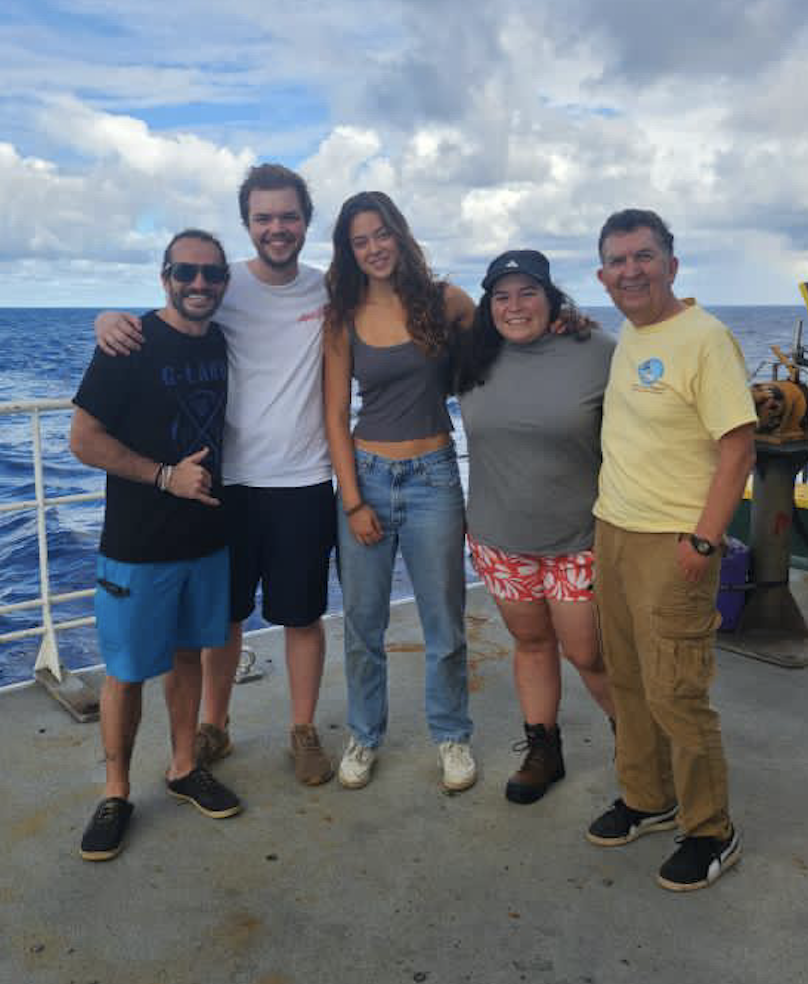
– Fellow HOT Cruise #354 volunteers 🙂
Cheers,
Briana Prado
* hehe, here is said whale shark, taken via go-pro by one of the AB’s on aboard!
I can’t believe I’m finally here for my six-month internship’s third and final leg. After the USCGC Cutter Healy had some technical issues delaying the scheduled October to December GO-SHIP cruise, I had the opportunity to come back to Hawaii and work aboard the R/V Kilo Moana for round two! It feels great to be back and I’m stoked to be working with the awesome Hawaii Ocean Time Series (HOT) and Ocean Technology Group (OTG) teams again.
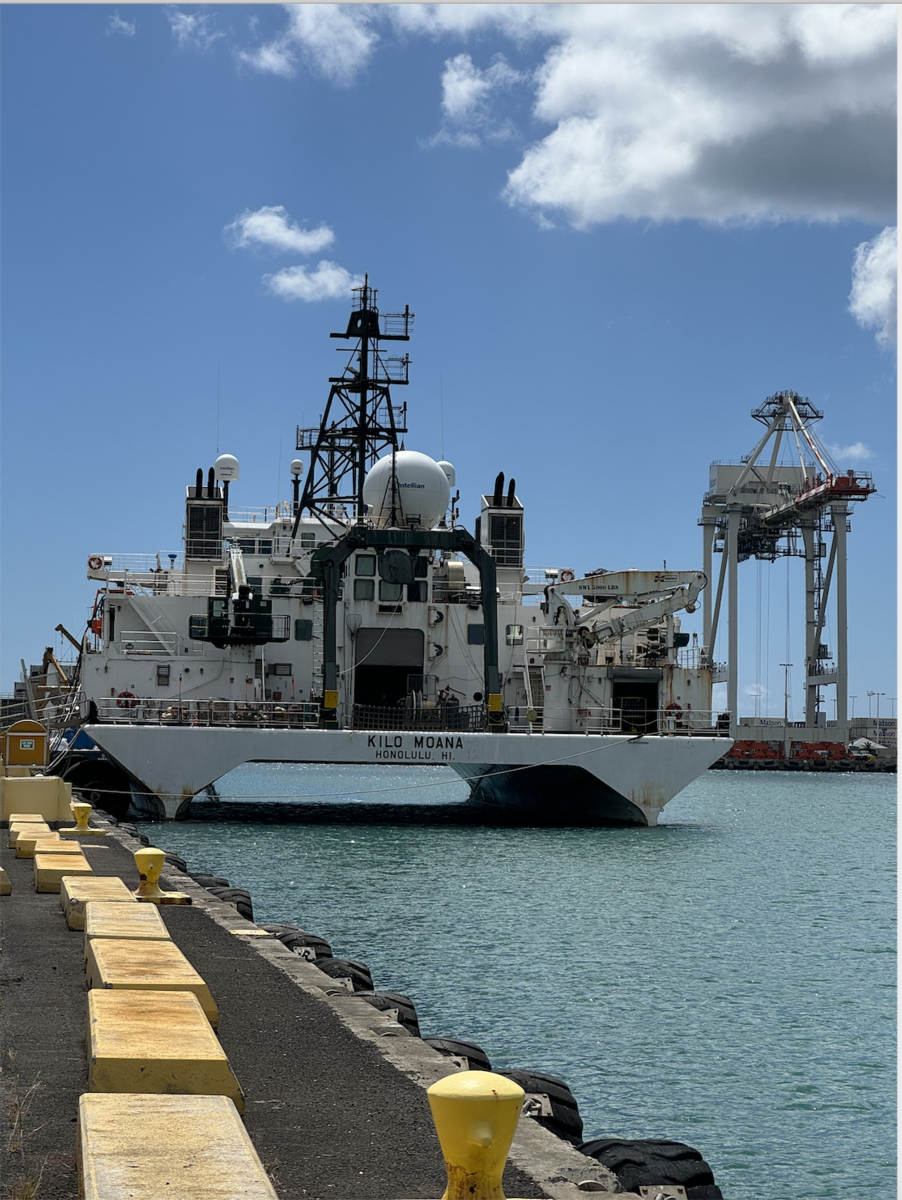
– The R/V Kilo Moana (photo credit to Multibeam Advisory Committee, UNOLS)
– Honolulu sunset from Magic Island
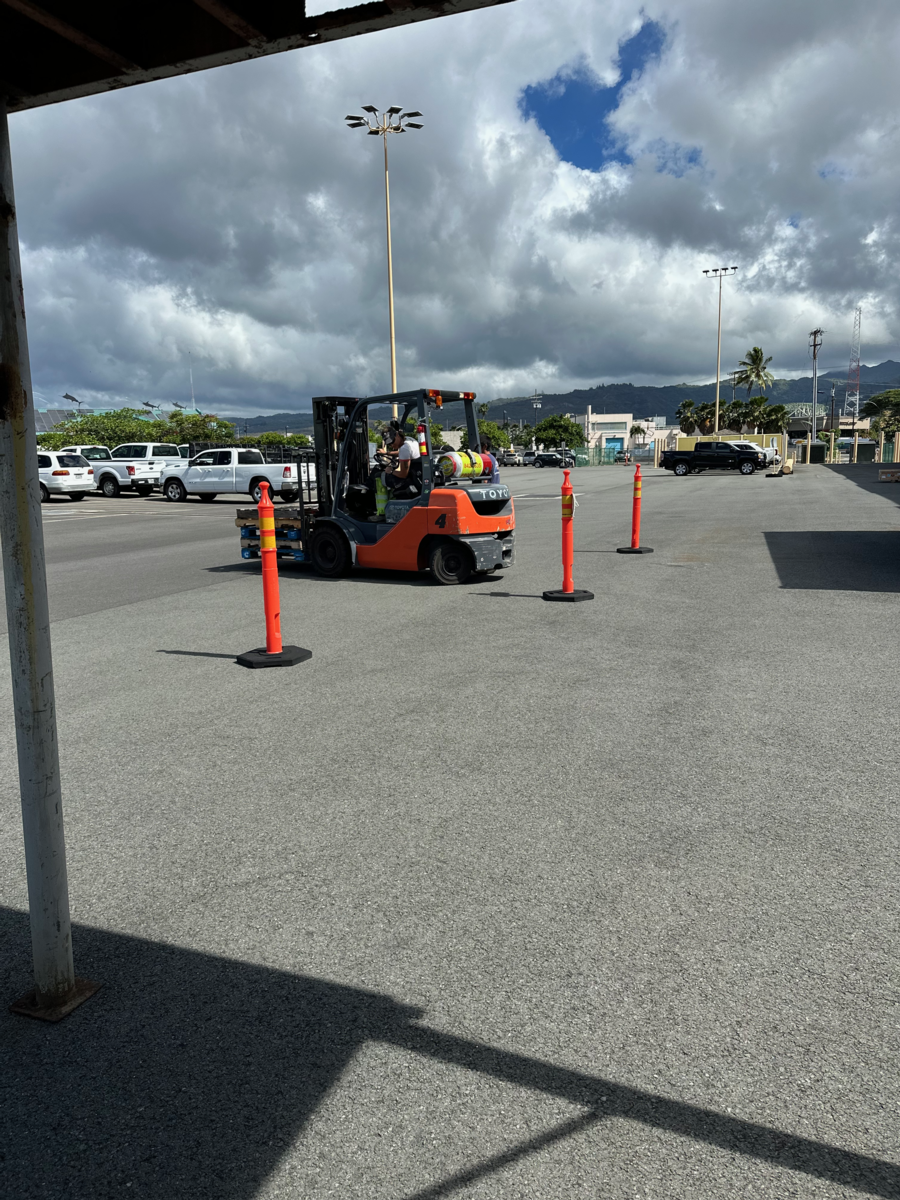
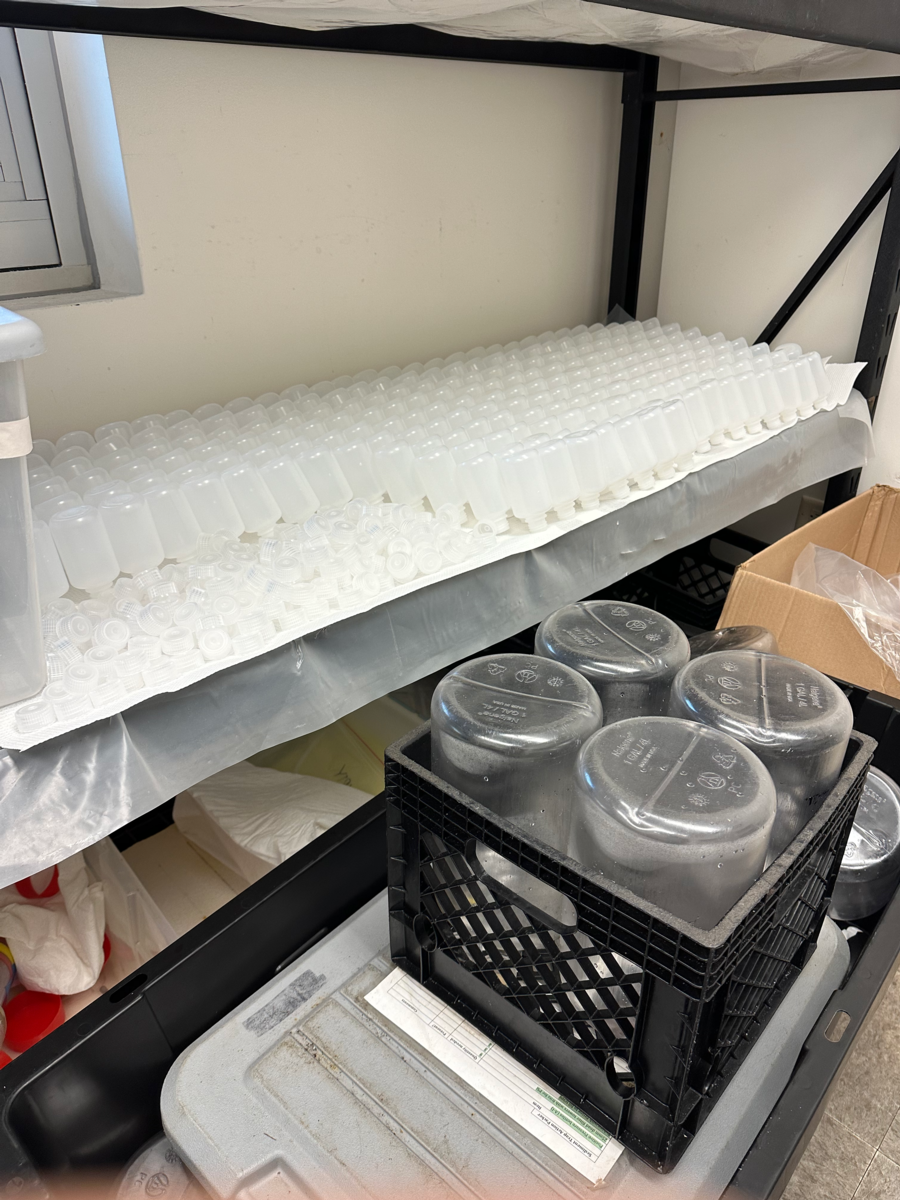
These past two weeks have been a whirlwind of activity as we gear up for some exciting science at sea. I’ve been assisting in the preparation of these cruises where possible and helping the researchers who are knee-deep in pre-cruise checklists (including old mentors such as Dan Fitzgerald and Tully Rohrer)! From maintaining instrumentation such as SBE 37-SM MicroCATs and CTD sensors on campus to helping with the tedious (but oh-so-important) task of acid-washing various sampling bottles at the UH Manoa Marine Center, I’ve been getting my hands dirty in the best way possible. Along the way, I’ve picked up some mad forklift and splicing skills! We’ve also been testing equipment, such as decade-old temperature incubators, to make sure we’re all set for our upcoming voyages.
– Getting forklift certified with crew from the Kilo Moana
– A whole lotta 10% HCl acid-washed bottles drying
Speaking of upcoming voyages, fellow MATE intern Briana Prado and I have a packed schedule while we’re here in Hawaii. First up is a 5-day HOT research cruise – short but sweet and luckily something I’m experienced with from last year. It’ll be a great opportunity to review old operations (such as deployments/recoveries for CTDs, arrays, nets, VPR, and Hyperpro) and learn some new skills in preparation for our next cruise. The real adventure kicks off after that when we join a two-month South Pacific research cruise to Tahiti that aims to expand the measurements of primary production and respiration rates in open ocean regions. Two whole months at sea, can you believe it? I’m very excited to join this collaborative expedition between several research institutes and work with a variety of new equipment including wirewalkers, underway CTDs, and Argo floats!
I’ve got to say, being back in Hawaii is just… *chef’s kiss*. It’s been great to reconnect with old friends and get back to doing what I love. And knowing that I’ll be contributing to important oceanographic research makes it all the more special.
Please tune in for my next blog post which will include more details about the HOT 354 cruise! I’ll keep you all updated on my adventures as much as I can. Until next time, mahalo for reading, and catch you on the flip side!
This week was filled with a lot of new skills and intense moments working with the ROV!
9/25
Late this morning, we got to Gulfport and that meant that the Point Sur crew has to clean up around the ship! Since we docked a few days early than anticipated, we had a few days to fix things and eventually clean around. I went ahead and focused on what the marine tech needs to take care of which is our precious flow thru system.
To clean this system, we have to run the system with freshwater for 10 minutes through the debubbler and 10 minutes through the rest of the flow thru system. To clean it, we close valve #1 and #2 which closes the saltwater input and closes the input to the rest of the flow thru system. Then we open valve #3 and run freshwater through the debubbler for 10 minutes. Then once that is done, we open valve #1 to run freshwater through the entire system!
I then cleaned the CTD sensors again with the same method I mentioned in my last blog post where I cleaned the sensors with Triton X, diluted bleach, and DI water. I slowly pumped the sensors with the chemicals in order and then did a freshwater rinse to clean the Niskin bottles.
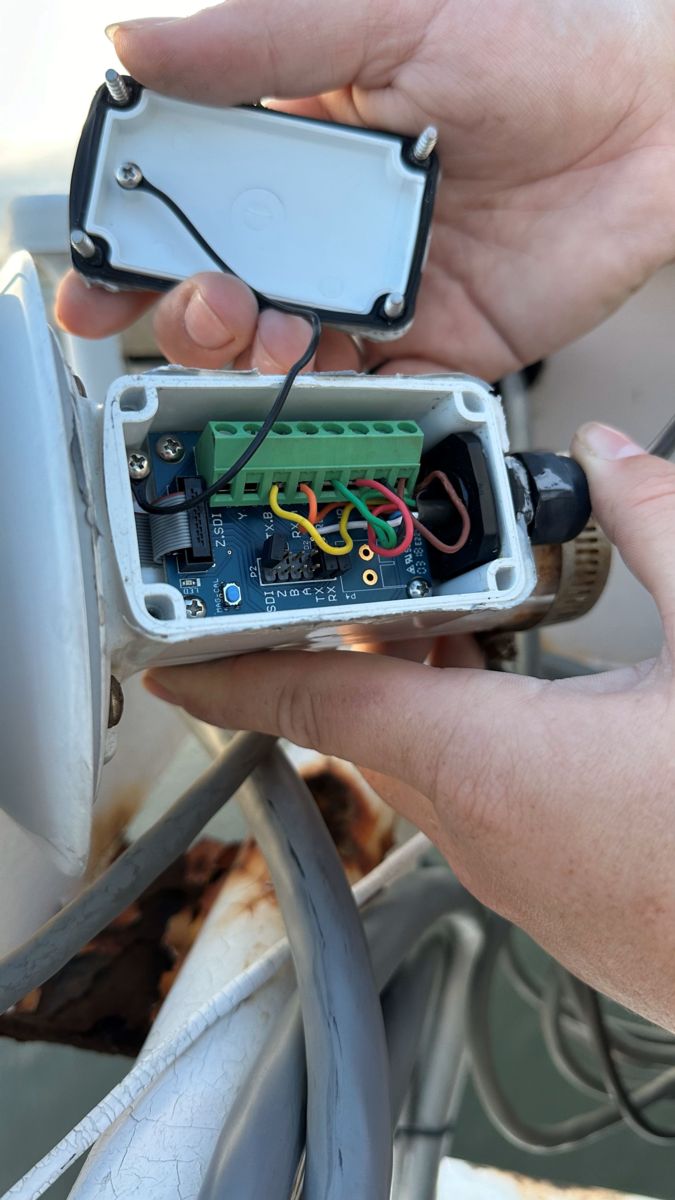
Once I was done cleaning the sensors, I helped Grace replace batteries on an UPS system. An UPS (Uninterruptible Power Supply) is a system where you can backup technology and other devices in case of a power outage so that the technology can still function without shutting down. This is important on ships because we need systems to continue working despite a generator randomly shutting down or losing power because of an incident. We have a lot of sensors that the ship and the science party is dependent on like GPS, internet, navigation, all of our science systems. Me and Grace carefully took out the old UPS system from the tech rack and slowly opened up the battery rack (since batteries from an UPS system might explode). We made sure all the batteries are safe enough to replace and went ahead with detaching and installing the new batteries. This took a lot of strength to take the batteries out because they were stuck on the UPS system with double sided tape. Everything worked out in the end and we put the UPS system back in the tech rack!
Once we took care of the UPS system, we went ahead and focused on the main mission of the day. Grace keeps a well-organized list of sensors of their model, serial number, last calibration date, and next calibration. There was a long list of sensors that needed calibration so we first filled out an RMA order from Seabird. Most of our sensors were from Seabird so we added all of them to a single RMA order to make things easier (although the site kept crashing when we tried submitting the order haha). We also had sensors from RM young and Biospherical Instruments, so we went ahead and emailed tech support for an RMA number to send them in for calibration. Once that was all done, I went ahead and gathered most of the instruments (the weather sensor is on the mast of the boat so I will learn how to dismantle it tomorrow), and found pelican cases for them to be safely shipped in.
9/26
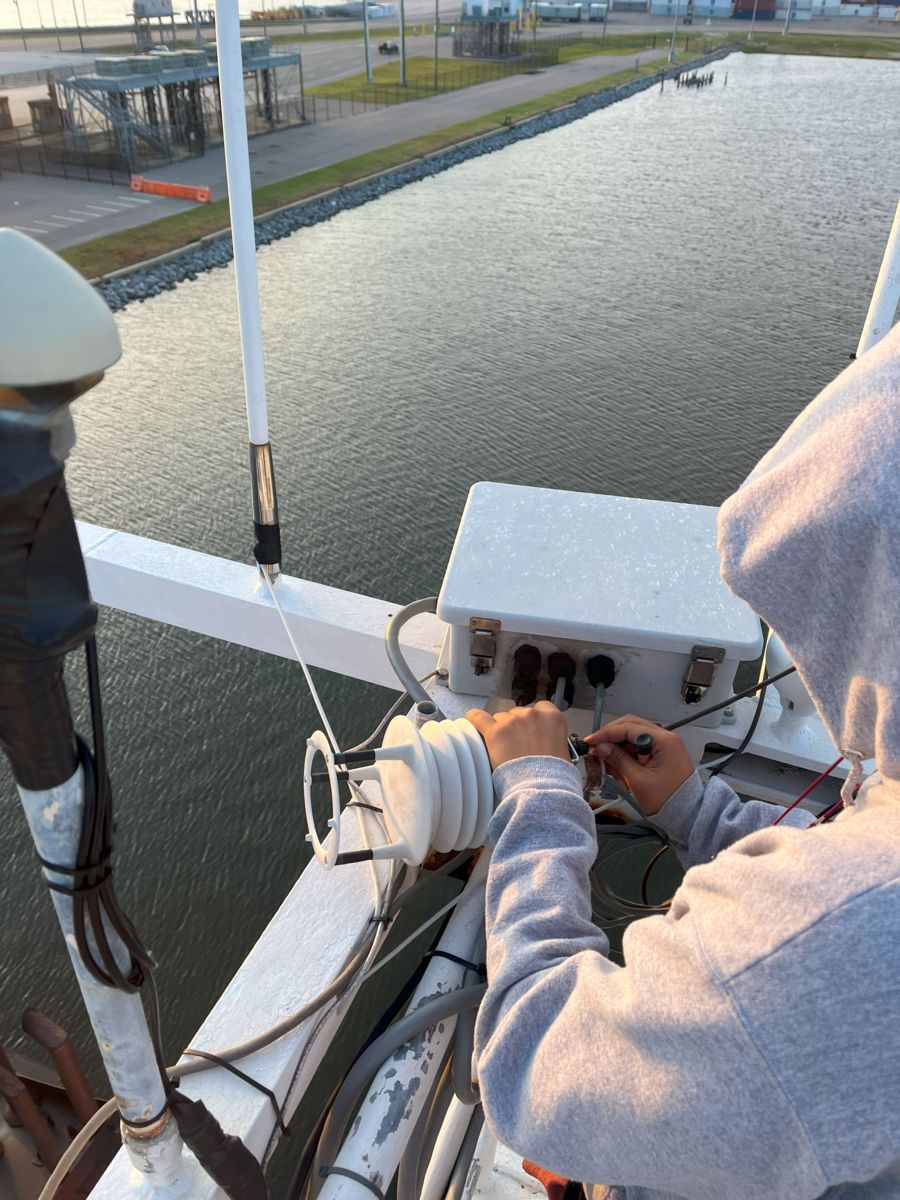
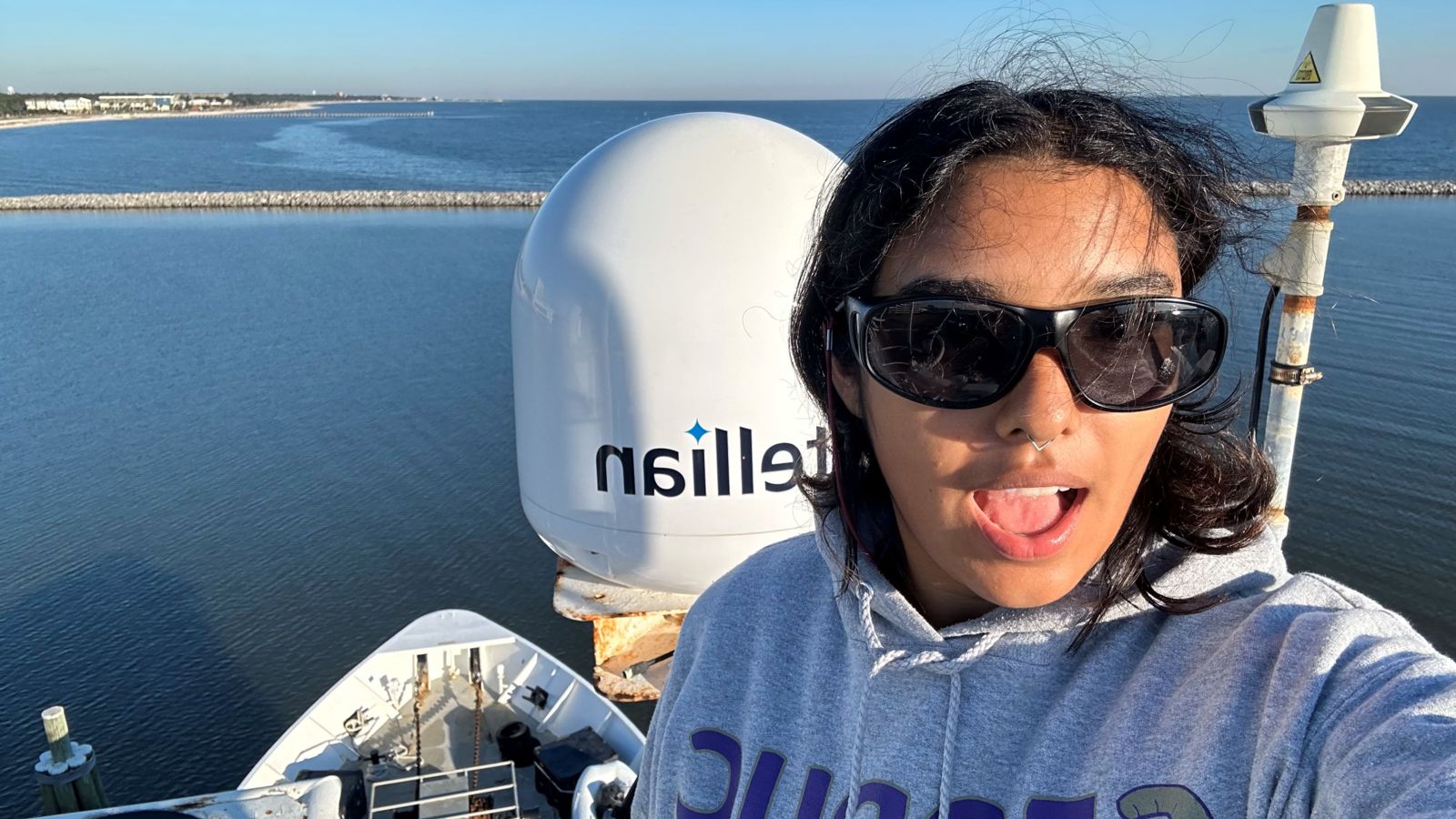
Today we are at the wooden dock in Gulfport and have a few things to get in order. The main thing is getting the weather sensor from the mast, which is located at the very top of the ship! Me and Grace agreed to replace the weather sensor in the morning to avoid the hot sun and we started the trek up with a bucket full of tools and some rope to haul in the bucket from below. Replacing the weather sensor with a newly calibrated sensor was fun for me despite being so high up and although it took a bit for me to learn how to do it, I still enjoyed it!
We took the old weather sensor down and went to the tech lab to test the new weather sensor. We put power back to the weather sensor button and tried connecting to it but an error popped up! The software kept recognizing the newly mounted weather sensor as the incorrect model number and wouldn’t properly connect. This is a bit ironic considering the newly mounted sensor just came back from calibration for the exact same issue! We tried troubleshooting it on our end using software’s like PuTTY and Tera Term by trying to display nmea feed to see if its outputting data and that would not work! We tried changing the baud rate (how fast information can go in or out of something) and it still wouldn’t work! I ended up emailing them the issue and they ultimately said to send it in for calibration once again which we did not want to hear. This meant that I had to go back all the way up to replace the weather sensors again and send in the messed up sensor for calibration once again.
We took a break and I asked about what the rope in the clear bag was and Grace explained to me that is was a yale grip. It acts like a winch cable protectant and a way to attach certain instruments like the ROV Beagle for our next cruise! This rope has to be tied around the winch cable in a specific way but it works just as great as its metal counterpart. Not only will the rope grip more tightly on the winch cable but will be easier for the ROV team attach and detach their tag line hook.
9/29
Since we were working with COM ports to troubleshoot the weather sensor issue, I asked Grace if she could explain what a COM port is. She explained that a COM port is a physical port on a computer or UPS that takes in as a serial port. Tera Term is a software that that access all COM ports on the tech lab computer. When we ran into the issue with the weather sensor, we first started troubleshooting on Tera Term. To test connectivity, we connect to the COM port using Tera Term and then it should display continuous nmea feed. If it isn’t showing nmea feed, then data isn’t been sent out of the weather sensor and there is something wrong with the connection. Connecting to the COM port with Tera Term wouldn’t worked so we switched to a different software. Just to be sure, we tried another software called PuTTY to access the COM port and that would not work either. I asked Grace what is the reason for having two different software’s that have the same purpose and she said that Tera Term can save the nmea files in a notepad format whereas PuTTY can’t save nmea files, only display them.
I also learned that COM ports run through MOXA boxes on this ship. MOXA boxes read data like a computer and can broadcast them over the internet to other devices, computers, monitors, and more! This type of wireless connection is preferred to avoid cable and wire issues when it comes to feeding it to different systems like the CTD, ADCP, SCS, and many other software. Side note, when accessing COM ports, if one COM port is being accessed by another system, you can’t access that same one since it’s in use. Scientists need this feed from the MOXA boxes and if they don’t prefer the wireless option, they can be directly wired to any MOXA box!
9/30
Today is our first day out in the Gulf with the ROV Beagle! The first deployment did not go so great since the ROV arm malfunctioned when it was attempting to grab some corals. The ROV was quickly retrieved and they repaired the arm in time for the next two dives which went well. What I quickly realized was that ROV deck operations were intense because there are multiple people on deck helping the ROV by guiding it out, controlling the umbilical cord, and tying the umbilical cord to the cable winch. I had to standby the A-frame and control when it came out so the ROV team can properly secure the umbilical cord to the cable winch along with other operations. I will admit, communication between the marine technician and the ROV team was very confusing since the ROV team radioed to the bridge directly and make decisions with the captain without advising us up until they needed someone to control the A-frame. What that meant for us was constantly check in with them and anticipate their next moves since they wouldn’t clearly tell us up until they are geared up, outside, and waiting on us, which was frustrating at times. I learned to take a step back and realized that them waiting on us is not a bad thing and we can take our time to have a moment for ourselves before getting out there. This means that since we as marine techs are on call, whenever they need us, whether that be during dinner or in the middle of our projects, we stop and go help deploy the ROV as a team.
Later that evening, we had night operations which were solely operated by me, and that meant I had to be in charge of the CTD casts and Chirp data! We had five stations we had to do CTD casts at, and thankfully the scientists only needed CTD data, no water samples! This would be considered yo-yo casts since we would deploy them to the bottom and make it come right back up. In between each station, we would turn on the Echo sounder Chirp at 12kHz to map the bottom of the seafloor. Although there were a few hiccups that evening, it was nothing major and we all ended the night happy with the data collected!
10/1
Today, we had two ROV operations, but the second one is what took the longest. The second dive took the longest because the science team wanted specific coral and took time to find, photograph, and retrieve samples of them. Although it was super long, it was fun for the rest of science party and the crew to watch what corals they found, what fish popped up, and saw some Spotted Moray Eels! While ROV operations were underway, I went ahead and asked Grace some questions on some skills and knowledge that marine technicians should be familiar with.
One piece of knowledge that marine technicians should know is what type of load is occurring when someone is operating a crane or machinery. Static load is when something is not moving at all aka constant pressure pushing against it. Dynamic load is an object/load that can be altered in position, magnitude and direction. If a force/weight is applied, the load turns from static to dynamic due to added weight to load. This is important when it comes to deck operations when out at sea and loading up the boat on the dock. Lots of equipment are static load until it is lifted up and then dropped back down on the boat with more weight due to gravity when on the dock. This changes when out at sea, with waves shaking the boat, it can alter the type of load when an instrument is moved around with added weight due to the rocking motion. This is all important to keep in mind when outside doing deck operations under any conditions.
I also asked Grace what a block is and she said it is a nautical term for a pulley. There are a few blocks on the A-frame that can help guide cable or rope (called soft line) but they all vary in size. I asked why that is and she explained how the diameter of the cable or rope can’t be bent too far into an angle. Basically the bigger the block the thicker the cable. This is important when it comes to deck operations because marine technicians and crew members need to keep in mind can the block hold the equipment’s weight? Can cable handle the weight or the shackles or the cable end? I did not realize beforehand this is something to always keep in mind and check on from time to time, especially after a few cruises.
Since there are no night operations happening tonight, Grace assigned me a new cable termination to complete and since making one takes quite a while I went right to work! It took me a bit longer since I accidently cut the outer metal shield too short and the pigtail cable couldn’t reach it fully, it still worked out when it came to soldering! I used a new heat shrink size that I found that fit perfectly over the pigtail cable head and shrank it down to a good size! This one turned out to be the best one I have made despite a few mishaps here and there but I tested the continuity and it works!
Look how pretty my termination looks!
That’s all I have for this week, tune in next time to hear more!
Hello Readers! This past week has been awesome learning new things but pretty intense with back-to-back deck operations.
Let’s dive in 🙂
9/16
Today, I practiced my CTD termination! Since we have yet to make a new CTD termination but instead have made a new trawl winch termination, I have been using scrap cable from the CTD to practice with.
So, what is a cable termination? A cable termination is when you are connecting two different cables together so that power can run through the cable to give and receive signal to whatever device you want connected! I have been practicing with a pigtail cable (cable that attaches to the CTD with no end, just cable that has been cut). In order to make a cable termination you must cut through the outer layers of both cables. The CTD cable is made out of two metal layers, an outer and inner layer. I will have to cut through both to reach the inner wire that sends and receives signal.
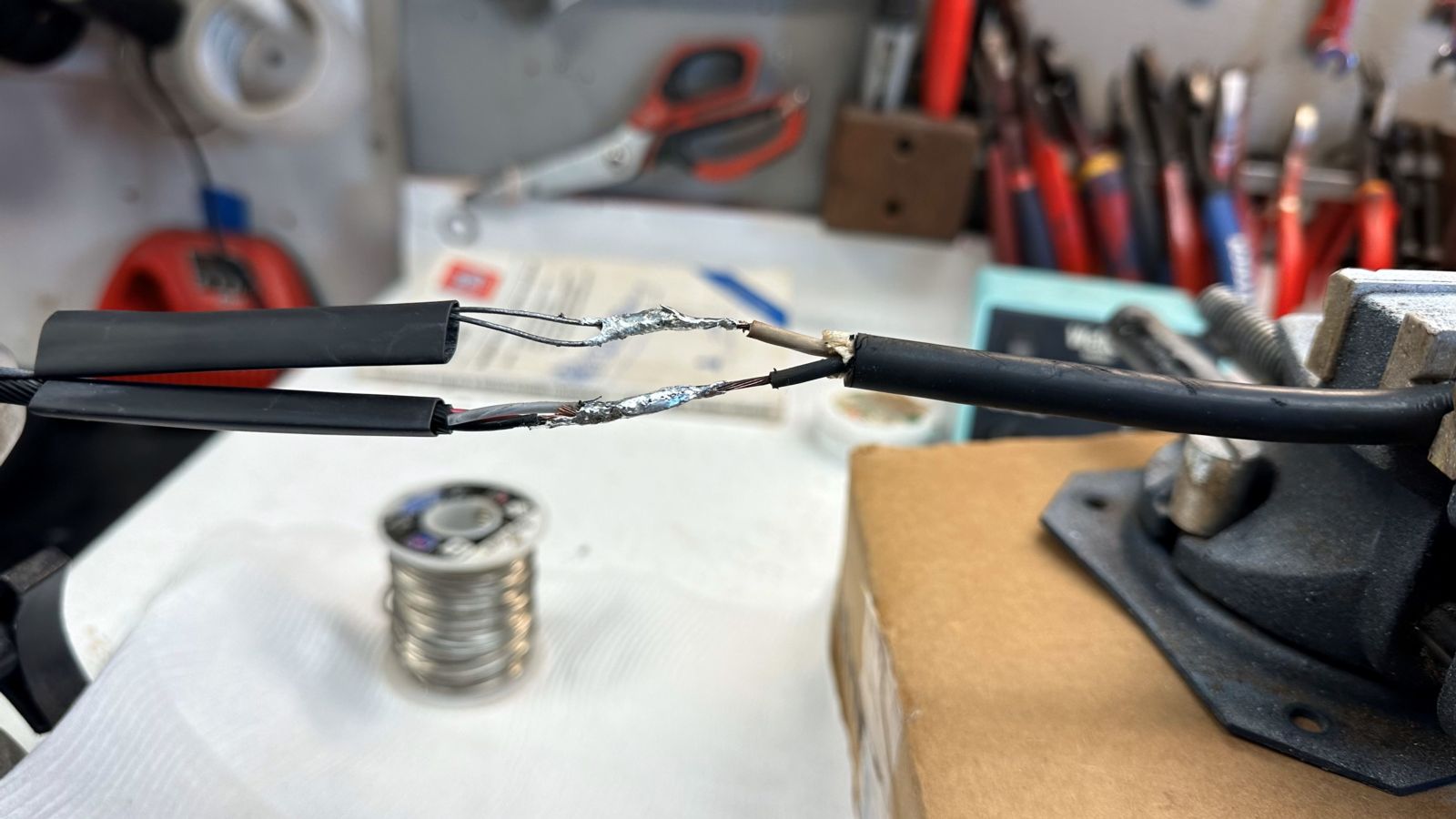
I first have to cut through the CTD outer layer using a Dremel and make sure it is an even cut so that when I cut the inner layer, it is even for termination. I then cut the inner layer and leave two metal strands alone so that the positive or negative wire from the pigtail cable will be later attached. I then move onto another layer which is a silicone shield, to protect the inner wires from touching and conducting electricity to the outer layer that also sends and receives signal. I strip the silicone shield by using a wire stripper and delicately remove it to reveal the 3 strands that can go to the positive or negative wire. The trickiest part is having to individually strip these three very thin wires without cutting through them! If I do make that mistake, I have to go down further into the cable to try again and if that happens too many times, I might have to start over from the start!! After I carefully strip each wire and sand wire to expose the pretty pink wire, it is time to move onto the pigtail cable!
Revealing the inner wires of the pigtail cable is relatively easier and the same process as stripping the three thin wires. I use a wire stripper to cut through the thick black pigtail cable to reveal the two inner wires and some paper to keep the cable in its circular shape. I use the wire stripper again to strip down these somewhat thin wires and sand them down to reveal the pink wires. I sand down the wires so that the next process is a bit easier for me.
Once everything has been stripped and sanded down, it is time to put the two cables together via soldering! I prepare the soldering material and twist the matching wires together so that soldering is easier. To find out which wires from the CTD cable match the wires from the pigtail cable, you do a continuity test using a multimeter to find out which wire is positive and negative. Once that is figured out, you can then twist the wires together and start soldering!
Before this internship, I was not too experienced with soldering since I did it a few times for a class. However, now that I have practiced a bunch of terminations using solder, I got the hang of it!
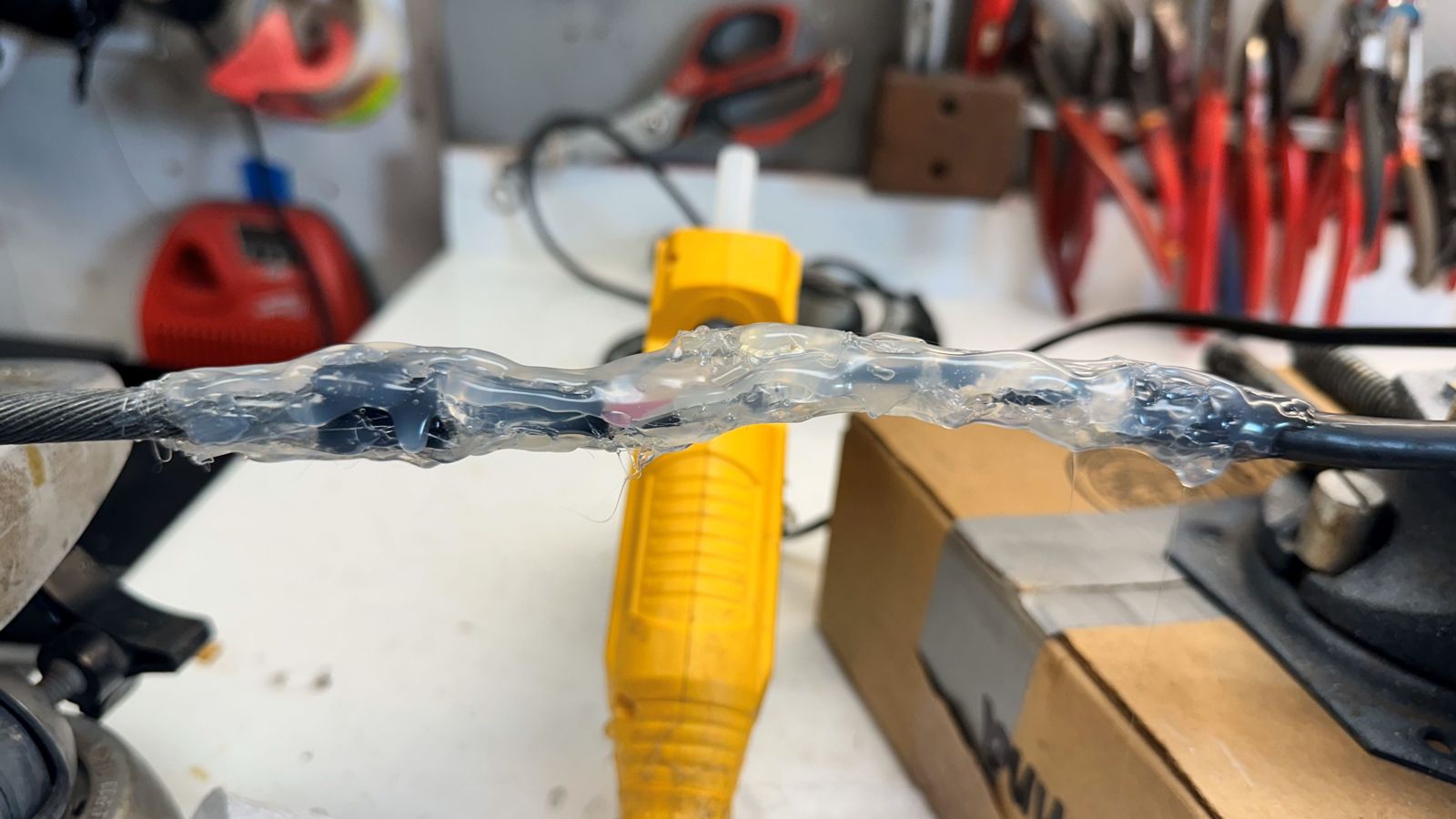
Once I soldered the wires together, making sure to cover most of the exposed wire, I then cover it with heat shrink to really secure the new termination I made. Then there are two ways to go after this step to fully secure the termination. There is a resin/silicone inline splice kit method or a hot glue method. Both choices vary on the context of making a termination, whether that be time constraint or quality of termination. The hot glue method is just as good as the resin inline splice method and dries quicker to use the termination ASAP. The resin inline splice method, depending on the manual, takes 24 hours to set but is very sturdy and has a nice mold it can set in. I went ahead and did the hot glue method since I am only practicing and would be very fast to set.
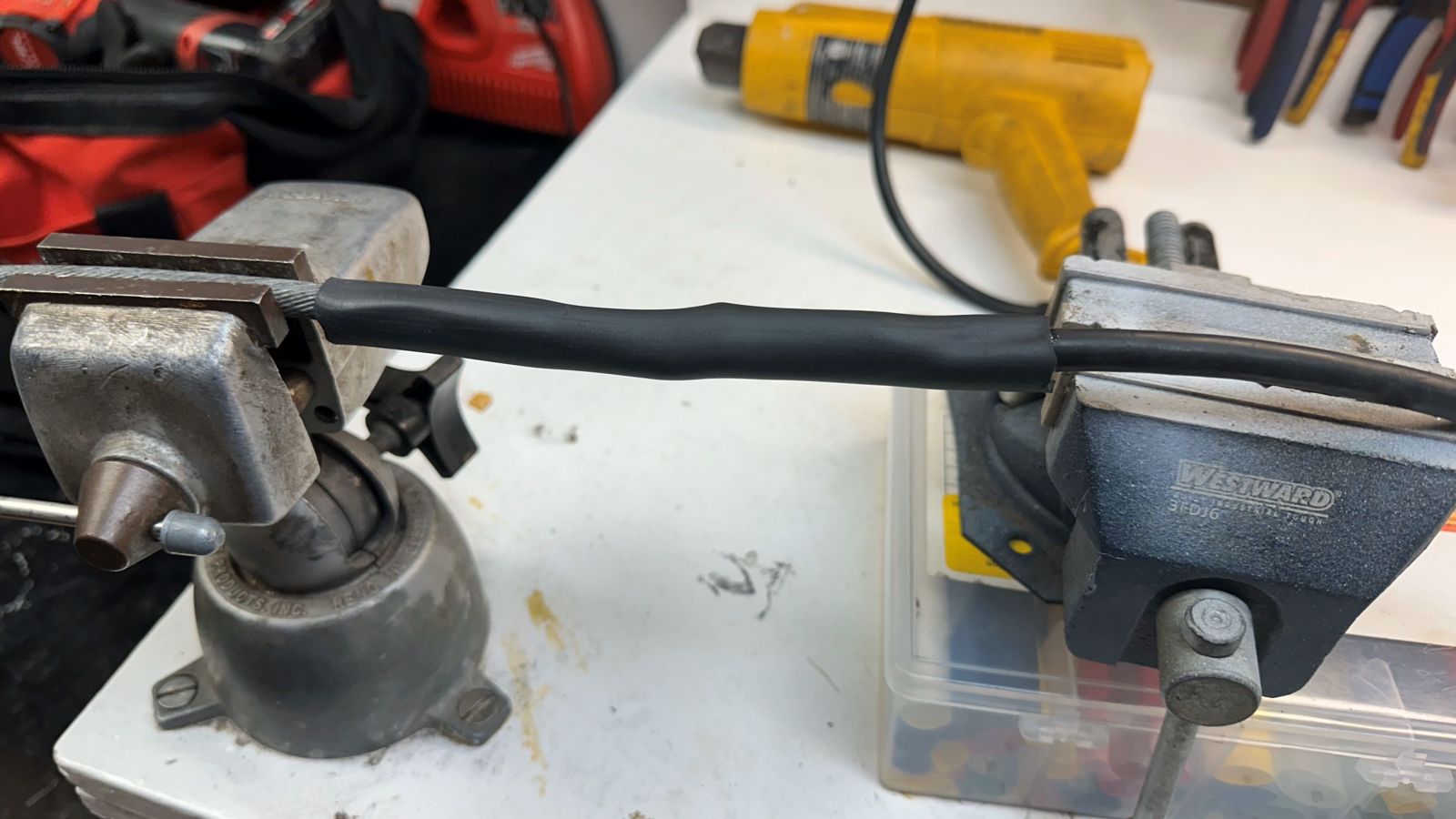
I started hot gluing the new soldered wires together to form a single cable, the same diameter as the CTD winch cable, and made sure it was nice and even. To really secure the hot glue termination, you should hot glue a few inches past the cables so that the hot glue has something to really hold onto. Once that is done, we can now use a bigger heat shrink to finalize and secure the new termination once more!
I use a bigger heat shrink so that the new hot glue can be covered, and that the diameter of the cable is even across the entire termination. This step usually takes a while if I use too big of a heat shrink but, in the end, they all shrink down to a good size and secure the brand-new cable termination I just finished!
9/17
Today, I learned how to process some CTD data to help scientists calibrate their data. To process CTD data, we use a software called Seasave that automatically gathers the data and averages values depending on the parameter. I first had to process all the CTD data which was one file output and then, to help out a scientist who wanted average sound velocity at every meter, I went ahead and processed the output file. To get sound velocity averaged at every meter, I had to bin the data by one (which accounts for every meter), and then press the process button to get the bin file! I then give all the processed and binned files to the scientist who needs it, and his data will be calibrated soon!
This current cruise is about to wrap up as we head to shore now, so in preparation, we turn off the SCS system, flow thru system, ADCP system, and ship track system once we reach Gulfport Bay. Once these systems are shut down, they will usually be saved in their respective folders within the ships network. That means the marine tech has to gather all the individual data from the systems and put them into folders labeled ADCP or SCS that then get added to one major folder with all the cruise data! This single folder with all the science data gathered from the entire cruise is then transferred to a USB which is then given to the Chief Scientist of the cruise!
It is very fun to know where cruise data comes from, how it is manipulated (sometimes), and see it all come together to be given to the Chief Scientist. I have been on the other side of the science where I receive that data and have to do some post processing to get the data I want and need. In my head, it all makes sense where the data comes from, how its saved, why it has to be saved in certain formats, so we the scientists can go crazy with the data!
Later that day when we had some down time, we went over the name of hand tools which I am not too familiar with. The only hand tools I know are a Phillips flat head, screwdriver, and a hammer. Outside of that, everything I learned and mentioned on this blog has been learned on this boat!
Then to end the day with an activity, I was introduced to hollow braid and how to splice with it! This type of rope is synthetic but braided very meticulously so that when you push against it, it opens up, but if you pull it, it tightens. To splice this rope, you need to use a tool called a fid. The fid looks like a knitting needle with a pointy end on one side and an opening on the other. The opening is for the hollow braid rope to go into to be able to tuck the rope into itself. Grace taught me a trick to cut the end of the rope at an angle and tape it off with electrical tape to be able to effectively insert it into the opening. To really secure it, she says to wrap the area around the fid where the rope is inserted into with more tape. Now that it is taped up, it is ready to splice!
To splice, you need to have enough line to either make an eye splice or an end splice. Usually, the amount of length needed to make a secure length is around ten inches. When beginning a splice, you put the pointy end of the fid into the rope (with enough space) and start pushing the rope into the hollow braid. It will naturally start to open up and go further into the fid. Once you are at or past ten inches then you take the fid out and then take the rope from the fid and pull the rope from both ends. This will make a seamless splice and keep most of the strength of the rope!
9/18 & 9/19
Today we reached shore, and I learned how to shut off the flow thru system! Yesterday I learned how to turn off the systems but now I have to fully shut the flow thru system down so that I can learn how to deep clean it! Lots of algae accumulates in the transmissometer and the TSG (temperature, salinity, and conductivity) so marine techs have to maintain these sensors and clean them every other month!
Cleaning the transmissometer, we use grit soap to clean it first, and then use diluted bleach to wash the grit soap and then rinse it with water to finish it off. The TSG is more delicate and can be cleaned with grit soap but cannot be cleaned with bleach! Then you must rinse the TSG with water and use a scrub to get the grime off. Once everything is clean, you put the sensors back together (which is hard on this ship) and boom, the flow thru system is cleaned!
Next on cleaning is the CTD sensors and Niskin bottles! This CTD cleaning has to happen after every cruise is complete so that the sensors are ready for the following cruise. The products used to clean the CTD are diluted Triton X (a surfactant), diluted bleach, and DI water in that order! I used a big syringe with a tube connected into the CTD sensor in order to pump the chemicals back and forth to get all the accumulated algae and saltwater out. Once I am done cleaning, I leave a bit of DI water in the CTD so that the sensors stay wet and maintain function.
Once that was done, I rinsed the entire rosette with freshwater and made sure to rinse the inside of all the Niskin bottles so that they were all nice and clean. I left the bottles open for them to air dry and once they fully dried, I closed them and finished cleaning the CTD rosette!
9/20
Now that the first cruise is done, the ship crew has to start preparing for the next one! Today we are mobilizing for the next cruise and that means getting our shift schedules in order. Me and Grace agreed that I should have the morning shift from 4am to 4pm, leaving me to be the sole marine technician for around four hours!! This means I have to be in charge of coring operations and CTD casts before Grace is even awake! This made me a bit nervous at first since I have not done a coring cruise before but the mate and deckhand on shift will help me through it all!
Since most of today was scientists getting their equipment on board, Grace went ahead and introduced the Chirp echosounder to me. The Chirp system on board has two settings; 3.5kHz and 12kHz. The 3.5 kHz is used to make a 2D profile of the seafloor and also display subfloor layers, which can tell scientists what type of rock it is. This, however, comes at a cost on the ship since the Chirp sends loud signals and at a fast rhythm depending on the depth, which might disturb sleep for people. The 12kHz on the other hand is much quieter and can give a profile of the seafloor but cannot display any subfloor layering. So, scientists may want to use one setting over the other depending on their needs. On this mud cruise, the PI wants to use the 3.5kHz to create a seafloor profile in order to see what type of rock is beneath the seafloor.
9/21
This morning was my first shift alone as the marine technician! It was a really rough start but, in the end, everything worked out how it was supposed to! Coring operations with the Mega core require someone to control the A-frame, the .680 winch, and the ship. The way things worked out this morning was that the deckhand controlled the A-frame, I controlled the winch, and the mate controlled the boat (to keep it on station). I was not expecting to control the winch, let alone do it on my first coring operation, but I did it anyway and learned on the spot.
When it comes to controlling the .680 winch, you have to keep in mind how the A-frame moves. If the A-frame moves out, the package the winch is connected to will start lifting up because the winch cable is getting shorter. If the A-frame moves in, the package will start to move down as the winch cable is getting longer.
With this operation, we have to lift up the Mega core above the ground so that the co-PI can switch a pin from one hole to another that allows the Mega core to capture mud samples when it hits the seafloor.
Then we can fully A-frame out and that will lift the Mega core up and that is when the winch operator must pay out (give more line) so that it can smoothly go horizontally outwards. Once the A-frame is fully extended out, the winch operator can begin to fully pay out at a certain speed before sending the Mega core down automatically.
I was the one controlling the winch during the first coring operation and that was a bit rough. I could not quite grasp the idea of the A-frame moving and influencing the winch cable at first so when it came to lifting the Mega core before deploying it and recovering it, I was scared that I was going to squish someone’s toes! Despite my nervousness, I was able to safely deploy it and get it back on deck, and even got 11 cores out of 12! This was important since the twelfth core had not been working for months and 11 cores means all samples were collected as much they could!
9/23
This morning was busy with coring operations back-to-back. The first coring operation was a pleasant success as twelfth core on the Mega core somehow worked (which had not worked since early this year) and almost got all coring samples! The science team was so excited to see that specific core get something and made me happier that all the deck operations and winch operations were worth it even for this small moment.
Since the science party wants to start coring operations at 4am when my shift starts, that means I do half of the coring and CTD operations on deck. Sometimes I go ahead and do them all because I really want to experience the true work life of the sole marine technician on board. I, of course, am never alone as Grace always has my back and the crew are always there to support me.
Since joining this ship, I have gotten a bit shy around the new science party that joins, and I was really curious as to what this science party were looking. All I knew before they joined is that they are sampling in the Deep-Water Horizon oil spill region. I got the courage to ask them about their science project and they were very kind and open to explaining the whole reason why! The main science group that processes the mud core samples is looking at the biological samples from this sediment, whether it be microscopic or macroscopic, and seeing how the Deep-Water Horizon oil spill has impacted the species in the area. I saw that they were slicing the cores in specific lengths and I asked about that and the Chief Scientist/PI of the lab explained that when science groups first did coring samples of this region, they all sliced the cores at different lengths, and they are attempting to match each study with different lengths. That way they can compare the samples with all the different studies in a somewhat standardized way! I asked another group what they are doing here, and they want to use water samples to filter for eDNA and POM (particulate organic matter).
We ended all deck operations successfully and headed back to shore a day early since a new tropical storm (turned into Hurricane Helene) was forming and creating high wave height by tomorrow, so we want to avoid it as much as possible.
This mud cruise was super hard yet super fun! See you all next week!




.jpg)