Category: Host Page 45 of 85

Week 6: Wilhelm Cruise

This cruise was particularly exciting because the science team was large (15), and they were all brand new to BIOS. Their research involves viruses and microbes, primarily in the mixed layer. This means that the CTD casts were shallow – usually 500 to 1000 meters, and most niskin bottle samples were fired at the surface. This means the cruise was fast paced compared to a BATS cruise.

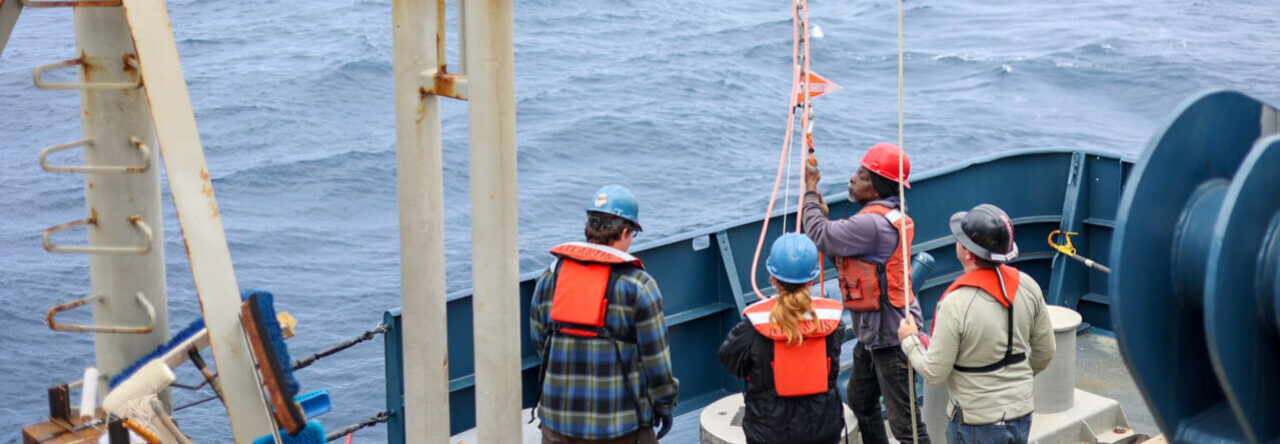
The first thing we did after arriving at the origin point, was deploy the drifter. This was a fun operation because it requires that everyone work together, and it was very hands on. A picture of the operation is below:


The recovery was also exciting because it was even more hands on! The drifter was basically pulled in by hand except for the highflyer buoy which was lifted aboard using the large a-frame:

The main event of the cruise were the CTD casts every 4 hours. This means I got a lot of practice deploying and recovering the package. One issue we had with the CTD was the secondary oxygen reading, which was coming in much lower than the primary reading. During troubleshooting, Jillon and I discovered that the small o-ring inside the pump head was dried up. Luckily I had just tested all of the spare pumps several weeks earlier, and was able to know which would be a good replacement.

On this cruise, there was a bit of concern about the MilliQ machines because there was excessive water in the room, indicating a possible leak. Throughout the cruise I monitored the room for spills/leaks and helped to inspect the inside of one of the machines with a potential leak.

Another project I worked on during this cruise was to connect the underway Thermosalinograph (TSG) instrument to a computer and run diagnostics. This was a bit challenging because we did not have the proper testing cable on board. To work around this, I wired a female DB9 connector directly to the TSG and plugged in a cable to the DB9 head. It took several tries to get the serial connection transmitting properly, but I eventually made the connection work, and have a better understanding of testing cables.

After this cruise, we have a quick 2 day turn around before heading out for a routine BATS mission for the next week.

Until next time!

Week 7: Sea Gliders

    We are just about done with our cruise. One more mooring recovery and we sail back to Dutch Harbor. I’ve had a great time working and learning all about marine technology and mooring operations. But my time on the Healy is not over in Dutch Harbor, I will be sailing back all the way to Seattle. Transits between ports are nice, the workload is not as time dependent as the actual research cruise. The science mission itself is drawing to a close. For me this was an unconventional cruise, as there was a lot of time dedicated to actually learning the theory behind all systems and instruments onboard. I feel like I’ve accomplished all of my goals during this science mission. I’ve learned all the intricacies of managing deck operations and coordinating science needs with the abilities of the ship and crew. I feel fortunate that the people I work with are always willing to take their time and teach me the skills and knowledge that they’ve acquired in their lifetime. As a novice MATE intern I have the opportunity to absorb what is taught to me without a bias. In fact, the way I see it, unbiased learning is a  privilege that only belongs to beginners. And I have to admit, I do ask a lot of questions. With every new scientific operation, there is something new to learn, something new to see, and I’m always happy to help scientists with whatever they need. There were numerous scientific operations within the last week, yet the most memorable one was sea glider recovery.

    One of the best things I got to do during the cruise was be a part of a sea glider recovery group. The operation requires two scientists deployed on a small boat. The sea glider comes up to the surface and floats tail up. The objective is to catch the glider, without damaging the instruments, deploy a glider cradle, while the glider is still in water, and bring them together back onto the small boat. Usually scientific party does the operation by themselves, but by the generosity of the Chief Scientist and the approval of the STARC Coordinator I was able to participate in the glider recovery operation. This operation was probably the most exhilarating event of the entire cruise. Not that other operations were boring, rather the thrill and adrenaline rush of the glider recovery is unparalleled. But, like any high risk operation, glider recovery requires meticulous preparation, and protective gear. Naturally, I did not bring any of the gear with me, so I had to borrow the thermal mid layers from my supervisor, and a dry suit from the science party. Once again, I am grateful to have co-workers that are invested in my experience and safety. I got a brief training by the science party, and sent out to the small boat. We boarded the small boat and were lowered into the water all the way from O-3 deck. Riding through the swells, Arctic wind in my ears, sea spray splashing in my face, I could not be happier. As we moved in onto the glider location, we reached for the tail, and missed. A few more tries, a couple of position adjustments, and we caught the glider. The command of the operation was delegated to one of the University of Washington grad students, as she had the most experience. While she held the glider and positioned it the right way, I lowered the cradle into the water. With the help of two crew members from the Coast Guard, we got the glider in the cradle and brought it back onto the small boat. Its funny, I was more nervous about messing up, rather than going overboard. Writing about this event, it does not seem that fun and exciting, but experiencing it, certainly was amazing. 

    Shifting away from the exciting world of science operations and into the world of marine technology, I keep finding new aspects of ocean technology that I’ve never thought of before. I’ve learned how to terminate fiber optic cables, and the intensive care required in doing such. The cable terminations are a craft, that require practice and patience. The skill requires a time commitment to comprehend and memorize, to the point when it becomes muscle memory. And after it has been learned and perfected, it’s seldom used. This is mostly due to the fact that infield fiber optic cable terminations are less than ideal, and are a last resort measure. But maybe that is the point of a Marine Technicians skill set, to know what to do when things fail, and hopefully have the foresight to prevent failure. It takes time, and an abundance of concentration to research different parts in the process of transferring an electronic signal to numerical data to computer visualization. Countless human hours are spent in troubleshooting and analyzing possible sources of error. Yet most often than not, the right answer is the most simple one. From what I’ve seen, a broken cable, or a failed battery are the culprits of most problems. And even though it only takes a minute or two to solve such a problem, it takes years of knowledge to properly assess the situation and make correct conclusions. The most important skill I’ve picked up so far, is the methodical approach to problems that I have not encountered before.
Week 5: Return to Bermuda

We departed from San Juan, Puerto Rico on Saturday for the 5 day return to Bermuda. This cruise is much more mellow compared to the cruise down, because we have fewer stations to sample, and the CTD does not need to go to the bottom every time.

Once we returned to port, we began preparing for the Wilhelm cruise, which is a new group of scientists. This involved taking all the BATS equipment out of the labs and helping to get the new scientists set up. Their research plan is to deploy a drifter at the BATS station and follow it, taking CTD casts and samples every 4 hours. The drifter utilizes a high-flyer buoy, a sea anchor and trailing buoys. It is equipped with a flashing beacon with a radio signal (RDF), an AIS transponder, and an ARGOS transponder. On the mobilization day, I helped turn on and set up the equipment for deployment and secured some items on the CTD (See picture!)

Until next time!

Week 6: Marginal Ice Zone

Back and forth in the Beaufort sea, a sea lacking any notable features. Most days are grey, without any marine mammal sightings, a few dim auroras flickering at night, and occasional snow. Hours seem to last forever, but days fly by without me noticing at all. Yet, even after six weeks aboard the ship, I still enjoy my time here. The science mission is steadily wrapping up. One of the projects that was added to the remainder of our time, is underway CTD system or UCTD. Simply put, it is a little torpedo looking device on a thin line that’s towed behind the ship. The UCTD operation is a round the clock survey of the top one hundred and fifty meters of the ocean. The main objective is to collect a continuous profile data along a specifically designed track. Such that, for the data not collected during the survey, it can be interpolated with statistical significance from the survey that is done by our scientific group. The shifts for volunteers are split up by two hours per person. One would think that two hours outside do not seem as a difficult task. But when the wind shear adds to an already below zero air temperature, two hours standing on deck can be difficult for some. Yet field observation often require an endurance of bad weather, and repetition of a mundane technique. It’s a difficult and exhausting pursuit, without much glory. But that is what our research voyage requires, a sacrifice of comfort for a glimpse into the unique processes of ocean dynamics in the Arctic. The ship’s track is a spaced zigzag in the Marginal Ice Zone or MIZ.The science party is highly interested in collecting all possible data in the interface of ice meltwater and ocean surface layer. The big picture of our cruise is to understand the increased impact of meltwater upon the physical mixing of the ocean surface layer. At least that is how I understand the mission. 

Marginal ice zone is almost an ambiguous sea state. Mostly made up of pancake and grease ice, the sea is a strange boundary layer between the open ocean and packed sea ice. The scientific definition is still debated, with only recent attempts at defining specific parameters. The simple explanation is that MIZ is the region between ocean and packed ice, where waves are still present in the sea state. The waves are dampened by the presence of ice chunks on the surface, but the swells still move through the ice zone. The dampened wave action manifests itself in long periods through the ocean surface, gently uplifting and dropping pancake ice. Every now and then there is just grease ice in the water, which looks extremely smooth, very much like a layer of grease covering the surface of the ocean.  The marginal ice zone is a unique section of the ocean, due to its peculiar fluid dynamic processes. 

 Even on slow days, there is still a sense of adventure and wonder in the scientific work that we do. Even the basic underway surveys from the ADCP unit and the Multibeam echosounder will be used by scores of scientists back on shore. It’s hard to explain our work to people who are not interested in the scientific pursuit. It does seem almost absurd to sacrifice so much time and effort into continuously collecting data that may or may not be used in further studies of the region. I guess it is an existential choice to work in science, there is no immediate gain from our work, but an addition to the collective knowledge of the world’s oceans. Prior to this cruise I had no idea what a Marginal Ice Zone is, or its importance in the physical processes of the Arctic Ocean. Being part of an effort that seeks to study the unknown, is rewarding in itself. 

        Besides assisting the science party, I’ve spent my time further studying computer networking. I’m not particularly interested in the subject, but it’s a big part of the Marine Technician industry, so I ought to know it. This week has been devoted to learning fiber optic cables. One of the big movements in the industry is to use fiber cables more commonly, as they are immune to radio frequency and electromagnetic interference, which are abundant on any ship. However, unlike the generic electronic cables, fiber optics are a lot more expensive and difficult to work with. They require much more care and specialized tools for termination and splicing. Even though fiber optic cables aren’t as exciting as other oceanographic work, it is still a part of the technicians job, in support of the science mission. There are many parts to this job that aren’t glamorous, and are rather mundane, but they need to be done. On the other hand there are very few workplaces that would invest a lengthy amount of time into training interns such as myself. I feel fortunate that the STARC team is invested in my professional development. Often times interns are used as a source of free labor for mundane tasks, without much educational value. However, my experience is without a doubt an educational one. Everyday I learn something new, that is part of is part of seagoing technicians career. I feel confident that by the end of this internship I will have the knowledge I need to continue my career as a Marine Technician. 


Week 4: BATSVAL Cruise and Puerto Rico

The BATSVAL cruise is a yearly cruise that covers a transect of 15 stations between Bermuda and Puerto Rico. Each station involves at least a CTD casts to 20 m above the bottom, and 24 niskin bottle samples. Some also included plankton tows, or McLane filter pump deployments. Since the stations are about 6 hours or more apart, and the CTD casts take 3 or 4 hours, we normally only did 1 or 2 per day. This makes for a pretty slow cruise, but efficient and well prepared deployments.

During the ample down time, I made a point to continue working on Arduino projects and practicing knots that I learned from last week. Each of the Marine Techs have also been teaching me about the various data logging systems aboard the ship. I also continued the cable inventory and organizing from previous weeks.

There were three larger projects I spent the rest of the time working on: calibrating the flowmeters for the underway sampling systems, inspecting and testing backup CTD pumps, and creating quality control plots for the meteorological sensors.

Calibrating the flowmeters reminds me of the lab procedures I did in a Water Resources Engineering class. With one of the other Marine Techs, we controlled the flow to different rates with the valve, and did multiple time trials to fill a vessel. Then, we can use the timetables in combination with the raw Hertz reading that is sent to the data logger to create a calibration curve that relates Hertz to mL.

Inspecting and testing the CTD back up pumps was my favorite project as I was able to take apart the entire assembly and check out the circuit board that controls the pump motor. I was able to see the things I have been learning about with the Arduino board in use. The pumps used on the CTD are actually pretty simple and involve a similar program to one of the Arduino projects to power a rotor that spins a magnet. The magnet then spins an impeller that sucks in water through the pump head. I also inspected the o rings and re-lubricated each pump.

The final project I spent some time working on was to use the data logger built in software to create real-time plots that allow data from duplicate sensors to be compared. For example, I created a plot that displays data from the anemometers on each mast, so that we can compare in real time if one may be different from the other when it shouldn’t be. I also discovered that the humidity sensor on one of the masts is not working correctly, and collected a sample of data comparing it to the working sensor, so that it can be sent in to the manufacturer for troubleshooting.

We arrived to Puerto Rico this afternoon, ahead of schedule. It is great to have a bit of a break between cruises, and to visit San Juan for the second time. The ship is scheduled to depart on Saturday, with some extra sampling planned for the way back to fill in between stations.

Cheers to be in Puerto Rico!

Deploying the CTD for a deep bottom cast: 


The disassembled Seabird 5T pump: 

Inspecting the electronics:

Castillo San Feliple del Morro guarding the entrance to San Juan’s port:


Week 5: Back to Beaufort Sea

Something that no one tells you about research voyages is that most plans are ever changing. Our research cruise has been ahead of schedule in accomplishment of the science mission. There are multiple additional goals that have been added, on a rolling basis. However, I do not know much of the details, and usually wait until a planning meeting prior to the evolution. Other than assisting science I keep myself busy by learning different skills of a marine technician. There is no single task that marine technicians do that would define them. Rather, the job requires working knowledge of a thousand little things that are necessary for continuous data collection. So far I’ve tried my hand in terminating CTD cables, deploying CTDs, computer networking, meteorological data acquisition, and an endless list of instruments and software that a MarTech is responsible for. 

    Sometimes I find it difficult to keep up with all the nuanced details that I have to learn. There is a sense of panic that I experience whenever asked to do something that I don’t know how to do. I guess one of the best ways to learn something is to figure it out as I go along. Sometimes I feel nervous while at work, maybe it’s something all newcomers experience when they enter a professional field. Other times I want to rush into a task and get it done as soon as possible. I have to remind myself to slow down, breathe, and listen to my superiors tell me how to do it right. As the coast guard likes to say “slow is smooth, smooth is fast”. But I’ve been doing alright, taking my time and learning. There are some things that I feel very confident in, such as: deck work, basic electronics, basic mechanical fixes. Yet there are other tasks that challenge my understanding. Most software, advanced electrical troubleshooting and computer networking prove to be quite a challenge. Much of the concepts behind something like computer networking are very abstract. Luckily there are multiple team members within STARC and the science party that can explain how to communicate with instruments, and how to direct data flow to the Healy servers. Information technology and its application to marine science is interesting in its own way. Yet it is also very much a background process. By design, IT systems are hard to notice and often overlooked by an untrained eye. So far I’ve been familiarizing myself with the IT nomenclature, such as: Dynamic Host Configuration Protocol, Domain Name System, Random Access Memory, etc. Sometimes it takes going over the material a few times before it starts to make sence. Lucky time is something I have quite an abundance of while out here. Just after a few days of studying the subject I can communicate with other devices on the network from my computer, route cables, and most importantly; understand what is going on. One of the main learning objectives that I had for the MATE internship was to learn system networking and its application to ocean instrumentation. During many application processes that I’ve underwent prior to the MATE internship I was always lacking the skill in system networking. Other than system networking I’ve also learned the details of CTD operations.

    Throughout the cruise, we’ve been performing a CTD cast at every mooring deployment site. CTD, or Conductivity, Temperature and Depth instrument is the most fundamental of all marine technician responsibilities. From my prior research cruise experience, CTD casts are the bulk of a scientific mission. However, since the objective of this science mission is to deploy moorings, there has only been a few CTD casts.  The responsibility of the marine technician is to maintenance and operate CTD instrumentation. With the assistance from the STARC coordinator, I’ve had to opportunity to disassemble and reassemble the CTD instrument, colloquially known as the “CTD fish”. It’s the fine details, of knowing which sensor requires a two pin or a three pin cable, what is the angle of tygon tubing connecting the seawater pumped to the conductivity sensor, that are the purpose of my internship. In science, precision data collection is guaranteed by equally meticulous attention to detail in instrumentation. While on this particular cruise, the CTD cast are specifically targeting physical properties of the ocean. There are no Niskin bottles installed on the rosette. It’s probably a better training environment since the task is not rushed by the demands of water sampling by scientists. I’ve been able fix small issues that I find on spare parts of the CTD, slowly putting together all of the details taught to me throughout this internship. 

    Our research cruise is about half way through the mission. Majority of the goals have been accomplished, and now additional projects are added to fill up the time on the Healy. With each day aboard I learn something new, even if it is stressful at times.

Week 3: Port Days

This week Hurricane Jerry delayed our departure to Puerto Rico for the yearly cruise from Monday to Thursday. The strength of the storm was much weaker than Humberto, and really just felt like a bad rainstorm. Some items around the ship still had to be tied down and put away to prepare, but we did not have to do major shutdowns like for Hurricane Humberto.

While waiting for the storm to pass, I helped with a variety of smaller tasks around the ship. Having a long stretch of time in port is useful because it is often easier to get projects done without the motion of the ship. One project was to dissemble, clean, and replace the bearings in the block used with the CTD, which is pictured below. The high frequency of CTD casts was evident in the difference between the older, worn bearings and the new ones. I also have been practicing knot tying with the help of the ship mates and the bosun – some important knots I hadn’t known before are the double bowline, clove hitch, a variety of joining bends, and a monkeys fist.

One other project I work on during slower periods of time is an Arduino kit that is aboard the ship. So far, the projects have been relatively fun and simple, but give a good introduction to how programming and electronics go together, which was something I hadn’t done before. I intend transfer what I am learning to programming sensors and inspecting their electronics in the coming weeks.

Our departure on Thursday was very rough, since we headed North from Bermuda for the first leg of the trip, basically following Hurricane Jerry. Winds were sustained at 35 knots and seas were about 12 ft, however I did not get seasick! While the schedule is still up in the air, we are scheduled to head South on Saturday after completing the one Northern station, and arrive in Puerto Rico in a week after sampling 13 more stations.

Heres to a successful rest of the cruise!


The Harken Block opened for cleaning and inspection and worn down bearings.


One of the quick Arduino projects involving a basic circuit and programming.

Week 4: Ice Station

The far north reaches of our sea voyage. We’ve lost the internet for about a week, which was a nice change of pace. It’s rather relaxing to detach from the troubles on shore. Some people have a hard time isolating themselves from the world, but that’s not a problem for me. Its kind of funny, I felt more isolated while on land, than while at sea. Some of the best conversations I had were at sea. That’s one thing about working in oceanography; Everyone who is aboard, wants to be here. From the intern fresh out of college, to the chief scientist, everyone has a reason to be out in the Arctic. It’s interesting to hear stories, of tangled and extraordinary lives that brought everyone to this voyage. Some of the scientists had vastly different careers prior to becoming oceanographers. Some were construction workers, others were bartenders, some were merchant mariners, and only a few knew their path from early on. It’s reassuring to me that there is no one way of starting my career, and that sometimes careers depend on luck more than anything. Conversation seems to flow a lot easier when there is one goal at hand. One way or another I’m helping out everyone who asks, learning new methods and building professional networks. As for the work we do, so much has happened in these last few days, it’s hard to put everything down in writing without missing all the details. 

    Our expedition has reached thick sea ice, and we’ve been hunting for the ideal ice floe. Ice floe is just a fancy word for a big ice chunk. First the the infrared sea ice satellite imagery is sent to STARC. Then the processed and re-projected images are then given to the scientific personnel onboard from the National Ice Center. The imagery is then analyzed with the use of ArcMAP, an older  GIS program. I was somewhat surprised when I saw government agencies using outdated software. There is often a misconception that government agencies have top of the line technology. But for the work that we do, it gets the job done. After the ice floe has been identified Coast Guard sends out a reconnaissance team assisted by sea ice expert from the science party. After the ice has been deemed suitable for working conditions, the work begins. Ice work requires layers of foul weather gear. Mustang suits and ice boots, balaclavas, waterproof gloves; we have to do everything possible to mitigate frostbite. Ice stations are a big deal onboard the Healy. Its one of the few times the routine of everyday life onboard is changed. Both crew and scientist alike volunteer to help with hauling equipment from the ship to the ice. Our first ice station required five separate buoy deployments. I was assigned to the one titled WIMBO, or Weather, wave, Ice Mass Balance and Ocean drifter. We got all of our gear together and began drilling the site that was mapped out for us. Ice drilling is probably one of the most exciting things I’ve done on this cruise. A seven foot tall, twelve inch diameter drill, powered by a gasoline motor that cuts through ice like butter. Handling the ice drill requires a least two people, since there is a lot of kickback. Yet, as soon as we drilled at the original site, we hit a melt pond. Melt ponds are a basins of melted freshwater within the ice floe. These basins are a nuisance for ice buoys because they destabilize the position of the buoy on the ice.  So, we had to gather everything up, put it back on the sleds and venture out beyond the perimeter to find a new site. Once again we set the drill, powered up the motor, and began drilling. After about a foot, we hit a melt pond again. Next four or five tries we kept hitting melt ponds, until finally we found the site worthy of buoy placement. We drilled a hole in the ice, and assembled the WIMBO buoy. The WIMBO buoy profiles the water column at a depth of two hundred meters. We lowered a cable riddled with temperature and pressure sensors into the ice hole. The entire operation took roughly four to five hours. The WIMBO buoy is one the most recent programs, seeking to quantify under the ice ocean layer horizontal temperature gradient. As I finished helping the WIMBO group I jumped over to the other buoy deployments. Part of me wanted to learn other ice drifter systems, and part of me just wanted to stay on the ice a little longer. I ended up helping out the Woods Hole group with their buoy drifter. The Woods Hole group was deploying an ITP buoy or Ice-Tethered Profiler. The ITP’s are also quite a unique buoy, as it has two instruments that slide up and down the buoy wire to measure ocean current velocity and heat exchange in the upper ocean layer of the Arctic. Much like scientific mooring buoys the ice buoys also require an astonishing amount of planning. While on ice the lead WHOI scientists leads the team by strict command and fast paced work pace. Unlike conventional scientific work is often slow paced, meticulous and generally safe ordeal, field oceanography is high pressure and high risk. The system of management in field oceanography is much more analogous to military style of management. Everyone knows their place and follows the order given. Yet despite the high pressure during ice operations  much of the science party and STARC personnel are patient with me, and try their best to educate me in field techniques.

    After our science group finished up the buoy deployment, most of the scientists went back on the ship. Myself and a couple other scientists stayed behind and helped out the coast guard with loading the gear back onto the ship. As we were finishing up cargo operations the ship’s whistle went off. A distinct signal; there was a polar bear sighted close to the ship. He was approaching the ship from the starboard side. After climbing the gangway back onto the ship, I immediately grabbed a pair of binoculars and looked on to where he was sighted. I say “he” mostly due to a semi-educated guess based on the size of this particular polar bear. He was quite massive, as it is the end of summer, which polar bears spend fattening up for the winter. The bow of the ship was full of coast guard and scientists looking at the bear passing around binoculars and quick facts about polar bears. I don’t know which one I enjoyed more, having the experience of seeing a polar bear, or sharing with people equally excited about it as me. Maybe it’s the nature of our work, or the remoteness of the surrounding environment, but there is something to be said about the camaraderie aboard the Healy. It is like no other ship that I’ve been on.Looking at the bear in his natural habitat is one of the few moments that truly make this job special. I was looking onto the horizon at the edge of the perimeter, where no human footprints pollute the view. It almost feels like looking onto a different planet. It’s a surreal experience to be out in the Arctic, to see places most people only see on TV in the comfort of their living room. The beauty and awe of the Arctic has not been lost on me just yet.


Week 2: Humberto


After returning from the first cruise on September 12th, we decided to reterminate the CTD cable because it was very rusty. This was a really fun and useful procedure to learn because it utilizes a variety of skills. First, we cut out the rusty protion of the cable, about 50 meters beginning at the CTD and working back. Then, the outer jacket of the cable is dremeled away slowly, so as not to damage the insulation. Once the 3 conductors inside the cable are accessible, they are spliced with heavy duty connectors. We did not use heat shrink around the splices, because we pour a mould around the conductors that should fill in any gaps, and we did not want bubbles trapped inside the heat shrink. The mould set overnight and the cable was ready to use the next cruise.


Here I am using the dremel to remove the cable jacket.


After the weekend, we left on Monday for a two day cruise to Hydro station. The cruise was scheduled to leave on Tuesday, but in anticipation of Hurricane Humberto we left early. Joining us on the cruise was a student group from Oxford college, most on their first research cruise. We did several CTD casts, and a plankton tow which all went very smooth. 

After our return, we began to prepare for the hurricane mostly by turning of many of the computers that were not essential for ship function. We did leave our meterological sensors running so that we could see the wind, pressure, and rainfall as the storm progressed. The rest of BIOS and the crew were busy removing small boats from the water and tying things down. The hurricane finally arrived on Wednesday evening after a slow build up all afternoon. The ship was the best place to be, as we did not lose power and were tied up to the dock. Even our satellite internet connection remained strong during the storm! The most incredible part of the hurricane was the wind, and how much water was blown around off the reach where the ship is docked. On land, many trees were down, and power was lost. See some pictures below:


The middle plot shows the wind speed in knots, from the anemometor on the ship. The strongest gust we saw was 110 knots, but winds were sustained at about 75-80 knots during the hurricane (22:30 – 00:00).


The view from the bridge on a normal day (left), and during the start of the hurricane (right). Swells in the reach were about 4 feet high.


The reach from the main deck on a normal day (left) and during the hurricane (right). 


After the hurricane passed, we restarted all of the electronics aboard, and spent half the day fighting to connect the computer to the CTD. In the end, a new install of the SeaSave software from Seabird solved the problem. I also continued to inventory the underwater cables, and test the custom built cables to create pin-out drawings that display the connections. 

Overall, week 2 was a bit slower, but it has been a good time to think about the different skills and components of the ship that I want to learn more about. Next week, we are schedueld to head to Puerto Rico and back on an 18 day cruise, but may be delayed due to Hurricane Jerry. 

Until then!

Week 3: Sea Ice

Our ship has crossed the Chuckchy Sea, and the Beaford Sea, and now we are in the vast Arctic Ocean. Most days are cloudy and unremarkable in scenery, but when the clouds are gone, and the sun shines through the clear blue sky onto the sea ice, the scenery is breathtaking. When we first saw ice the whole crew ran onto the bow, some without coats or hats, just to the see the first ice of our voyage. There is no wave action in the arctic, sea ice dampens the energy transfer from winds to waves. Yet when the ship hits ice, you can feel the shaking, and the hallow thumps of ice chunks crashing against the steel hull. Moving through the ice feels less like a ship at sea, and more like severe turbulence in an airplane. Throughout last week the watch standers on the bridge have spotted Arctic animals, a walrus and a polar bear. While I got to the see the walrus up close, about ten feet from the port side of the ship, the polar bear could only been seen from binoculars. I don’t have any good pictures of the animals to post, for a couple of reasons. One is that the fauna is mobile and most often seen in a blink of an eye. And more importantly, I’d rather enjoy the experience myself, without attempting to take a blurry photograph on my phone. We’ve transited for a four days, and as we approached the first science station, all the commotion began.


A whole week of scientific work. I feel like I’ve learned more about oceanography in the last week than in last year of college. There is so much to learn, so much to see, everyday is like a semester of material crammed into twelve hours. My day starts around five o’clock in the morning, with a vigorous reading of instrument manuals. For me Its much easier to spent hours upon hours reading while at sea than while on land. Maybe perhaps its due to regimented lifestyle while at sea, or less responsibilities, or maybe just because there is just simply much less of distractions.


By nine o’clock there is an updated plan for the days operations. So far I’ve had the opportunity to finally see mooring buoy retrieval and deployment. The amount of calculations and hard manual labor that mooring buoys require is astonishing. Every little detail has to be accounted for; From the location of everyone on deck to the position of a small temperature probe installed on the wire. But I’m getting ahead of myself. In general, a mooring buoy is an anchored buoy with a wire that stretches from the ocean floor to the near surface of the ocean. The wire is riddled with different sensors, mostly pressure and conductivity sensors, temperature probes, ADCP units, and numerous other instruments depending on the aspect of ocean properties the scientific group is interested. The current scientific project utilizes many acoustic instruments, with a sound source on one of the moorings and receivers installed on others. Moorings themselves are designed and redesigned every year to account for different environments and missions. During the morning briefing the course of action is planned out for the day’s operation. From what I’ve seen; There is no usual course of action for a mooring operation. There is a general plan of how the operation is going to go, but the circumstances are constantly evolving, often with sudden, abrupt changes to the procedures. It takes years of experience to understand every possible detail affecting the operation. Some of the scientific personal have been doing mooring operations for over forty years. After all the planning has been discussed, and risk assessment has been agreed upon, the scientists and BM’s (Boatswains Mate’s) go out on deck. I do not have to be there, but I join the science party on deck anyway. I really enjoy working on deck, the differences between the coast guard and scientists are quickly dissolved during difficult tasks as such. A mooring operation can take anywhere from four to eight hours. Most of the crew rotate their positions with shift changes, scientists stay out for the entirety of the operation. After all is set and done, the ship departs the mooring and transits to the next station. There are many steps that I’m leaving out, partly because I don’t fully understand them yet, and partly because even though they are important, they aren’t exciting to write about. In fact, there is so much going on between the science lab, technicians office, and deck department that I have yet to learn and see. By now I feel comfortable with my duties and responsibilities, I would say I’m rather invested in the work we’re doing out here. Day by day I feel more and more comfortable working with the STARC, even though I am new to this industry.


Page 45 of 85

Powered by WordPress & Theme by Anders Norén