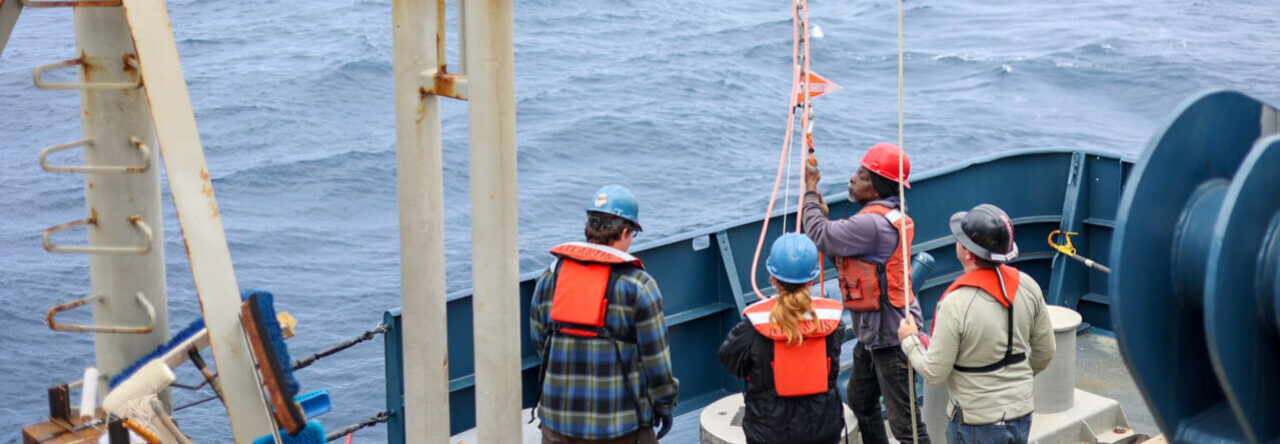
We are just about done with our cruise. One more mooring recovery and we sail back to Dutch Harbor. I’ve had a great time working and learning all about marine technology and mooring operations. But my time on the Healy is not over in Dutch Harbor, I will be sailing back all the way to Seattle. Transits between ports are nice, the workload is not as time dependent as the actual research cruise. The science mission itself is drawing to a close. For me this was an unconventional cruise, as there was a lot of time dedicated to actually learning the theory behind all systems and instruments onboard. I feel like I’ve accomplished all of my goals during this science mission. I’ve learned all the intricacies of managing deck operations and coordinating science needs with the abilities of the ship and crew. I feel fortunate that the people I work with are always willing to take their time and teach me the skills and knowledge that they’ve acquired in their lifetime. As a novice MATE intern I have the opportunity to absorb what is taught to me without a bias. In fact, the way I see it, unbiased learning is a privilege that only belongs to beginners. And I have to admit, I do ask a lot of questions. With every new scientific operation, there is something new to learn, something new to see, and I’m always happy to help scientists with whatever they need. There were numerous scientific operations within the last week, yet the most memorable one was sea glider recovery.
One of the best things I got to do during the cruise was be a part of a sea glider recovery group. The operation requires two scientists deployed on a small boat. The sea glider comes up to the surface and floats tail up. The objective is to catch the glider, without damaging the instruments, deploy a glider cradle, while the glider is still in water, and bring them together back onto the small boat. Usually scientific party does the operation by themselves, but by the generosity of the Chief Scientist and the approval of the STARC Coordinator I was able to participate in the glider recovery operation. This operation was probably the most exhilarating event of the entire cruise. Not that other operations were boring, rather the thrill and adrenaline rush of the glider recovery is unparalleled. But, like any high risk operation, glider recovery requires meticulous preparation, and protective gear. Naturally, I did not bring any of the gear with me, so I had to borrow the thermal mid layers from my supervisor, and a dry suit from the science party. Once again, I am grateful to have co-workers that are invested in my experience and safety. I got a brief training by the science party, and sent out to the small boat. We boarded the small boat and were lowered into the water all the way from O-3 deck. Riding through the swells, Arctic wind in my ears, sea spray splashing in my face, I could not be happier. As we moved in onto the glider location, we reached for the tail, and missed. A few more tries, a couple of position adjustments, and we caught the glider. The command of the operation was delegated to one of the University of Washington grad students, as she had the most experience. While she held the glider and positioned it the right way, I lowered the cradle into the water. With the help of two crew members from the Coast Guard, we got the glider in the cradle and brought it back onto the small boat. Its funny, I was more nervous about messing up, rather than going overboard. Writing about this event, it does not seem that fun and exciting, but experiencing it, certainly was amazing.
Shifting away from the exciting world of science operations and into the world of marine technology, I keep finding new aspects of ocean technology that I’ve never thought of before. I’ve learned how to terminate fiber optic cables, and the intensive care required in doing such. The cable terminations are a craft, that require practice and patience. The skill requires a time commitment to comprehend and memorize, to the point when it becomes muscle memory. And after it has been learned and perfected, it’s seldom used. This is mostly due to the fact that infield fiber optic cable terminations are less than ideal, and are a last resort measure. But maybe that is the point of a Marine Technicians skill set, to know what to do when things fail, and hopefully have the foresight to prevent failure. It takes time, and an abundance of concentration to research different parts in the process of transferring an electronic signal to numerical data to computer visualization. Countless human hours are spent in troubleshooting and analyzing possible sources of error. Yet most often than not, the right answer is the most simple one. From what I’ve seen, a broken cable, or a failed battery are the culprits of most problems. And even though it only takes a minute or two to solve such a problem, it takes years of knowledge to properly assess the situation and make correct conclusions. The most important skill I’ve picked up so far, is the methodical approach to problems that I have not encountered before.