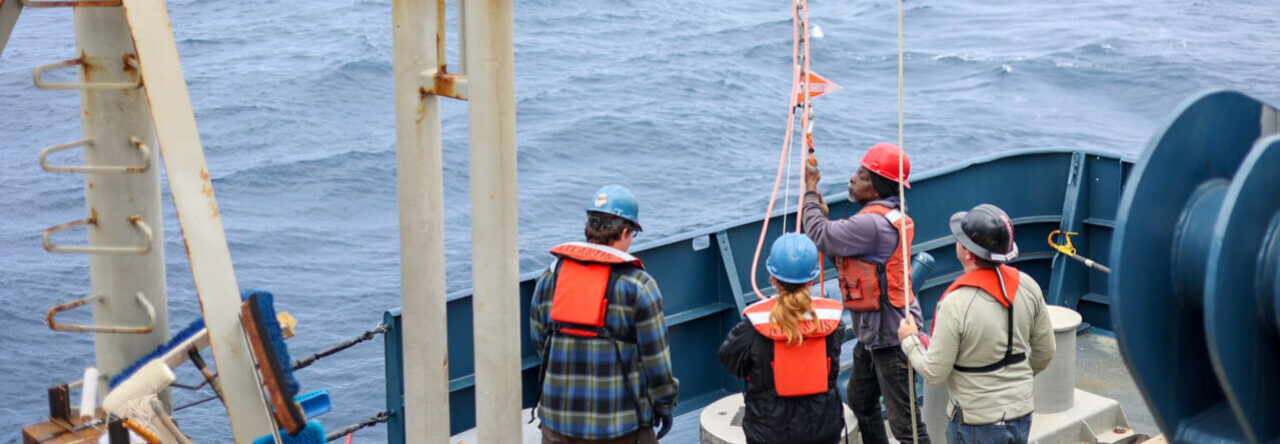
Back and forth in the Beaufort sea, a sea lacking any notable features. Most days are grey, without any marine mammal sightings, a few dim auroras flickering at night, and occasional snow. Hours seem to last forever, but days fly by without me noticing at all. Yet, even after six weeks aboard the ship, I still enjoy my time here. The science mission is steadily wrapping up. One of the projects that was added to the remainder of our time, is underway CTD system or UCTD. Simply put, it is a little torpedo looking device on a thin line that’s towed behind the ship. The UCTD operation is a round the clock survey of the top one hundred and fifty meters of the ocean. The main objective is to collect a continuous profile data along a specifically designed track. Such that, for the data not collected during the survey, it can be interpolated with statistical significance from the survey that is done by our scientific group. The shifts for volunteers are split up by two hours per person. One would think that two hours outside do not seem as a difficult task. But when the wind shear adds to an already below zero air temperature, two hours standing on deck can be difficult for some. Yet field observation often require an endurance of bad weather, and repetition of a mundane technique. It’s a difficult and exhausting pursuit, without much glory. But that is what our research voyage requires, a sacrifice of comfort for a glimpse into the unique processes of ocean dynamics in the Arctic. The ship’s track is a spaced zigzag in the Marginal Ice Zone or MIZ.The science party is highly interested in collecting all possible data in the interface of ice meltwater and ocean surface layer. The big picture of our cruise is to understand the increased impact of meltwater upon the physical mixing of the ocean surface layer. At least that is how I understand the mission.
Marginal ice zone is almost an ambiguous sea state. Mostly made up of pancake and grease ice, the sea is a strange boundary layer between the open ocean and packed sea ice. The scientific definition is still debated, with only recent attempts at defining specific parameters. The simple explanation is that MIZ is the region between ocean and packed ice, where waves are still present in the sea state. The waves are dampened by the presence of ice chunks on the surface, but the swells still move through the ice zone. The dampened wave action manifests itself in long periods through the ocean surface, gently uplifting and dropping pancake ice. Every now and then there is just grease ice in the water, which looks extremely smooth, very much like a layer of grease covering the surface of the ocean. The marginal ice zone is a unique section of the ocean, due to its peculiar fluid dynamic processes.
Even on slow days, there is still a sense of adventure and wonder in the scientific work that we do. Even the basic underway surveys from the ADCP unit and the Multibeam echosounder will be used by scores of scientists back on shore. It’s hard to explain our work to people who are not interested in the scientific pursuit. It does seem almost absurd to sacrifice so much time and effort into continuously collecting data that may or may not be used in further studies of the region. I guess it is an existential choice to work in science, there is no immediate gain from our work, but an addition to the collective knowledge of the world’s oceans. Prior to this cruise I had no idea what a Marginal Ice Zone is, or its importance in the physical processes of the Arctic Ocean. Being part of an effort that seeks to study the unknown, is rewarding in itself.
Besides assisting the science party, I’ve spent my time further studying computer networking. I’m not particularly interested in the subject, but it’s a big part of the Marine Technician industry, so I ought to know it. This week has been devoted to learning fiber optic cables. One of the big movements in the industry is to use fiber cables more commonly, as they are immune to radio frequency and electromagnetic interference, which are abundant on any ship. However, unlike the generic electronic cables, fiber optics are a lot more expensive and difficult to work with. They require much more care and specialized tools for termination and splicing. Even though fiber optic cables aren’t as exciting as other oceanographic work, it is still a part of the technicians job, in support of the science mission. There are many parts to this job that aren’t glamorous, and are rather mundane, but they need to be done. On the other hand there are very few workplaces that would invest a lengthy amount of time into training interns such as myself. I feel fortunate that the STARC team is invested in my professional development. Often times interns are used as a source of free labor for mundane tasks, without much educational value. However, my experience is without a doubt an educational one. Everyday I learn something new, that is part of is part of seagoing technicians career. I feel confident that by the end of this internship I will have the knowledge I need to continue my career as a Marine Technician.