Category: Host Page 44 of 85

Week 2: Finally Underway

It’s hard to believe that it’s been a week since I last wrote a blog. Every day is so full of things to do that the time flies by. We were delayed in leaving port two days due to some thick fog. When we finally got the all clear, we zoomed out to the dive site. I was fortunate enough to not get motion sick but others were not so lucky. In the time that we were delayed, we finished working on the elevator. In addition to the fence, we added a cover that can be pulled over in order to keep everything inside.

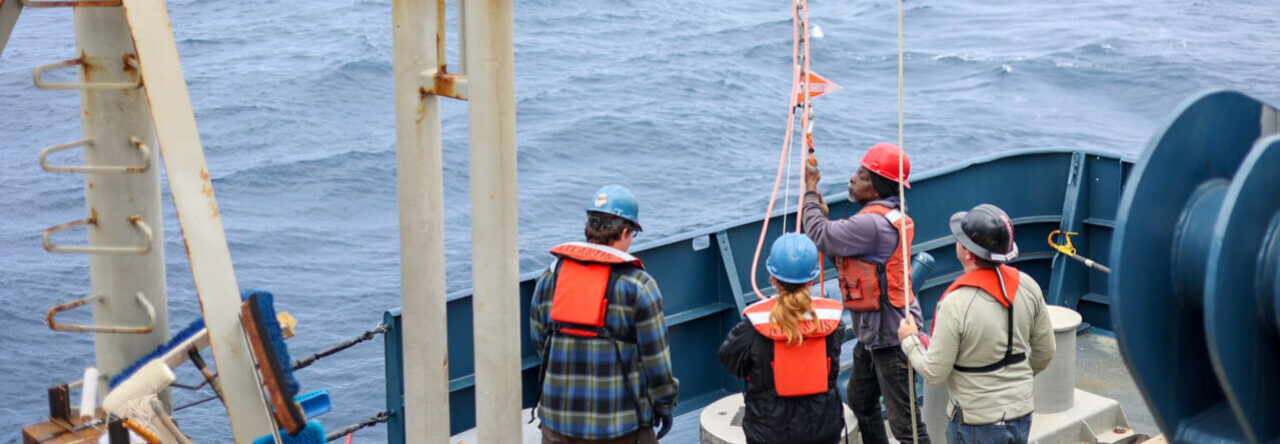
During one of the work lulls, the bos’n taught me some knots: the clove hitch and the bowline. Now when I’m sitting with nothing to do I’m thinking ‘the rabbit comes out of the hole, around the tree, and back into the hole’. We have had several sub launches. I am in charge of the cameras and have gotten the routine down. During one of the sub recoveries, I was able to throw the tow line out. While it didn’t get very far, the line made it into the water and I stayed on the boat so I consider it a success.

Throwing out the Tow Line


Waking up early in the mornings isn’t so bad now that I’ve adjusted to the time difference (Mississippi is 2 hours ahead of California). After the sub is launched and we clean up, I have a couple hours of free time. I’ve been using that time to read for the most part, a little bit of Steinbeck to remind me of home. The food on the ship is also really good. Fortunately there’s a little gym on board so I can work off all the extra food I’ve been enjoying.

Pre-Cruise Introduction

Hello, 

My name is Jonathan Raymond. I will be joining the crew of the F.G. Walton Smith out of the Rosenstiel School in Miami on February 18th. I’m originally from New Hampshire. While I have a bachelor’s degree in anthropology, I have always had an interest in boats and fixing things. This interest led me to enroll in the Marine Systems Program at IYRS School of Technology and Trades in Newport, RI where I have been living the last 6 months. I’m very excited to start my internship and gain more experience running and maintaining research equipment out in the field.


Week 1: On board (kinda)

I arrived in Gulfport, Mississippi Thursday night after a rather pleasant day of flying (considering some of the others had delays due to tornados, I’ll call it pleasant). Since the ship was inbetween cruises, those of us that had just arrived had to sleep in a hotel for a few days while the people from the previous cruise packed up. In the morning I met up with some of the others that I would be working with and then off to the ship! I got a quick tour of the different workspaces then got to work.

My first day was pretty easy doing inventory and putting stuff away. I learned how to set up the cameras that go on the sub and how to make sure they’re properly sealed in their waterproof tubes. It’s pretty similar to what I’ve done in the past so it’s good to know that my previous experiences are in fact useful.

Inside the Camera Housing

Day two I got to be a little more hands on as I helped make a fence around a platform that will be used to bring up the recovered objects from the dives. I learned more about the extra steps that need to be taken when equipment is put in water, especially salt water.

Day three we moved onto the ship! My roommate is nice and there’s more space than I expected. On deck, I did some manual labor stacking steel plates that would be used to weigh down the sub and the platform. The steel plates are dirty and rusty so naturally I got it all over me. In order to help with the pre- and post-dives, I need to be trained on every item on a checklist. I started with a big one: window cleaning. I know it doesn’t sound that impressive but the sub’s pilot does need to be able to see. We have one more day here in Gulfport then it’s out to sea!

The R/V Atlantis!

Pre-Cruise Introduction

Hi all! My name is Lydia Sgouros and in just one, short week, I will be going aboard the R/V Endeavor for my first cruise as a MATE intern. I am from Rhode Island, currently attending Case Western Reserve University in Cleveland, Ohio, where I am a senior in Mechanical Engineering. Last year, some classmates and I started up an ROV team and competed in the MATE International ROV Competition with our robot, the Wobbegong. I loved the unique engineering challenges of the undersea environment and I look forward to learning more about these challenges and the special technologies used to collect data from the depths of the ocean over the next six months.

The Wobbegong    [Photo by ROV Team Captain, Rhys Hamlet]

The Endeavor’s homeport is at the University of Rhode Island Graduate School of Oceanography.  In the next couple days, I will drive home, finish packing, and prepare to go aboard. I will be sailing with the Endeavor until April at which point I will head to Bermuda where I will sail with the R/V Atlantic Explorer out of the Bermuda Institute of Ocean Sciences until mid-July. I will post a weekly blog here giving updates about my cool new experiences at sea.

Last year, on Lake Erie. Now to bigger seas!    [Photo by Kristina Collins]

Pre-Cruise Introduction

Hello! My name is Kaitlyn and I am preparing to go aboard the RV Atlantis for the next few months. This will be my first cruise and I am very excited to get underway! 

To get to know me a little better:

  • I grew up in Monterey Bay which sparked my interest in the ocean at a young age
  • I have been a member of the Monterey Bay Aquarium for 20 years
  • I have a Bachelors in Marine Science
  • I am currently working towards an Associates in Mechanical Engineering
  • I am a NAUI certified SCUBA diver
  • In my free time I enjoy reading, video games, and surfing

Next week, I will be in Mississippi to meet up with the Atlantis and Alvin. Can’t wait! 


Week 10: Homeward Bound

The last leg of our voyage might have had the most scenic horizon. Juneau is quite a different town than Dutch Harbor.  First thing that comes to mind is the abundance of trees in Juneau. As we sailed through the surrounding archipelago, the evergreen covered mountains greeted us along the shores. Even the air is different in Juneau, it was humid, yet gentler than the Arctic winds. While in Juneau we had the chance to see Mendenhall Glacier, one of the most  monumental landmarks in Alaska. Beautiful in its scenery, and tragic in its fate, Mendenhall Glacier, was the highlight of our port call. One of the first things that I’ve learned about the glacier is the increased melting due to Climate Change. It is undeniable that the glacier has retreated significantly in the last forty years. Its a somber reminder of the effect of human activity upon nature. For me, Mendenhall Glacier was also a reminder of the cause of my career. With each data set I’ve collected, or at least assisted with collection, there is an addition, however small, to the scientific understanding of Climate Change. I’m glad to have seen some much of the Alaskan nature. I don’t know if I’ll get the chance to see it again, or if it will be the same when I do. The port call in Juneau was memorable, and a good way to slowly reintegrate into society. While in Juneau some of the crew were allowed to bring their family members for the transit to Seattle. Yet while our transit took us to the awe inspiring Glacier Bay National Park, this was one of the busiest times for STARC technicians and myself. We found ourselves a week away from our final destination–Seattle, with multiple projects yet to finish. The projects involved securing all the sensors used for underway pCO2 systems, backing up data files, and organizing an inventory of all other sensors shipped for calibration. Nothing exciting or glamorous about our last week of work, but something that had to be done. Although, I do feel that I’ve won the confidence of my supervisors, as I’m entrusted to do the inventory on my own. During this leg I was able to test my organizational skills acquired throughout the cruise. I had experienced the importance of documentation and record keeping, while organizing equipment shipments. There so many details, and meticulous tasks that are impossible to fully memorize. I understood why the documentation was created and carefully curated. I was able to optimize my efficiency by following the instructions and guidelines written in years prior. I’ve also realized what defines good documentation. It is pure work, and constant effort to communicate actions and decision making, especially under the stress of deadlines. By the time we got to Seattle, I had completed the tasks assigned to me. Yet, my work was not over. 

    While in Seattle there were still projects needed to be completed on the Healy. The two that I was able to take lead on were Multibeam echosounder impedance test and remove wind sensors from the ships masts. Impedance test was a day long affair, with multiple shift changes. It is a simple task of disassembly of multibeam transmitters and receivers and electrically testing the resistance to applied voltage. However mundane the task was, it’s important we did it. I understood the bigger picture, and so I was content with performing the task. The data we collected during the impedance test improves the performance of this particular echosounder, and the quality of hydrographic surveying as a whole. It’s not numerical models, or exquisite presentations that improve data collection, but simple routine maintenance of scientific devices. I understood why we had to do it, so it was not a problem for me to spend the whole day conducting the impedance test. And at the end of the day, one of the two tasks I had to do was complete.

    While the impedance test was rather mundane, climbing masts was by far more exciting. Over a hundred feet in the air I climbed, the foremast and the midmast. Tool kit strapped to my chest, and refreshing wind in my face. I was eager to climb, even if a bit nervous. I’ve been terrified of heights my whole life, and climbing the masts was no exception. But I volunteered to do it despite my fear. I knew the carabiner was sturdy, and my footing trustworthy, I was determined to climb. My breath was steady, but my legs shook anyway. The wind oscillated the masts a bit, and I dropped a couple zipties. But I did it, I took down the wind sensors, and safely climbed back down. The adrenaline rush hit me as I stepped back on deck, and I felt great. However absurd my fear of heights is, I felt proud that I faced it. In the grand scheme of things, climbing the masts was not all that heroic, technicians do it all the time. But it was important to me, and that’s all that matters. Needless to say, I told everyone about my achievement, humility is not my strong suit. This was a great way to conclude my internship.

    And then, one day I woke up and departed the Healy for my flight home. The last three months were some of the best time of my life. I felt that I truly lived the life I wanted, filled with excitement, adventure and purpose. Three years ago I decided to to be a Marine Technician, and I am not disappointed. This is more than a career for me, it is a life choice, that I’m willing to follow through. I have completed every task and goal I set out to do during my MATE internship. There are not enough words to describe the sense of accomplishment I have. MATE internship gave me the tools to build the career I want, and for that I am grateful.


Week 8: Conte Cruise

The Conte cruise preparation takes two days – winches have to be respooled with mooring lines, and tones of equipment is brought on board. The Conte cruises consist of deploying and recovery a deep sea mooring in 4500 meters of water. The mooring line, which is broken into sections, also must have some sections replaced when the mooring is recovered. This means the operation takes almost two full days, and all hands available on deck.

At the top of the mooring is the ADCP buoy with, radio transmitters and flashers:

Then there are hard hat floats:

Sometimes the line becomes tangled as it comes to the surface, forming a wuzzle. This complicated recovery as hundreds of meters of line are now bundled together, with no clear indication where tension is highest.

Throughout the mooring are three sediment traps, that rotate the sample bottle every two weeks:

There is also a camera attached to the mooring that we deployed:

Finally, at the bottom of the mooring are the transducers, and 2000 lb weight:

When it is time to recover the mooring, transducers onboard communicate with those at the bottom of the mooring, and tell it to release, which sends the entire mooring line to the surface. The bottom of the mooring is recovered first, and then we slowly work our way to the top. During deployment, we do the reverse, deploying the top first.

The first few days of the cruise were quite rough, so we opted to recover/deploy the mooring at the end of the cruise when the sea was calmer. Throughout each operation, I helped by managing the deck lines, and tying off after they were attached. I would also assist in steadying the package being lifted in the air. I tried to keep everything neat and tidy so that no one would trip and keep important tools on hand and easily accessible.

Overall, the cruise was exciting and exhausting, like on big puzzle. I particularly enjoyed this because it was so hands-on, and everyone had to work together as a team. I feel loads more confident in my ability to work on the back deck after just a few days.

After we return to port, we have a few days before a one-day hydrostation cruise, which will be my final trip.

Until then!

Week 9: Gulf of Alaska

 The three day port call in Dutch Harbor was a much needed break from the sea, for myself, and for most of the crew. My time was primarily occupied with visiting museums and hiking in the snow capped hills of the surrounding area. I tried to spend time for most of the port call by myself. On the ship I spent so much time constantly being surrounded by people, being alone seemed like a luxury. Dutch Harbor is always a nice place to stop for a couple of days. There is always so much to see; bald eagles perched on street lights, sea otters swimming along the shore, fishing boats gliding in and out of the bay. It seems just yesterday I arrived to Dutch Harbor for the first time, ready to depart for the Arctic. So much has happened since then, I’ve seen and learned so much in the last eight weeks, but Duth Harbor is the same as when I left. At the same time, when the ship cast off for departure, I was ready to leave. Albeits its beautiful nature, Dutch Harbor is a transient place, a rest stop really, nothing more. We sailed off into the Gulf of Alaska, bound for Juneua. I had volunteered for the night shift, partly to provide relief to my colleagues that worked nights all cruise, and partly to have time to work on my own projects. Working nights at sea has its merits, mostly the uninterrupted chunks of time to focus on specific tasks. As I’m finishing up my internship I’m applying for jobs, and dedicating time to supplemental reading of the science behind the measurements taken in the last science mission. I had anticipated a rather boring transit through the Gulf of Alaska with an uneventful work week. And at first everything was fine, as we left the Aleutians, we passed by a pod of sperm whales to to our port side. The sighting was a moment of joy for just another day at sea. But within the first couple of days underway things started to go wrong. First we had to turn and wait out a storm in the Unga strait, just north of Dutch Harbor. While there, we were in constant rain, engulfed by a thick fog. Two days we spent drifting back and forth in the Unga strait. By the third day the command decided that the seas have calmed down enough to sail through. 

    One of the drawbacks of sailing on an icebreaker, is the fact that it handles poorly in waves. The rounded bow is ideal for breaking ice, but it also takes the full force of a wave in non ice bound seas. When we hit roughly ten foot waves, we felt the force of each one. In addition, Gulf of Alaska has an almost constantly confused wave state. This is due to a peculiar physical oceanography of the region. Bound by mountainous terrain on three sides, and the Pacific current to the south, Gulf of Alaska is effectively a massive gyre. The mountains also provide large influxes of freshwater during the melting season, which create eddies all along the coast. The strong wind shear drives these eddies along the coast in what is known as the Alaska Coastal Current. Combined with the complex bathymetry of the ocean floor, riddled with seamounts and trenches, the effect is a confused sea state. My research into the subject was sparked by looking at the seas from the deck, and observing such unique wave front structures. Most notable is the irregular period of waves, which can not be accurately predicted by forecasts. With comprehension of these factors, I understood the caution of the ships command in sailing through this region. 

    The STARC team, myself included, prepared for the seas thoroughly. We had identified all potential hazards, and secured them. Yet since high seas are such an unusual event for the ship, there are things that we overlooked. I guess that’s a good lesson to learn, to accept that there will be failure. That’s something everyone at sea accepts, that you can’t prepare for everything. But I was not nervous at all, in fact I was kind of excited for high seas. I’ve seen high seas, three years ago, during my time in the South Pacific. At the time I was volunteering on the NOAA ship Ronald H. Brown. I was nervous then, as it was my first time at sea. By now, things like high waves and storms excite me. Mostly because it is thrilling, to be on a rolling ship, where things fly off into the air, unexpectedly. Of course, part of my excitement is rather vain, as high seas always make for a good story to tell back on land. 

    When I reported to my shift in the computer lab, we were still sailing through waves of about ten feet. It was kind of let down for me, we were so prepared for a storm, and it did not happen. But I accepted the fact that not all of my time here is going to be exciting, and worthy of stories to tell. Unfortunately that’s a big part of going to sea, preparing for something that never happens. I got through most of my shift working behind my laptop, and that’s when it happened. The ship took a roll, with such great force, that computer monitors flew into the air. I was shocked, I genuinely believed that the monitors were bolted down to the table, as it turns out, they were not. The ship continued to roll well over twenty degrees from side to side. We were in high seas. My excitement quickly drowned in a rush of adrenaline, the things we overlooked, found they’re way into the air and dropped crashing onto the floor. We spent the next hour cleaning up and tying down everything that posed a threat in the roll. We were lucky, of all the computers that fell, only one was broken. The galley however was not as lucky. They lost one of the ovens, and two others moved across the kitchen, since they too weren’t bolted down. Elsewhere on the ship a drum of hydraulic oil spilt in one of the engine rooms. Everyone was up and moving, cleaning up the mess. Maybe that’s why I like high seas, the solidarity of everyone aboard facing the same challenge. By breakfast the seas have subsided, and we were laughing off the events of the night prior. When its only things that get damaged, it’s easy to laugh. Working on the ship, is one of the few places where events like this are laughed off, almost as soon as they are done. Of all the places that I could be right now, I’m happy that I find myself here, aboard the Healy.
Week 7: Second BATS Cruise

Some of the small fish that (used to) live near the ship.

The CTD being deployed (I am on the tagline in the middle, cleated out of the frame)

This week was the next BATS cruise – the same routine and practiced mission that I went on in my first cruise. We started out with CTD casts along an ocean acidification transect, and eventually made it to the BATS station itself. We also recovered all three small gliders, and one of the large gliders. Then, we attached one of the small gliders to the CTD by lifting it up with the winch, so that it can be calibrated on a cast.

During this cruise, I tried to work on improving my deck handing during back deck operations and visualize how I might lead the operation. Timing the winches and a-frame apparently gets much easier with time. The common deck operation during this cruise is McLane pumps, and plankton net tows. Marine techs are responsible for relaying to the bridge the angle of the line if they cant see it, and for leading the winch and a-frame operators.

I also started working on a project with a Campbell Science 1000 datalogger. I downloaded new software and set up the logger so that it is ready to take instruments. Then, I wired a temp and humidity sensor into the analog pins and wrote the appropriate code in CRBasic to set up logging. This project was really cool, because it was a lot like the Arduino I had been using in past weeks but was a real application. I also finally finished inventorying and organizing the spare cables which felt very rewarding to finally be done.

Week 8: Port Call

    Forty-five days at sea, and we’re back in Dutch Harbor, at least for a couple of days. It feels like yesterday we set sail for the Arctic. A month and a half have gone by in a blink of an eye. Yet the last week has not been as exciting as the weeks prior. Some days are just less memorable than others. We had dropped off the majority of the science party at Nome, mostly due to the fact that Nome has a bigger airport than Dutch Harbor. After that we remained adrift in the coastal regions of Nome. Due to the typhoon that was in the North Pacific this week, the command of the Healy had decided to wait out the storm in the safety of Norton Sound. Norton Sound is certainly a scenic place to be; with views of snow-covered mountains on the horizon. It felt so much different than the Arctic Ocean that we’ve sailed for the last six weeks. While the color of the water in the Arctic was a dark blue color, almost black, Norton Sound had a green, almost malachite color to the water. My speculation is the green color is due to the runoff of nutrients from the Yukon river on the south side of the sound. The nutrient rich water is also the reason why we had to turn off the underway water sampling systems, as it would clog up the instruments. The three days at Norton Sound were some of the best weather we had, clear skies and gentle land breeze. The effects of the typhoon were felt ever so slightly, with waves breaking against the bow. I really liked to stand in the forecastle and watch the wall of sea spray hit the ship with each breaking wave crest. Sometimes the simplest things are the most impressive ones. Something that I don’t really think about anymore, waves breaking against the bow, are the first thing that comes to mind when I think about my life at sea. Our first day drifting was a nice change of pace, a much slower day without any science operations. I guess I didn’t realize how tired I was until I got a chance to rest. 

    In this last week I’ve been following the footsteps of previous MATE interns and learning hexadecimal programming for a signal converter box. System networking has its moments, I certainly take pride in learning how to program a sensor on the spot. I do enjoy working with electronics, even though the subject is rather dry. The way I see it, I need to know how to do the difficult tasks, in order to have the opportunity to do the exciting ones. To ensure those opportunities, I’ve taken lead on multiple projects for STARC. One of them was designing a work order for power outlet replacements in one of the science labs. In order to formulate the most effective work plan, I thought of what instructions I would need to get the job done. I applied the knowledge from my prior experience as an engineer on the R/V Walton Smith, to complete a task I now have as an intern on the USCGC Healy. This is not a project typically assigned to a MATE Intern. But, one of the skills that novice MarTechs generally lack, is the organization of facility management. Once again, a skill that is not glorious or exciting, but is essential in this career path. Throughout this cruise my notions and expectations of the marine technician career path have become a lot more realistic and practical. Not that it’s a bad thing, just a perspective through more experienced eyes. I’ve gain a significantly more professional outlook about the marine science industry during this cruise.  

    All in all this has been a fantastic cruise. During the last quarters with the captain and crew I was awarded the Coast Guard Arctic Service Medal. I feel honored to have the chance to work so extensively beyond the Arctic Circle. The award is given to all personnel that spent over twenty one consecutive days beyond the Arctic Circle. I have also participated in the line crossing ceremony, but that’s as much as I can say about that. Even though the bulk of my time on the Healy is over, I’m still scheduled to sail on the ship for two more weeks. And although the next two weeks will not be as demanding as the science mission, it is still an opportunity to fine tune my skills and knowledge that I’ve picked up. 


Page 44 of 85

Powered by WordPress & Theme by Anders Norén