Month: July 2024 Page 2 of 3

USCGC Healy Week 2

Hello 🙂

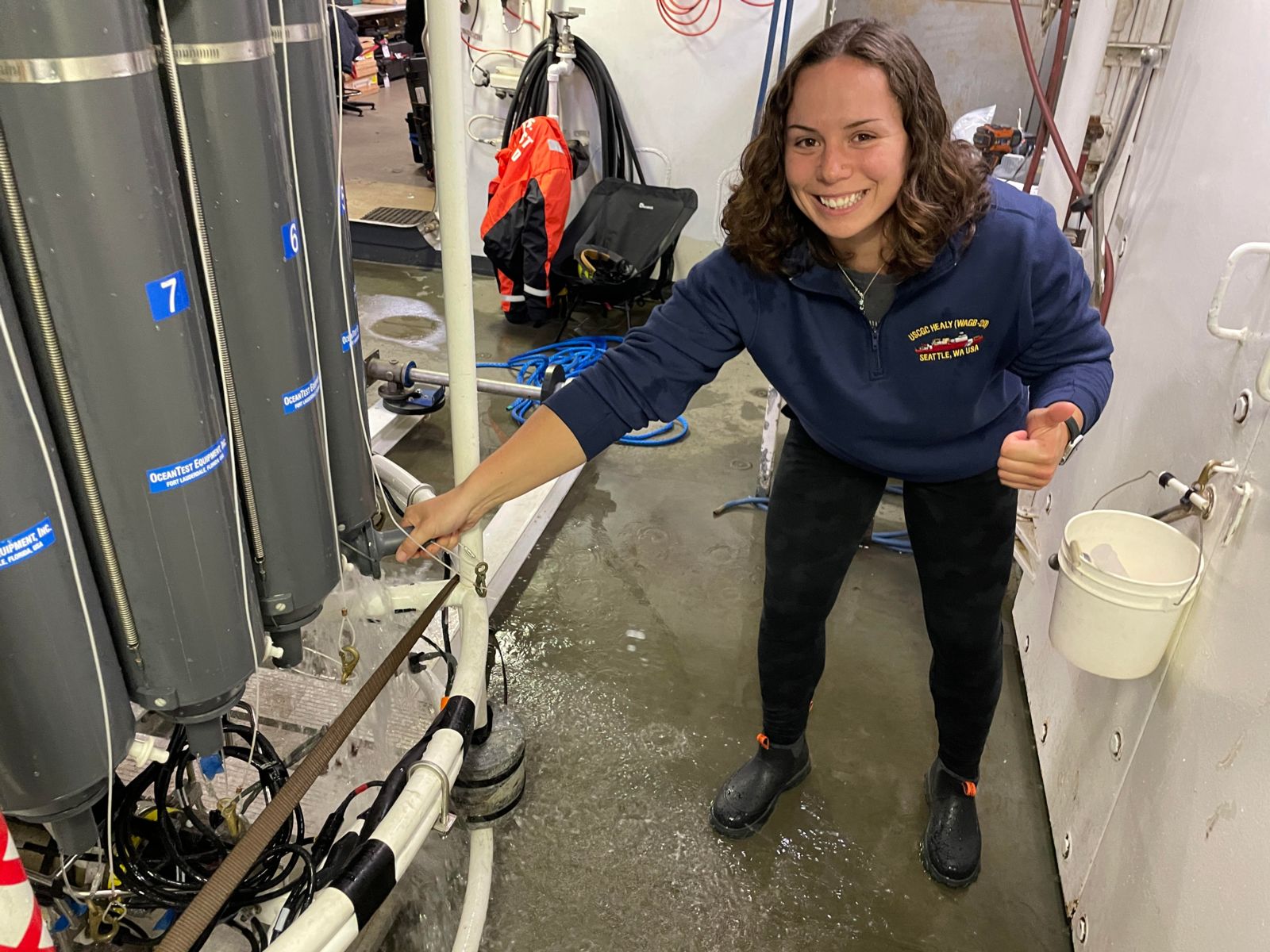
The past week we have been doing many CTD casts. We did our deepest cast the other day that reached about 2800m. We colored some styrofoam cups and sent them down on the rosette to shrink; they were all very creative and turned out so nice. After each cast, we secure the deck unit and take water samples for the scientists. We first need to ensure the bottles did not leak and were properly closed when fired. At each collection depth, we fire two bottles in case one of them leaks. After we have all of our samples, we flood the floor by emptying the Nisking bottles. Then reattach the strings to the top and bottom to leave the bottles open for the next cast. The sensors are then covered with caps and the seawater pumps are flushed with DI water. They did an NSF livestream in which Lorelei and I are in the background of the video doing our CTD maintenance haha.

This week we have also done two mooring deployments. I soldered a new cable for Jim’s deck unit because he needed a five prong pin out as opposed to the three prong that was connected to the Knudsen. The Knudsen is a sub-bottom profiler that performs seismic profiling of the seafloor to indicate water depth below the ship. Jim’s deck unit allows him to send a ping to communicate with the acoustic releases on the bottom of the mooring cable. The moorings are a rather complicated set up because they are anchored at the seafloor and each device on the cable needs to float at certain depths. To set up the mooring correctly, there is a lot of communication going on between those on deck, those on the bridge, the winch operator, and the A frame operator. I learned about the hand signals used between the deck and operators, as well as safety procedures on deck. They had two successful mooring deployments but were not able to recover the older mooring because of the thick ice in the area.

We have also been conducting XCTD casts which are small expendable CTDs. They are released through a canister and connected to a copper wire that transmits depth, temperature, conductivity, and salinity information. For one of the casts I was on the radio communicating with the bridge and aft con. We need to ask for permission to stage the cast, give the serial numbers on the device, load the probe, aft con tells us we can launch, then we cut the wire once we reach the seafloor or terminal depth.

My 3D printing knowledge has also been expanded upon. The printer is capable of making really cool objects, but there are sometimes limitations based on the settings used before printing. I have learned to use supports and a brim to help the printer follow the correct path, stagger the seams for more strength, use alpha infill for an exposed roof so the part does not implode under pressure, and to minimize the size as much as possible so the print does not take too long. My fluorometer mount design is finally working and we will test it out on a CTD cast soon.

I have spent some time on the bridge/ upper decks to get a good view of the ice breaking. It’s pretty incredible to watch and I am impressed with the ship’s capabilities. I’m glad to be here and have definitely been enjoying my internship on the Healy.

Will post another update soon.

-Gabby
week 4 Ayse M. On the Langseth

Week Four 6/30-7/6

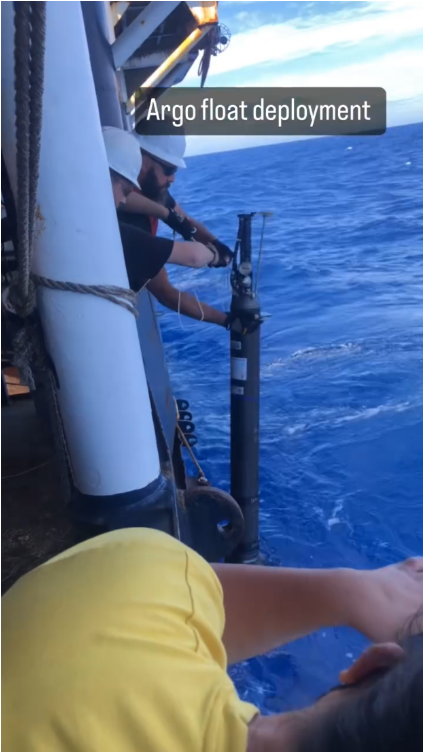
The team began the week traveling to station 03 at Orphan Knoll, 320 nautical miles off northern Newfoundland. Upon arrival on Tuesday, they successfully obtained 6 usable cores from the first cast. However, the sediment from the second cast was unsuitable for their project due to its coarse-grained. The team then moved to a new site, station 4, just east of Orphan Knoll. This location had deeper waters, resulting in longer days. On Wednesday and Thursday, they performed four casts per day. By Friday, they had collected enough mud after the third cast and deployed an Argo float. 

This week the weather took a noticeable change. The days were longer, colder and with frequent fog. We’re planning to head further north along the eastern coast of Greenland. I also spent a good chunk of time on our transit, relabeling all shuttles for the multicorer. I did this because many of the shuttles had different numbers from old attempts at labeling. And the inner plastic tube had no label. This made it difficult to track which shuttles were actually collecting usable cores. Additionally, I made a data sheet to record the sampling data that allowed us to see if the location on the multiorder had any impact on sample success. I was a bit nervous about showing the data sheet to the science crew because no one had actually asked me to do any of this but I had asked one of the senior techs if I could do this in my off time but I am happy to say that my efforts seem to be a appreciated! 

week 3 Ayse M. On the Langseth

6/23-6/29

The days are really blending together now. I feel like I was just in New York a week ago but I also feel like I’ve been working on the boat for a year.  Overall, I’m still having a blast, and everyday I’m excited to be on shift. Deployments have been going well, but we are having difficulties with the samples. At one point we were all really really excited that 5 out of 8 samples were usable. The ocean conditions were not the best but we were also dealing with issues with the shuttles. There’s a lot of discussion on how we can improve them. We’ve been adding wooden blocks to the bottom to help the shuttles not penetrate the bottom too deeply. 

One of the days, the main block (the pulley that the winch wire is run through) on the A-frame was making an awful sound. Turns out the bolts used were too small and some had snapped. It was a really great example of how amazing the engineers on the ship are because they erected scaffolding and had it fixed within the hour. I wish I knew his last name but Sam, the Chief Engineer, has literally fixed every problem that comes up in record time. I am beyond amazed by him and his team. 

I also got to see an ARGO float! Which is something I’ve learned about in college and have used their data for projects. The deployment was pretty straight forward but it was amazing to have that hands-on experience with something i’ve only read about. 


USCGC Healy Week 1

Hello!

Over the past two weeks I have done a lot of traveling. My journey started on June 26 by flying to Seattle then to Anchorage. My thrid plane was much smaller, and I arrived in Dutch Harbor on June 27. I made my way to the Grand Aleutian Hotel and had a nice meal in their Margaret Bay Café. The next day, I met Kristen who had just finished her internship on the Healy. I also met a few of the other marine techs (Brandon, Bowman, and Max). During our few days in Dutch, we explored all that the small town has to offer including the famous Alaska Ship Supply, LFS, the abandoned underground hosptial, Safeway, Amelia’s, and last but not least the Norweigan Rat to play some pool. We did some hiking on Mt. Ballyhoo and enjoyed a beautiful view over the harbor; we saw about a dozen eagles. We did another hike behind the shipping supply; we had an amazing view of the coast and saw many old WWII bunkers. We also got a tour of the labs on the NOAA ship next to us in port. They are mainly studying pollock to monitor the health of fisheries in the area. After I moved onto the Healy, it remained in port for a few days while the engineers and technicians were troubleshooting some issues to ensure that we were ready for a long voyage.  

Once the ship was underway, I spent a few days becoming familiar with the different routes to get where I need to go, and the equipment that we would use during the trip. This expedition is very CTD focused, so I spent a while talking with the other techs about each sensor and configuring ways to install the devices onto the rosette frame. Nick and I added a camera to the rosette; we had to find a good way to mount it without other devices blocking the view of the light and lens. The camera detects organisms underwater by interacting with their fluorescent pigments and illuinating them. One of my tasks was to create a mount for the fluorometer so that we can fasten it horizontally as opposed to vertically. This orientation would reduce interference between the multiple devices that are emitting light. I spent some time taking measurements of the rosette and fluorometer. I learned a new CAD software to design a mount that is 3D printing now, I’m excited to see how it turns out.                                  

I was working with Maria-Christina to understand her mass spectrometry instrument that was analyzing oxygen and argon concentrations in the underway seawater. We have to make sure there are no bubbles entering the mass spec and we need to take samples of seawater every few days.

I worked with Chrisitina to disassemble, clean, and reassemble the port side and BioLab waterwalls. The waterwalls have a number of sensors including the debubbler, flow meter, fluorometer, eco-triplet, thermosalinograph, TDGP (total dissolved gas pressure), transmissometer, dissolved oxygen sensors, and the WetStar. All of these devices measure various properties of the underway seawater such as the flow rate, temperature, conductivity, concentration of matter in seawater, flourescence, and more. It is important to do regular maintenance on these systems to ensure the received data is accurate. Another one of my tasks was to use LucidChart to complete a wire diagram that shows how everything is connected on the waterwall. I traced the wires from the Adam boxes and mapped out where the devices were connected.

Brendon also taught me how to solder, that was fun I first practiced by making some wire loops and performed continuity tests. Then we tested my new skill by replacing a float switch on the waterwall. The float switch lifts up when the sink is overflowing and activates a light on the computer to let us know there is overflow. 

I worked with Lorelei during the CTD casts to understand the data collection process. Communication between the deck, winch operator, and person operating the data collection computer is important to receive useful data. This communication is also important to ensure the safety of those on deck and to prevent equipment damage.

Before the cast, the rosette needs to be prepped by cocking the Niskin bottles and making sure they are fully open so they do not implode underwater due to the difference in pressure. Brandon and I replaced some of the strings on the bottles that experienced some wear and tear. The camera is also turned on a few minutes before each cast and turned off after each cast. The CTD needs to be submerged about 10-15m below the surface to acclimate the sensors to the water. Then the CTD is lowered to about 10m above the bottom, and it is slowly brought up to specified depths where the Niskin bottles are fired and samples are collected. The data is then processed and a script is run so that the hex file can be interpreted as a cnv file. The scientists then use the data to plot graphs of the pressures, density, salinity, and temperature at each station.

The scientists are also doing seafloor grabs using the Smith-Mac to collect samples from the seafloor. They are studying the samples to check for harmful algal blooms and other toxins that can be identified in invertebrates.

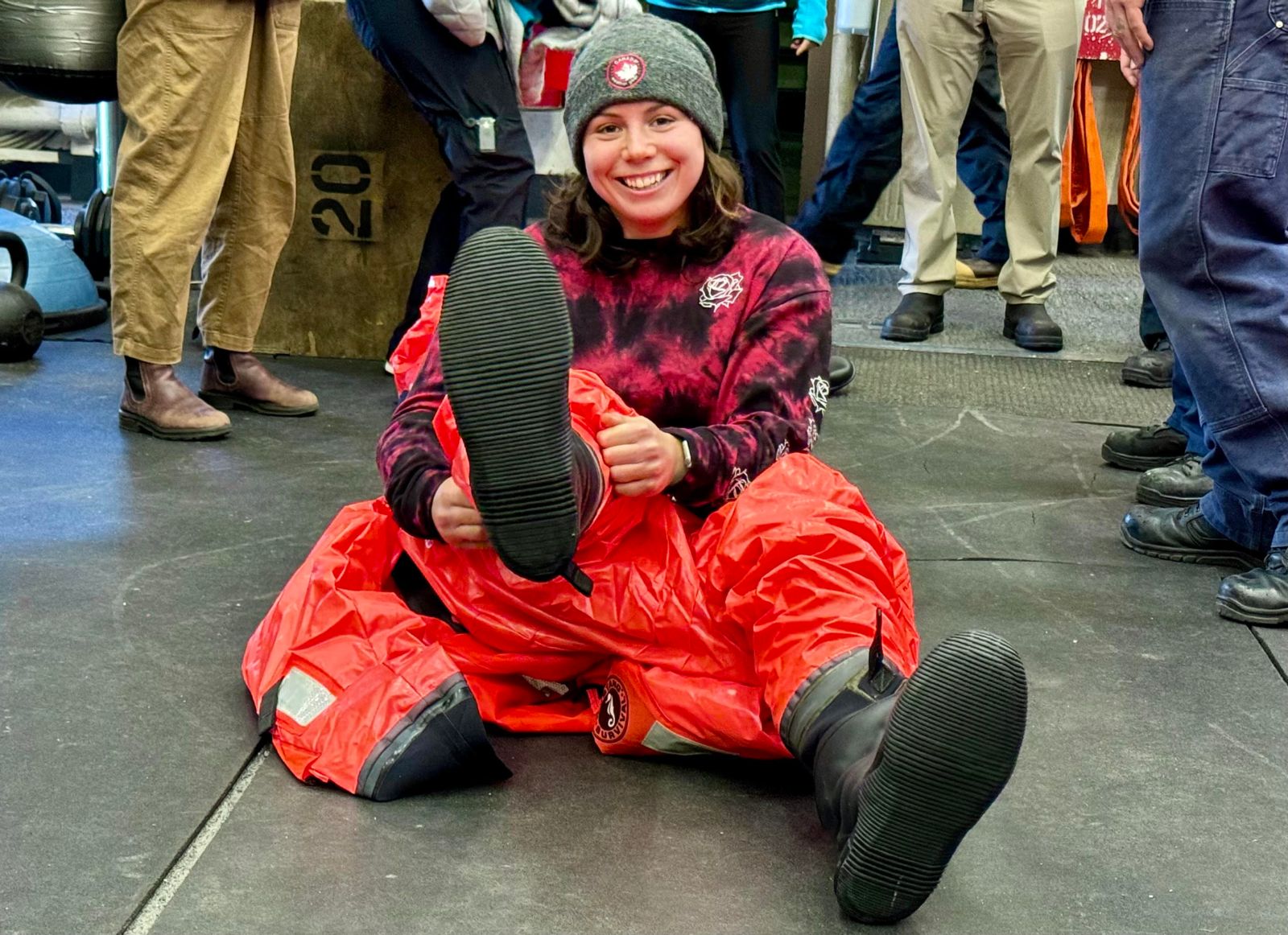
We did an abandon ship drill in which every member onboard meets at the bridge and gathers with their designated raft number. Each person is assigned to bring certain items such as blankets or food. When the ship’s coordinates and heading are announced, we are supposed to write on our the backs of our hands so if we were to contact help they could locate us. They showed us where the abondon ship locker was then I got to try on the cold water mustang suit.  

I have really enjoyed my experience on the Healy. I have met and talked with many technicians, scientists, and members of the Coast Guard. I have learned a lot about the roles of those working on the deck and those on the bridge in charge of steering the ship. I have attended a few Coast Guard Officer trainings to learn more about the Healy’s engineering design and ice breaking capabilities. I have been lucky enough to do some whale and bird watching too. After work, I’ve enjoyed going to the gym and have invited some of my friends to learn how to erg. It has been a unique trip and I will update with another post soon!

Thanks for reading 🙂

-Gabby


Week 1: In port + first two days of cruise EN719

We embarked on cruise EN719 aboard the R/V Endeavor yesterday morning at 10am! Currently, we are steaming towards our first study site, the Atlantis II Seamount Group, and testing some of the acoustic systems the scientists brought aboard. Since this cruise is studying underwater acoustics, we will be doing multiple CTD casts and XBT deployments to get a profile of sound velocity in the ocean, towing acoustic sources and receivers, and collecting passive acoustic data (listening for sounds in the ocean). The CTD is a profiling instrument that collects data on conductivity (salinity), temperature, depth, and often other data such as oxygen, pH, and turbidity. XBT stands for eXpendable BathyThermograph, and it is a single-use probe that measures temperature throughout the water column. 


This morning, we successfully tested one of the onboard winches and a towed acoustic receiver, and I performed some basic maintenance including changing the o-rings on two Niskin bottles and cleaning/changing the filters of the two -80 degree C freezers. The Endeavor has one flow-through system with two sensor packages, the SBE21 and SBE45, which take seawater from near the water’s surface (5m) and return real-time data on temperature, conductivity/salinity, and chlorophyll fluorescence. This afternoon, the salinity sensor on the SBE21 was measuring about 1 full PSU lower than the sensor on the SBE45, so we decided to clean the sensor to see if biological fouling was the cause of the problem. Surprise: it was! The offset was fixed once the system was cleaned and re-installed. After dinner, my mentor Bonny and I changed the CTD connection from winch 2 to winch 1 and did a deck test of the system to make sure everything was working the way it should be. 


For the week and a half before we left port, I spent the majority of my time getting situated on the ship, learning a bit about the systems and instruments I’ll be working with, and helping out with all of the various pre-cruise tasks. I arrived at the R/V Endeavor on Thursday, June 27th, and on my first full day of work, I got an introduction to the computers/displays for the underway flow-through system, CTD, CCTV cameras, navigation, ADCP, and the various network connections. The following week, I learned about how power is supplied to the labs and instruments, including the flow-through system, and how data is transferred from instruments to the databases and displays throughout the ship. I also got an introduction to the satellite internet systems on the ship. There are 4 different satellite internet systems on board, so there is a backup to the backup to the backup! Each one has a different speed and coverage, with the fastest being Starlink. We should be under Starlink coverage for the entire cruise (Yay!), which means that the internet is good enough to do video calls, if necessary. The second fastest satellite connection is called Sealink Plus, or the KU band, and its antenna lives in a big white dome on the 01 deck. Prior to embarking, we inspected the antenna and everything looked good!


Seas have been gentle so far, and I am excited to keep learning more!


Marine Technician and former MATE Intern Claire Mayorga (right) and me (left) inside the KU band antenna dome 07/03/2024

Leaving Narragansett Bay on 07/08/2024

Flow-through wall in the wet lab

Acoustic array being deployed 07/09/2024

MATE Internship Introduction: Riley LaPerriere

Greetings! My name is Riley LaPerriere, and I am thrilled to embark on a voyage into the world of marine technology with MATE. As an ocean conservation and exploration advocate, I have always been captivated by the mysteries beneath the waves.

From a young age, my fascination with marine life and the environment sparked my curiosity in how technology can be harnessed to understand and protect our oceans better. This curiosity led me to pursue a bachelor’s Degree in Marine Technology which I will acquire after completing my internship. Although Marine Technology is the main focus of my studies, I also have been awarded my Associate of Applied Science Degree in Unmanned Aerial Systems.

Joining MATE represents an exciting opportunity for me to combine my passion for marine science with hands-on experience in cutting-edge technology. I am eager to contribute to the advancing marine technology industry while fostering environmental stewardship.

Beyond academics and professional pursuits, I am an avid skier during the winter months and enjoy scuba diving, mountain biking, adventuring, swimming, boating, and pretty much anything outdoors during the warmer summer months.  

I look forward to the challenges and discoveries that await during this internship. Together with MATE, I am ready to explore new horizons, innovate solutions, and contribute to a sustainable future for our oceans.

Thank you for joining me on this journey. Let’s dive in!

Week 4 aboard the Langseth

We’ve passed our 4 week mark on our cruise aboard the R/V Marcus G. Langseth. We’ve been steadily making our way north and its becoming apparent. The days have become much longer as well as colder. We’ve had a steady stream of fog that comes in most days for several hours at a time. We are almost done with our current station and have been working at a steady pace for the last several days.

Recently I’ve been learning how to operate the winch during deployment and recovery of the mutli-core instrumentation. This is certainly been one of the more challenging technical skills I’ve had to learn while aboard. Both deploying and recovering instrumentation takes quite a bit of coordinated effort between several different people. While I am in the winch booth operating via a remote joystick, there are two people running tag lines, someone operating the A-frame and a deck leader managing everyones actions. It is quite an intricate dance and one where safety is paramount. It can be an anxiety inducing build up but is done within a moment and comes with elation when everything works well.

Tomorrow we will begin setting our sights even further North, riding along the Eastern coast of Greenland. I will be keeping my eyes out for any auroa borealis though seeing the occasional pod of whales has been a good consolation prize if not.

Duva Week 4 R/V Langseth

Week Four: 6/30-7/6

With our first three (00, 01, and 02) stations in the rearview, we started week four in transit to station 03 at Orphan Knoll, a feature of the ocean floor about 320nm off the coast of northern Newfoundland.

On Tuesday, we arrived to the site. The first core cast came up with 6 usable cores! Yay! However, by the time the second cast hit the deck, the science team has determined the structure of this sediment was not suitable for their project. It was too coarse-grained, which means it is advective sediment that water flows through rather than getting trapped in. Also, trying to centrifuge the water out of it doesn’t work as well.

We started steaming again and started fresh on Wednesday morning, now calling this site 4, just a little east of station 3/Orphan Knoll. The water is deeper here, which means more wire time and longer days, but hopefully better mud.

Wednesday and Thursday we cranked out four casts per day, pulling 5 or 6 cores off each of them. This sediment contained rocks! Which is exciting, if you like rocks. The rocks are all a sooty black color, until you crack one open to reveal granite or dolomite. This dark outer coating is manganese oxide. Dolomite is a very common bedrock where I live, so I got a nerdy little thrill out of holding pieces of it that we had pulled up through 4000 meters of seawater.

On Friday, we had collected enough mud after cast three of the day, yay! This site was our second of three designated places to deploy an Argo, so we sent that off the stern as we headed out. At first, the Argo laid flat in the water, but within a few seconds, it “came alive”, righted itself, and immediately began a “dive” to 2000m.

In the evening, we spent some time tracing wires and troubleshooting because our echosounder isn’t receiving data properly from the GPS. Then, we played some MarioKart. The following days in transit went similarly; projects and troubleshooting anything acting up, then MarioKart. On Monday we expect to be on station and coring.

L2W2: BIOS, BATS, and BVALiciousness

Howdy all,

It’s been a minute since my last post and I have some big updates to share! After a two-week break and a lengthy flight, I touched down at the Bermuda Institute of Ocean Sciences (BIOS) station to kick off the second leg of my internship! Over the first few days I was at BIOS, I met the marine tech team, sang karaoke with the crew of the R/V Atlantic Explorer, and connected with the Bermuda Atlantic Time-series (BATS) techs through a glow worm light show. In addition to meeting everyone and getting acquainted with BIOS, I helped with some light cruise prep, like setting up WiFi access points and relocating a rain gauge with the tech team. 

The R/V Atlantic Explorer

For those unfamiliar with BATS, here’s some good information for ya. The BATS study is a time series of ocean physical and biogeochemical data that has been maintained since 1988. Scientists and technicians try to conduct a BATS cruise every month of the year to consistently observe trends in oceanographic data, much like the Hawaii Ocean Time-series does in the Pacific. In oceanography, some research requires decades of data, so the length and quality of these time series are extremely valuable to the global ocean research community. Some topics of research that BATS addresses include how the ocean responds to increased levels of atmospheric carbon dioxide, surface ocean nutrient concentrations, phytoplankton blooms, ocean acidification, modeling, biogeochemical cycling, and much more! 

The BATS/BATS validation (BVAL) cruise I am currently on is an extended version of their typical four-day cruise. Once a year, the BATS team samples at multiple stations between Bermuda and Puerto Rico to better understand the mesoscale and large-scale variability of the region surrounding the regular BATS sampling station. At these BVAL stations, technicians collect ocean physical and biogeochemical data using net tows, CTD casts, in-line pumping, optical sensor casts, and the ship’s flow-through system. Working under BIOS marine tech pros Lydia Sgouros, Emily Tate, and Jace Innis, I have had the opportunity to assist with the preparation, execution, and troubleshooting of these operations. Lydia and Rory O’Connell have also thrown me various projects to do in my free time. Each of these projects has presented a new challenge and learning opportunity.

 A Manta net tow, used to filter out microplastics at the ocean surface by skimming across the water

– Deploying CTD using tag lines and the ship’s starboard A frame

– McLane pumps being deployed through the ship’s aft A frame to sample specific proteins from different depths in the water column

Over the last two weeks, I’ve tackled everything from deploying and retrieving instruments like the CTD and Manta net to wiring LED lights for freshwater tank monitoring. I’ve also linked various meteorological sensors to a CR1000 data logger and set up CCTV hotkeys for easy camera switching for crew and winch operators. So yeah, I’ve been doing a little bit of everything (which is awesome). Working with the BIOS team so far has been a great opportunity to get hands-on technical experience at sea and expand my project portfolio – all in just the first two weeks!

– Making a project box to hold LED light strip battery and button at the tech bench

LED strips are used to illuminate the inside of these freshwater reservoir tanks to make checking fluid levels easier for techs

After a quick stop in San Juan, Puerto Rico for some sightseeing and downtime, we’re now homeward bound to BIOS in Bermuda. On the way back, I’ve been working on some of my projects, helping out with deck operations, and learning as much as I can from the pros. Stay tuned for more updates. I can’t wait to share more from BIOS in my next post, which will be coming your way in about two weeks!

– Leaving San Juan

All the best,
Hunter

Duva Week 3 on Langseth

Week Three: 6/23-6/29

Week three was spent collecting sediment from our station in the Newfoundland Basin. We arrived on station Sunday evening, and spent our first full day coring on Monday. We were also met with some challenges: a few cases of COVID, low success rates on core casts, a blip of foul weather, and a repair on a crucial turning block.

COVID cases springing up was a bit out of left-field, given we had been at sea for two weeks. Testing, isolation, and masking were parts of the (very calm and collected) response initiated by the captain, and by the end of the week things were mostly back to normal.

We kept up a steady pace of 3-4 casts per day, but each cast only produced one or two usable cores. Progress was slow. This was an interesting chance to experiment with the multicore, and adding wooden blocks on the bottom of the “spider” helped to produce better cores by keeping the multicore a little shallower in the sediment when it touched down.

One stroke of good luck was the weather we had been tracking mellowed out by the time it reached us, and we only missed a half day of work rather than the 2 days we initially expected. On either side of the poor weather, we enjoyed some warm, sunny days.

On Friday, Ayse noticed the main turning block (mounted on the A-frame, which the winch wire runs through), was starting to make an odd squawking sound, a lot like the sound of a mallard duck. After we finished that cast, the deck crew assembled some scaffolding to take a look at it. They quickly determined that source of the squawk was the inner sheave, which was starting to separate due to improper hardware. With the proper bolts in place, the duck was silenced, the block was fixed, and coring was resumed.

On Saturday morning, the morning shift completed the final cast at station 2 to send the CTD and Niskin carousel! Once the CTD was secure, they turned their attention to one of three wooden crates on deck. In each of these crates, there is an Argo float. These are robotic instruments that meander around the ocean, measuring CTD profiles as they descend and ascend, and send these data back to scientists. This is an international project that started in 2000. Today, there are 3908 active Argo floats taking these measurements. The Argo float was deployed off the stern, and we were on our way to station 3!


Page 2 of 3

Powered by WordPress & Theme by Anders Norén