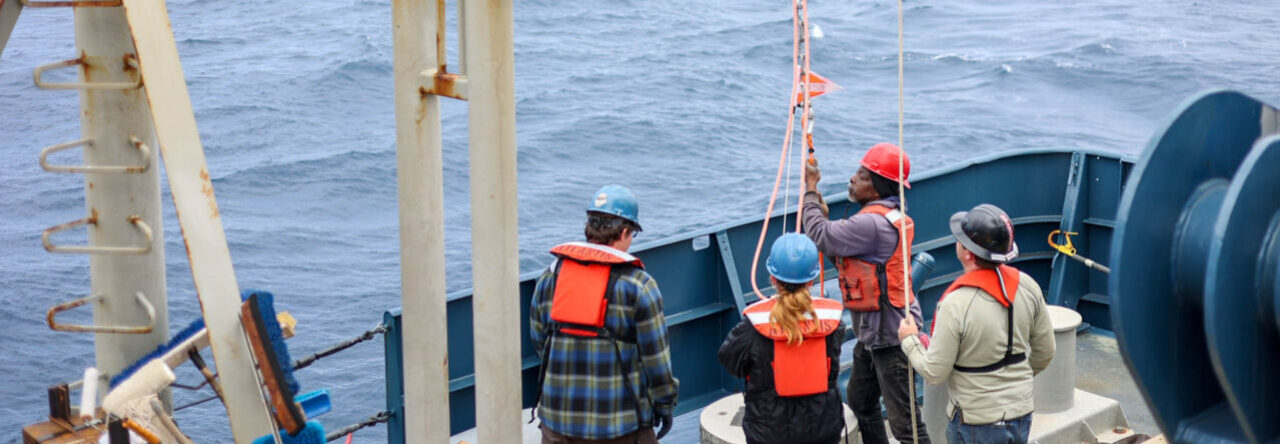
We got an early start on monday to get ready to head up the Miami river to a shipyard where we could have our antenna switched out. We loaded the new antenna onto the ship with one of our cranes. Once we had everything loaded we made our way to the river. We had to cross under 6 different draw bridges along our way. Once we made it to the ship yard I helped prep the new antenna and decommission the old one. We then had a crane come and swap the two antennas. I helped secure the new antenna to its platform. We then headed back down the river and to port. The rest of the week we worked more on general maintenance of the ship. We filled our water tanks. We also topped off our diesel tanks with 2,000 gallons of fuel.
Category: Vessel/Laboratory Page 46 of 89
Hi all! Since my last post, we saw the end of science for this cruise, a brief stop in Cabo Verde, and now we are heading back across the Atlantic. When I wrote my last post, things were just starting to look up for this cruise. As I mentioned, coring is notoriously difficult and this cruise was actually the repeat of one that happened about ten years ago in which they only had success getting cores at one site. So there was a lot of pressure this time around to do it right. We had a much larger corer than the last cruise and the Soutar as backup and that, along with the camera and some other tools were our efforts to see what was happening and get it right.
One of the things that makes coring so much harder than operating the CTD is that our communication with it is very limited. The CTD wire has electrical cables in it running all the way up to a deck box. During deployments, we are able to watch the data from the sensors appear on a computer screen real time and decide exactly when we want to trigger each Niskin bottle to capture water samples. So, we put it in the water then run inside and watch the data plots all the way down and back up. Occasionally, a Niskin bottle doesn’t seal right and we lose the sample, but most of the time there is very little tension when it comes back up, we already have the data. Operating the multicorer is completely different. There is no computer aboard the multicorer and we use a dumb wire, so once we lower it into the water, communication is extremely limited. All that we generally have is a pinger that we put on the wire 10m above the corer. The pinger pings each second at a specific frequency and we use our echosounder in a listening only mode to watch the time delay of each ping increase as the multicorer moves away from us. As we get close to the bottom, we also track the reflection of the pinger off the seafloor and the convergence of this and the original ping marks the corer reaching the bottom. That and change in tension are all that we have to judge what happens on the seafloor and after that we have to wait another two hours to see if we got any mud.

Tension runs high as we peer in to catch sight of the corer. Casts were at all hours of the day; this one came up around 2am [Photo by Sam Katz]

Relief as we catch sight of mud, two casts later and during the day this time, but same idea [Photo by Ben Geyman]
Last time I talked about the camera system that I worked on for the corer. That was very useful in seeing what went wrong, but every time the corer fails, we lose about 5 hours of time, so real time data is really what we need. To this end, I also worked on rigging up a pre-trip pinger system – a way to mount a second pinger onto the multicorer that only turns on once the multicorer trips. We didn’t finalize a good configuration for the second pinger on this trip, but have some methods and new ideas to test on future cruises with the multicorer.
Sometimes when the CTD or multicorer comes back up, it brings us additional presents from the deep. The other day, when the CTD appeared at the surface I caught sight of this strange thing tangled at the bottom of the cable.

Reminiscent of a jellyfish or sea cucumber, it turns out that this is a pyrosome, and only related to each of those as far as kingdom, which is to say not at all. In fact, they’re closely related to the tunicates that live on the underside of docks. In contrast to those, pyrosomes are free-floating and can grow to be many meters long. The pyrosome is actually a large colony with each little bump its own zooid. They’re also bioluminescent and in high enough numbers, can be seen glowing in the sea.
One other cool thing that we found in a mud sample is the following:

The photograph doesn’t do it justice, but this is nature’s fiber optic. It’s a spicule, or structural element, from a deep-ocean silica based sponge species, sometimes called a glass sponge. It has some amazing optical properties. It conducts light just as well as the fiber optic cables that our communications depend on and, in fact, possibly a little bit better due to the sodium content. Besides that, it’s extremely strong and flexible thanks to an inner protein layer. All that we have are the spicules, so we don’t know exactly what species they’re from but one similar species, Venus’ Flower Basket may use these optical properties to its advantage. The depths of the ocean are not exactly where you’d think that organisms would have adaptations to use light, but it turns out that Venus’ Flower Basket serve as the home to bioluminescent bacteria. They also house small shrimp and it seems that the optical properties of the sponge funnel light in such a way to attract small organisms that the shrimp eat. It’s a crazy adaptation for a crazy symbiotic relationship and a great example of the cool things that live deep in the ocean that we still know little or nothing about.
It has been scary watching the extremely fast progression of COVID-19 separated as we are on our ship. Since I last wrote, we watched as the various schools we come from – URI, Case Western, and Harvard – announced transitions to virtual learning, first for a few weeks and now for the whole semester. While we are safe on the ship, stopping in ports and getting scientists from places all over the world are now more dangerous things. Due to the risks, nearly the entire academic fleet will hold off on their operations until the situation improves. This decision was made near the end of our cruise and so we still had to go to port in Praia, Cabo Verde in order to get fuel and stores for the trip back. However, we stayed in quarantine in Praia to protect the ship and made an extremely quick turnaround of about 21 hours.

Praia looks like a beautiful place. I’d love to visit sometime.

One of the last planes before Cabo Verde shut its borders.
Now we are headed directly back to the Endeavor’s homeport at GSO instead of to Florida, where the next cruise would have begun. Those of you who have been following my blog from the beginning know that after my time on the Endeavor, the plan was to head to Bermuda. That is now on hold until the situation improves so just a couple more blogs for now and I’ll make sure to post an update if that changes.
These are strange times, stay safe and healthy out there.

We spent the week at the dock taking care of daily maintenance as well as continuing with our list of repairs. On top of that I also had the oprtunity to reassemble a CTD.
Every year the CTD’s are sent out to be recalibrated. They are taken apart and all the different instruments are sent out separately. Once they are calibrated they are sent back to us and we reassemble the CTD. It was a great experience to learn where all the parts go and what each part actually does. I now have a much better idea how the CTD operates.
One recurring task we have been doing frequently is cleaning out the sea strainer for our air conditioners. Normally the strainer might need to be cleaned once a week but because we have been so close to shore and there is a higher amount of seaweed in the water we have been needing to do it daily. So i’m getting pretty good at that.
This week I have been spending most of my time tracing and fixing freshwater leakes. Two of the leaks were from condensation that accumulated in the air conditioners. But one took a while to figure out. A puddle kept forming in a corner of one of the cabins every couple of hours. We had to cut out some of the walls to figure out where it was coming from. Eventually we figured out one of the water connections for an ice maker in another room. The water was dripping and then running along the inside of the wall all the way to the other cabin. We were able to just tighten a hose clamp on it and it fixed the problem, but now i’ll have to spend the rest of the week putting the walls back together.
After more bad weather delaying the dives, we started heading back south. We went from being near Maryland to slowly making our way to North Carolina. During the delay, I was able to assemble a tiny circuit board under a microscope using solder paste! Placing the first component was super nervewracking; watching my hand shake and go all over the place with the tiniest movements trying not to bump any of the other components. After the first piece was in, it was a lot less stressful. Once all the components were all placed, we used a toaster oven to fully solder all the pieces together (we were strictly told not to make pizza in the toaster oven).


On our last day of clearance, we were able to do two dives. The first one the sub was in the water two hours, then pulled out, a quick transit south, then back in the water for four hours. It’s actually really nice having two dives because I’m able to keep busy which I prefer over doing nothing. I was able to do the subs internal post dive for the first time. With the time I’ve spent in there looking at all the switches and reading the operations manual, I knew how to do a lot of it already. One of the techs was in there to explain the things I didn’t know and to make sure it was all done correctly.
We made port in North Carolina and all the scientists disembarked. The ship is so quiet now that there are only 30 people on it.
Wow. What a crazy week. I got involved in a large project to trace cables throughout the ship to have a better understanding of what sensors and antennas on the mast are attached to on the bridge and in the tech lab. For part of that task, I was able to climb up the mast and got an amazing view. I also helped with preparing for the upcoming cruise (that ended up being canceled) and wrote a program in CRBasic for a Campbell Scientific Datalogger. The weather finally cleared up and we got some nice sunrises. I also got a small boat tour of Bermuda by one of the Marine Techs. By the end of the week I found out that I would have to leave my internship early due to COVID-19 precautions. I will be leaving in two days. I am very thankful for this opportunity even if it was cut short. I hope I get to come back and finsh my internship if possible later in the year.


This week we spent our time back at the dock so we did a lot more work to the ship. We are replacing one of our large antennas in a week. I did a bit of work getting everything set up for the removal and for the installation of the new Antenna. I ran new cables throughout the ship and also made sure none of the bolts holding down the Antenna were seized. We are also going to have the entire ship hauled out to be inspected and repaired in April. So we started to prepare for that as well. We scuba dived under the ship to measure the cutless bearings around the prop shaft to see if they needed to be replaced, which we found they will be. So now we can have the new bearings made, which will take about 2 weeks and should be ready by the time the ship is taken out of the water for the inspection. While we were diving we also inspected a large transducer window under the hull to make sure there were no cracks. Not only was the dive important for our work but it was a lot of fun! There were lots of really cool fish and rays under the ship.
Hi all! It’s been a busy, busy week and a bit. Sorry for the irregular blog schedule, it turns out that 5° is not a great place for satellite internet coverage when crossing the Atlantic. Anyway, this week all the fun really began. We left Bridgetown, Barbados the morning of Thursday the 27th for a three-day transit to our first station.

Bye Barbados! The last land we’ll see for 3 weeks
The main object of this cruise is to look at black carbon from biomass burning in Africa as well as heavy metals and PFAs in the atmosphere, water, and sediment. For the air sampling, the science party runs 4 high volume air samplers on the level above the bridge and one above that. For the water sampling, the scientists run filtrations all the time with our flow-through seawater system to look at water near the surface. These systems are always on while we’re in transit and are only shut off when it’s time to stop for a station to do deep water and sediment sampling. Over the course of the cruise, we’ll be stopping for between 10 and 12 stations. At each, we start with a CTD cast. On the way down, we get to see the profile of the water concerning temperature, salinity, oxygen content, fluorescence, and more. Then on the way back up, we trigger bottles to fill with water at depths of particular interest, like the maximum depth, maximum oxygen content, or right below the surface. At some stations, we’re just interested in the top 1000 meters of water, and at others we will do the CTD to full depth.

Directing a CTD cast. That’s me with the blue hard hat by the rail [Photo by Sam Katz]
Following this, it is time for the main object of the cruise – to get mud. We have time to do up to 2 or 3 casts at each station using the MC800 multicorer or the Soutar box corer. The MC800 is a notoriously tricky piece of equipment. It has a large outer frame and a central portion that holds the core tubes. The outer frame will sit on the bottom while the central portion gets pushed down into the mud. Then as it pulls out of the mud, it triggers lids and feet to flip shut on all of the tubes and capture the sample. The problem is that sometimes it gets triggered too early by motion in the water column and sometimes it doesn’t get triggered at all. The Soutar is simpler in its triggering mechanism, but requires enough tuning that we keep it as the backup in case we’re having no luck with the MC800 and so far, we’ve only had to use it once when we failed to collect samples with the MC800 twice in a row (we didn’t have success with the Soutar either).

Setting up the MC800 multicorer. You can see the bottles, feet, and finicky triggering mechanisms [Photo by Sam Katz]

The box corer getting it’s turn. That’s me on the A-Frame [Photo by Sam Katz]

Lots of nerves in the room as the corer gets close to touching down [Photo by Sam Katz]
One of the big projects that I’ve been working on so far is a small camera system called DEEPi developed at URI. A previous iteration of the camera had been tested to depths of around 1100 meters and during this cruise, we were hoping to test it at greater depths and use it to determine what was causing our multicorer to trigger early. During a 3300 meter cast at the second station, I put the camera on for the first time. That cast ended up going poorly with an early trip and no mud collected and the camera was able to show us just how early the mechanism tripped. At a depth of 3300 meters, the pressure is nearly 330 times more than what we experience and this turned out to be enough to kill the light that we used with the camera, but not the camera itself.


The DEEPi camera, the full system undergoing thermal testing, and all set up to watch the multicorer [Center photo by Gabe Matthias]
A couple of additions to the list of things I wish the Endeavor has are LEDs and lots of clear epoxy, but I was able to harvest some LEDs from a flashlight and found a couple tubes of five-minute epoxy. That plus some resistors and a lovely duct seal sacrificed to form a mold yielded a light to let us continue testing. I had some trouble with the epoxy not hardening well and my attempt at a vacuum chamber went poorly. But, we decided to put it in and see what happens. Bubbles are a big problem at the depths we’re talking about, but I figured that it would yield good data even if it lasted for only the first few hundred meters.
Unfortunately, the DEEPi did not survive its second cast, to a depth of 4645 meters. It’s cause of death is from some combination of the super high pressure itself and possibly some water ingress, but it’s a bit hard to tell with everything buried in epoxy.

Despite the unfortunate foreshortening of its life, the camera was able to capture the bottom of the ocean. That’s the slightly browner smear near the bottom of the frame.


The light that died. The light that survived. The one on the left is not rated to 3300m and the one on the right is, surprisingly, okay at 4645m.
We are currently at Station 8 and have 4 more before reaching port around March 17. I’ll try to post another blog before then to talk a little more about the different things we’re up to and for now enjoy the stern at dusk.

We spent the week getting ready to take a group of students and professors out. We finished up all the projects we had been working on. We got the CTD prepped on Thursday. Then did a wet test on friday. It was my first time deploying the CTD. It went pretty smoothly, and was great practice for when we would do it for real. While we were doing our prep I got to see a few manatees. They like to spend time in the area we are docked.

We started around 8am Saturday morning. I helped the engineer get the engine fired up. We also setup the generators and took out the shore power. We went about 8 miles offshore, and dropped the CTD in to get some samples. The seas were pretty rough, but it still went really well. We ended up doing 2 different CTD deployments throughout the day. We also deployed two different nets to collect micro plastics and we dragged another to collect plankton. After we finished collecting the samples we headed back to port. On the way we saw a pod of dolphins ride the bow wake. We will do another similar trip Sunday as well. 
We’re traveling up the east coast now. During one of the previous dives, one of the sub’s pumps had a water leak. I got to put a new one on the sub and clean up the previous one. We stopped in Florida to swap out some of the science party, then headed north. We ran into a few days of bad weather, which on top of making a lot of people sick, delayed the dives. Four days with not much to do but watch movies. It sounds like fun but after the third or fourth terrible movie that someone else put on, it’s almost tempting to throw myself off the boat just for something to do. When we finally got the weather to calm down enough, we got one short dive in. As we continue to head north, we’re going to hit even more bad weather. We’ll see what happens to the other dives on this cruise.
My first week here in Bermuda is already coming to an end. I arrived at BIOS Monday afternoon after a overnight flight. BIOS is home to the Bermuda Atlantic Time-Series Study (BATS) where they use the R/V Atlantic Explorer to collect oceanographic data every month.

Pictured below is the R/V Atlantic Explorer at sunset. The weather has been windy but otherwise pretty nice.

I spent most of the week getting acquainted with the boat and the marine tech world. I was assigned little projects and reading to get me up to speed with some of the technology and equipment that I am unfamiliar with. It is exciting to be learning new skills that will benefit my career in the long term!

One of the little projects I am working on is simplifing and organinzing the ship’s media storage which meant opening hard drive cases and moving files between the different hard drives.
I am excited to continue learning new aspects of this exciting career and getting to go out to sea in a week!