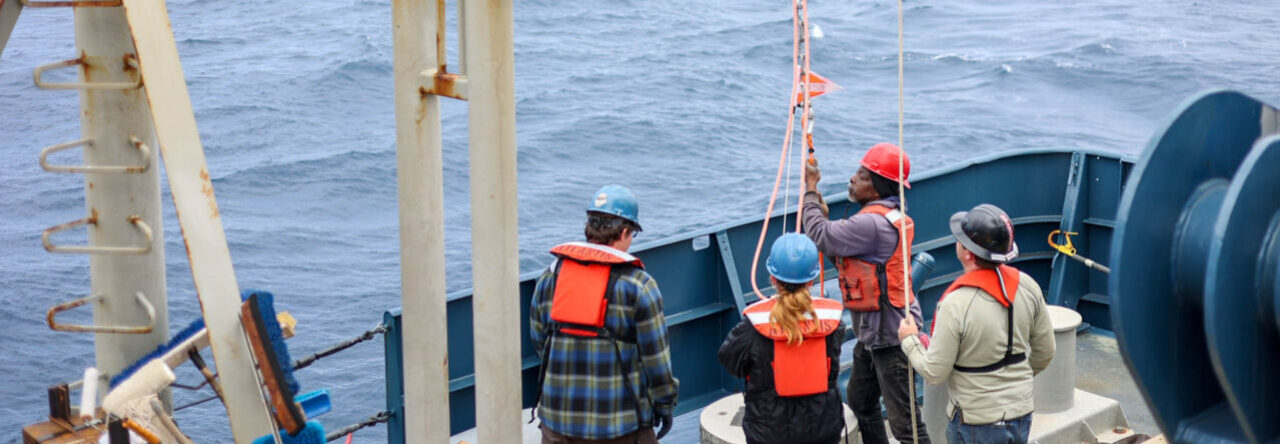
We did another test and inspection of the safety equipment this week. We ran the fire pump and emergency budgie. We inspected the fire suppression systems for the engine rooms. We also went through and tested all the emergency lights. Testing the emergency lights is normally done by the deck crew but they have been away for a while now due to Covid-19 and the lights were due for an inspection. We found three lights that were not working properly. The emergency lights are wired so they stay off as long as the power is going to them but as soon as the power goes out they light up powered by either a 6v or 12v battery that is wired into each light separately. The lights that we discovered not working, each had a different problem. One light had a dead battery that just needed to be switched out. One had a problem with its test button. The test button normal temporarily shuts off the power inside the light when it’s pressed so you can tell if it is working properly. This light would not light up when the button was pressed but would light up when we shut the breaker for it circuit off. So that shows the light was functional all it needed was a new test button. The last light needed to be replaced with a new one. From our test it looked like its circuit board was fried.
Category: Vessel/Laboratory Page 45 of 89
We spent a lot of time this week servicing all the air conditioners and fixing some of our refrigeration systems. We also had the ship’s black water pumped out. The ship has around 14 Air conditioners. For most of them we just need to check them out and clean the filters. Unfortunately we had 8 that were getting cover in mold. The mold grows in the inside of the air conditioner unit and it can get pretty thick. This can actually put extra wear on the AC and cause it to run less efficiently. This mold can also have a negative impact on the air quality of the ship. Cleaning them can be a little tricky. We have to partially disassemble the AC to get to all the parts that need cleaning this process can take up to 2 hours per unit. So it took up alot of our time this week, but we got them all cleaned and checked out. 

This week we worked on the ships two deck cranes. The ship has a port and starboard crane. We used them for loading and unloading equipment. We also used them to deploy different scientific equipment. The cranes are integrated to the ships hydraulic system. The system has two large pumps that continuously pump fluid through the system. When you would like to use one of the machines once the pumps are turned on you just need to open the valve for it. The cranes and pumps have been running really rough. We found the problem was air in the system. Because the system is constantly circulating we were able to just run the cranes for a while. Working them in all different directions till the air was all cleared out. We then cleaned and greased all the fittings, joints,and roles on both cranes. While we were doing our work, Don showed me how to operate the crane. It was really good to learn how they worked and I also got a lot of good practice running them.
Some parts of Florida are beginning to re-opened even though there is still a threat from Covid-19, but Everything is still locked down on the University of Miami campus for now. Which has been good. I’m able to stay pretty isolated the way things are. My only contacts are Don the chief engineer and occasionally Denis the marine tech.
Don and I finished a few projects together this week. We replaced a coupling for our fire pump to its motor called a love joy. It turned into a tricky project because everything was seized up which made it very difficult to take apart. Then it was tricky to get back together because we had to line up the motor’s shaft perfectly with the pump’s shaft. It was pretty difficult to get it perfect but we managed to in the end. We had another tricky task we took on. We replaced the main aft door gasket which was difficult because it has to be glued in place perfectly, then needs to seal totally with no gaps around any of the edges. Once we finished that we went around and tested all the bilge alarms. We only had a problem with one getting stuck on but we were able to free it up. As I was looking closer at the alarm panel I noticed one of the voltage regulators had burt. It hadn’t affected our bilge alarm so we will test the smoke alarm system next and order a new regulator unit to replace the old one.


The crew is still on leave so it has been just Don the chief engineer and I working on the ship. It has been really quiet around here but we have been able to get a lot done. Our starboard generator was due for an oil change. I Have done multiple oil changes to marine engines in the past but each ship has different procedures to how they like to do each engine. So it was good to do it with Don to learn the best way to change the oil on this engine. We replaced both oil filters as well as changed the fuel filters. Once we finished we pumped 55 gallons of new oil to our ships oil holding tanks. Now that we have the time we might start going through and changing the oil on the other equipment as well. We have been doing alot of engineering work on this ship because our other operations have been suspended for now, but this has been good practice. Don has been taking his time to show me all the different systems on board. The last thing we did was go though the whole fier pump and bilge pump systems which have been very helpful. Don also lent me his two QMED study guide books and a stack of flashcards so I can start studying for the QMED. The QMED is the Coastguard engineering licence it stands for Qualified Member of the Engine Department. Studying these will help me a lot in having a better understanding of all the working on the ship, and it could also prepare me for the examination. I would like to take the test in the future.
Hi all! We returned to port about one week ago now. The last few days were filled with taking the rest of the science equipment down, packing everything up, and enjoying the last little bit of time at sea.

Taking the passive air sampler down (and missing the weather in the Tropics) [Photo by Ben Geyman]
Nearly the entire research fleet is shut down for the next few months, so we also took a detour to check on the Coastal Pioneer Array. This is a complex array of surface moorings, gliders, and AUVs located on the continental slope south of Rhode Island that is part of the Ocean Observatories Initiative, a program involving collecting an incredible amount of data in arrays at sites of interest in order to observe processes and change. Three of the moorings had problems with either a wind turbine or antenna and we went to take pictures and see if we could determine any more about these problems.

One of the moorings. With two of most components and many backup systems, none of the failures were critical
Ultimately, two of the failures were easy to identify – the wind turbines were simply gone – but the third remains a mystery.
We landed the morning of April 1st and New England was kind enough to welcome us back with some classic April weather – cold, windy, and with some sleet.


Landing [Photos by me and my mother, Celia Gelfman]
This has been an amazing adventure. I got to learn and do new things nearly every day from running CTD casts to finding a computer that could still run DOS to visiting the highest and lowest parts of the ship – the transducer well and the upper decks. And all of this on a moving platform where some days there is 10 meter heave (motion up and down from passing over a wave), 20 degree roll, and 40 knot winds to deal with and other days you are treated to dolphins, flying fish, squid, and strange creatures from the deep. The crew has been fantastic from the steward, Mike, and messman, Rick, who made three delicious meals for us plus cookies and cakes each day to the engineers who happily answered my million questions including whether they had thin copper pipe, shim stock, something to make an epoxy mold with, a 5” pipe wrench, or anything metric (yes to all but the last) to our awesome boson, ABs, mates, and captain. The scientists have been great to work with and learn from and Gabe has been an incredible mentor.
Returning home to this strange world of Zoom, masks, and bleaching your groceries has made me more grateful of my time at sea. There’s nothing like being trapped in a 50 foot across apartment to realize just how spacious 185 feet is.
 [Photo by Ben Geyman]
While my internship has unfortunately ended early due to COVID-19, I know that this is absolutely a field I would like to continue in and I can’t wait to get back out.
Stay safe out there and a big thank you to MATE for giving me this opportunity.

Our trip to go to the dry dock for our 5 year ABS inspection was postponed due to the coronavirus. We have a stay in place order till further notice. We had done a lot of work to get ready for the inspection though. We spent a lot of time in between the decks and in all the void spaces to inspect the aluminum for pitting. We cleaned any salt that may have built up over the years as we went through. It was not easy to do. The chief engineer and I crawled around some pretty tight dirty spaces for a couple of days to get it all cleaned up. But lucky we did not see any major corrosion or cracks.

Now that we have been staying in place I have been doing alot of other work. I fixed two of the ship’s pneumatic pumps. I took them apart and I found two of the check valves were fouled up with debris. I cleaned them out and put the pumps back together. I tested it out and they worked. The ship also has a distilled water system for the scientists, but the system has not been working for months I was told. We ordered new pressure gages for it because the old ones seemed to not be working. I had a little bit of extra time so I decided to install the gages and see if I could troubleshoot the system and figure out the problem. I narrowed the problem down to the pressure tank. I read the manual for the tank and found out it was possible the air pressure in the tank could be too high. So I used a car tire pressure gage and found it was at 45 psi and it needed to be at 18psi. So I let out air till it was at the proper pressure and turned the system on. Once everything was recharged and all the air was bled out of the system I tested it out and it worked.
The rest of the crew have been asked to stand down until april 15th due to the coronavirus. So they are not coming on board the ship now and are trying to do what work they can from home. Now just the engineer and I are staying on the ship to make sure everything keeps running smoothly and we continue to chip away at projects.
Yesterday we noticed the black water pump was not shutting off. Which means there is either a problem with the pressure switch or the system had a leak somewhere and are losing the vacuum pressure that way. We shut the system down last night and decided to work on it today. We did a lot of trouble shooting to figure out where the problem was. We figured out that it was not a problem with the switch but a vacuum leak in the system. This is not an easy thing to find because the system runs throughout the ship and the leak could have been anywhere. By shutting down different parts of the system we narrowed down the leak to the part of the system where all the other parts come together to the vacuum pump. We found that there were two bad check values that were letting air escape. We replaced the valves and tested the system and it solved the problem. This kind of problem shows the importance of having someone on board the vessel. If this had happened and no one was here to catch it. It would have kept pumping and could have really damaged the system and the pump would have needed to be replaced.
Hi all! We are now just a day out from returning to port in Narragansett. This week has been a lot of packing up stuff, working on miscellaneous improvement tasks, helping the scientists with their ongoing sampling, and working on some small scripting projects in my extra time. One of the big projects early on this week was disassembling the entire multicorer and packing it all up in crates for storage.

That’s all that’s left! [Photo by Gabe Matthias]
Besides that, we’ve been doing lots of cleaning, refinishing tables, and reorganizing, the tasks that have to be taken care of when there’s time between cruises.


Cleaning, organizing [Photos by Gabe Matthias]
We’ve also definitely left the Tropics behind by now. While not quite the weather we’ll be returning to, it’s now in the 50s and rainy. Twice a day, the high volume air samplers get filter changes and I caught a couple of pictures over the past week that nicely show the difference:


Tropics vs New England in March [Right Photo by Ben Geyman]
We also felt the edges of the Nor’easters that have hit New England in the past week. For us, this mostly meant waves up to about 25 feet which yielded pitch and roll up to 10-15 degrees and 10m heave at the stern (total motion up and down as the ship passes over a wave). Changing the air filters with that was particularly exciting.

The bow while we’re changing the filters up above the bridge
After five weeks at sea with the same 20 people, we’ve definitely seen some increase in cabin fever, or “cabin” as we prefer to call it. At this point, I know that Rhode Island, Ohio, and many other states have issued stay-at-home orders and a lot of you are probably feeling the same way, though the 185 feet we have may feel luxurious to some of you in your small apartments and homes. Anyway, some of my favorites from the last week include hot sauce ingredient readings at breakfast, searching for the biggest, baddest toaster money can buy, and sieving all our extra mud (we found mostly mud with a smattering of foraminifera and a couple possible worm casts).
We’ve been quite lucky aboard the Endeavor the past few weeks in what seems to be one of the safest spots on the planet at this time. Once we arrive in port, some of us will be headed to our homes in Rhode Island, and others to Massachusetts, Maine, and even Mexico (eventually on that one). As I mentioned last time, it’s been scary watching the news and how fast everything has been changing from out here and, while we would like to get home, it’s scary circumstances to be returning to.
Tomorrow we will land, unload, and head home. I’ll be sure to write an update about that and finishing up the cruise; lots more pictures to share too.

What’s up?
Everyday is a back and forth game of being on the ship and trying to take something apart or clean and the tools you need have already been offloaded. So you get what you need and return to the ship except two minutes later you realize you need something else, so go get it and then return to the ship. Rinse and repeat. Finally everything is off the ship and the spaces have been cleaned, and you turn around and realize all the stuff you’ve taken off the ship has to be sorted and put away on land. So everything gets rearranged and reorganized and so. much. cleaning. The work spaces are eventually set up and ready to go for overhaul. At this point, the Alvin team is on a stand down for a few weeks. A little mini vacation before the work starts (if you can call it a vacation while sheltering in place).
We had another delay in leaving North Carolina. Something went wrong with one of the engines so there were a couple more days of sitting around not doing much. Once it was finally fixed and we set sail, there was another delay. There was some thick fog so the ship had to slow down and blow it’s horn every. single. minute. for hours. The highlight of having nothing to do is that I finally convinced some of the other Electrical Technicians to play Uno. A decision they probably regret but I had fun.
We finally arrived in Woods Hole (just five days behind schedule but who’s counting)! Myself and some of the other techs are living in a house together. It felt weird to sleep there the first night; it was so quiet and nothing was moving. We also offloaded Alvin from the ship. It made me a nervous to watch a crane casually lift a 45,000 lb sub so high but everything went smoothly. The next few days will be spent continuing to offload the ship and setting up the shops to take the sub apart.
