Category: MATE Blog Archive Page 26 of 89

Posts that were imported from the historical MATE blog at marinetech.org

Walton Smith Week 3: Learning about networking and completing jobs around the ship

This week has been a wealth of new information. Since we are dockside waiting for the new engines, we have lots more time to dive into learning about networking and time to complete jobs around the vessel. To start off on learning about networking the Marine Tech explained the flow through water system we have onboard and how those instruments connected to it send the data to the tech space through physical connections. He explains that most problems that arise with the equipment onboard are through the physical layer connections, which is as simple as forgetting to plug a wire in or it shimmying out of place in rough seas. In everything we are learning about Internet Protocols (IP)m modems, switches, network programming, and PowerShell vs. command prompt. Slowly but surely, I am learning how computers are able to talk to each other. In the process about learning about networking and how information is sent. With the help of YouTube videos, I am able to get a better grasp at these concepts and dive further into them on my free time. The Marine Tech explained how the data collected onboard is sent to Columbia University and added to an online database that compiles raw data from 49 vessels. This database includes 8,655 cruises and 13,805,504 downloadable files. All this data is available to the public at www.rvdata.us.

For vessel work we have been working on the AC system with cleaning the sea strainer and checking refrigerant pressures and the temperature associated with that part of the system. We then compare those values to pressure-temperature charts based on the type of refrigerant used. Our next job was the hot water system. We were having problems were sometimes there would be no cold water, only hot water coming out of the spicket when the cold water was turned on. To begin, the engineer get us a run through of the system and how we have a recirculating system which allows for us to have hot water on demand and not waiting some time wasting water. After isolating certain areas of the system, we figured out that one of the check valves was not working and/or broken. This allows the heated, recirculating water to enter the cold water supply pipes, and enter our drinking water. Another small job we completed was using 5200, a permanent marine adhesive sealant, to prevent the ignition, on the fast boat, from spinning when the key was turned to start the engine. We “locked” it in place. The last small jobs to finish this week was to add Sikaflex, a marine watertight sealing adhesive, to the through hull wires that came into the bridge and galley and then to replace the valves for the water hose spicket on the bow and adding the male adapter end to the hose so we can attach a sprayer nozzle.

For the weekly marine life that has been spotted, while working of the ignition of the fast boat we saw a Southern Stingray swim under the vessel.

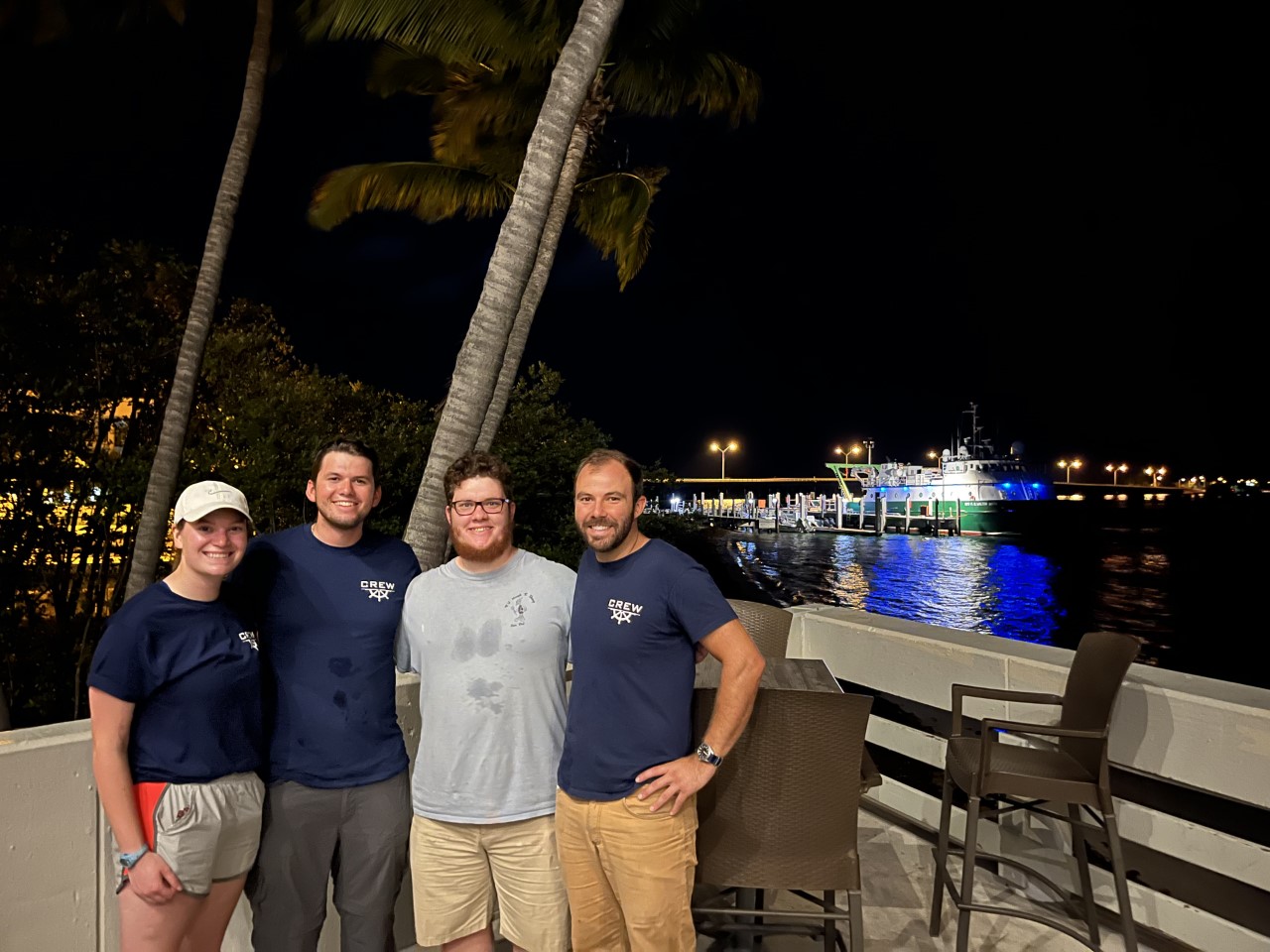
Past and present MATE interns from the last cruise. From left to right: Alesha (F.G. Walton Smith, Summer ’22), Kyle (F.G. Walton Smith, Summer ’22), Sebastian (Hugh R. Sharp, Summer ’19, now a scientist onboard), and Jon (F.G. Walton Smith, ’20, now the Chief Engineer)
Week 3 R/V Sharp

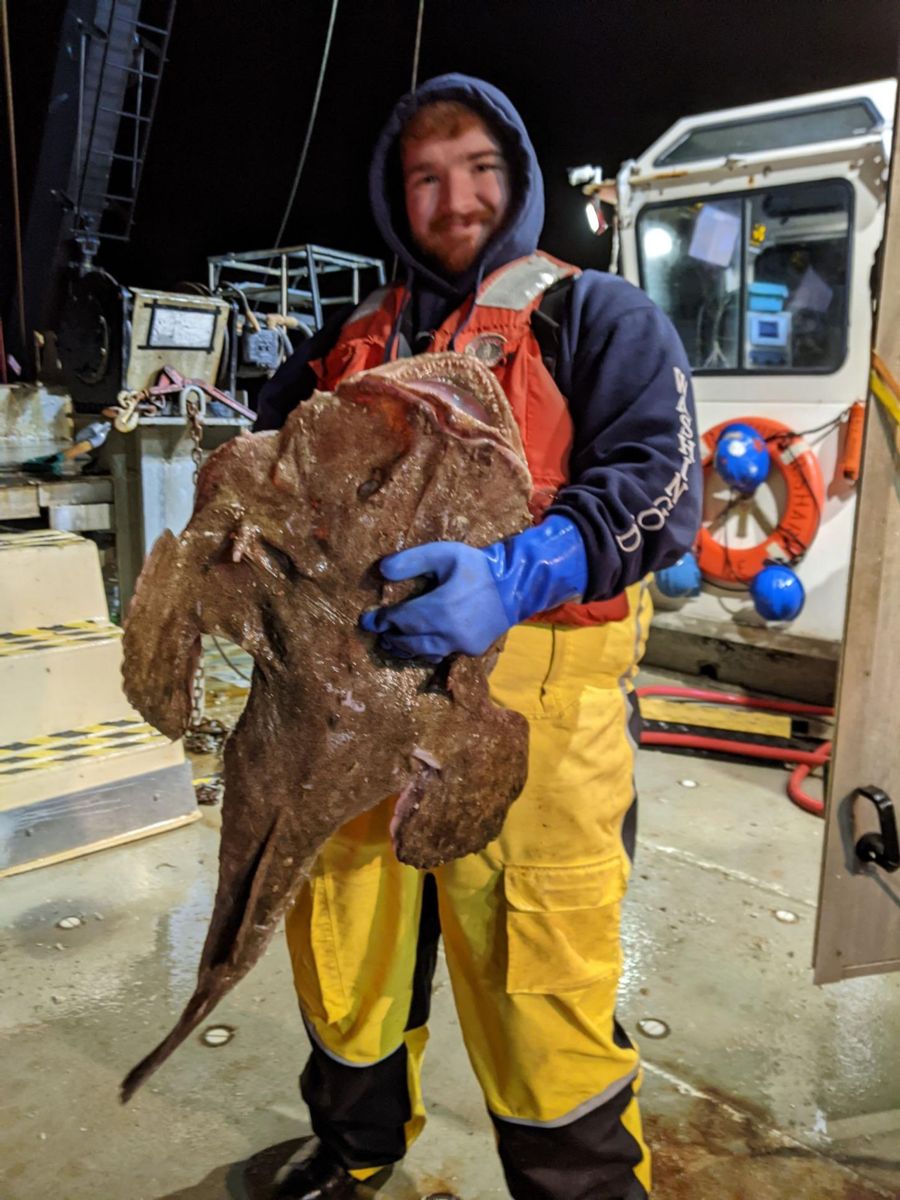
This week we finished up leg 2 in its entirety both in dredging and habcamming. We started by briefly switching from dredging to habcamming in order to take pictures of the ocean floor and determine scallop numbers from that as well. I assisted in annotating some of the obtained pictures, many of which this time included seeds which are basically baby scallops that require special markings different from regular scallops. This continued for a few days and then we got right back to dredging. The loads often varied between what made up the majority of the catch sometimes it was sand dollars and other times it was groups of barnacles or shell fragments. The sizes also varied, sometimes it was a very small load that only took about five minutes to massive loads that could take up to thirty minutes and needed help getting all of the catch out of the bag. In between these different dredges, we would take a device called a CTD which we would prep and send down to nearly the ocean floor to measure the salinity, temperature, oxygen level, and fluorescent level along the water column occasionally taking water samples from the bottom. I was typically in charge of setting up the winch camera and watching the data, communicating with the winch operators when it was close to the bottom and when to bring the CTD back to the surface. I also sometimes helped wash it down with fresh water to keep salt from building up on the CTD. We continued this schedule,(finding many interesting species like the biggest monkfish I had ever seen), until around Saturday where we once again docked at Woods Hole to bring on the last round of supplies and replacement scientists for the third and final leg of the survey. I have been very much enjoying this voyage and I have been learning many practical skills such as how to transfer data and identify many of the native species. I hope to learn even more on the final leg.


2nd week with WHOI

The second week of work has been quite the challenge.

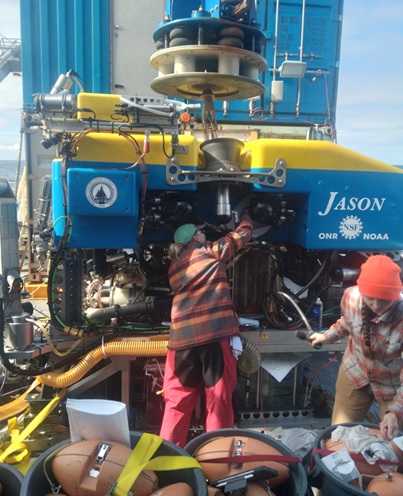
Due to weather conditions, JASON was unable to safely deploy on Saturday (5/28). This hiatus gave extra time to train in the Control Van. That is where the magic happens! There are twelve screens that allow us to see and operate all of the camera angles on the ROV, JASON’s hydraulic pressures and sensors, wench diagnostics, navigation settings, sonar displays, and so much more! To monitor and operate JASON while diving, it takes three people.

The pilot sits in the center, where they have the best views of all the screens. The Navigator sits on the left and is responsible not just for the navigation of JASON, but also the R/V Thompson. They also document the target points and locations as well. Lastly, the Engineer Tech sits in the right chair (this is where I will be). I will be responsible for maintaining, operating, and overseeing all of JASON’s hydraulic equipment such as:

  • Thruster Comp Pressures                            
  • Main Comp Pressures
  • Manipulator sensors
  • Camera settings and positioning
  • Ground Fault alarms
  • Basket (front retractable porch), slurp (suction system for retrieving samples), side sample bio-boxes, niskin sampler triggers, etc.
  • I also am able to help operate the manipulator arms as needed by the pilot
  • Completing hourly checks of all temperature and pressure levels, alarm systems, and reacting to every alarm that may go off.
  • Tether management

I would be lying if I said I was not nervous, but the WHOI team training me are so helpful and insightful and I have no doubts they will support me the whole time.

The rest of today was spent rebuilding the sampler MAJORS from last week. These devices, when triggered, retract, and suck up whatever water or sediment they are inserted into. I ended up replacing the inner seals because they were worn and had a build up of gritty residue on them.

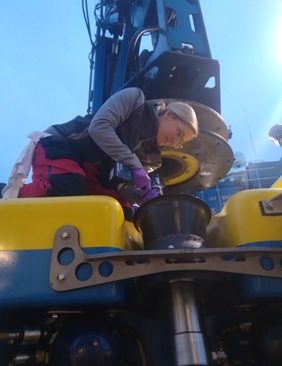
I also lead the Pre-dive check for the vehicle, which consists of over forty-five checks ranging from:

  • Upper Vehicle & LARS checks
  • J-Boxes & Comps
  • Powering Up the vehicle/devices
  • Laser & Light testing
  • Thruster checks
  • Hydraulics
  • Manipulators
  • Misc. checks like vehicle safety vests, securing inner cables/wires, etc.

Sunday (5/29)

First JASON dive is a go!  

– Completed Pre-Dive checks.                                                  

– Secured and arranged sampling tools inside JASON’s front porch/basket.

– Added front weighted plates and rear weighted bricks that can be removed during the dive.

JASON was successfully launched at 11 am.

For my 4-8pm shift, I sat in the Engineering Tech seat in the Control Van and was witness to the amazing capabilities of JASON. This vehicle is capable of unbelievable things, but it is the crew that makes it possible. The dive was successful with its decent and sample collection at over 3200 meters, but towards the end of our shift, it was noted that JASON’s Thruster Comp levels plummeted from 9 to 0.5, and the decision was made to recover the vehicle.

It takes almost two hours for JASON to get to the surface, but only 40 minutes to get him safely back and secured on the vessel. The team removes all 38 tether floats (which are quite large and heavy). One person ropes off the cable to bring it closer to the side of the vessel, another holds the float ropes to secure it and one last person unlatches the lock. With the crane operator timing the retracting carefully, it only takes minutes to clear the cable and finish the recovery.

It would be too long to list off everything that happens with each of these tasks, but I can tell you that everyone has several responsibilities, and each one is vital to mission success.

Monday (5/30)

4-8am shift:

  • JASON investigation revealed possible water seepage into one of the thruster lines. Cleared and bled thruster lines.
  • Pre-Dive checks at 6am
  • JASON launch at 8am
  • Unfortunately after securing all of the tether floats onto JASON’s cable, a thruster alarm triggered and JASON was brought back onto the vessel.
  • The day was spent replacing the vertical thrusters and trouble shooting cable issues.
  • Though my shift is scheduled 4-8, when JASON is down, everyone is working. We spent the whole day triple checking all of the adjustments and hope tomorrow’s dive is successful.

Tuesday (5/31)

  • 12 – 1am – JASON was deployed.
  • Both 4-8 shifts were completed in the Engineering Tech position.
  • Sample collection was successful and JASON operated without issues.
  • Some of the sampling tools did not perform as expected, so it was noted and will be addressed upon recovery/ post-dive.
  • 8pm – JASON was recovered and secured on deck.

Wednesday (6/1) – Friday (6/3)

  • JASON was launched each day and successfully completed sample collection objectives.
  • The normal dive time was approximately 20 hours each dive.
  • Trouble shooting and repairs were completed during post and pre-dive times.
  • The brow pan/tilt camera suffered ground fault issues and was replaced.
  • The thruster control pods for the vertical thrusters were disassembled, cleaned, repaired, and reattached.
  • All lines were continuously bled for air and the junction boxes \checked for water leakage.

This week’s lessons:

  • Oil pads are lifesavers! (We call them diapers) While replacing thruster lines, camera lines, whatever lines…they are all filled with either royal purple (an oil) or mineral oil. Even with clamps, sometimes the amount of oil lost can be substantial. So plan ahead, layout a “diaper” to collect whatever oil may spill. Clean everything!
  • I was able to diagnose a thruster connector leak by making sure to clean the area after replacing the vertical thruster.
  • Be meticulous. Ask questions. Double and triple check everything. Have someone else check your work. Good practice!

Week 2: Prepping for engine overhaul F.G. Walton Smith

Following our exciting week out at sea, we have arrived at the dock and are spending each morning with the Marine Tech going through the Local Area Network (LAN) Infrastructure and how the sensors and scientific equipment communicate to each other. We are then spending the afternoons with the Assistant Engineer going through figuring out projects that have been on the list to do for awhile as we await the new Cummins Diesel Engines to be delivered for the Engine Overhaul scheduled on June 16th. These projects include replacing a torn rubber seal on the diaphragm pump for the head system, changing out faulty relays for the A/C compressor system, recharging the A/C compressor refrigerant, and fixing a faulty check valve in the hot water recirculation system as it is mixing with the potable water. 

I have been learning a lot working with the Marine Tech on how data from sensors are packaged, read, transported, and understood by computers as the physical layers of voltages and amps become this sort of metaphysical data stream. It is quite interesting as the further I dive into it, the more boggling it gets, how we can convert something tangible (but not perceptible to the human eye; electrons) turn it into something intangible (a bitt or packet of information) and transport that across atmospheric space, between systems, to receive and be able to comprehend the information on the other side. From working with Dennis, I think most computer engineers would argue that none of it is actually intangible, but to me it is very abstract. However, I am enjoying the process of learning about Internet Protocols (IP), Firewalls, Modems, Switches, Access Points, Software vs. Hardware, and Network Programming. I have been learning a lot about binary and hexidecimal languages as well. I am beginning to understand that is how these scientific instruments are communicating via the network of operating systems and storage devices. This is very important as a Marine Tech as understanding the basics and layers of the local network and how the local network connects to the wide area network (WAN) or satellite connections while out to sea can help when troubleshooting issues that arise in the tech. Dennis has us learning the Open Systems Interconnection (OSI) Model, which describes 7 layers of interfacing with the equipment; the physical, data link, network, transport, session, presentation, and application layers. Dennis has made it clear that 99% of the time when troubleshooting the problem lies in the physical layer between connections and electrical terminations. We are beginning to learn the tools of how to troubleshoot network issues and establish connections to the equipment. It is also in the plan in the next couple of weeks to get some practical experience making new connections and terminations to the 3-2-2 cable and parts of the seabird CTD. Looking forward to that experience!

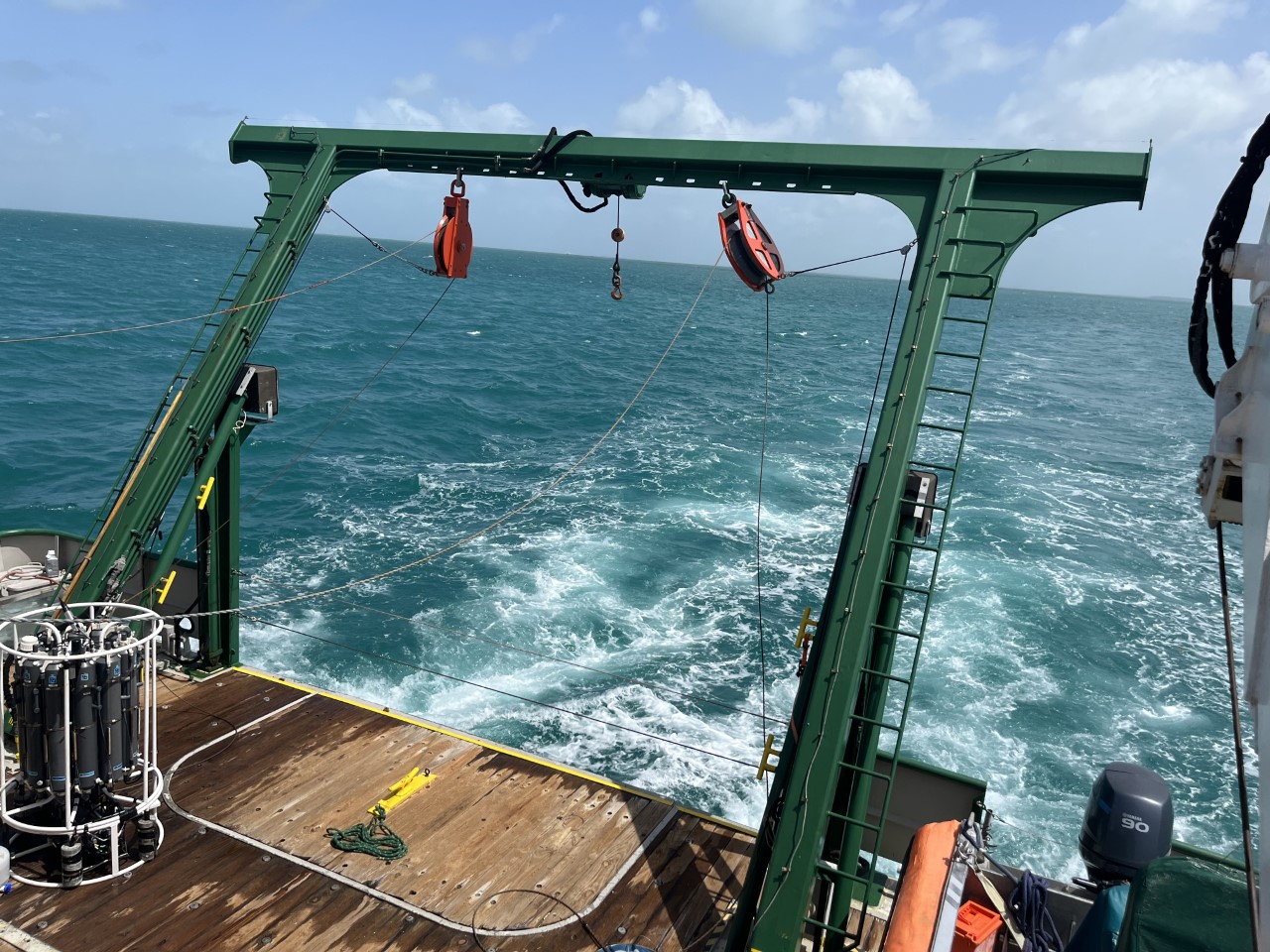
As a tertiary (but also super important) element to this internship I am enjoying the networking and relationships that I am forming with the crew and scientists, as there is a stark contrast from the climate onboard the F.G. Walton Smith research vessel with the tugboats I am used to working on. It is a collaborative, interesting, and thoughtful work environment that is both challenging and rewarding! Everyone shares enthusiasm for the environment, animals, and learning, which promotes everyone to become interested and involved in different areas of research or technical expertise. Here is a picture featuring Alesha Gregroire (left), Jonathan Raymond (Far Right), Sebastian DiGeronimo (Middle Right), and I (Middle Left) all Mate Interns at one point sharing our experiences after the cruise! Below that is a picture of the stern of the R/V F.G. Walton Smith with the CTD connected by the 3-2-2 wire to the starboard side hydraulic winch drum.

WEEK 3: R/V Sharp

Week three primarily consisted of dredging. My current shift is 6 hours on and 6 hours off. Depending on the dredge load it can be very physically challenging. After the load is dropped on the dredge table I shovel the contents to the sorters. Some very heavy dredge loads result in upwards of 30 minutes of shoveling. Typically on a productive day we can achieve 4-5 dredges per 6 hour shift. I have also become relatively confident with the CTD casts: during these I prep the CTD by taking off all plugs and caps from the pumps and sensors communicate with the science watch chief so I know the station number and cast number then I communicate with the engineer with the bottom depth and I watch the sensors and make sure they are functioning as expected. When the CTD reaches the bottom water bottles are popped that collect a water sample and we recover the CTD. We then secure it in the ship and flush the system and hose it with freshwater. 

On the steam back to port the WHOI technation discovered that a connection to the Habcams electronics bottle was damaged to the point of failure. At port the NOAA tech and I inspected the Habcams electronics bottle and blown connector. Because there were no blown fuses we came to the conclusion that the issue was caused by a short circuit within the connector caused by a water intrusion or insulation breakdown. He also taught me to look for signs of arc damage within a connector which can indicate a breakdown in the insulation. After the problem was diagnosed I assisted the NOAA team with reconnecting the electronics bottle and testing system power. 

Overall I had a great time and learned a lot this week. I got experience troubleshooting the R/V sharps computer systems and helped fix an issue with a gyro signal transmission with my mentor and I got time with the NOAA team troubleshooting the Habcams electronics system. The dredge work was very rewarding and fun. I am also excited about all of the contacts I have made. I have met some awesome people from NOAA and WHOI who I hope will be great future references. 

Week 2 R/V Sharp

This week we finished up the first leg of the voyage doing the last bit of habcam piloting and annotating after briefly bringing it back on deck for maintenance and putting it back in the ocean. We briefly docked in Woods Hole, Massachusets to restock on supplies and switch out the leg one crew with the leg two crew. Starting on leg two we switch from a 12 on 12 off schedule to a six on 6 off schedule to better accommodate the dredging schedule. We start dredging this leg which involves sending a large net behind the ship which then collects different creatures which are then brought up and sorted depending on what they are. The main species we are after is scallops but we also pull up skates, crabs, hermit crabs, lobsters, and many other different types of fish species like halibut or sea robins. It’s very exciting seeing all of the different species that I previously only saw in habcam pictures and I am excited to possibly see more species.


Walton Smith Week 2: Finishing the second cruise

Week 2 was very similar to Week 1, as we finished the second cruise at the end of the week. As time progressed and I had more time on the aft controls, I got more comfortable with maneuvering the boat during CTD casts. I also got to interact with the scientists onboard helping them recover the CTD on deck and learning the computer aspects to deploying a CTD with knowing how deep it is, the depth until it reaches the bottom, how to fire Niskin bottles, and a lot more. During my down time onboard I had the chance to play card games and learn a new one, Scopa, an Italian card game. 
On the way back to the docks, the port engine had troubles once more. This time it was a coolant problem, we had none. Because of that, more coolant was added to the engine and the engineer wasn’t sure if it was a quick or slow leak, so every 15 minutes levels were checked along with engine temperature to try and figure out the problem. It was in fact a slow leak because after 2 hours of checking, the levels were staying the same and the engine temperature was staying consistent. Right before we entered Biscayne Bay, for the final stretch before the docks, we heard a distress call over the radio. All crew was up on the bridge wing looking for flares and informing the Coast Guard of their location.  Once we finally made it back to the docks and tied up it was time to relax for a nice 3 day weekend. It was spent relaxing at the beach, exploring the area on some bikes (getting caught in the beginning of the thunderstorm) and SCUBA diving were I saw many Florida lobsters “bugs”, massive sea stars, lion fish, tarpon, a nurse shark, an eagle ray, some barracuda, and conch.
I cannot wait for more weeks to come to learn more. 

Cape Florida lighthouse, built in 1825, on Key Biscayne, FL. This is the oldest structure in Miami-Dade and has survived almost 200 years of hurricanes. Today, the lighthouse is a cultural landmark and part of the National Register of Historic Places. 

First week with the JASON team

Talk about hitting the ground running!

Monday (5/23) the JASON team boarded the R/V Thompson at 8am, dropped our duffels/suitcases in the main lab area and went to work!

First order of business was unwrapping the vehicle and rinsing it down, while checking to ensure everything was undamaged.

The primary goal of my first day was to disassemble, clean, and reassemble six Majors (water sampling systems). Once finished, we attached the handles but later detached them for the testing and training phase.

 (Pic of Major) without handle or nozzle  

We then trained a member of the research team how to:

  • Operate, test, and empty the Majors
  • Attach the Major handles and nozzles

Vehicle checks were then completed. Half of the team was up in the control van while the other half was outside with the vehicle.

The second day (5/24) was spent creating a layout of Jason’s basket (extendable/retractable front porch) to include collection boxes, empty crates, and sampling equipment mounts.

All had to be securely fastened down but we also needed to create a system was so the milk crates containing equipment and samples could be removed by the research team members and easily reattached as needed.

Vehicle checks were then initiated and completed.

At the end of the day, a line test was completed to test the JASON tether and backup cable system.

Day three (5/25) started off with attaching the slurp collector (sediment/soil sampling nozzle) to its collector hose. This attachment was completed using hose clamps and heat sinks.

Team members then began filling JASONS’s oil chambers, checking all hoses and primary/auxiliary boxes for air bubbles. The goal was to bleed out any air in JASON’s systems (which there are many!).

Towards the end of the day, the thrusters, manipulators, and hydraulic oils were also topped off.

Day four (5/26) was departure day!

The first three hours was dedicated to strapping down and securing all JASON systems, equipment, and supplies to prepare for vessel launch. Anything that could potentially move needed to be secured.

All of JASON’s cables, wires, and connections were zip-tied to ensure total security.

The thrusters were again bled for air bubbles and will be bled multiple times over the next couple days. The ship’s movements will help shift any air bubbles to the top of the lines so by deployment day, the air will be completely expelled.

The afternoon was spent rigging a base for the Fluke Temperature Probe to sit at the front port side of JASON’s porch in front of the collection crates. This will be used by JAONS’s manipulator arms to measure temps inside hydrothermal vents. The maximum temp this probe is rated to is 500 degrees Celsius.

Vehicle checks were initiated and completed. (This time I was able to be inside the control van)

Throughout today, fire and safety drills were executed, and all crew members met in designated parts of the vessel with their life vests and float suits to discuss steps in case there was a fire or if the ship was sinking.

The end of day was spent securing a location for a “Mapper” tool that a research team member requested be attached to the vehicle. It was positioned on the top front, starboard side of JASON, above the starboard manipulator. Once finished, team members bled out the starboard manipulator arm. (This arm was attached the day before. It is a rental arm, used for this mission while the previous one is being repaired)

Day five (5/27) is zip-tie fiesta day! You can not have enough zip ties. That is the number one rule.

Especially with JASON, if any cord or cable is not sufficiently secure, it can loosen and possibly end up in a thruster, which means disaster! So most of this morning is double checking everything.

The port side manipulator was then bled and checks were completed to ensure all air has been evacuated.

At lunch time, the team goes on break and after lunch, shift times begin.

The shifts for this mission are 4 hours on and 8 hours off. But if something breaks, everyone is working.

For example, my shift is 4-8 every morning and night. A major rule: Start your shift 15 minutes early. This gives time for the previous shift to update you on what has happened and what needs to be done.

I begin my 1st shift in approximately 2 hours.

So far this experience has been absolutely thrilling.

Hands-on, always busy, and always working. Everyone works together efficiently and as soon as someone if finished with a task, they jump right into another or ask how they can help. If you have questions, a team member is there to graciously help explain, train and teach you how to get something done. I cannot wait to see what tomorrow brings!

* I will try to upload more pics next post, the data is limited on this trip so this is all the time I have today!

Week 1: First Trip with the F.G. Walton Smith

Today, marks my seventh day onboard the F.G. Walton Smith and it has been a bundle of great experiences so far! On the first day, I arrived to the RSMAS campus after a long redeye flight just in time to meet with the Marine Operations Manager, Don Cucchiara, and the whole shoreside team. We caught the lines for the F.G. Walton Smith as it returned from a 4-day cruise diving to recover a few 3-5 year old moorings off the coast of Jupiter, Florida. While underway on that cruise, the crew was having trouble keeping the port main engine alive, so they were limping back to the dock on one engine. 

My introduction to the ship and the crew was quick as I dove right in! Right away the Chief Engineer and previous Mate Intern, Jonathan Raymond, took me and Alesha Gregroire to troubleshoot the engine. We first tried to switch the Fuel Actuator and High Pressure Sensor from the starboard engine to the port engine as we wanted to test if those had gone bad on the portside. We also tested the connections with a multimeter to see if there was a short somewhere in the Engine Control Module (ECM). Finally, we deduced that the ECM was cutting power to the engine when it sensed there was a problem with something internal. As the engines are upon their death bed at a little over my age, 22-23 years, it was decided for the next cruise we would bypass the ECM on the port main engine. Essentially, we hotwired the solenoid of the ECM straight to the battery as we didn’t have time to find out what the internal problem was. 

The second day, we spent some more time with the engine as we figured out it couldn’t be shut down with the bypass wire. So, we added a switch. There was also a problem with the head system as it wasn’t providing enough suction. So, we replaced some duckbill valves by the pump. We helped load stores when the cook arrived and helped load the scientists gear when they arrived as well.

At 0400 on Friday, we set sail with both engines up and running on a 7-day cruise to collect water samples and CTD profiles from stations outside of Miami down to Key West and back around to Tampa and Florida Bay. Onboard there were scientists working from NOAA’s Atlantic Oceanographic and Meteorological Lab (AOML), the MOTE Marine Lab, and Kristin Buck’s Lab at the University of South Florida (USF). This was a great introduction and experience to research vessel operations as Alesha and I learned how to deploy and recover the CTD, Net Tows, and collect trace metal Samples over the side. We also stood navigational bridge watches and learned new card games from the scientists. 

By the third day of the cruise, the F.G. Walton Smith was becoming super hot as the A/C system was struggling in the Florida humidity. Jonathan and I took a look into the compressor system and found numerous pinhole leaks, which were contributing to loss of cooling abilities. We worked to fix the leaks and everyone onboard was grateful to have the A/C back up and running as it was 82 degrees with 90% humidity throughout the trip. 

Watches were exciting as their was plenty of life to watch between pelicans divebombing fish, dolphin pods following the ship, and bioluminescence at night. There were also plenty of boats to avoid as Florida is riddled with amateur boaters and crazy for fishing. 

This has been a great experience so far and looking forward to spending more time with the crew!

WEEK 2: R/V Sharp

Leg 2 Operations will consist of dredging and habcam operations. I have been trained by my mentor for this leg on how to safely bring the dredge on deck, attach it to the dredge table, and empty the bag. This involves three people: the engineer, the other tech and myself. After the dredge is secured, the other tech and I shovel the contents of the dredge to the sorters from the science party at the edges of the table. Habcam operations are the same as the first leg. 


On the technical side I have been assisting the WHOI and NOAA technations with troubleshooting on the habcam. After the end of leg one the malfunctioning sidescaning sonar was taken from the habcam to be troubleshooted. The WHOI technation and I opened the electronics bottle and began troubleshooting using the schematic. we found that the computer would recognize that there was an ethernet signal but the sonar software would crash when we attempted to communicate. This made us think the issue was either in the software itself or the wiring for communications from the sonar. Unfortunately, there were multiple sources for the proper wiring of the communications block and they contradicted each other and none of them worked. After switching the communications cables every possible way we were not able to get a signal. Later it was found the software we were using was incompatible with the model of sidescan. 


I have also been assisting with other ship operations like lowering the transducer keel after we leave port. This involves closing and opening valves and then hand signaling the engineer operating the crane to move it in place and attaching the hook to the crane and moving the keel into place.


Overall I am doing well and working hard to assist the crew as much as possible. I am really enjoying dredging operations because they keep me physically active and engaged. Although I do not want more equipment to fail I have enjoyed learning from the NOAA and WHOI techs and I am excited for future opportunities to work with them. 

Page 26 of 89

Powered by WordPress & Theme by Anders Norén