Category: Host Page 50 of 85

The Midnight Sun Has Set on Week 1

            It’s hard to believe it’s only been a week! It feels like both so much and so little has happened. Once offshore from Iceland and within our permitted range, the marine tech team and MATE interns (Ella, Jacob, and I) started off this week by turning on the EM710 multibeam sonar and 3.5 kHz Knudsen CHIRP sub-bottom profiler. We then launched the magnetometer, and got all associated software properly running and collecting data. Once our depth increased beyond ~1000 meters, we switched from the EM710 to the EM122 multibeam sonar system, which we have been using ever since. Our first day or so involved minor troubleshooting of these systems as we became familiar with how to properly operate and monitor them.

            As a MATE intern on a geophysical remote sensing cruise, my on-watch tasks have primarily consisted of routine monitoring of the multibeam, sub-bottom, magnetometer, and gravimeter systems. Off-watch, the other Armstrong MATE interns and I have been making a point to learn as much as we can about the diverse technology and protocols that are central to most UNOLS research cruises, despite the fact that this one is limited in scope. The majority of our instruction has been under the lead marine technician aboard this cruise, known here as the lead member of the Shipboard Scientific Support Group. However, we also learn additional relevant skills from other crew members including the Mates. This week, our training has included: 

  • Learning about the pCO­2sensor, turning it on, and properly adjusting flow rates through the system
  • Fully disassembling and reassembling the CTD and Rosette (Conductivity, Temperature, and Depth probe with other optional additional sensors and the Niskin bottle carousel)
  • Gaining an understanding of how power and data are transmitted between the CTD deck box and CTD sensors, and properly entering our CTD configuration into the associated software so as to enable this flow of power and data
  • Creating hypothetical deck plans with the Chief Mate and entering them into DELFTload, a program which enables one to calculate the effects of different loads and their positioning on the ship. We also then utilized this program to balance these loads using the ship’s various ballasts.
  • Processing and cleaning multibeam data using two common programs: Qimera and CARIS
  • How to properly launch an XBT, upload the cast data into SSM (Sound Speed Manager) for processing, and incorporate the updated sound velocity data into SIS (the EM122 software).

Other than training, I’ve been eating amazing food (including daily cheese and charcuterie at cheese o’clock), making up for it at the gym, getting other work done, and hanging out with the crew, science party, and other MATE interns. Most of our free time has been spent chatting about life, playing endless card games, enjoying the deck when it’s not too cold and wet out, watching the FIFA Women’s World Cup, playing assassin, and talking about the gnarly weather ahead. Speaking of the weather, things are looking pretty rough for Wednesday! To prepare, we’ve been steaming toward a more optimal location, securing anything we don’t want flying, taking sea sickness meds, and being dramatic. Luckily, I haven’t had any need for sea sickness meds so far, so let’s hope it stays that way!

Week 1 in the N. Atlantic

So far we’ve learned a great deal of information in a short time. It’s a bit like trying to take a drink from a fire hose. But, overall it is great exposure to the Marine Tech way of life. We got the fundamental training on breaking down the CTD, cleaning all connector pins, and reassembly. The CTD has been described to us as the “bread and butter” of research cruises which is true in my experience. We also built the CTD software from scratch. This exposure will be vital in any future position as a tech. Techs are a liaison between science and crew so we also got some time in on the bridge discussing communications and load plans of scientific equipment. In general, it has been a week of life at sea where there is a lot to do and not enough time to do it. I tend to ask myself “Am I learning?” And if the answer is yes then all is well at sea! I am learning out here.

Orienting ourselves on an ocean mapping cruise

With 20 crew members, 14 scientists, 2 SSSG techs (marine technicians), and 3 MATE interns aboard, we exit the Reykjavík port with rare, beautiful, Icelandic weather. The first 24 hours consist of exploring the layout of the boat, learning everyone’s names, safety trainings, an abandon ship drill, and indulging in fresh fruits and vegetables like avocados, berries, cantaloupe, starfruit, pineapple, sprouts, the list goes on and on. With 35 days straight at sea, they won’t last long.

The R/V Neil Armstrong is a more modern boat than I’ve ever sailed on. If it wasn’t for the pitching and rolling of the waves, the inside would feel no different from any given science building at my alma mater, the University of New Hampshire (UNH). In my time onboard UNH’s R/V Gulf Challenger and the Sea Education Association’s SSV Robert C. Seamans, I spent most of my time on deck, collecting samples and adjusting sails, with the horizon constantly in sight. On the R/V Neil Armstrong, however, with few portholes for viewing the horizon, the ship’s movement is disorienting and stomach upsetting (at least until my sea legs grow).

Most of our time is spent inside due to the nature of the sampling plan. Unlike chemical, biological or physical oceanography cruises which include deployments several times a day, this geophysical research cruise focuses on data collected from instruments attached to the bottom of the hull. So, on top of learning deck operations, and the many duties of a marine technician, I am also responsible for monitoring the bathymetric, gravitational, and magnetic data on screens in the science lab as they come in.

The magnetometer is one of the only instruments we will deploy. We tow it behind the ship during the entire cruise, with plenty of pay out to ensure the metal ship doesn’t influence its measurements. It measures the magnetic field of the earth. By looking at the anomalies from the earth’s overall magnetic field, we can distinguish slight changes due to the presence or absence of rocky lava flows (which preserve the earth’s magnetic field at their time of formation), even if they’re beneath sediment. This data, combined with the bathymetric data from the multibeam sonar (which is limited to mapping only the sediment or rocky surface layers) and the gravity data from the gravitometer, help us reconstruct the history of fractures formed from the spreading of the Eurasian and North American plates – the main goal of this cruise.

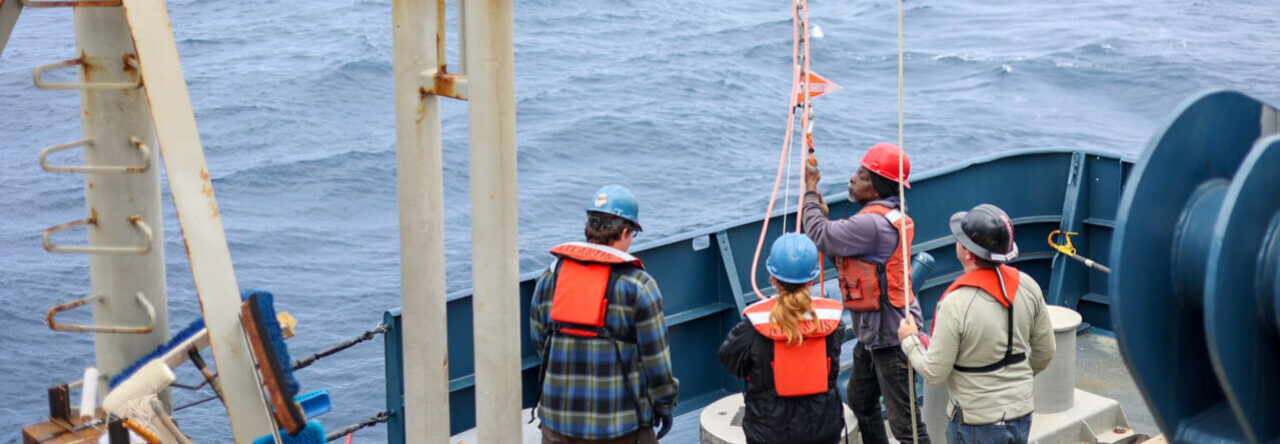
Photo: Ella and Lila observing while shipboard science support group members Cris and Becca prepare for deploying the magnetometer.

Photographer: Jacob Cooper, MATE Intern

Week Six: The Final Week on the R/V Hugh R. Sharp

6/24/19

              Hello all,

              The last full week of being out on the R/V Hugh R. Sharp, what a wonderful time it was. This was probably the easiest time for me with mostly demobilization and remobilization for a one-day cruise with the Office of Naval Research. The plan was to deploy four bottom mounts and one line of small sensors, then finally a few days to enjoy Delaware for all its flat glory.

              For Sunday, we arrived to Lewes around 0500, but since we got in when it was low tide, we couldn’t go into the channel until 0700. We were all just waiting ducks until the tide started to rise. The final tie off for the scallop trip finally ended. Since everyone was beat from the past few weeks, everyone tried to leave early to get some actual sleep in their beds and rest up for a demobilization and remobilization for a two-day cruise working with the Office of Naval Research. The boat was tied off in an easier fashion due to the nature of having lines on the dock instead of throwing them overboard. By 1200, the majority of the crew had left. All we ended up completing was removing trash. Tomorrow will be a hard day.

              We ended up with Christian later that night where he showed us around Rehoboth, DE. WE had some food a one of the restaurants and went back to the ship for an early 0700 morning. An early day to sleep at last.

              For Monday, an early morning to get all the large equipment off the deck and a few items onto the deck. We started around 0700 where we started with removing the sorting table, dredge ramp, HABCAM ramp, and HABCAM tracks. This part was mostly easy; we just needed to hook up lifting straps to the crane and move it to the shore where one of the shore-support would get the forklift move the items back to their spots. We spend a good few hours removing these large items. The last major removal was the laboratory van which was a little bit more involved due to a rigid metal lifting harness needed to be attached to the crane and then lifted to the van. We had to get on top of the van to attach the metal harness to van and off went the van. Next was washing the deck with ‘on-off rust remover’ to remove the rust that had built up being at sea. While I was working on that, a few guys removed the port side winch block as it was not going to be used for the next cruise with the Office of Naval Research

              After everything that could be taken off was, now its time to add some gear to the deck. We added a Zodiac type boat, as they call it a NAZ (not a zodiac) back to the 01 deck where it normally is; we added a huge 7200 pound winch to the center of the deck; we added a couple of cleats near the A-frame and the rails back to the port side of the deck; and we added a few counter weights as the winch was shifting the boat a little to starboard. All was easily done with the crane, a few lifting straps, shackles, and a tag line or two. We secured all the items with either bolts or rachet straps. By this time the science team had arrived, but they were working in the low bay in the operations building to work on getting their two spider bottom mounts and two larger platform bottom mounts ready for deployment on Wednesday. This was basically the end of our day as well because we got most everything done.

              Later that day, the cook, Hunter, took Shaun, Huxley and I to Dewey Beach to show us the little beach town. It was an interesting place that reminded be of a smaller Jersey Shore. Beaches and restaurants all around. Unfortunately, it started to rain a few hours in, and we ended up leaving back to the ship. I was able to get a good night sleep to keep getting ready for tomorrow.

              For Tuesday, another early morning at 0700, a great time to wake up with so much time having to finally sleep. After breakfast, Christian gave Shaun and I news that we needed to get the multibeam set up and installed before we leave tonight as it was a last-minute addition to the cruise plan. The multibeam was stored in a cargo container, but it wasn’t clean since they removed it, so a lot of TLC was needed before it was ready to be used. We also needed to take out one of the unused pods currently in the keel to put it in its place. Christian and Tim Deering were showing me the tricks of the trade to clean it off. I was using wooden dowels to scrap off the buildup of mud and barnacles. They did this because it was a soft and wouldn’t scratch the transducers. I will tell you; it took many hours of cleaning because they were satisfied with it. We also had to replace a couple zinc plates and rinse with water. Once it was cleaned, the other trick they told me to use for anti-fouling was vacuum grease and cayenne pepper. Tim told me fishermen used to use this for anti-fouling as paint cost too much as the time. Once greased up, we were good to move it to the ship. All the while, Shaun had been removing the metal grate that holds the pod in place in the keel so that it could be removed with the crane. First, lunch with sandwiches from the local sandwich shop. As soon as got done, we got the old empty keel pod out by Christian and Shaun going in the keel and hooking up to the crane. Huxley and I were guiding it out as the crane operator rose it up. A line was tied to it and we guided it back to shore where it was placed on the forklift. Next, we lifted the multibeam pod and placed it into the keel. This time I went down to put and tighten the grate. Then we ran the cable through the passage and into the dry-lab where we hooked it up to the computer. We finally got it all hooked up and it was ready to go. Most of the crew had left at this point, but soon the science team would start loading all their gear. All we needed was a forklift driver, a crane operator and Shaun, Huxley and I. We started with the gravity corer attached to a wooden frame, then the two spider bottom mounts, an hour later the two platform bottom mounts. We talked with the science team on how to secure all them down, then we went at it. A few large containers were added, and everything was on board. The plan was to leave at 2000 and start the next day at 0500. The crew came back around 1900 and we started off. Since all the deployments were during the day, Christian, Shaun, Huxley and I went to bed shortly after.

              For Wednesday, another early morning at 0500 this morning. We were getting ourselves ready before the science team wake up. The game place was to deploy a platform, then a spider, then a platform and lastly a spider. Before each deployment we would do a corer sample to make sure we at an acceptable location and deploy. After everything is in, we will do a little multibeam over the sites and back to Lewes.

              The first deployment of the platform was pretty quick. After we had to core sample finished, we used the winch to and four tag lines to inch it close to the transom until right at station. The science team had rigged up a removal compass to adjust the direction of the platform once in the water. Ever so slightly, they inched it closer with four men on the tag lines. It went over without any problems. It did take some time to get the compass right as the current and the boat made it a bit difficult. A couple of surface floats were laid out and the first site was done. Next was a spider which was easily moved into position by five men. We had to rig up two shackles to the side of the A-frame to get a line around the spider to lower it into the water easily, this was done pretty easily with two people on the spider to stabilize it. The first one went in without a problem, we adjusted its direction and it went in without a problem. Lunch time was shortly after then the last two. Another core sample was taken and another platform was released into the water. Again pretty quick and easy. The last spider was set in as well a little while later without an issue and we were done with everything on deck. The final task was the multibeam.

              They had one of their personnel working on the multibeam, but she hadn’t used it in some time and our crew was not fully familiar with the system.  I spent much time watching her figure out how to set up the system, get a base map, plot points, and figure out what was needed for the calibration test. Roll, pitch and yaw we needed to be calibrated using flat points in the water with two lines going in opposite directions for each variable. Once she figured out good points, we get the boat driver geared up to follow transect lines and we off. It took a good three hours before getting to this point, but only one and half hours was needed to actually perform the passes. Once we made multiple passes across the transect line for the bottom mount sites and calibration, we set for Lewes. By 2000, all was said and done back at the dock and ready for bed.

              For Thursday, the demobilization was a quick one today, with mostly just the bins and corer needing to be removed from the deck. This took maybe two hours and our day was over. All the science team were quick to leave by 0900 and my time aboard the Hugh R. Sharp was basically over. No more work was going to be getting done as the crew was taking a short vacation after being out at sea for so long.

              I spend the last few days in Delaware going around with Christian to show me the sights. I saw downtown Lewes with a few restaurants, but mostly I hung out with the graduate students for the University of Delaware. I talked with them about their projects and the type of work they were doing. By Monday morning, I was back in Florida and ready to take on the next part of my life. The last few days were quick, but unfortunately not much occurred after all the work was done for. I had to prep for a cruise with the Ocean Circulation Lab at the USF College of Marine Science so much time was spent getting all my needed paperwork for that.

              This had been an amazing experience, with lost of meeting of people and learning much about being a marine technician. I think I want to pursue a master’s degree after being a part of all this from talking with the different scientist involved. Here comes my next phase!

              A bittersweet time to leave. I had too much fun and worked extremely hard to learn what it takes to be a marine technician. I found my enjoyment of all the tasks at hand, but I feel a strong pull in specializing with a master’s degree. I definitely loved doing the work, but I’m feeling very motivated from all these experiences to keep it going and get a higher education degree in oceanography. I want to be out at sea and collecting data for my own research projects. I am definitely more affective when being on deck and collecting data, so I should use this experience to continue that for whatever I get into with it. I’m super appreciate for every opportunity I got in this; I really felt like part of the crew when I was here. Time to get myself in gear and get to grad school! Thanks for everything Christian, Huxley, Tim D., Tim N, Andy, Chuck, Hunter, Pam, Chris, Casey, Jimmy, Joe, and all the science team. I will never forget this and will continue to strive for greatness.

Best,

-Sebastian D.
Pre-Cruise: Preparing for a Month Under the Icelandic Midnight Sun

MATE Test Blog 


After a wonderful, but hectic few days of visiting family and packing, I am certainly looking forward to the next month at sea aboard the R/V Neil Armstrong. Although not always calm, weather-wise or work-wise, I enjoy the simplicity of shipboard life. Since graduating from Eckerd College in May of 2018 with a degree in Marine Science, I’ve been fortunate enough to partake in three cruises aboard the E/V Nautilus as a member of the Science Management team. As a member of this team, I was able to gain familiarity with diverse marine technological equipment, but was not responsible for operating or maintaining it. 


During this cruise aboard the Armstrong, we will be focused on acquiring geophysical data along the Reykjanes Ridge, a tectonic feature extending about 1000 km southwest of Iceland. We will primarily be utilizing multibeam sonar, sub-bottom profiler, gravitometer, and magnetometer equipment. So while not new to working aboard research vessels, I’m excited for the opportunity my time aboard the Armstrong will provide me to further diversify and expand my experience with marine technology. I’m also looking forward to sailing in the Atlantic for the first time and experiencing the midnight sun!


Wish me safe seas and black-out curtains!

After a wonderful, but hectic few days of visiting family and packing at home in NYC, I am certainly looking forward to the next month at sea aboard the R/V Neil Armstrong. Although not always calm, weather-wise or work-wise, I enjoy the simplicity of shipboard life. Since graduating from Eckerd College in May of 2018 with a degree in Marine Science, I’ve been fortunate enough to partake in three cruises aboard the E/V Nautilus as a member of the Science Management team. As a member of this team, I was able to gain familiarity with diverse marine technological equipment, but was not responsible for operating or maintaining it. 

During this cruise aboard the Armstrong, we will be focused on acquiring geophysical data along the Reykjanes Ridge, a tectonic feature extending approximately 1000 km southwest of Iceland. We will primarily be utilizing multibeam sonar, sub-bottom profiler, gravitometer, and magnetometer equipment. So while not new to working aboard research vessels, I’m excited for this opportunity to further diversify and expand my experience managing and operating marine technology aboard the Armstrong. I’m also looking forward to sailing in the Atlantic for the first time and experiencing the midnight sun.

Wish me safe seas and good black-out curtains!

Going Underway

Don’t mind if I do…

I spent some time before on the R/V Roger Revelle and it was an amazing experience. I recall thinking that the Marine Techs have a “pretty sweet gig”. I am thrilled to dust off my prior SONAR equioment knowledge from having been a SONAR Technician in the Navy and apply it to this sweet gig. Also, highly excited for 5 weeks of delicious cuisine on one of the newest research vessels. I feel like I have all of the luck right now and I’m grateful. 

Week 7

We have reached the final station of the cruise. Our plan is to sit tight and sample here for the next day or so, then make our way back to Seattle. With only a few days to go, the chief scientist loses his balance during a roll and tumbles headfirst into the steel doorway of the ship. Todd sees him take the fall and is by his side in an instant. We head for shore.

We all sit around the galley, John in the corner with a towel pressed on his wound, and trade head injury stories to pass the time. Turns out, every decade or so, John hits his head. It’s been fifteen years since the last one, so he laughs and says he was overdue. The guy has had dozens of staples in his head, and by the end of the day, he will have nine more.

After an injury occurs, there is a twelve hour window for stitches. We are due in Neah Bay at 0200, leaving just four hours to get John to the nearest hospital. It takes the whole team, both on shore and at sea, to make arrangements to dock in Neah Bay, get a shoreside crew member to drive from Seattle to the peninsula to pick John up at the dock, make the bumpy back road drive to Port Angeles, find a hospital, seek treatment, get breakfast, and get John back on board at 0900. By some miracle, it all comes together, and we are off again.

Our last day on board is spent navigating among the San Juan Islands. The water is clear and green as sea glass. We glide past cliff sides covered in evergreens above and mussels below. With the underway pumping system chugging away on its own, the entire crew and science party are out on deck, taking in the smooth seas and sunlight. At slack tide we make it to Deception Pass, Todd tells me of the insane currents he has encountered here, and of the time he once flooded a fishing boat trying to make it through at the wrong tide. But the water is calm enough right now, and as we coast along we wave to the onlookers standing on the bridge above, who eagerly wave back. Sunset hits as we head south on a run behind Whidbey Island. The Cascades and clouds turn pink as our cruise comes to an end. 

Week 5 – This is how the survey ends

With the HABCAM (and my pride) recovered, we remained in the Nantucket Sound area while the science party assessed the damage to the vehicle. There was little external physical damage, thanks to the monster steel frame the vehicle sits in. Over the next few days, we would dredge while the vehicle was repaired. I assisted in the retermination of the cable for the third time since the start of my internship – a process involving many finely detailed steps, including the use of a sort of “chinese fingertrap” to push the fire optic cable into the wire clevis. Even with the cable repaired, it was determined that the fiber optic connection needed work since the cable had been sheared off. So, just as soon as we had left, we returned to Wood’s Hole for the science tech team to get some shore side support. Little did we know that even greater obstacles were waiting.

After more maintenance on the slip ring that integrates fiber optics into the towing cable, we were set to depart again. Only this time, our window of opportunity began to shrink as a low pressure system developed, threatening bad weather. Though a seagoing ship and capable of withstanding some wind and seas, it is generally dangerous to tow in such conditions and would have made for a long, uncomfortable, and risky towing operation to be out in the weather, so the plan was modified. We wouldn’t be out long enough for this to be of concern however, ass everal hours into returning the HABCAM to the water the vehicle would lose all power and data output. Recovering it from the water, it was determined that an internal fuse had blown, requiring another visit to lovely Wood’s Hole.

During our stay, the weather in the Atlantic would rapidly deteriorate, shrinking our window of available tow time. The HABCAM was returned to fully functional status, but the high winds barred us from returning back to sea. So it was, that the third and final leg of the annual scallop survey ended on a note of caution and appreciation for the many variables, good and bad, that may appear when engaging in ocean research.

So, without a HABCAM in tow for me to find uncharted rocks with, I am free to return to the bridge as we navigate the vessel back to its home port of Lewes, DE. A new, shorter 3 day mooring trip awaits us, and will be the last operation for my MATE internship.

Week Five: The Last Week of the Scallop Survey

Hello all,

              This week had a roller coaster of ups and downs with the greatest up being the recovery of the HABCAM but getting it to work properly was harder than expected. Unfortunately, we may have got it working, we didn’t end up using it again. Not enough time was allotted to make use of the HABCAM once all the issues were corrected. We continued with a few more dredge sites, but they were mostly ones that we either skipped due to a sand wave bottom, flips or hangs. Basically, we ran out of time for HABCAM and sites for dredging. With extreme issues, comes extreme learning as I have found out.

              To bring it back, on Sunday of 6/9, we were finishing up some more dredges before steaming back to the location of the HABCAM. The divers were going to meet us there around 1300, do some sonar scanning to pinpoint the HABCAM location. My watch with Huxley had two dredges on the first watch and four on the second. These areas were added stations along the eastern side of Cape Cod. The contained many clams and mussels. The bags were very full and needed to be shoveled to dump the dredges. This made the dredge process take an extra forty-five minutes and covered the entire table before sorting. That morning, I was running into a wall. I just wanted to give up, but I came here to learn and perform tasks. My will power was tested, sleep deprived and all. I made it through until the next day, the important day of this week. The best part of the week after all we’ve been through.

              Monday was the day that we recovered the HABCAM! The morning was mostly just steaming, Huxley and I made use of our time to do regular rounds around the boat again. When I woke up, the sorting table had been rigged to pull up the HABCAM with a manual winch winder so that when the rope was pulled up, we could use the tugger to get it on board. We arrived on site around 1100, but the divers didn’t until 1300. They took their time scouting out the area with their sonars for a few hours. Then the divers went in, tied of a line at thirty-seven meters with a float. We backed down on the float, hooked her and pulled her on to the tugger. The most stressful part was over, next came the pull up on the tugger. With Tim North’s (Chief Engineer) experience, it came up without a hiccup. Once on the dredge ramp, a few adjustments were made with the trawl winch and the tugger winch. Eventually, the HABCAM was brought on board. Then, we moved it to the deck near its normal location on the port side. We found out from the divers that we hung up on a massive rock, who would have though a rock? Next, a few quick checks to see if it powered on; to everyone’s enjoyment, it did in fact power on. Now a full diagnostic was needed to see if they could re-terminate to the fiber optic cable at sea. They would give themselves eight hours to try and fix it, then we would go back to Woods Hole for their better equipped shore support. This decision was made on my off time, but the decision was made to go back.

              Tuesday was the day of traveling back; the AM watch was mostly just steaming. An easy watch after having basically a week of nonstop dredging. On my second watch, we arrived at Woods Hole around 1200. Most of the work done for this watch was tying off the boat at port. I helped Christian on shoreside by getting the boat tied off to the cleats on land. After tying off, the engineers and scientist from NOAA came aboard to diagnose issues with the HABCAM. It took until 1700 before they were confident that it would work again. The personnel that came aboard had left shortly afterwards with the termination to be done while steaming back to where we left off. It took until the next day before we one, at location and two, ready to deploy it again. Another up for us.

              Wednesday was the day where we finally put the HABCAM back into the water. It wasn’t until 0300 where the termination was completed, and a load test was initiated at 5000 pounds just like the first time it was terminated. The termination passed without a problem; it took some time though due to one of the shackle nuts not screwing in. Afterwards came the painstaking process of reattaching the termination to the HABCAM. This was only an issue because the cotter pin was not going on very easily. Once everything was together, another test was performed, and it was good to deploy. Huxley, Andy and I deployed it without a problem around 0500, so it was soon for bed. For our second watch, I found myself gearing up for more dredging. What happened? The possibility that a fuse blew on the main can caused a failure in data acquisition and could only be fixed when at port. The decision was made to do a few last stations, seven, then head back for hopefully one day on Friday. Thursday would have been a day for fixing it, but the weather would have been poor so departing was delayed. The areas that we had to dredge were left over sites, which unfortunately were the locations of where we got many rocks. Huxley and I only made it through three dredges before our off watch. We did find many rocks and scallops though, which was a nice end to our dredges. They weren’t even too heavy either.

              Thursday was an easy day for sure. The first watch was mostly just steaming back to Woods Hole to fix the HABCAM again. The weather was expected to be pretty poor so we wouldn’t have been able to leave again until Friday morning at the earliest if everything went well. It was determined that we would not be able to leave Friday so the scallop trip ended one day early. Huxley and I most relaxed for once after all the shoveling we’d been through. Finally arriving, Christian and I tied off the boat once more around 0500 on the shore side with Shaun and Huxley feeding us tag lines. A few shore side scientist came aboard around 0900 to get started on fixing the HABCAM. It was eventually fixed, but no one knew if we would be leaving again the next morning. The plan was to take it easy on all of us and get off the boat for a few hours. Around 1800, we, as in the crew and science team, made our way a few restaurants. I mingled with the different science members as per usual at this point. We all had fun as it would turn out to the last day for them to be aboard the ship.

              On Friday morning just before breakfast, it was determined that we would not be setting sail with the HABCAM. I guess the science team figured it wouldn’t be worth going out for six hours of HABCAM. It would have been a twelve-hour round-trip steam and they only had the boat until Saturday morning. The arduous task of unloading the boat was the main concern from then on. Unloading the three dredges, HABCAM, getting both ramps unbolted and securing all the deck items was everything that needed to be done for the science team to be on their way. For the crew, we would leave to go back to Lewes, DE after dinner. We set sail shortly thereafter and a thirty-one hour steam was underfoot. Since there was no science team aboard, the four of us could be on the same watch to get the major cleaning done on Saturday. With that being said, we all went to bed for an early morning of cleaning.

              Saturday, the day of cleaning! The key areas to clean are the dry-lab, vestibule, below deck state rooms, life jackets, the wet-lab fridges, and the tool room floor. Shaun and Huxley tackled the state rooms first, while Christian and I handled the dry-lab. The dry-lab was an easy clean it just took some time as the floor had tiny blue rubber mats with holes to allow dirt to get off shoes. This covered the entirety of the lab so we had to pull them up in sections, sweep and mop. Then there came the wiping of the benches which was a very easy task. The two of us then went to the fridges. The two fridges in the dry-lab contained scallop meat for continued science testing, but it left a very rank fish smell when opened. Therefore, a thorough cleaning was in order with a product called ‘Simple Green’. It took a couple times of cleaning for the smell to go mostly away. Shortly after we started cleaning the life vest. More Simple Green was used in this process and hung them up to dry. Shaun and Huxley were taking out the vestibule mats and cleaning the floor with, you guessed it, Simple Green. The last main task was the tool room. All four of us were working to clean it up. It seemed it hadn’t been cleaned in some time. All said and done, the boat was looking, Sharp. The rest of the steam for that day was mostly catching up on work or relaxing. We all could get some sleep finally and be up early to get the boat tied off in Lewes.  A bittersweet end to the scallop survey, but I at least have one more week on the Sharp with a quick turn around for a quick two-day cruise with the Office of Naval Research.

              This week has been full of ups and downs, laughs and pain. I never realized how much hard work could go in to protecting different species of economic value. I’m glad to have been a part of this even when major issues came up, that being the lost HABCAM. If anything could go wrong, it definitely did, but everyone was very professional about it and solutions were made. I hope to keep that adaptability with me as I progress myself.

Best,

-Sebastian D.

Page 50 of 85

Powered by WordPress & Theme by Anders Norén