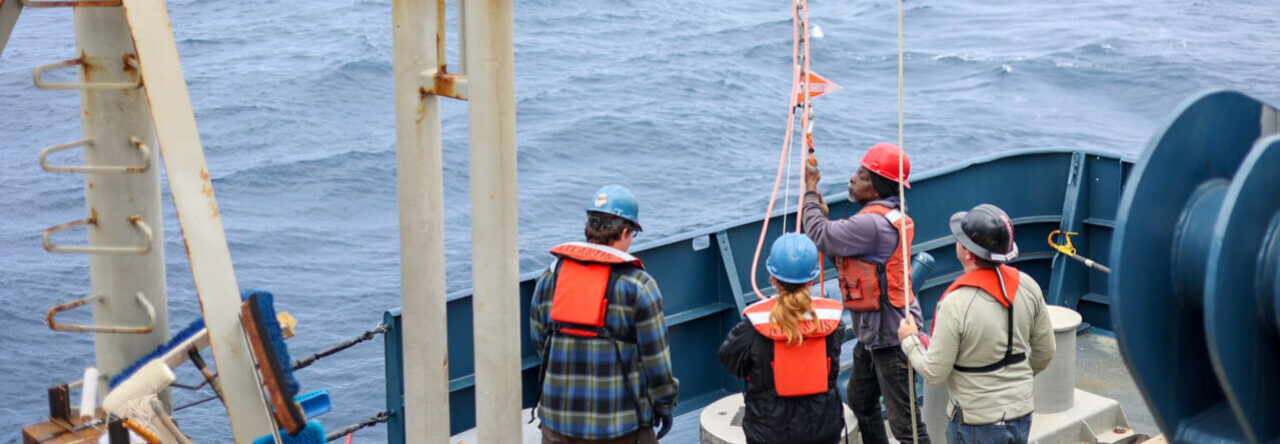
Monday through Thursday we were still on the BATS cruise for this week. On Monday we deployed a production array which was great to be apart of because it is a more complicated deployment and we will leave it out sampling for a few hours while we go to another location to conduct CTDs. We also deployed three zooplankton nets off of the A frame on the back deck and they go down to 250 meters and fish for around 30 minutes. The next few days we deployed in situ pumps that go to different depths and are in the water for four hours pumping water through these special filters. There were more small boat operations throughout this week for the scientists studying trace metals to be able to sample away from the ship so there is no interference. We recovered the sediment traps that we deployed a few days ago and there was a pretty strong current so we could actually see Bermuda from afar while we were recovering them. In the sediment traps there is a special solution the scientists make to trap the sediment. They have an 85 ppt salinity in them so as the water circulates they go into the traps and get stuck in the solution because it is so dense. We went to different spatial stations so sometimes there were a few hour transits in between. We got back to the dock on Thursday around 1400 and that morning was pretty stormy and rough seas but besides that the rest of the week was great weather and sunny skies. We were having some discrepancies between our primary and secondary TSG (SBE45 MicroTSG Thermosalinograph) so when we got back to the dock we took it apart and conducted some tests on it. This is my last long cruise as we will be back at the dock for a few days and then leave again on Wednesday and Thursday for a Hydrostation cruise. It has been such a great experience working on the RVAE and I hope to come back and visit in the near future.
