Category: Louisiana Universities Marine Consortium

Week Two: The Sound of Pelicans and the Smell of New Orleans!


Hello, All!

It has been a long few weeks, and due to a few technicial errors, it has been longer than I expected since my last post. Boy, can things change overnight!

I will start at the end of my first cruise, and continue with my New Orleans trip to summarize week two:

The ending of my first cruise, in comparision to the beginning, ended very smoothly with only small technical issues caused by wifi- which seems to be a commonly occuring issue in all marine realms. In all honesty, despite how good the wifi network, there is also issues with connection and perhaps one or two overzealous wifi users downloading copicious amounts of data. But, can you blame them? With the crew particiularly in mind, it is natural to want to stay in contact with your loved ones back home. I ended my first cruise on Easter Sunday, where I truly began feeling the effects of what it is like to be a marine technician- that is, a worker bee. We did not arrive back on dock until very late Easter Sunday, as the scientists chose to prolong the cruise because we were ahead of schedule (scientists are too busy to celebrate holidays). It is sad to miss events such as family holidays, or graduation, and a small part of me feels as if I am being robbed of priceless moments, but the experience of being out to sea- with the accompaniment of beautiful sights, smells and sensations- is equally as gratifying and priceless. Last night, a fleet of sea birds and pelicans swarmed the boat during sunset because we were churning up fish. The sight of sea birds, dolphins, sunrises and moonsets, are making this experience well worth the energy I am putting in. Not to mention, the beautiful dinner our chef made to make us all feel at home. The crew truly is a family, and I am honored to have been welcomed into it so gracefully.

Week 1: The Gulf of Mexico and Dolphins!

So, here we are! I boarded the R/V Pelican mid morning, April 5th, after spending the night in Kenner, LA. Upon arrival at the LUMCON facilities, I spent the day meeting the crew and becoming accustomed to the R/V Pelican. Around noon, the crew and I used the a-crane to deploy the vessel’s small boat into the water for a test run, prior to our cruise. The marine technician and I were lucky enough to take the small boat for a test run, but even luckier to find a few pods of dolphins swimming around- A sight I later found is blasé to the crew who always sees them. After performing small boat ops, I helped the crew prepare for the cruise. Our vessel’s freezers were down, so I spent most of the later noon removing old freezers and helping to rig them to the top of the ship to store food and additional science samples. Through early evening to dusk, most of the science Intel had arrived and I spent my remaining time exploring the LUMCON area and facilities. Cruise departure time: 12am

While most of my first day tasks slid onto the backburner, I learned an important lesson: ALWAYS bring seasickness medication, despite whether or not you have been seasick before. Evidently, “sea legs” are earned, and I spent most of the day recovering from illness. Though, I can’t complain about the amazing food on board- it was so good I tasted it going both up and down several times…Despite not feeling up to par, I did my best to complete and learn as many new tasks and instruments as possible. I learned the basics of CTD casts both within the tech lab and on aft deck. After observing and assisting in my first on board CTD cast, I removed the tubing for our sensors and did a clean: triton x, DI, bleach, DI and a good spray down prior. In down time, I perfected my soldering- using the hot glue gun method- and worked on terminating RJ 45 Ethernet cables and rewiring them for practice. After the first day, I began to gain my sea legs, just in time for the chaos that would ensure days latter.

By the third day, we had run into every CTD issue possible-which functioned as a phenomenal learning experience. Overnight, an oxygen sensor imploded under pressure during a deep cast. Due to the incredible variation in depth within and along the Gulf of Mexico, sensors must be changed according to their depth range, prior to casts. This oversight resulted in only one of our two oxygen sensors working. In addition to the oxygen sensor imploding, the firing mechanism within the top carousel of the CTD was not closing all our bottles- an issue resulting from either a “dirty” firing mechanism, or an issue within the internal firing unit of the CTD. Our vessel’s technician and I began by soaking the firing carousel in a detergent bath, a troubleshooting method less time consuming than changing out the internal firing unit. After several soaks of our firing carousel- in addition to replacing the top with a new carousel- the issue persisted later into the evening, which told us there was a potential internal issue- but it is important to follow up with deck tests before committing to a big change. While the firing carousel was soaking I assisted in replacing our missing oxygen sensor with a new one, which worked beautifully. But, of course, it’s never that easy and as one issue plummets, another surely surfaces. During a CTD cast, a scientist removing the sensor tubing broke a small screw holding our sensor in place. The sensor was rigged with zip-ties the first time, and a second time when the same issue occurred with another sensor. Part of my job as a marine technician is to function as a liaison between the crew and science Intel- unfortunately sometimes warnings about equipment are not always followed. We made our way to “jacked-up-city”- which I later learned is a sea name for a set of oilrigs that are clustered together, during periods of non-use. An interesting sight, but we were here to deploy sensors and perform box coring. I assisted in lifting a box core off the back a-frame, using the Appleton crane. After performing box coring, and receiving extra equipment from folks at Lumcon, we performed more boat ops. Using the crane, our small boat was lifted out of the vessel, and into the water. A science member, John and I, drove the boat close to a rig, and deployed an instrument attached to a mooring. The experience was exciting and I couldn’t help but to hum the Hawaii-five-O theme song in my head, as soaring through the Gulf. After some circuit issues were resolved in the tech lab, we called it a day.

After my morning tasks and duties, it was back to the white elephant in the room: our CTD. We began by troubleshooting the CTD with several deck tests- one of which involves an on deck procedure of firing and checking bottles. Through radio, our marine technician and I communicated (one on deck, the other in the technician lab firing bottles) to assure the firing mechanism was working before casting again. It is important to use tubing in both the top and bottom of the bottles before firing- as to assure the bottles do not crack under stress or pressure. Another test involves a very similar firing procedure, but instead of cocking the bottles, a technician places a screwdriver at each magnet of the firing carousel, awaiting a click for confirmation that it fired. After several on deck tests, and a discovery within the internal firing unit, it was confirmed the issues were internal, and the SBE 32 unit did indeed need to be changed. In order to change the SBE 32 unit, several CTD bottles were removed, as well as the top shackle, which involved a sensor being removed and covered in electrical tape for protection. After changing out the unit, several more tests were completed, one more firing mechanism soak, and we were back in business. Due to our long transit time, several lanyards were also replaced.

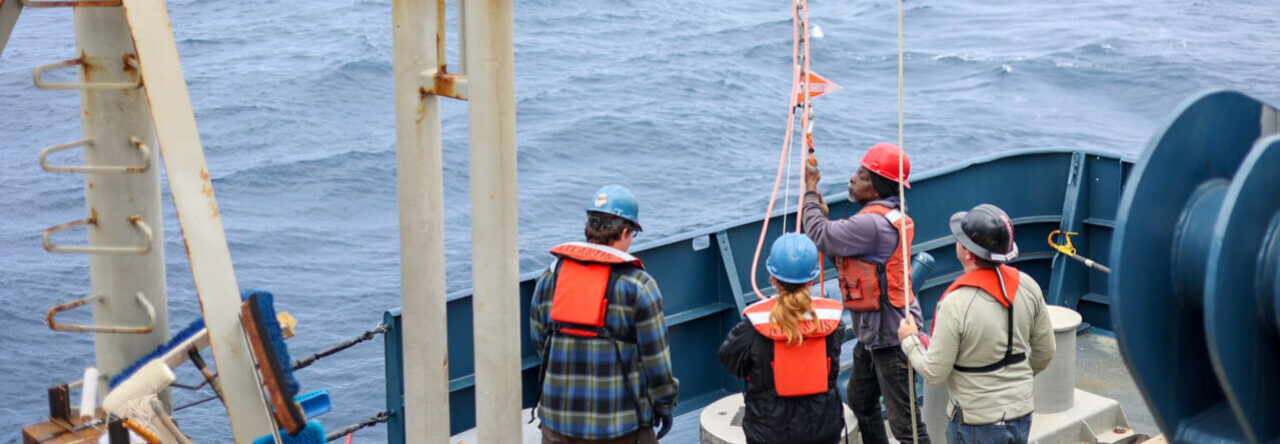
 During longer transits later in the week, we performed a transmissometer field calibration test. The test includes filing all the CTD rosette bottles with fresh tap water, going through calibration standards within the computer and our manuals, and running an on deck test to assure our values are similar to the calibrated ones. The calibration ran smoothly and I worked on several lanyards for the CTD. Yesterday, we added heat shrink to some stoppers on our lanyards, and while heating accidentally melted away some of our plastic lining. I replaced these, finished my firing mechanism soak and reattached the firing mechanism on my own. During down time throughout the week, I have been shadowing our vessel’s Captain, in the hopes of driving by the end of the trip. I have my USGS 6-Pak License, so learning the rudder mechanisms, boat mechanics, and steering has been incredibly interesting to me and is a goal I plan to pursue throughout my internship. I have been reviewing radar, navnet, AIS, radio station etiquette (if fishermen, rig workers and captains ever actually follow it), along with the basics of throttle, propulsion and steering. An important aspect within the computers, and especially with all the boat traffic and rigs of the Gulf, is CPA- other known as the distance to stay away from boats or rigs that may have line, pipe, etc. hanging around.

All in all, after learning the stresses of being a marine technician, I seized ship and am the new Captain (see below). Just kidding. Disclaimer: auto-pilot is a great way to pretend like you know what you’re doing.
 

R/V Pelican- The End

Although our cruise was cursed with bad weather, by the end of the two-week cruise, we have received a lot of great data! Our research area consisted of a “box” about 50 miles south of Louisiana in the Gulf of Mexico looking at hypoxic zones from the Missisippi River runoff. At each corner of the box we had a “barney,” which had an ADCP (acoustic doplar current profiler) that records data on the currents in the water column. In addition, each corner had a string mooring equipped with several CTD (conductivity, temperature, and depth) sensors that took samples throughout the watercolumn as well. In the middle of the box, was an optics package which looked at the turbity of the water, another barney, and a wirewalker, a new piece of equipment that uses wave energy to move up and down the watercolumn continuously taking samples of oxygen, chlorophyll, CTD, etc. depending on what instrauments it is equipped with.  

While we left those instruments to collect data throughout the entirety of the cruise, we also deployed a glider, scanfish, CTD rosette, and an optics pacage several times as we cirucited the box. I personally was in charge of the operation of the CTD rosette and got very comfortable working with the program and the instrument itself during my time onboard. By my last week, I had learned a lot from my mentor and from the science team. The last few days were spent retrieving the instrumentation from each of the sites.

We had collected half of the equipment and were on our way to the northern stations when one of the scientists checked the GPS data off of our WireWalker, which we left at the center station. According to the data, 2 hrs before, our WireWalker started moving to the west at 6 knots. Hoping that the GPS data was off, we moved to the center station to search for our gear. After hours of pinging and searching on the echosounder, we were confident that both our WireWalker and the Barney was gone, suspicious that some shrimpers picked them up while trawling. We followed the GPS location for several hours, finally catching up with the boat around midnight. The entire crew and science team were awake and eager to see who had our equipment. We spotted the boat and our captain hailed them on the radio, asking for our equipment back. After a few minutes of “we caught it in our nets fair and square, bub” and “you need to pay for our ripped nets” they finally agreed to give our equipment back when we casually mentioned that we had Navy personnel onboard. In order to transfer the equipment, we had to back into the other ship so both of our sterns were touching, a delicate manoeuver, so our A-frame could pick up the heavy mooring. Finally, after a long day of chasing down “shrimper pirates” we had our equipment (worth about $200,000) back on board with one more day to retrieve the rest of our gear. Unfortunately, after hours of searching the other two stations, it seems like some more shrimpers took one of our string moorings (always have GPS tracker on your gear!)

Despite the loss, we headed back to LUMCON with tons of data and a happy science team. I am so grateful for the time I had onboard R/V Pelican. I learned so much more than I had expected and made some great relationships with the crew and scientists==. 


Julianna Diehl


R/V Pelican: Waiting on the Weather

Week 1 of my MATE internship down and I’m eager to get back out into the Gulf. The Pelican is currently being chartered by the Naval Research Labratory, (NRL) who are conducting research to test the accuracy of Satelite monitering. Our four stations are layed out in a box pattern in the upper, Northern part of the Gulf of Mexico. At each station, a mooring and a string mooring is deployed to moniter conductivity, temperature, oxygen content, chlorophyll content etc. along the entire water column. In the center of the box, what we call “C1” is a wirewalker and another mooring. The wirewalker uses wave generated power to slide down a cable, taking samples of the water column. We’ve also deployed a scanfish takes transect measurements as we circle the entire box. Unfortunately, there’s a tropical depression forming off the Gulf, which has brought swells of 5-6 feet, which hinders the deployments the scientists can do. So for now, we are back in Chauvin, Louisiana waiting out the weather. The forcasts say the weather seems like its going to stay strong throughout the entire week, however it seems like to me the weather in the Gulf changes on a dime, so we will see if it holds out. Hopefully it doesn’t becuase I want to see some gliders deployed! 

The crew and the science team has been very easy to get along with! By the third day of being here, I’ve been running my own CTD watch, being in charge of the computer program as well as deck operations relating to the CTD. I’ve also been able to help the scientists a lot, helping to attach sensors to their instruments and helping them get the information needed back to their computers and labs. Looking forward to my last week on this internship. 


Julianna

R/V Pelican- Almost there!

Hello everybody!

By this time tomorrow I will have boarded my flight from Philadelphia to New Orleans, marking the beginning of my eagerly awaited internship with the Louisiana University Marine Consordium.   I just finished my Sophomore year at Maine Maritime Academy majoring in Marine Science and Small Vessel Operations and am eager to incorperate everything I learned at school to my duties as a Marine Technician intern. 

I just finished packing all my things and by some miracle everything fit! Looking forward to stepping foot aboard the R/V Pelican and meeting Nick and the rest of the crew tomorrow. I’m a little nervous, but I am eager to get into the swing of things. 


Talk to you soon, 

Julianna

Page 3 of 3

Powered by WordPress & Theme by Anders Norén