Although our cruise was cursed with bad weather, by the end of the two-week cruise, we have received a lot of great data! Our research area consisted of a “box” about 50 miles south of Louisiana in the Gulf of Mexico looking at hypoxic zones from the Missisippi River runoff. At each corner of the box we had a “barney,” which had an ADCP (acoustic doplar current profiler) that records data on the currents in the water column. In addition, each corner had a string mooring equipped with several CTD (conductivity, temperature, and depth) sensors that took samples throughout the watercolumn as well. In the middle of the box, was an optics package which looked at the turbity of the water, another barney, and a wirewalker, a new piece of equipment that uses wave energy to move up and down the watercolumn continuously taking samples of oxygen, chlorophyll, CTD, etc. depending on what instrauments it is equipped with.
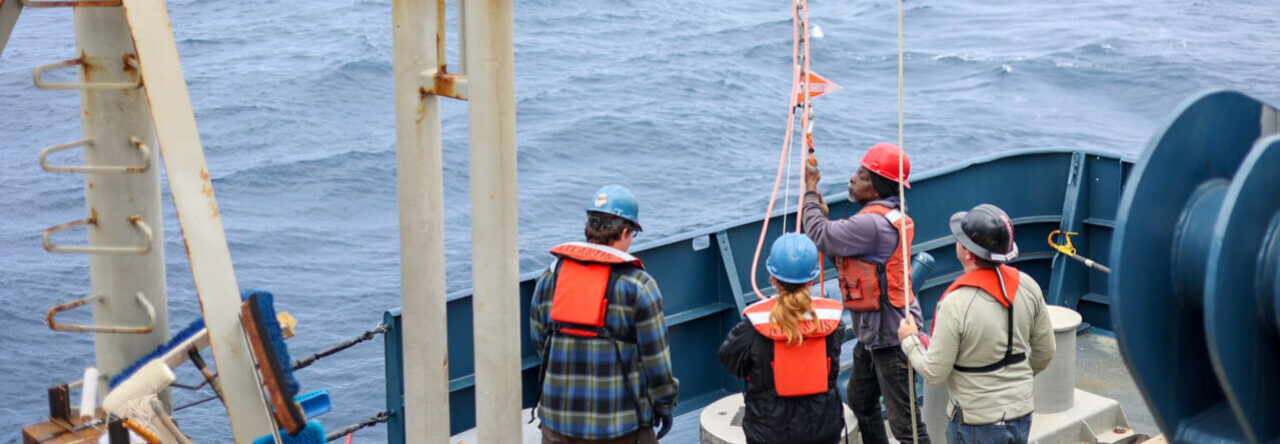
While we left those instruments to collect data throughout the entirety of the cruise, we also deployed a glider, scanfish, CTD rosette, and an optics pacage several times as we cirucited the box. I personally was in charge of the operation of the CTD rosette and got very comfortable working with the program and the instrument itself during my time onboard. By my last week, I had learned a lot from my mentor and from the science team. The last few days were spent retrieving the instrumentation from each of the sites.
We had collected half of the equipment and were on our way to the northern stations when one of the scientists checked the GPS data off of our WireWalker, which we left at the center station. According to the data, 2 hrs before, our WireWalker started moving to the west at 6 knots. Hoping that the GPS data was off, we moved to the center station to search for our gear. After hours of pinging and searching on the echosounder, we were confident that both our WireWalker and the Barney was gone, suspicious that some shrimpers picked them up while trawling. We followed the GPS location for several hours, finally catching up with the boat around midnight. The entire crew and science team were awake and eager to see who had our equipment. We spotted the boat and our captain hailed them on the radio, asking for our equipment back. After a few minutes of “we caught it in our nets fair and square, bub” and “you need to pay for our ripped nets” they finally agreed to give our equipment back when we casually mentioned that we had Navy personnel onboard. In order to transfer the equipment, we had to back into the other ship so both of our sterns were touching, a delicate manoeuver, so our A-frame could pick up the heavy mooring. Finally, after a long day of chasing down “shrimper pirates” we had our equipment (worth about $200,000) back on board with one more day to retrieve the rest of our gear. Unfortunately, after hours of searching the other two stations, it seems like some more shrimpers took one of our string moorings (always have GPS tracker on your gear!)
Despite the loss, we headed back to LUMCON with tons of data and a happy science team. I am so grateful for the time I had onboard R/V Pelican. I learned so much more than I had expected and made some great relationships with the crew and scientists==.
Julianna Diehl