Category: Louisiana Universities Marine Consortium Page 2 of 3

Week 1: R/V Pelican (Athena Abrahamsen)

Yesterday, July 26th, marked my first week aboard the R/V Pelican. The first cruise I am participating in during the course of this internship is conducting a shelf-wide hypoxia survey whose data will help continue a time-series data set that was started in 1985! For those who aren’t familiar with the word “hypoxia”, it means “low oxygen”. So, this science group is tracking zones of low oxygen along the continental shelf in the Northern Gulf of Mexico. The purpose of this time-series data set is to monitor the extent and severity of the summer hypoxic events that occur in this region. If you’d like to learn more about this project, you can do so through this website: https://gulfhypoxia.net/

So far, 101 stations have been completed. All of these stations have occurred in locations West of the Mississippi River.  As I write this, we are transiting to the stations and transect lines that are East of the Mississippi River. I have not been involved in all 101 stations, mind you. We are doing 24 hour operations, so myself, and two other Marine Technicians, Maggie and Susie, are working staggered shifts. I have been on shift for 52 of these stations. 

At each of these stations, a CTD cast was completed, as well as the deployment of a Niskin bottle with a EOX3 Multiparameter Sonde Instrument attached. 

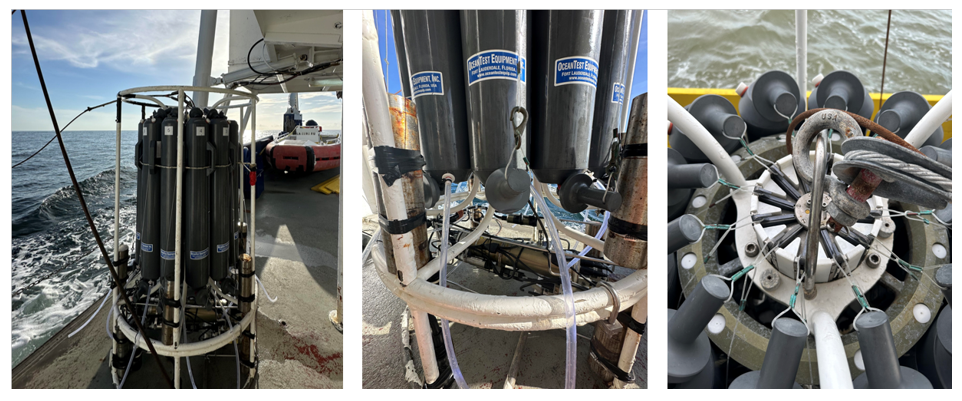
A CTD cast is obtained using a CTD Rosette. On a CTD Rosette, a CTD instrument is housed in an instrument frame that also holds Niskin bottles. The CTD instrument collects the conductivity, temperature, and depth data of a water column. It can be outfitted with accessory instruments that measure other biological, chemical, and physical properties of the water. The Niskin bottles are used to collect water samples at certain depths within the water column. Niskin bottles can be manually or electronically closed to collect water at a certain depth in the water column being observed and measured. In the case of the Niskin bottles that are mounted on the CTD Rosette’s frame, they are electronically closed, or “fired”. This is done by hooking the elastic cords that are attached to the stoppers on both sides of the Niskin bottles to a central release mechanism. Each Niskin bottle has its own corresponding number that is identified in the computer program and, when “fired” the elastic cord is unhooked from the released mechanism and causes for the bottle to close, with the water inside. 

During CTD casts, I have been involved with the physical deployment and recovery of the equipment (i.e., putting it into the water, and then taking it back out of the water, and getting the equipment back on the boat deck)., as well as the electronic/computer operations needed. I have enjoyed becoming more familiar with the SeaSave software, as well as becoming better able to troubleshoot issues faced during CTD cast operations. 

Below is a series of pictures that will attempt to show what was described previously. From left to the right, the pictures are: The CTD Rosette, a close-up image of what the CTD instrument looks like (this specific model is the Seabird SBE 911Plus CTD), and the release mechanism for the Niskin bottles on the CTD Rosette.
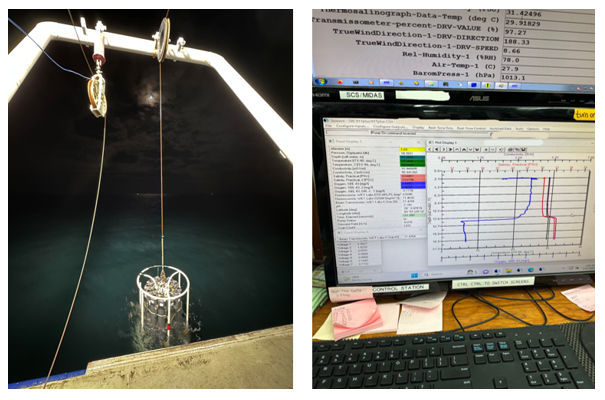
On the left is a picture of the CTD Rosette being deployed, and on the right is a picture of the data that was being collected by the CTD Rosette (this water profile was super cool, it was stratified!):
Like what was stated earlier, Niskin bottles can also be “fired” manually. This is done using a weight that is attached to the winch line (the line that connects the equipment in the water to a system, a winch, that can bring the equipment back on deck safely) and throwing it down the line so that the weight will trigger a release mechanism similar to the one seen on a Niskin bottle rosette set up. Again, I am glad that I have become more familiar with the deployment and recovery procedures associated with Niskin bottles. 

The EOX3 Multiparameter Sonde is an instrument that the science crew brought with them, from my understanding, it’s like a small CTD. They are using this instrument to get oxygen concentration measurements closer to the seafloor than can be done with the CTD Rosette, also as a backup for the CTD Rosette if something were to happen.

Here is a picture of the Niskin bottle we have been using, I don’t have a picture of the EOX3 Multiparameter Sonde at the moment:
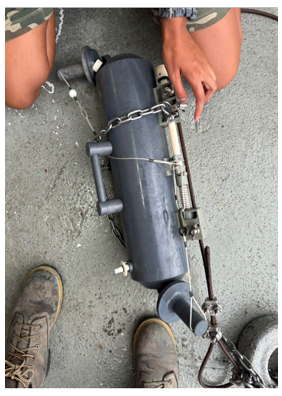
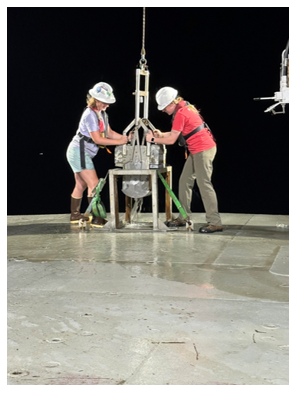
Also, at five of these stations, box core samples were also taken. A Box Corer is used to collect sediment samples (though, there are many methods and designs used to take sediment samples). This group will use the core samples to look at total and relative abundance of benthic infauna (organisms that live in the sediment on the ocean floor). Gaining experience with preparing the box core for deployment, deploying, recovering, and maintaining the equipment has been fun! 

Here is a picture of myself and one of the other Marine Technicians on board, Susie, deploying the Box Corer: 
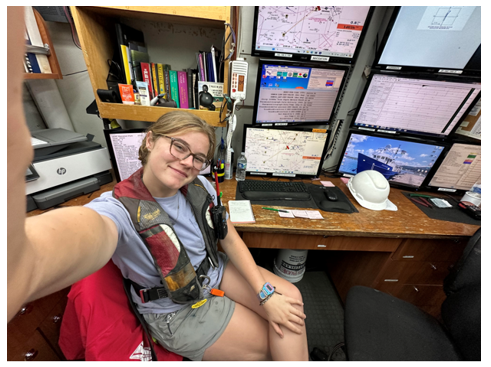
Some other responsibilities I have while on shift include: monitoring the Flow Through system’s status, and turning off the water to the Flow Through when we get into really shallow water depths (< 5 m); making sure the ADCP (Acoustic Doppler Current Profiler, these instruments are able to determine current speed and direction within the water column) is working well; monitoring the Knudsen Chirp’s accuracy (the Knudsen Chirp is what we use to measure the water depth, it uses sound waves to do this); update transit times on the Navigation software; monitor the Science Computer System (SCS) (the SCS is where all of the background data constantly being collected is displayed and stored); and monitoring internet usage and connection. It has been interesting to learn more about computer networking! 

In the next picture, you’ll see the monitors I use to monitor the computer network that displays the Flow Through, ADCP, Knudsen Chirp, SCS, Navigation software, and Wi-Fi network:
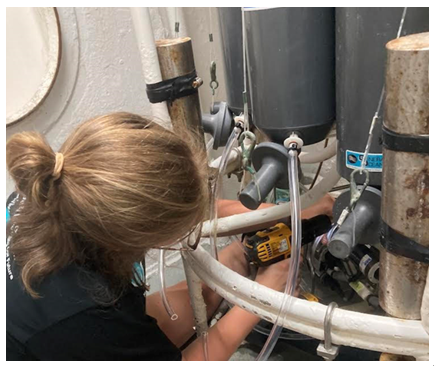
Besides the operations that I have been a part of during this cruise, I also helped with pre-cruise preparations and mobilization for this cruise. During my first morning aboard the R/V Pelican, I helped my mentor, Maggie, with preparing the flow through system, as well as the CTD with the correct instrument set up. I also learned how to add station points into the ship’s navigation program, and got to go out on the small boat that we have on board to learn how to run it! It was awesome to see a Louisiana bayou as I have never been here before!

Here is a picture of me adding a sensor to the CTD:
Here is a picture of me operating the small boat:

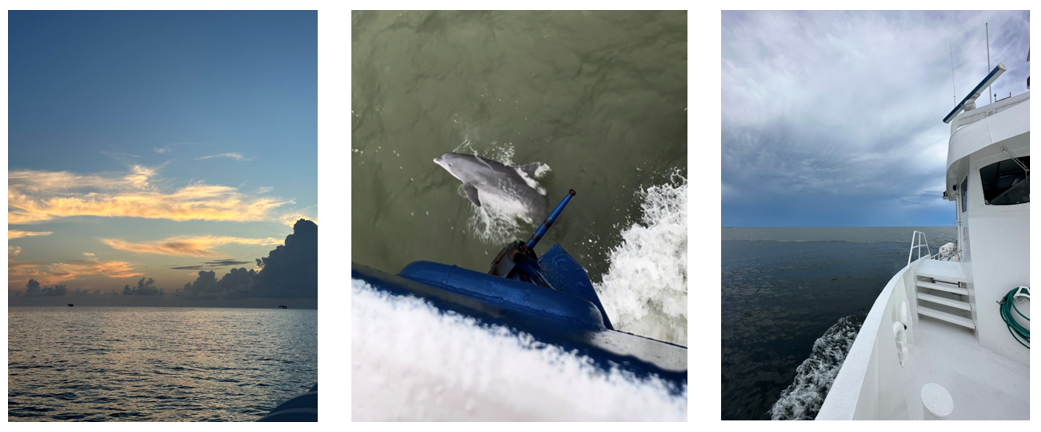
Of course, all of this has been related to the Marine Technician Intern role that I have been learning to fill. BUT, on transits and during my personal time on board, I have seen some cool stuff! Among the vibrant sunsets (when it hasn’t been overcast), there have been dolphins, and when we went into the Mississippi River, I got to see a phenomenon, where two water masses meet (in this case the Mississippi River and the Gulf of Mexico), but have not mixed yet!

Here are some pictures of what I just described seeing during transits and my off times: 
Until next week! 

Athena 

(p.s., I am finding that communicating about what goes on during my day is quite difficult! There are a lot of moving parts and pieces (literally!), and a lot that goes on!)
Introduction: Athena Abrahamsen

Hello! 

My name is Athena Abrahamsen. This fall, I will be entering my senior year of my undergraduate degree. I am working towards obtaining a B.S. in Oceanography from the College of Earth, Ocean, and Atmospheric Sciences (CEOAS) of Oregon State University. 

I am incredibly excited to have been selected to be the MATE Intern aboard the R/V Pelican. This opportunity has been on my radar for quite some time, and I am honored to be chosen for this position. 

My interest in participating in sea-going research began my first year of college when I completed the Introduction to Field Oceanography course series at Oregon State. In this course series, students learn about various ways that oceanographic data is collected, and then get to go out on a multi-day cruise aboard a research vessel to see these data collection techniques in action!

When completing this course series, I participated on a four day cruise aboard the R/V Sally Ride and absolutely loved every second of it – I definitely caught the “I-really-like-going-to-sea” bug. I am beyond grateful that I had the chance to participate in an experience like this, it is an incredible privilege that donors make this possible. 

Between the Sally Ride experience and now, I have tried to grasp where within the realm of oceanography my interest lies. Working as a Research Assistant in a lab that analyzed the Organic Carbon and Nitrogen contents of water and sediment samples, completing and internship with the goal of developing educational materials surrounding the concept of Ocean Acidification, and my current role as Student Technical Assistant for the Ocean Observatories Initiative’s Endurance Array have all provided clarity about the path I hope to pursue. Your undergraduate experience is meant to help you guide and form your understanding of your area of study. This comes through trial and error– you’re not going to know right away (spoiler alert: I didn’t). 

 For all of those reading, something that has stuck with me as I’ve searched for  my place within the realm of ocean science is wisdom my internship mentor shared after a data exploration project. It was along the lines of ‘finding out that something didn’t work is equally as valuable as something that does work.’ Don’t be afraid to try something just because you’re scared that you won’t be good at it or absolutely love it on the first go. If you don’t even try, how are you going to learn and grow? Embrace the uncertainty and unpredictability!

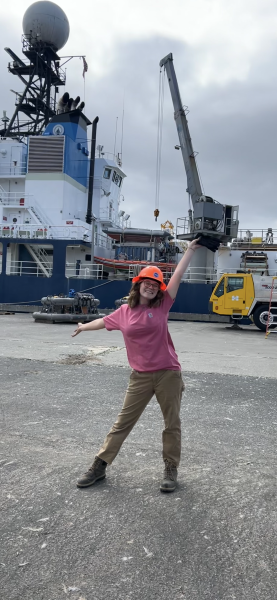
With the Endurance Array project and team, I have learned so much about what goes into oceanographic data collection, and have had the chance to go on multiple day-cruises, as well as two of their multi-day research cruises (so far). I was aboard the R/V Sikuliaq in Spring of 2023 for 15 nights, and the R/V Atlantis for four nights in the Fall of that same year. The cruises took place off of the coasts of Oregon and Washington. The picture above was taken in front of the R/V Atlantis as we were loading some of our moorings onto the vessel! 

The hands-on experience I’ve been able to accrue due to the support and mentorship of my colleagues and the crews aboard the vessels has been invaluable in supporting and solidifying the path I want to follow as a Marine Technician. The MATE Internship will allow me to further my understanding of the intricacies of this role and how I, personally, can best fit the role to support the completion of science missions. I have found the dynamic environment of this work incredibly rewarding. The situational awareness and problem solving that come with this field ensure that I’m always learning and seeing the results of the scientific work being completed. As I am in my final days of prepping to go aboard the R/V Pelican, I am looking forward to beginning this internship and I’m excited for all of the knowledge that will come with it (I peli-can’t wait)! So far, I have never been on a cruise outside of the Northeast Pacific, so being in the Gulf of Mexico on top of this new role within the sea-going science world will be super cool. 

I look forward to keeping everyone updated on my journey as I get to experience the role I have dreamed so long about obtaining. Thank you to all who have supported me to get to this step. Your contributions are what have gotten me here. 

Reflections and my Final Trip on the Pelican

I am approaching my final weeks at LUMCON and I cannot help but to feel melancholy. While it is exciting to move on to new endeavors, it is sad to leave a crew and ship I have grown so fondly of. I will be riding my last cruise solo, and will be the only technician on board. I am excited to work independently, but even more excited to spend time with the crew before I leave.

On my final cruise, we worked with an organization named fugro- whose mission was to retreive, service and deploy a weather buoy. In addition to assisting with deck duties, I spent a majority of my time assissting in the deep CTD casts.

Fortunately no major issues, that I could not problem solve, occured- aside from some small monitor and electrical failures. During buoy operations, our aft driving station monitor blew out. Luckily our captain was able to drive without them, but the issue proved to be an exercise in futilty because after reterminating all the RJ-45 cables and rewiring our VGA cables, I found the monitor had simply gone bad.

Prior to the screens going out, our gfi outlet tripped when both our hydraulic crane and winch were powered on. The outlet tripping resulted in several computers and breakers down. The problem was easily fixed by resetting our systems, but the monitor was not completed until after the cruise. Aside from a few scratches, it was exciting to solve issues independently and I felt proud when I finally conquered an issue. 

Leaving LUMCON is a bittersweet experience. I am happy to move onto new endeavors, but saddened to leave friends who taught me so much. During my internship I have learned and grown immensely. I say with a chuckle- I did not know how to properly fasten a ratchet strap prior to my internship. Now, I have a well-rounded knowledge of tools, scientific instruments, practical engineering, computer softwares and I can even terminate most cables. I am very proud of myself and to this program, for the accomplishments I have achieved. I am excited to see what Bermuda holds for me!

Final Two Weeks: Hurricane Season


A picture of our group from Dr. Leila Hamdan’s multi-coring cruise! Though it was my first time using the multi-core, I learned a lot through troubleshooting and working with both the science and boat crew alike.


Before our incliment weather abruptly hit, I spent the weekend on the boat getting some side projects done. Our hold in the tech lab was severely rusted and corroded. I hit it with a needle gun for the day, removed a majority of the rust and painted it over with an anti-rusting paint enamel. I also serviced the CTD, fixed a mast light and several of our AIS speakers along the boat.


Monday into Tuesday is when our weather and flooding began to hit. LUMCON, as a result, has been shut down for several days as I, and a small crew, watches over the boat and premises. Fingers crossed that we will get out soon!

Beautiful Deep Sea Discoveries- Photos Galor, A MUST Read!


The back of our computer control panel       Can you spy Wilma? She made it and was set free!

-or as I like to think- my wire castle.

PC: Jason Bradley


Brittle Star                                 Sea Cucumber- ventral view                 Glass Sponge


  Stone Coral                               Translucent Sea Cucumber                     Flat Worm


   Stalk Anenome                       Translucent  Sea Cucumber                Squat Lobster

Deep Water Horizon, Shipwrecks and ROVS

After completing our event in Baton Rouge we made our way to Morgan City, where we met several workers at the Oceaneering facility. For many years, Oceaneering has centered its ROV work in the Gulf of Mexico, laying pipelines for oil rigs. However, due to a dying industry, they have shifted their energy towards research endeavors. We will be working alongside oceaneering workers, scientists and LUMCON’s director- no pressure! The Mississippi Canyon is a region located wtihn the Gulf of Mexico-where the Deep Water Horizon tragedy occurred only several years ago. The mission of our ROV cruise is focused on deep-sea biodiversity. We will explore many sites, including the Deep Water Horizon region and several other shipwrecks. In addition to ROV footage and collection, our scientists onboard will be conducting several “woodfall” stations using a basket rigged to our side winch (see top description).

Our first day in transit set the tone for the rest of our cruise- full of problems and excitement! We spent a majority of the first day refueling and rewatering, while also fixing and ordering a port navigation light that went out during the night. During our cruise, we deployed both the ROV and a steel basket filled with logs off our side winch. However, the memo that we would be using a basket did not make it up the chain of command, and many crew members found themselves dumbfounded and flustered by the event. Because Oceaneering made our floating tether for our basket too long, we spent a majority of our trip retooling a method for disconnecting and reconnecting the basket at the bottom. The idea is to deploy the basket and ROV to the bottom with transducers on the basket, ROV and site mooring. The mooring will be dropped at our log location and the ROV then must open the basket with a robotic arm and insert logs into the sediment for later recovery. The mooring will stay down below for later return.

In short, the basket caused much more trouble before it became better. Deploying both a basket and ROV off our boat- which is not a DP vessel- is very dangerous as wires can become tangled in our wheels. Because of this, the Captain held position manually our whole trip. After a few days of refitting, and very very long nights, we found several issues wrong with our side winch. Our side winch has not been used this deep (2000m+) in a very long time. While deploying our basket, our chief engineer found several kinks at 1800m of line. We had to immediately pull and address the winch issue, which could not be fixed. Luckily, we reterminated our basket wire and fitted it to our other side winch- which worked swimmingly! Posted below is a photo of the infamous basket! Which I may add a small ancetdote- we found a lizard in there! The lizard must have came from LUMCON and got stuck in a log pile. She (which we originally thought was a he, before she laid an egg) swam all the way back to the boat when the basket was deployed. I took care of “Wilma” for several days and she made it back to LUMCON safely! I will post a photo in my later blog, when the cruise ends!


PC: Jason Bradley- an extremely talented photographer who accompanied us during our cruise! He has many more pictures coming- so stay tuned for more 🙂

In addtion to our basket and winch, I learned so much during this fun- yet extremely stressful cruise! For starters, I learned about transponders- an acoustic location system which uses pings and beeps to locate objects for later deployment. As stated, we used these devices on our ROV, basket and moorings and tracked them on a program called Tracklink 5000. It is very important to know where our equipment is while on the vessel- to ascertain nothing is under the boat or tangled (which almost happened a few times). Perhaps my favorite part of the cruise was all the amazing ROV technology! It is incredible that we can set an instrument under water and see what is happening in real time- and do scientific sampling and work! I learned how to tagline, deploy, recover and “fly” an ROV. All very dangerous- yet exciting. Posted below is a photo of my flying for the first time! The cruise is not yet over, but I am so extremely grateful for this experience, the science party and the crew I’ve grown to love with all my heart.


PC: James Aldridg from Oceaneering


And the rest! (more to come) All from Jason Bradley!

A deep sea isopod we collected!

Dreaming of beer and hamburgers.


STAY TUNED!

Big Wigs and Boat Celebrations in Baton Rouge

Our short cruise is now officially over and we spent the following late evening in transit to Baton Rouge. The trip was much longer as expected as we had several locks and bridges to go through, which never ceases to tickle my excitement! We took on board our chief scientist for our upcoming ROV cruise- along with two other scientists conducting work on micro-plastics. The Mississippi River is a huge sink for most of the United States pollution, and a large amount of that pollution is composed of micro-plastics. During a selected number of stations, along our transit to Baton Rouge, we slowed down periodically to deploy net tows. The net tows are put over the side deck and slowly drifted until sufficient plastic is accumulated. A scientist on board informed me that it’s not a matter of if fish will be filled with plastic, but a matter of how much. The information was saddening to hear, and holds greater weight knowing a very large majority of US fish bought originates in Lousiana and the Mississippi River. We arrived around 7pm to Baton Rouge, set up our gangways for our event tomorrow, demobilized and called it a night. We have a long few days ahead of us- full of legislative talks and public boat tours.

The following day marked the start of our massive ‘Meet the Fleet’ event. Over the next few days, thousands of people swarmed the boat for tours, info sessions and rides. I worked at our environmental monitoring booth today. The system Amanda and I worked on was placed in a spare lab on board, along with several posters, sensors, artifacts and informational pieces. Though the subject is not as interesting- in lieu to our 5 million USD dollar ROV on display (see picture posted below)- the subject is extremely important and I enjoyed educating the public about its place in society. I tried my best to make it fun and relatable to the public. I believe I was able to reach a large audience-which makes me very happy.


The next few days went as planned, with a premature cancellation on Sunday, due to poor weather. Unfortunately, the call was made too early and we did not receive our storms until the following day. Evidently, the following day was our most important as all Louisiana legislative would be touring the boat..

Big Wigs in Baton Rouge

Today was our last, and most important, day in Baton Rouge. This afternoon, several members of the state legislative department came aboard our vessel. Shortly after the event ended, we made our way to the state capitol for a ceremony service of LUMCON. The service, and several days of boat touring, was meant to educate the public of the importance of LUMCON, its research, educational outreach and vessels. We are hopeful that this event will help fuel funding for a new vessel, which has been extremely beneficial- physically and economically- to the state of Louisiana and Gulf of Mexico region.


Docks and Landers in the Gulf

For the remainder of the week, I worked on environmental monitoring with our instrumentalist Amanda. We have a “Meet the Fleet” event coming up in Baton Rouge soon- a large PR event that broadcasts our boats, instruments and different areas of research and education within the LUMCON facility. We are currently working on a weather monitoring station for the event, to rig on board within one of our labs. Amanda spent the week picking up the last of our supplies: PVC piping, and a mounting block that we will attach our sensors to for display. We spent the day rigging our display, and adding last minute aesthetic touches such as blue spray paint. The boat will return tomorrow afternoon- in the meantime, I am swinging by New Orleans to pick up my mentor John at the airport after work. All in all, I am very excited to be back on the boat with the crew!

Back at it again:

Back on the boat for demobilization and loading: We have a short three-day cruise coming up tonight until the 16th. During my very first cruise on the Pelican, a group of scientists dropped a lander at the bottom of the Gulf of Mexico. This particular lab group has now returned and will be joining us on a cruise to retrieve their deployed sensors. Several CTD and MIDAS flow-through samples will be taken on the way, to maximize additional research on our transit to our lander station. I am excited to return, and this three-day cruise should be a relaxing transition back onto the boat!

We spent the first day in transit, and picked up several CTDs along the way. I spent some of the morning driving, testing our boat’s alarm systems and learned more about our navigation and anchor lights. By mid afternoon we made our way to our lander station and retrieved our device using a transducer and hydrophone system, which brought our lander afloat. We were able to pick the device up with our back a-frame and did not need to deploy our small boat. Unfortunately, upon arrival on deck, we had the discovery that the lander was fried in several spots and only recorded about ten days of data. Our chief scientist ruled out several possibilities and believes there is an issue with the stepper motor, which draws samples and data. A new part was ordered and will be delivered tomorrow morning at C6C- a common station within the Gulf of Mexico only 3 hours from LUMCON.

Following day:

Our new stepper motor was delivered around 11am, hooked up around lunchtime and tested several times. However, while the stepper motor is fixed, the issue lies in several fried wires. After a long few days of troubleshooting- to no prevail- we had to turn around and are hopeful that we can send a small boat out tomorrow to get our lander back in the water. Heading back now, we should be arriving at dock around 7pm. We will quickly mobilize, bring items on the boat for Meet the Fleet and our scientists will stay on board until our small boat trip tomorrow.

We are leaving late tonight for Meet the Fleet in Baton Rouge. Most of the boat is packed up and our scientists are planning to leave soon to deploy the lander. The wires are fixed and our boat’s MATE will be leaving soon to deploy.

 But, I am very excited for our PR event!


First Month Down

Our cruise in Mexico is now over and I have set my legs on land. I spent the last day before entering my dorm on the boat and assissting in several technician projects that needed to be done prior to the following research cruise. The science crew showed up later our first day back and most of the day was spent preparing for their needs on board. More specifically, I worked on preparing our CTD. Our CTD rosette was lost to sea last cruise and now we must employ a much smaller option. There are many sensors mandatory for this trip, even a horizontal niskin bottle that must be rigged to the bottom, so it has been difficult to make room for everything. Nonetheless, my mentor and I successfully rebuilt a whole CTD sensor and pump system. The experience was extremely beneficial for me, as I was not only allowed to switch our sensors, but also rig a complete system from scratch.

After working on the CTD, fixing our weather station attenaes aboard our mast, and supplying an extra hand on deck, I made my way back to my dorm. While it was sad to see the vessel leave, I am excited to enhance my technician and boating skills in a new environment.

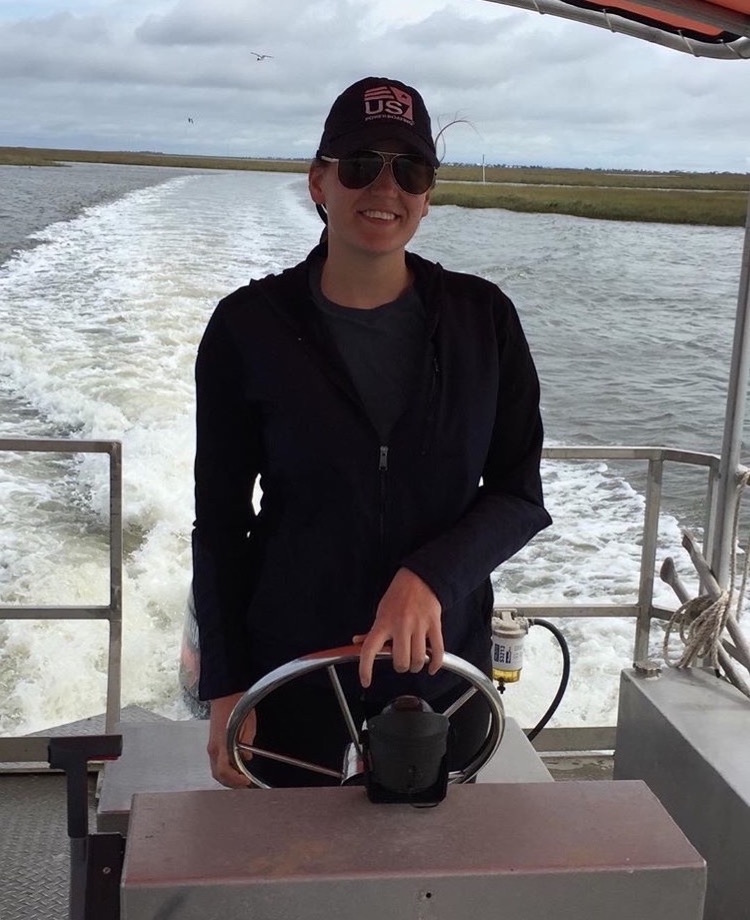
My first few days back on land I worked with our small boat manager, Carl, for the remaining of the week learning about boat fueling, repair and maintenance. I will also be helping with the environmental monitoring systems as well towards the end of the week. My first day back was slow and I mostly shadowed Carl around the ship yard fixing small boats. I spent the remainder of my time driving and preparing our pontoon boat, as I will be captaining an education class come Monday. Prior to my time on docks, I have never driven a pontoon boat- but the same general rules of small boating apply. The pontoon boat uses a two-stroke engine and I spent the day driving around the bayou in preparation for Monday. The bayou area is very low and tidal influxes are small in range- unlike up North where you can see a ten-foot change within only a few hours. With this in mind, I went through the bayou for a while with Carl to get a feel for new landmarks and areas of precaution, such as oyster beds. It is a tricky area and you have to constantly pull your engine up to prevent from sucking in mud. Luckily, mud is not as damaging to an engine as sand and you can easily clean your engine out with flexible wire while driving, if your “piss” hole becomes clogged. Attached below is a very smiley picture of me driving my first pontoon boat!

Pontoon trip:

My class arrived around 8:45, which gave me time to set the boat up in the morning, start my engine, prep my ropes and prepare my life jackets. There were several educators on board, which made captaining much easier as I could just focus on driving. I gave a quick safety brief in the beginning and then drove them over to a marsh platform for sampling. Essentially, I edged the top of my boat unto the marsh in neutral, so we can sit around for a while without drifting or floating away. Around noon, the class was ready to return and I used a boat hook to push us away from the marsh and slowly backed up without churning up mud in the very shallow areas. All in all, it was a successful trip. I spent the remainder of the day helping out Carl.

I spent the remaining of my time this week running a few day trips on our research vessel the R/V Acadiana- which is much smaller than the Pelican but is a very capable vessel. Before our trip, we added in new windows, new navigation systems, new tile and a new captain’s chair and counsel. The task was lengthy but we are all prepared for tomorrow. We are set to leave around 7 am with a class and plan to go around the Gulf of Mexico (a very short drive from LUMCON) and spend the day doing mud coring- a memo I did not receive when I showed up in my brand new sneakers- lesson learned.

R/V Acadiana Trip

I met with our deck hand and other tech at the boat around 6:30 am to prep for our morning departure. I spent the morning cleaning windows, starting the boat engines up and removing the boat from shoreline power. It took a few hours to get to our first station, which gave me a great opportunity to drive to our location. The Acadiana does not have auto-pilot yet, so I manually drove the boat- which is far trickier than the Pelican because the steering is very sensitive and deviates from your position, so you must constantly turn your lever back and fourth to keep a straight course. Throughout the day, we did about 50 or more mud cores and around 4:30, headed back to make it to the docks around 7:30 pm. I spent the evening cleaning off the boat, which was covered in mud, and turning the rest of our switches off. It was nice to drive another research vessel, as every vessel steers and drives differently.

Attached below is a picture of the R/V Acadiana.


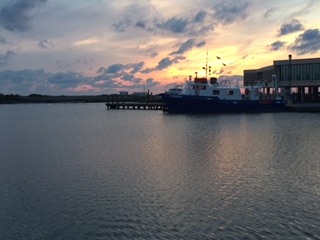
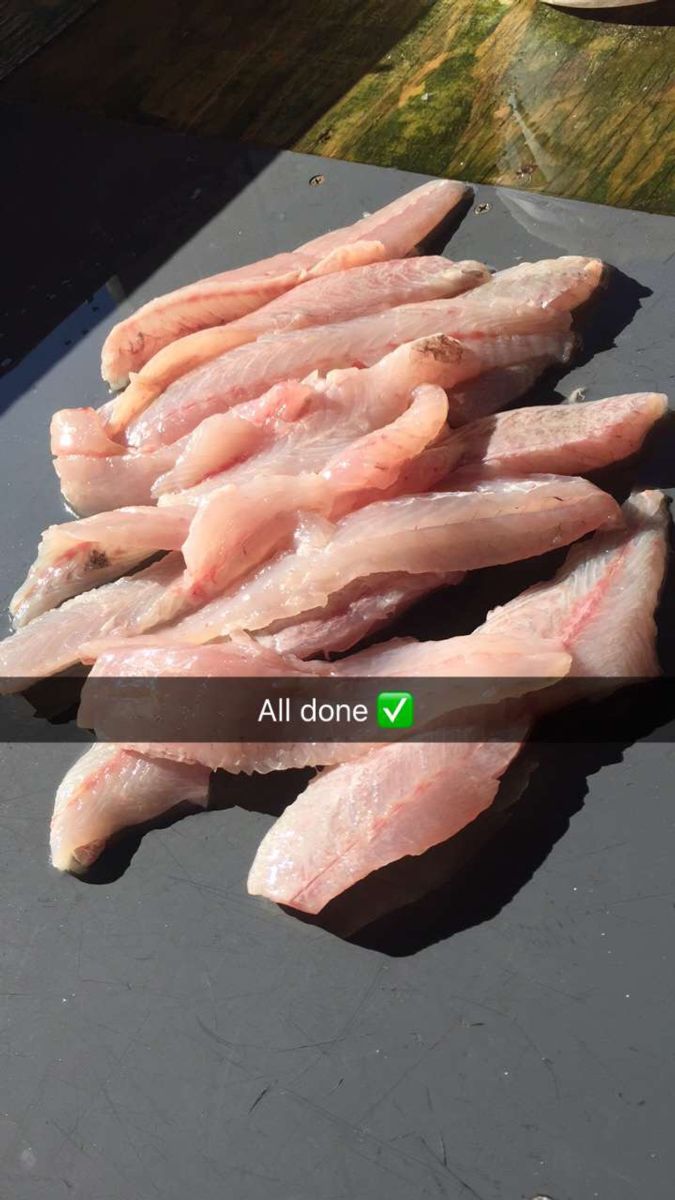
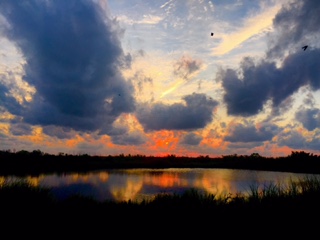
A story of Southern hospitality at its finest: During this week we had a very large storm which made many food places closed. Our chef was out for the week and it was hard for me to find good food. Our security guard Kenneth, an older guard at Lumcon, caught a surplus of fish for me, taught me how to fillet them (it was my very first time) and fried them with me for several nights in a row! He even made me beignets, brownies and brought me several other snacks and goodies throughout the week. I have never met Kenneth, but we treated me like family and I will be eternally grateful for his kindness- and even the gut I grew during my time! I posted a pictur below of a sunset we saw while fishing and a set of my first filleted fish. Enjoy!

Mexico, Storms and Drones

Well, it can’t be all fun and games- after returning from New Orleans we were back to the wire preparing for our Mexico cruise, and this time, my passport finally got put to use! The Gulf of Mexico is off the coast of Louisiana and while we do explore the Gulf, it is not considered Mexican or ‘International Waters.’ However, this cruise we traveled to the Bay of Campeche which is Mexican territory. Before the science party arrived, we spent a majority of our time adding the rest of our sensors to the CTD on our back deck. Every cruise involves different sensors, dependent on the scientists needs, and this cruise involved two aquatracka sensors and a CDOM sensor- which measures the “colored dissolved organic matter” within the water. Once the chief scientist arrived, we were able to add the last aquatrack sensor and finish wiring our c-cable with zip ties. Adding sensors to the bottom of the CTD is a lengthy process- especially considering that some may have to be moved around to fit all your necessary needs. It’s like the age long game of Tetris! We use hose clamps to rig the sensors to the bottom rosette platforms, then a cable plug (matching with the sensor) is run to the other end (channel) of the rosette pump. The cable prongs needs to be cleaned with contact cleaner, canned air and then silicon is added for extra lubrication and hold.

Due to the need of a 24 niskin bottle rossette- which is much large than a regular 12 bottle- it was neccessary to deploy our CTD off the back a-frame using our Dynacon Winch. Deployment off the back deck involves a process called tag-lining. Tag-lining is a simple- yet sometimes hard to maneuver- task that involves wrapping ropes on both ends of the rosette and loosely rigging the ropes around our two side cleats on aft deck. While our chief engineer uses our back deck winch to control the CTD, two people hold tightly onto the taglines and maneuver the CTD into the water as smoothly as possible. The tasks involves great tension and pull on the ropes to ensure the CTD does not crash into aft deck during descent. Once the CTD is in the water, two workers quickly pull the rope off the CTD and walk around our winch wire and off aft deck. While tag lining is a simple concept, it is also very dangerous as there are several “pinch points” where the CTD can potentially pin or slide into a worker. Like all things on a vessel, it is very important to always keep a watchful eye and ear for potential hazards. While bringing the CTD to surface, we use a hook called –for lack of better word- “a happy hooker”, which can be used to attach rope on both sides of the CTD to pull up for ascent. Due to the lack of visibility with the aft deck winch, a third worker is needed to signal our chief engineer when the CTD is at surface. During our daily CTD casts and tests, we noticed several anomalies coming from our temperature sensors during up-cast- which consequentially affected our salinity readings as well. After several modifications, we eventually changed out our temperature sensor, channel station and cable to ensure any possible issue was resolved. So far…so good.

Our biggest issue with this cruise was our constant need to terminate our CTD winch wire. Due to deep casts, and the inevitable spinning of our CTD underway- caused by currents, waves, winch spead and boat position, it was a reoccuring issue. We later found the issue of our winch wire, which needed to be replaced, compounded the issue greatly. Our technician and I were up all hours of the night and day terminating. A swivel device can easily fix this issue, but it is expensive and we do not always have all the equipment we need at sea- hence the need to always think on your feet. Terminating a winch wire is a long process (3-4 hours at a descent speed) and involves multiple layers of wire, plastic and internal termination. Despite the stress of constant termination, I learned a lot during the process and am happy for the new skill!

Unfortunately, despite the most valiant efforts, our CTD was lost to Neptune on our last day of sampling. Luckily, 99% of our CTDs were done and we returned in time for a lovely Cyclone- Seriously, someone pissed off the Sea Gods during this cruise. In the end, everyone landed safely and the spanish crew and our crew celebrated our stresses away the following evening on the docks. I am thankful to have met so many interesting, vibrant and unique individuals during the cruise!

Page 2 of 3

Powered by WordPress & Theme by Anders Norén