Month: October 2026

Week 1: Emily Pinneo

I arrived in Honolulu this Tuesday and had the chance to meet the team and assist with mobilization for our upcoming cruise. It was amazing getting to see and participate in the work that goes into maintaining such a high-quality time series dataset!

On Wednesday, I completed a safety training quiz and assisted the HOT team at their onshore labs in the C-MORE Hale building on campus. I helped prepare water for nitrogen fixation incubation experiments, which was a lot of fun – after the team removed other gasses from the seawater, we chilled the water and enriched it with nitrogen. In order to dissolve the nitrogen bubbles into the water, we used a highly technical tool – a flyswatter!

Next, I helped out with acid cleaning to remove any trace metal contamination from some of the HOT team’s lab equipment. In between tasks, I could look out the window and see White Fairy Terns, or Manu o Kū, perching in the nearby trees. The team was very welcoming and showed me a good cafe to eat at for lunch, with amazing banh mi!

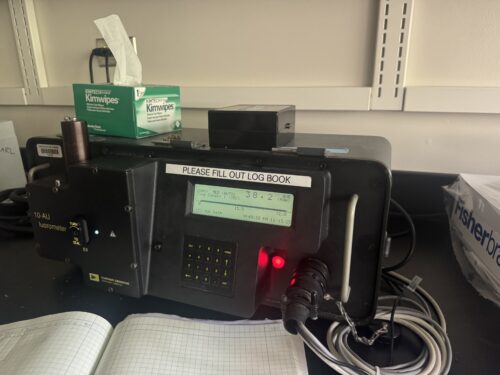
After that, I learned how to run chloropyll samples with the HOT team’s fluorometer. The team had conducted an extra transect between their normal station and shore, and still had samples left over, so I was able to practice. At first the fluorometer was acting up, but the readings returned to normal after we turned it off and back on again!
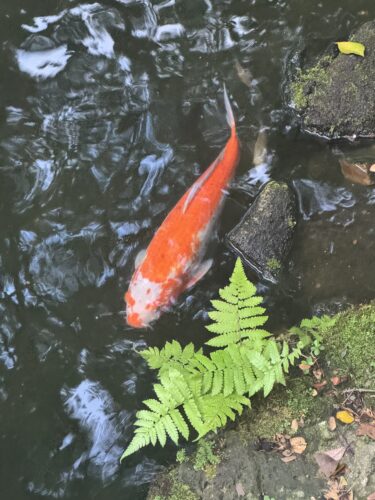
After work, I was able to explore the campus Japanese gardens near my lodging.
On Thursday, I toured the ‘beach lab’ at the marine operations center and got started preparing a CTD for the cruise. We got to see different winches, sediment traps, wave buoys, and the ROV Lu’ukai, as well as getting our first glimpse of the R/V Kilo Moana!

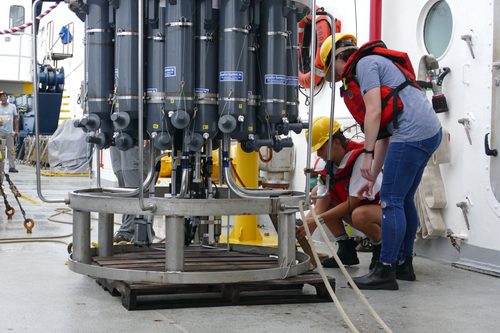
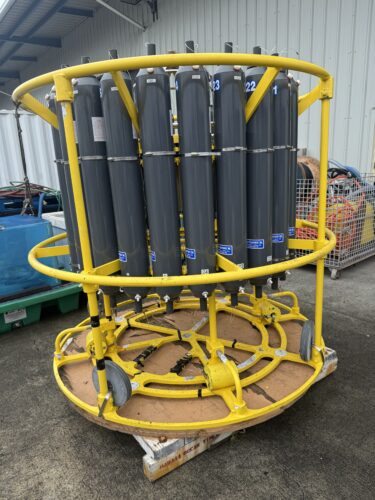
We learned how to string the niskin bottles on a CTD rosette – which, like a lot of things, is easier with a little teamwork! I had cocked CTD bottles before, but I had never previously worked with the internal springs that hold the caps in place. This experience gave me a much better understanding of how these instruments work – the top and bottom caps of each niskin bottle have to be connected with the right length of cable and spring, without damaging the O-rings that help the bottles seal shut after sampling. The HOT science team re-strings their CTD bottles before each cruise to avoid leaving them under tension and reduce unnecessary wear and tear on their equipment.
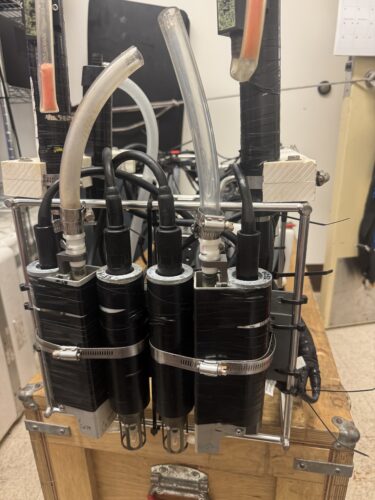
Next, we were introduced to the sensor array on the CTD itself. The CTD had hit the seafloor during a cast on a previous cruise, so they wanted to replace the more susceptible sensors in case of any damage. One of our mentors demonstrated how to replace a conductivity sensor, and then gave us a chance to practice. Then, we learned how to update the calibration files needed for the new sensors. The HOT team uses two duplicate temperature, conductivity, and oxygen sensors on each CTD to ensure consistent measurements, and updates calibrations after each cast by ground-proofing each measurement with lab analyses on water samples.
On Friday, we mobilized for our first cruise! The team worked seamlessly to get three vans full of equipment onto the ship and set up in the lab, including positive and negative pressure pumps for filtration. Next, we shadowed our mentor while he completed a CTD cable termination – a process we’ll be able to practice later in the internship. Then, the team tested the termination under tension using a crane on deck. For lunch, we stopped by a local fish market with amazing poke bowls!
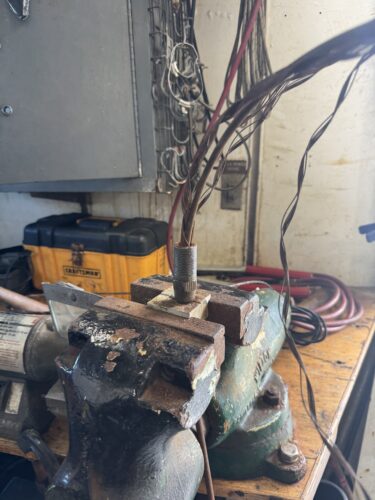
All in all, I’m amazed by how much I’ve learned in just three days and I can’t wait for our upcoming cruise!
Drake Goes to Hawai’i: Week 1

Hello, all!

I made it into Honolulu last Sunday, and have spent this past week getting the lay of the land at the University of Hawai’i Manoa to learn all about how the HOT team prepares for their cruises. They’ve done this a lot, roughly every month since 1988, so they were pretty much already all set for our upcoming trip leaving next Sunday, Cruise HOT 367.

The HOT team collects the same measurements every single cruise within the time series to very precise levels of detail to provide a consistent record of how the ocean changes over seasons and time. Getting to meet the team, one collecting nutrients, another oxygen, another chlorophyll, has been a really cool chance to get to put faces to each component of this amazing dataset.

Below are a few pictures I took as I spent this past week in the lab:

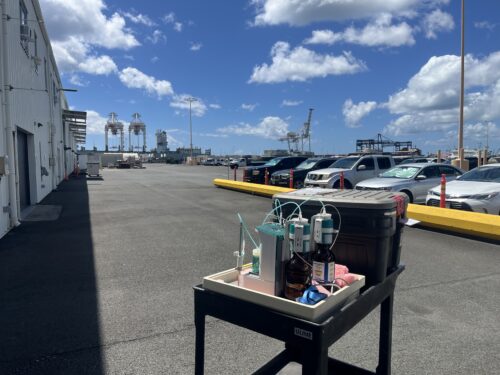
Grabbing the Winkler Oxygen Titration rig from the “Beach Lab,” the UH Marine Center with storage and lab space directly on Pier 34.

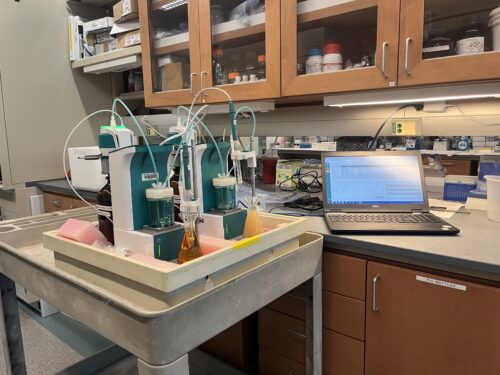
We brought the Winkler Oxygen Titration rig mack to the Center for Microbial Oceanography Research and Education (C-MORE) building on main campus for calibration. Here we see two samples running: (left) neutralized and (right) acidified, showing color changing with pH to find the specific O2 concentration of seawater.

Just outside the C-MORE lab space, this extremely technical piece of equipment is critical to the HOT research mission.

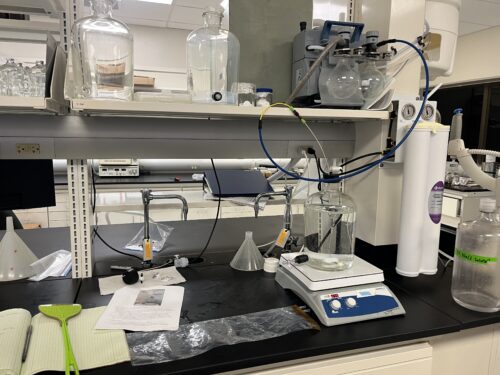
To mix up 15N2 tracer for Nitrogen fixation experiments, the team pulls all oxygen out of a batch of seawater under vacuum before spiking a chilled bag with 15N2 gas and slapping to dissolve all gas.

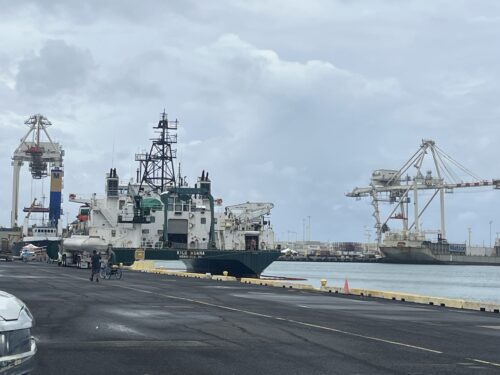
Our first view of the R/V Kilo Moana, back from her many different projects and now waiting patiently for us to leave for HOT 367 on Sunday.

My pictures make it look like a ghost town, but know there are many people hustling just out of frame to get everything going. With so much going on to get things cruise-ready, I’ve been snapping photos in the brief moments I have without stuff happening.

Week 2 – CTD Overhaul – Jessica Leonard

The first week after pulling of the dock was definitely an eventful one! We are at the base of the Kermadec Trench dropping a lander to the seafloor and running CTD casts to 6,000m. The whole week we experienced one issue after another with the CTD which involved days of troubleshooting. Alas, the CTD is now fully functional, and I have spent a great deal of time helping overhaul it while at sea.

Aside from CTD troubleshooting, I helped train the science party newbies on how to setup the CTD for deployments as well as use SeaBird’s Seasave and communicate with the CTD and winch house for deployments.

Dropping the lander to the seafloor involves using the A-Frame for deployments and recoveries which is the SSSG’s responsibility. Running many deployments a day, I am becoming a pro at operating the A-Frame.

For the CTD overhaul, after experiencing lots of modulo errors (electrical related issues), we opted to re-terminate the wire at least 4 times. I got to take a jab at this one of the times, but, this was unsuccessful (not by my termination likely, but other persisting issues). Calling it quits after this, we changed out some sensors, some wires, and after that didn’t quite do it, we replaced the whole SeaBird unit all together and moved winches. Luckily, as I have used lots of SeaBird products on gliders and in lab, I was able to help in this rebuild.

After our rebuild, no modulo errors! We got down to ~5,000m where the scientists wanted to collect water, and……the bottles wouldn’t fire. Just when we thought we’ve solved it, one more issue. We brought up the CTD and replaced the last electrical component on the CTD, the SBE32 carousel. Now, I can officially say I’ve done a full CTD build, minus the frame and the bottles.

Our CTD is functioning better than ever, and we are en route to the top of the Kermadec Trench ~700nm away (~60h transit).

We have had some lovely Cape Petrels, Wandering Albatrosses, and Common Dolphins following us around which I will showcase below.

Intro: Emily Pinneo

Hello! My name is Emily, and I am excited to join the Hawaii Ocean Time-series team as a UNOLS MATE intern this fall. I will be participating in cruises KM26-13 HOT 5 and KM26-14 HOT 6 on the R/V Kilo Moana.

I studied Oceanography at the University of Washington, where I discovered a love for marine technology and fieldwork. I worked for the Ocean Observatories Initiative Regional Cabled Array while in school, where I helped maintain an array of deep sea instruments and participated in two research cruises on the R/V Thomas Thompson and R/V Atlantis. I am interested in deep sea ecology and conservation, and also completed an undergraduate thesis project mapping the benthic fauna at the methane seep Pythia’s Oasis. I can’t wait to broaden my technical and lab skills with this new internship opportunity!

I love incorporating marine science into art, including drawing, painting and pottery. In my free time, I also enjoy reading, creative writing, and gardening. I’m excited to travel to Hawaii and meet the team!

If tomato is a fruit, is ketchup a smoothie?

Transits move fast! After an easy flight from NC to VA, I met up with the STEMSEAS cohort in Norfolk. All the students were excited to meet each other and get on board. If you’re not in the loop, STEMSEAS is a program designed to get undergrads time at sea and expose them to different types of science and careers. Joining us in this expedition are two ChOP fellows, Drs Piffer-Braga and King. They’re on board as chief-scientists-in-training. I’m excited to work with them, as one of the biggest things I learned in school is that the job of a marine technician is to act as scientific support. We also have two doctorate students joining this cruise, so there’s a whooooole lot of academia happening on board. Leading the cruise as the chief scientist is Dr. Joe Montoya of Georgia Tech. He’s led several cruises in his time as a professor, and also provides a wealth of knowledge. Plus a strong interest in sargassum.

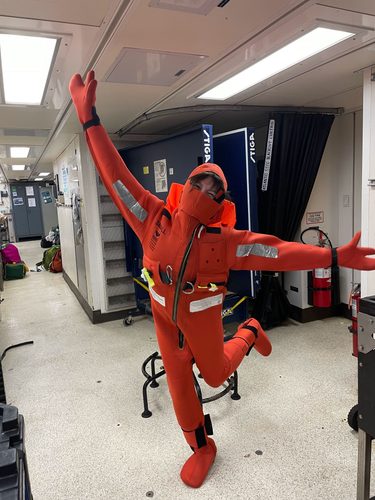
Due to an incoming nor’easter, the captain of the Atlantis made the decision to leave port the night of the 22nd instead of the following morning- this meant we hit the ground running with onboarding procedures and getting settled in. Most importantly, learning how to put on immersion suits (aka Gumby suits).

STEMSEAS mentor Jen Valenzuela as the immersion suit model

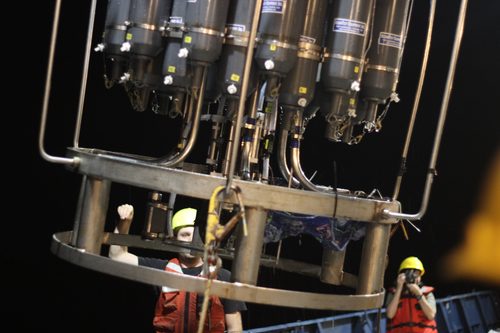
The first night was a bit sporty out of Norfolk, but it eventually calmed down! The first day on board was a bit mellow, with some of the cohort not feeling too hot in the rolling of the ship. The mentor group started setting up the lab, and the students that were up and about started getting to know the ship and her crew. We hit calmer waters by the 24th, and then we could get down to business! The business of science, that is. I got to help perform a deck test of the CTD the day before we deployed it, which was a great chance to refamiliarize myself with the instrument. It’s been awhile since I used one! We got a demo of CTD casting led by the fearless ChOP fellows and the SSSG the morning of the 24th, and the students were all excited to be out on deck learning how to conduct science. This meant proper deployment and recovery, as well as good sampling habits. On my end, I got to attach the various instruments that can work with the CTD.

Securing the CTD, photo by Jen Valenzuela

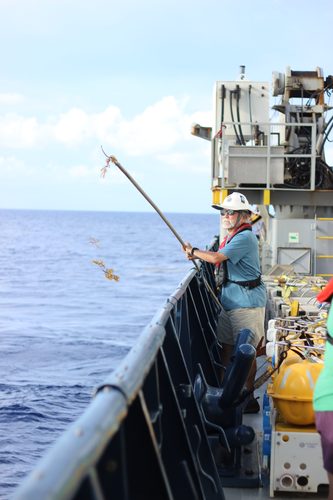
I’ve spent my time in an even split between shadowing the SSSG’s on board and also working with the STEMSEAS cohort. In the mornings, the students sit in lectures before moving onto the starboard deck to participate in CTD casts and ring net tows. It’s been fun watching them learn deck ops, and get so excited about collecting samples from different depths. There’s also been a pretty noticeable interest in the mechanics of flying fish (belonging to the family exocoetidae)! A few of the poor guys have flung themselves on deck, and most of the students had never seen a fish that could fly. Part of the STEMSEAS experience is for students to create a project while on board and have it ready to present by the end, and a couple of them have decided to put their focus on the winged creatures. Along with our CTD casts we’ve done several ring net tows to bring up phytoplankton. Dr. Montoya has also been vigilant in his sargassum collection, and is always on the lookout for floating patches of the stuff.

Dr. Montoya in action, photo by Eve See

There’s been a lot of learning opportunities on board, not only in the realm of marine technician work, but all the parts that go into making a research vessel run smoothly. We toured the engine room, the forward water wall, the bridge and all the laboratories on board. And the Atlantis has a LOT of labs. Plenty of room for science! Luckily for this transit, the two doctorate students on board are collecting samples to use in projects back at their home lab, so it’s a real-life collection scenario. I’ve also gotten some traditional intern grunt work, like cleaning tools, organizing hardware and fixing little things around the ship. Also learning how to use an angle grinder! It’s been pretty enlightening, seeing all the pieces that go into making a successful MT.

We’ve also gotten to participate in a hallmark of the STEMSEAS experience that I was completely unaware of, called the “Shrinkage Event”. If you take a regular styrofoam cup, (decorated, of course) and then tie it to the CTD rosette for a deep cast (approximately 3000 M!) it will shrink to a teeny tiny version of itself from the pressure. The quality of styrofoam cups has come into question from those more experienced with crushing them- apparently close-cell styrofoam is superior.

Recovering the shrunken cups, Photo by Eve See

Outside of daily operations, we’ve all been enjoying each others company and having heated debates fueled by questions left on the galley whiteboard. Most notably, if a tomato is a fruit, is ketchup a smoothie? I am firmly in the NO category. You can come to your own conclusions though.

As we near the Panama Canal, the work starts to wrap up as we prepare to offboard, and the students have been hunkering down to finish their projects. We’ve been treated to some incredible stars now that the moon has waned, and even some bioluminescence! There’s still a little bit of time left in this cruise, but for now, I’ll see you on the other side of the canal!

Page 2 of 2

Powered by WordPress & Theme by Anders Norén