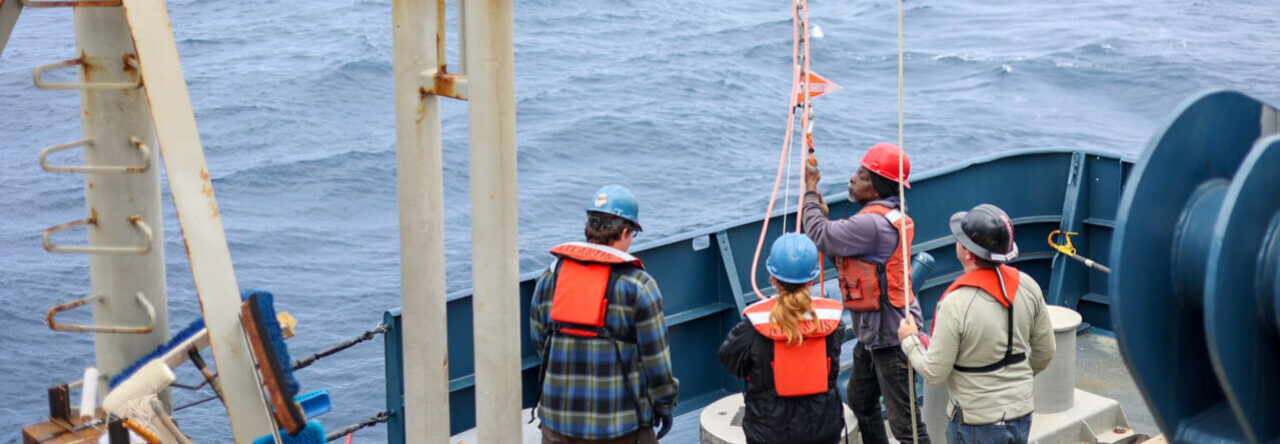
Once we left Seattle, we headed out to perform calibrations on the new 304 sonar array and the 710 sonar array. We originally were going to do all our calibrations on the open ocean but we were able to get permits for Canadian waters last minute so our first few days were smooth sailing (thank goodness, I could’ve kissed the messenger). Calibrating the sonar arrays involves driving the ship over the same stretches of ocean repetitively, recording sonar data as you go. A software package then uses the data to correct for heading, pitch, and backscatter. Some days, data collection was tricky due to windy conditions. During conditions with lots of wind and the boat starts to crab, bubbles can be driven under the ship which interfere with the sonar readings. Bubbles cause disruptions to the data due to their difference in density from water and prevent the sonar beams from traveling through the water column to the seafloor. One of the exciting new things I’ve been able to learn is how to deploy a CTD. The process involves communicating with the winch operator which depth to bring the CTD to, cocking/firing Niskin bottles, guiding the CTD in/out of the baltic room, and sending the thermosalinity profile to the sonars. However, there is some downtime but I have kept busy by doing small 3D printing projects such as creating a new CTD mount for the PAR sensor and a table stand for our Black Box monitor. I also started to plan my next steps as I only have one more week on board:( Our SUNA sensor is also having problems so I got to help troubleshoot the problem.
 CTD monitor
 CTD ready to be picked up and boomed out
Thanks for reading,
Sarah
