After the ship was floated, we needed to get the ship ready for the voyage to Seattle on the 14th. This meant finishing closing up the eighteen! opened Roxblox and installing a temperature sensor. The temperature sensor is located in the bow thruster room on the inlet pipe of our seawater system. The intake pipe is located about six meters below the waterline on the hull of the ship to the bow of the ship. This location is important because the seawater taken in from this pipe feeds an array of scientific equipment called the wet wall and its important that the collected seawater isn’t contaminated by the ship. Having the temperature sensor at the beginning of the intake pipe is also important for getting accurate data because as soon as the water enters the ship, it gets warmed. Some things that the ship constantly monitors through the wet wall of sensors is pH, oxygen, and salinity. Another sensor that we installed was the Met4ay which measures barometric pressure, humidity, and temperature. This install was located on top of the foremast.
 Inside passage and foremast. The Met4ay is hanging off the top left of the ledge.
 Wet wall. These instruments are fed by the intake pipe.
The centerboard is a three thousand ton feature of the ship that runs vertically through the whole ship and is moved up and down by ropes. At the bottom of the centerboard is an array of sensors such as temperature and pH but also ADCPs. ADCP stands for Acoustic Doppler Current Profiler and it measures ocean currents. It does this by measuring the speed of tiny particles suspended in the water using sound and exploiting the Doppler Effect. Another thing that exists in the water column besides particles is bubbles. Bubbles “look” the same to the ADCP as particles but dont give accurate current data. The centerboard allows the ship to lower the ADCP instruments below the hull of the ship to avoid the bubbles that the ship creates as she moves through the water. The centerboard has a locking feature that allows the centerboard to be moved into the exact same position every time it’s deployed. This feature was broken and I was tasked with helping fixing it. This meant jumping into the centerboard well, climbing on the centerboard itself (it likes to move in the well), and shimmying into a tiny crack next to the three ton beast. Unfortunately, the task proved impossible and we were unsuccessful in fixing the locking mechanism:/
 Exiting the centerboard well
The next two days were spend at the mercy of the Gulf of Alaska. It’s safe to say that I get seasick and that bacon does not taste as good coming up as going in haha. Luckily, there are some very good drugs out there and I was back in fighting shape the next day.
 Rockin, rollin, and hurlin
The other day, I was able to install my IRT design! Once it has been properly calibrated, this will allow us to measure the skin sea surface temperature. As I mentioned before, the ship takes in water at about six meters below the surface. In areas such as the Arctic, there could be high stratification in the water column so the ocean temperature at six meters down could be radically different than on the surface. Eventually, this will also allow the ship to validate satellite sea surface temperature data. Satellites experience barriers such as clouds and so their data could be compromised. By comparing data taken right above the sea surface to the satellite data, we can know how accurate the satellite data is. I’m really grateful to my mentor for giving me this project, and collaborating with me on it’s design and fabrication. During the fabrication process, I used SOLIDWORKS to CAD the design, a 3D printer to create the dial parts with a nylon/carbon fiber blend, and drill press.
 Desktop assembly
 Installed! The sensor on the foreground is measuring the sky radiation and the other sensor is measuring the sea surface radiation.
 🙂
🙂
Bonus content:
 Ethan working on installing the CTD winch boom bearing
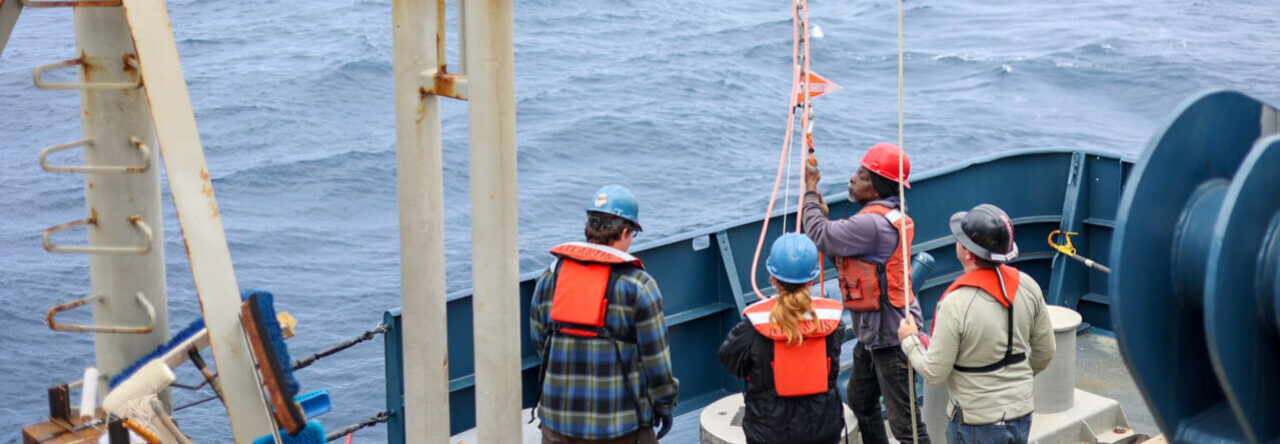
 CTD and winch boom. The CTD, structure with the gray bottles, is lowered into the ocean using the winch. The bottles (in gray withitn the cage) allows scientists to take water samples at different depths. The depth at which samples are taken is controlled in the computer lab by marine technicians.
 A nice day
Thanks for reading,
Sarah



 Driving under the Newport bridge
 CAD assembly of PAR mount. A cool technique that I learned during this internship was to combine hardware and 3D printed parts. Printing threads is tricky so instead one can incorporate nuts into the design to provide the means of threading in a bolt. In this design, the nuts were press-fit into the print and aligned with the bolts. Now, what would be the weakest point of the design, printed threads, is no longer an issue.
 Mounted PAR sensor
 CTD monitor
 CTD ready to be picked up and boomed out
 Water bag in yellow
 A-Frame testing with full water bags
 CTD cable splice. The cable was first electrically connected to a pigtail that would be plugged into the CTD and then mechanically connected.
 ADCP dunk test. During the cruise over to Seattle, two of the ADCP’s beams broke and it needed to be taken out in order to be troubleshot.
  MouseTrap version 1, a 3d printed device for preventing the computer mice from flying off the desks.
 Final installed version of the MouseTrap.
  Biking to the Fremont Troll
 Before cable organization
 Cables being sorted/organized before being woven into the cable trays
 After cables were organized into the cable trays on the ceiling. Also, some excellent final touches with zip ties above and below the transceivers
 Cables organized and Roxblox (seen in blue at the base of the cables) closed
 Installing Roxblox
 Ethan at the top of the mast helping the surveyers collect point data
 Tx array before ice windows installed. The blue color is due to a thin layer of anti-fouling paint added to the transducer faces.
  Three techs contemplating the Rx array. The white square in the hull (top left) is the Topas, a sub-bottom profiler which sends down low-frequency pulses that can penetrate into the seafloor. This allows scientist to see the different layers of sediment and rock in order to find features like ancient lakes. The trade off for sending out low-frequency pulses is that the resolution of the image you generate is lower. The round yellow ADCP in the hull (top middle) sends out higher frequency pulses which is less penetrating but the resolution is much finer. With enough resolution, scientist can detect plankton in the water column!
 Raising ice windows on the Tx array. Ice windows are put into place for, as their name suggests, protecting the transducer faces from ice. The Sikuliaq often works in the Arctic and this buffer is a very important safety mechanism.
 Sikuliaq riding high out of the water, being barged into place
 Shipyard survivors 🙂
 Transceiver room pre-transducer cables
 Where the cables come out from the bottom of the ship
 Tx frame on telescoping forklift
 Tx frame rolling in on casters
 Moving in the Rx frame
 Tx frame ready to be lifted
 Lookin like a million bucks 😛
 Raising the transducers into the Tx frame, they are super fragile so every surface they rest on needed to have foam on it
 The transducers slide between the pegs, then a plate is screwed into the pegs to lock the transducer in place
 Transceiver room after pulling the transducer cables

 Sunset at UAF warehouse
 Pre-work fit
 Working to remove the transducers
 Empty frame
 Small break
 Pipes holding the transducer cables
 Hired muscle
 Pile of pulled cables