Category: MATE Blog Archive Page 39 of 89

Posts that were imported from the historical MATE blog at marinetech.org

Week 2: Constant Change

Wow. What a crazy week. I got involved in a large project to trace cables throughout the ship to have a better understanding of what sensors and antennas on the mast are attached to on the bridge and in the tech lab. For part of that task, I was able to climb up the mast and got an amazing view. I also helped with preparing for the upcoming cruise (that ended up being canceled) and wrote a program in CRBasic for a Campbell Scientific Datalogger. The weather finally cleared up and we got some nice sunrises. I also got a small boat tour of Bermuda by one of the Marine Techs. By the end of the week I found out that I would have to leave my internship early due to COVID-19 precautions. I will be leaving in two days. I am very thankful for this opportunity even if it was cut short. I hope I get to come back and finsh my internship if possible later in the year.

Week 3: Preparing For Haul Out

This week we spent our time back at the dock so we did a lot more work to the ship. We are replacing one of our large antennas in a week. I did a bit of work getting everything set up for the removal and for the installation of the new Antenna. I ran new cables throughout the ship and also made sure none of the bolts holding down the Antenna were seized. We are also going to have the entire ship hauled out to be inspected and repaired in April. So we started to prepare for that as well. We scuba dived under the ship to measure the cutless bearings around the prop shaft to see if they needed to be replaced, which we found they will be. So now we can have the new bearings made, which will take about 2 weeks and should be ready by the time the ship is taken out of the water for the inspection.  While we were diving we also inspected a large transducer window under the hull to make sure there were no cracks. Not only was the dive important for our work but it was a lot of fun! There were lots of really cool fish and rays under the ship.

Week 2: First time out

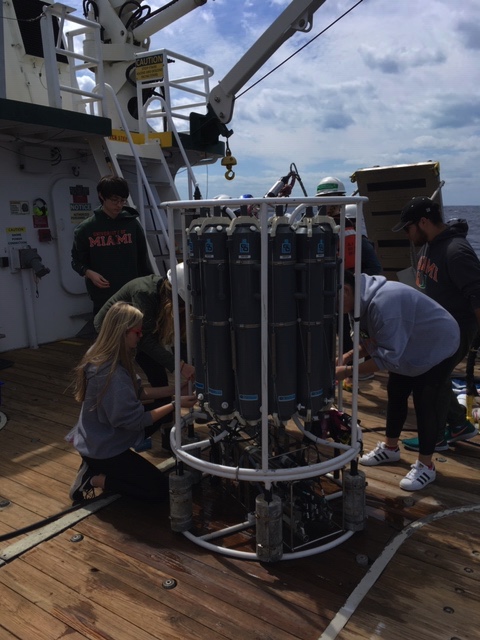
We spent the week getting ready to take a group of students and professors out. We finished up all the projects we had been working on. We got the CTD prepped on Thursday. Then did a wet test on friday. It was my first time deploying the CTD. It went pretty smoothly, and was great practice for when we would do it for real. While we were doing our prep I got to see a few manatees. They like to spend time in the area we are docked.

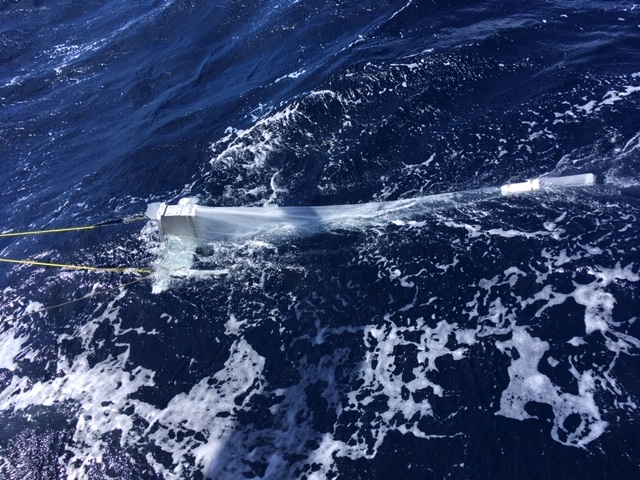
We started around 8am Saturday morning. I helped the engineer get the engine fired up. We also setup the generators and took out the shore power. We went about 8 miles offshore, and dropped the CTD in to get some samples. The seas were pretty rough, but it still went really well. We ended up doing 2 different CTD deployments throughout the day. We also deployed two different nets to collect micro plastics and we dragged another to collect plankton. After we finished collecting the samples we headed back to port. On the way we saw a pod of dolphins ride the bow wake. We will do another similar trip Sunday as well.

Weeks 3&4: Thinking Mud

Hi all! It’s been a busy, busy week and a bit. Sorry for the irregular blog schedule, it turns out that 5° is not a great place for satellite internet coverage when crossing the Atlantic. Anyway, this week all the fun really began.  We left Bridgetown, Barbados the morning of Thursday the 27th for a three-day transit to our first station.

Bye Barbados! The last land we’ll see for 3 weeks

The main object of this cruise is to look at black carbon from biomass burning in Africa as well as heavy metals and PFAs in the atmosphere, water, and sediment. For the air sampling, the science party runs 4 high volume air samplers on the level above the bridge and one above that. For the water sampling, the scientists run filtrations all the time with our flow-through seawater system to look at water near the surface. These systems are always on while we’re in transit and are only shut off when it’s time to stop for a station to do deep water and sediment sampling. Over the course of the cruise, we’ll be stopping for between 10 and 12 stations. At each, we start with a CTD cast. On the way down, we get to see the profile of the water concerning temperature, salinity, oxygen content, fluorescence, and more. Then on the way back up, we trigger bottles to fill with water at depths of particular interest, like the maximum depth, maximum oxygen content, or right below the surface. At some stations, we’re just interested in the top 1000 meters of water, and at others we will do the CTD to full depth.

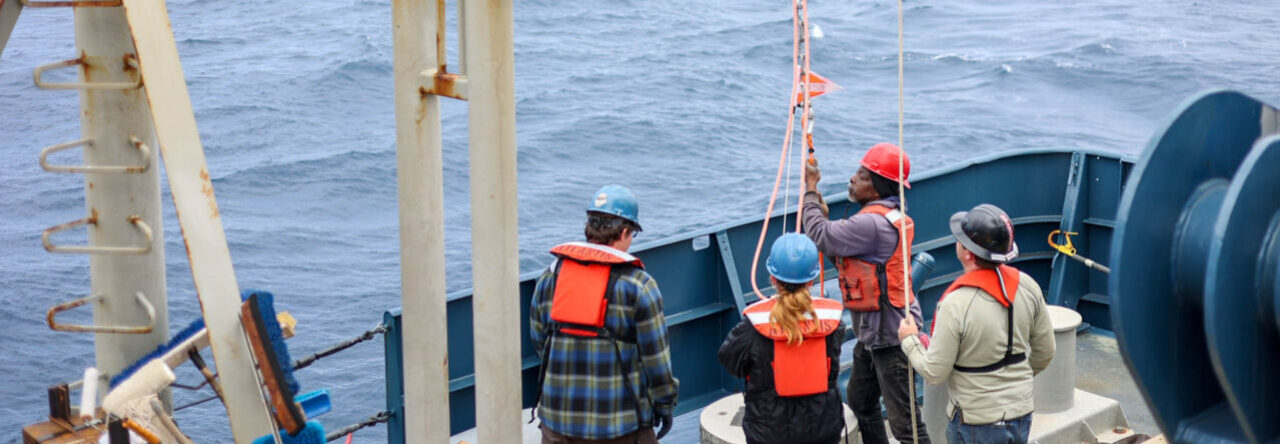
Directing a CTD cast. That’s me with the blue hard hat by the rail     [Photo by Sam Katz]

Following this, it is time for the main object of the cruise – to get mud. We have time to do up to 2 or 3 casts at each station using the MC800 multicorer or the Soutar box corer. The MC800 is a notoriously tricky piece of equipment. It has a large outer frame and a central portion that holds the core tubes. The outer frame will sit on the bottom while the central portion gets pushed down into the mud. Then as it pulls out of the mud, it triggers lids and feet to flip shut on all of the tubes and capture the sample. The problem is that sometimes it gets triggered too early by motion in the water column and sometimes it doesn’t get triggered at all. The Soutar is simpler in its triggering mechanism, but requires enough tuning that we keep it as the backup in case we’re having no luck with the MC800 and so far, we’ve only had to use it once when we failed to collect samples with the MC800 twice in a row (we didn’t have success with the Soutar either).

Setting up the MC800 multicorer. You can see the bottles, feet, and finicky triggering mechanisms     [Photo by Sam Katz]

The box corer getting it’s turn. That’s me on the A-Frame     [Photo by Sam Katz]

Lots of nerves in the room as the corer gets close to touching down     [Photo by Sam Katz]

One of the big projects that I’ve been working on so far is a small camera system called DEEPi developed at URI. A previous iteration of the camera had been tested to depths of around 1100 meters and during this cruise, we were hoping to test it at greater depths and use it to determine what was causing our multicorer to trigger early. During a 3300 meter cast at the second station, I put the camera on for the first time. That cast ended up going poorly with an early trip and no mud collected and the camera was able to show us just how early the mechanism tripped. At a depth of 3300 meters, the pressure is nearly 330 times more than what we experience and this turned out to be enough to kill the light that we used with the camera, but not the camera itself.


The DEEPi camera, the full system undergoing thermal testing, and all set up to watch the multicorer     [Center photo by Gabe Matthias]

A couple of additions to the list of things I wish the Endeavor has are LEDs and lots of clear epoxy, but I was able to harvest some LEDs from a flashlight and found a couple tubes of five-minute epoxy. That plus some resistors and a lovely duct seal sacrificed to form a mold yielded a light to let us continue testing. I had some trouble with the epoxy not hardening well and my attempt at a vacuum chamber went poorly. But, we decided to put it in and see what happens. Bubbles are a big problem at the depths we’re talking about, but I figured that it would yield good data even if it lasted for only the first few hundred meters.

Unfortunately, the DEEPi did not survive its second cast, to a depth of 4645 meters. It’s cause of death is from some combination of the super high pressure itself and possibly some water ingress, but it’s a bit hard to tell with everything buried in epoxy.

Despite the unfortunate foreshortening of its life, the camera was able to capture the bottom of the ocean. That’s the slightly browner smear near the bottom of the frame.


The light that died. The light that survived. The one on the left is not rated to 3300m and the one on the right is, surprisingly, okay at 4645m.


We are currently at Station 8 and have 4 more before reaching port around March 17. I’ll try to post another blog before then to talk a little more about the different things we’re up to and for now enjoy the stern at dusk.

Week 5: Smooth Seas Do Not Make Skillful Sailors

We’re traveling up the east coast now. During one of the previous dives, one of the sub’s pumps had a water leak. I got to put a new one on the sub and clean up the previous one. We stopped in Florida to swap out some of the science party, then headed north. We ran into a few days of bad weather, which on top of making a lot of people sick, delayed the dives. Four days with not much to do but watch movies. It sounds like fun but after the third or fourth terrible movie that someone else put on, it’s almost tempting to throw myself off the boat just for something to do. When we finally got the weather to calm down enough, we got one short dive in. As we continue to head north, we’re going to hit even more bad weather. We’ll see what happens to the other dives on this cruise.


via GIPHY

Week 1: Welcome to Bermuda

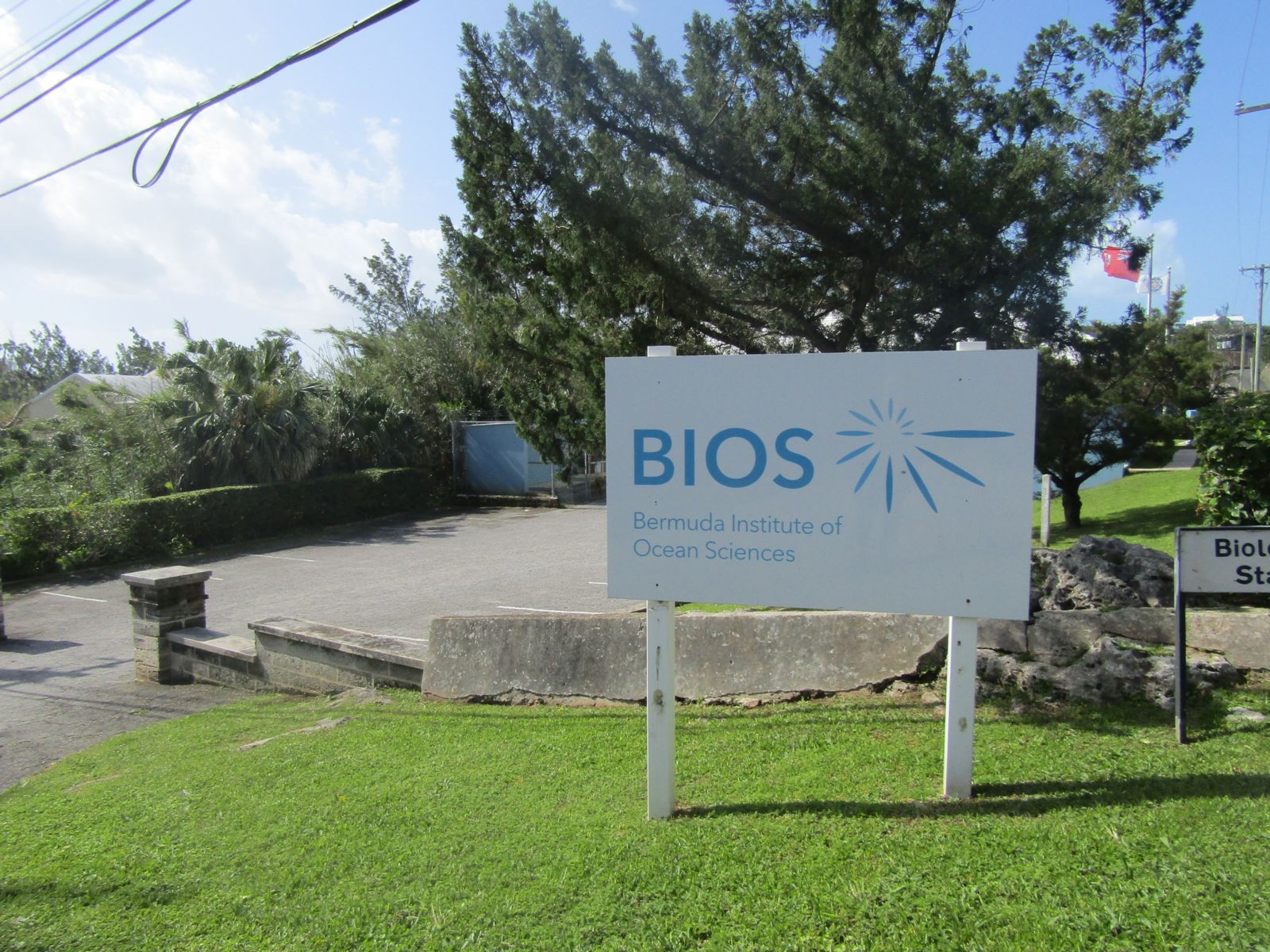
My first week here in Bermuda is already coming to an end. I arrived at BIOS Monday afternoon after a overnight flight. BIOS is home to the Bermuda Atlantic Time-Series Study (BATS) where they use the R/V Atlantic Explorer to collect oceanographic data every month.

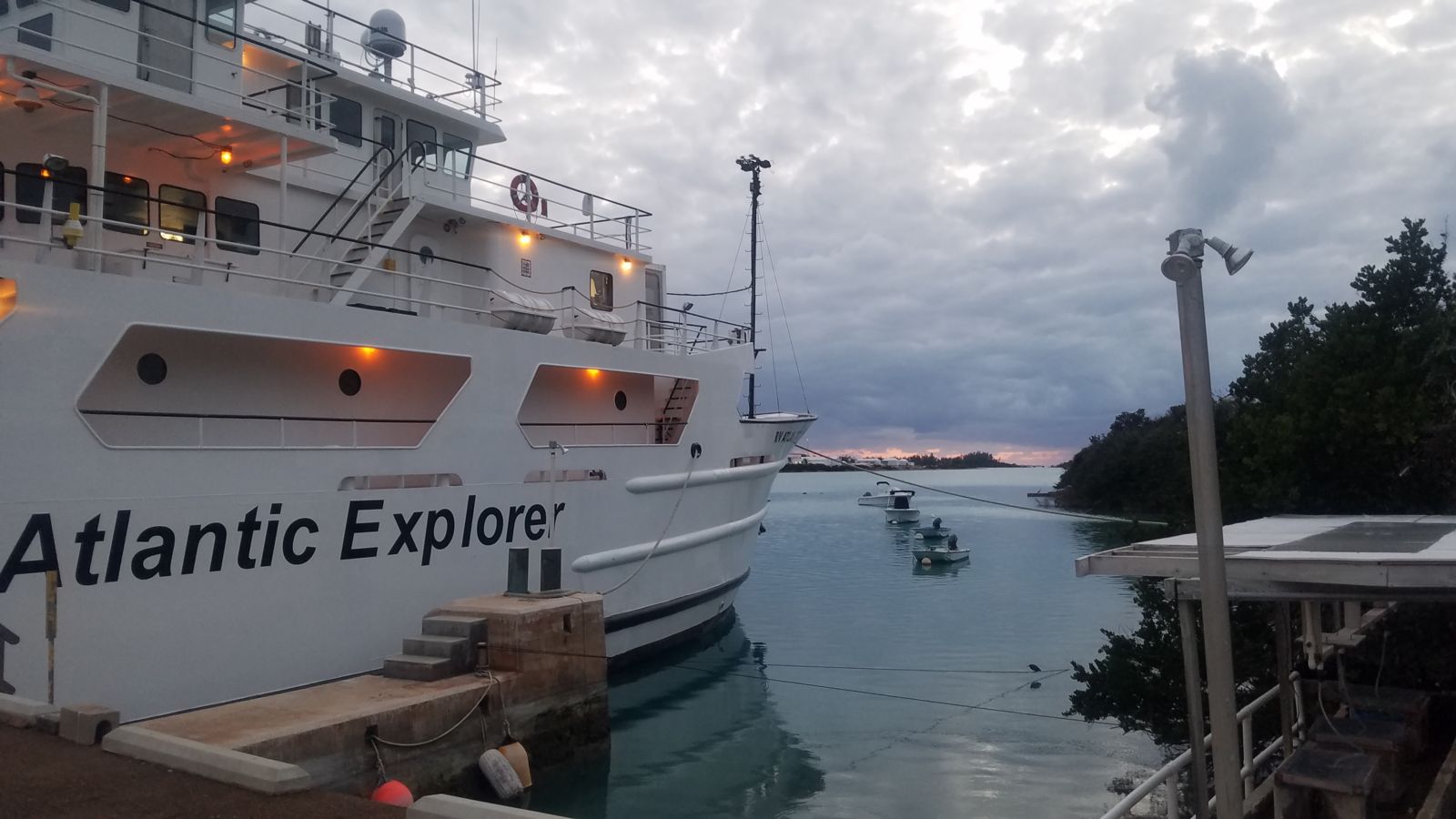
 Pictured below is the R/V Atlantic Explorer at sunset. The weather has been windy but otherwise pretty nice. 

 I spent most of the week getting acquainted with the boat and the marine tech world. I was assigned little projects and reading to get me up to speed with some of the technology and equipment that I am unfamiliar with. It is exciting to be learning new skills that will benefit my career in the long term! 

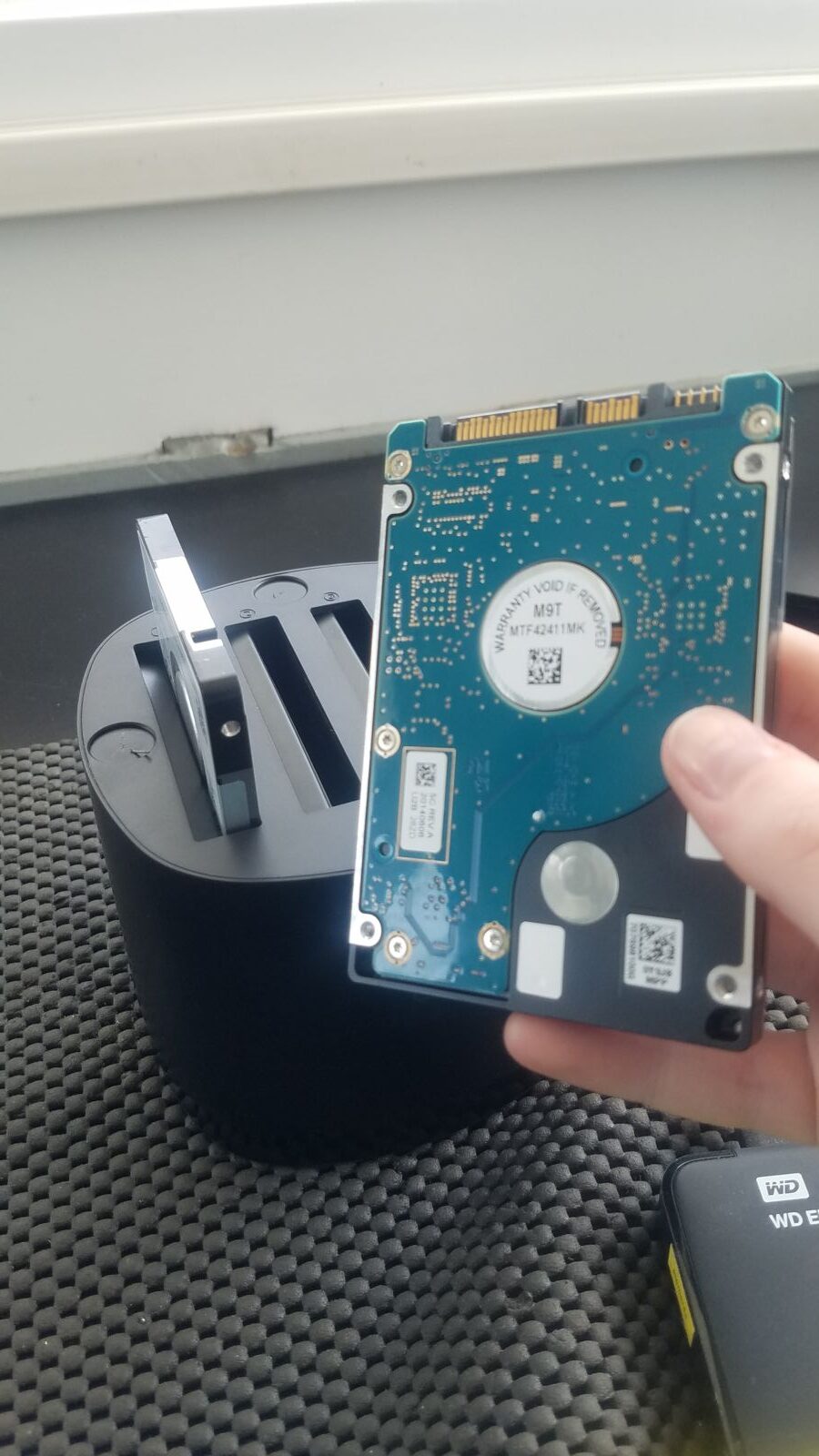
One of the little projects I am working on is simplifing and organinzing the ship’s media storage which meant opening hard drive cases and moving files between the different hard drives.


I am excited to continue learning new aspects of this exciting career and getting to go out to sea in a week!


Week 4: Work, Work, Work

We are back out in the Gulf of Mexico. This cruise there’s another intern in the Alvin group that I have a lot in common with (video games, it’s video games). It’s been a lot of fun having someone around my age to hang out with while we work. Right after we got into the Gulf, we had a day with some less than optimal weather and the dive was canceled. It was quite an experience to look out a window and have the view shift from being all water, to all sky, back to all water. Another day the sub had to come out early as the wind had been building up.

The days feel like they last forever. I get up early, help launch the sub, read in my time off, help recover the sub, help fix anything that was broken during the dive, go to bed, and do it all again the next day. It’s a lot but I’m really enjoying myself out here especially working with the electronics techs. I took a test to be a maintenance technician and I passed! Now I’m allowed to sign off on my work. It’s weird to think that we only have 5 dives left and in 2 weeks we’ll be in Woods Hole. 

Week 2: Barbados

Hello from Barbados! This past week has been a busy mix of finishing up the first transit, reaching Barbados, and preparing for the science on our upcoming cruise. Last Wednesday the 19th, we started to see some islands popping up through the mist. Saba was particularly striking with it’s clearly volcanic peak rising straight up out of the water.

With the warmer water and islands nearby, we also started to see many more birds, like the brown booby below. They were flying along with the boat and catching flying fish as they popped up. Flying fish are another thing I have not seen before and it is amazing how far they are able to propel themselves out of the water.

We could have reached Barbados on Thursday evening, but did not have berthing in the port till Friday so we hung out nearby and went in early Friday morning. After yellow fever shots for all, we cleared customs. In port, we have been following a schedule of working during the day and then spending our time in the evening exploring Barbados. Many things are easier to do when the boat is still, so we worked on a number of items that had gone on to the to do list during the transit.

Our upcoming cruise has a few scientific aims, but the main one is examining carbon content in the sediment. Ideally we will be using the MC800 multicorer in order to collect mud samples, but in case we have trouble, we also have a Soutar box corer. Whereas the MC800 can push up to 8 core tubes into the bottom at one time, the Soutar only has one square tube. Because of this, it has more force pushing the single tube into the ground so if the sediment is too hard for the MC800, the Soutar may still be able to push through. In order to get it functional just in case, we fixed and lubricated the release system and examined some rusty areas. While we are in port, we still do not have great access to everything we could need, so we sometimes have to come up with creative solutions. In this case, the problem was that petroleum-based lubricants could mess up the carbon being measured in the samples. The solution: Crisco.


Working on the core tubes and reassembling the CTD     [Photos by Gabe Matthias]

While we’re on the move, there are always some water measurements being taken. We have a flow-through system for seawater and measure temperature, conductivity (for salinity), and fluorescence (for an idea of phytoplankton in the water). Only when we’re in port will we shut off these sensors. We took advantage of their being off to clean the fluorometers and remove a PAR sensor (which measures light) that is no longer needed.

The Port of Bridgetown, Barbados is very large and has rapid turnover. There’s been an average of about 3 cruise ships arriving in port each day. Besides that, we’ve gotten to see a beautiful tall ship as well as a German research vessel, the Maria S. Merian. The Merian was right behind us and we got the chance to take a tour and talk to some of her crew. Their ship dwarfs ours at 311 feet as compared to our 185. While we have similar equipment, it was amazing how much bigger, more complex, and more modern her equipment was. For some comparison, their winch cable has a working load of 4 to 5 times ours. She’s headed on to Punta Arenas and then Antarctica for research involving clouds.

The Maria S. Merian

We were supposed to depart port for the next cruise on Monday, but again we ended up with a delay in the schedule.  This time the reason was a failing bearing on one of the generators. Sleeves were made to fit around the shaft (which had lost a significant amount of material) as well as around the bearing and the installation was just finished. If all goes well, we will be leaving Barbados tomorrow morning at 9am and the next time I write it’ll be from out at sea.

We got the chance to go for plenty of evening swims and enjoy the beaches of Barbados. We even saw the silhouettes of a couple turtles once the sun went down.

Week 1: Arrived at the Walton Smith

I arrived at the F.G. Walton Smith on Tuesday afternoon. I was introduced to the captain and some of the crew. I was able to explore the ship and the Rosenstiel Campus but that’s about all I had time for that night. The vessel is a 96 foot Catamaran. It has a 7 foot draft which makes it great for accessing shallow waters. 

These first few days we have just been at the dock doing work on the ship. I have been working with Dennis who is the marine tec. There is not a lot of work to be done on the equipment at the moment so I have been helping set up and replace the old ethernet cables for the ship’s computers. When I’m not working with dennis I have been working with the ships engineer. While we are at the dock there is a lot of work that needs to be done in the engineering department. We have done electrical work, kept up with the daily maintenance checklist, worked on the exhaust system, made laminate panels, replaced a faucet and worked on the air conditioning system. 

So far my experience since arriving has been great. I have already been learning a lot about the ship and how it operates. Everyone has been very helpful and welcoming. I’m excited for what’s to come.

Week 3: Out and Back Again

The unfortuante part of mounting cameras near moving parts is they tend to get scratched. Which has happened. Twice. The 4k video camera was out first. Then the still camera went. We fortunately had a backup housing for the still camera, but nothing to replace the 4k. After the first cruise was finished, I was switched from working with the mechanical techs to working with the electrical techs. It’s exciting to see the other side of what goes on with the sub and some of the stuff I’m working with I already have experience with! Once we reached port we did a switch over: new expedition leader, new scientists, and new crew. I said goodbye to my lovely roommate but now I have the room to myself. We were also able to get new camera housings! We again have a still camera, a 4k camera, and we have a backup that may be mounted for more 4k footage. Tomorrow we head back out to sea!

On top of the Alvin

Page 39 of 89

Powered by WordPress & Theme by Anders Norén