Category: Host Page 22 of 85

Week 1: Working at sea is HOT (Hawaii Ocean Time-series)

After leaving the rain behind in Seattle, I was thrilled to arrive in a sunny and warm Honolulu last week! My first stop was the R/V Kilo Moana to drop off my bags and get situated in my room on board.

The chief mate, Jamie, gave me a fabulous tour of the ship and introduced me to almost the entire crew. After my intern partner, Hunter, arrived and settled in, we took an Uber to Waikiki and spent the afternoon lounging on the beach before a busy work day on Friday.

The next morning, we woke up bright and early for the 6:30 am breakfast call and fueled up for Loading Day. Vans full of sensors and lab equipment pulled on to the dock ready for our help to set up the science labs on board. We carried box after box and carefully stowed them in their designated spaces in each room. The whole loading process was incredibly organized and efficient. This was the 345th HOT cruise so they’ve got a routine down by now! We finished up after a few hours, ate lunch and headed back to the beach to enjoy our last few hours on land.

…And we’re off! We left port on Saturday morning around 9:00 am headed for our first station of the cruise at Kahe just off the coast of Oahu. I helped Hunter and Dan prepare the first CTD cast and then headed to bed after my shift ended at 3 pm. Hunter and I split up the day in shifts-I have the morning shift from 3am to 3pm, he covers the evening, and we will switch for the next cruise in November.

2:15 am. Rise and Shine! The first task of the day was recovering the primary production CTD cast and collecting water for the primary production array. The hard part? We have to collect it in the dark. Any white light could cause a spike in biological activity before we deploy the array. Luckily, we use these groovy red lights while we filled up the big jugs. The rest of the day included a trace metal cast, hyperpro and net tow before our big transit out to Station ALOHA.

The following day started with a tense moment when the hydraulics on the Hawboldt CTD winch failed, spraying oil on deck. Big efforts by the science team and crew were made to move the CTD casts to the A-frame which involved re-terminating the CTD wire and moving the CTD rosette into the staging bay–both deceivingly difficult to do. Many hours later, the other winch failed too. Ultimately, the team fixed the original winch and moved everything back to its original position.

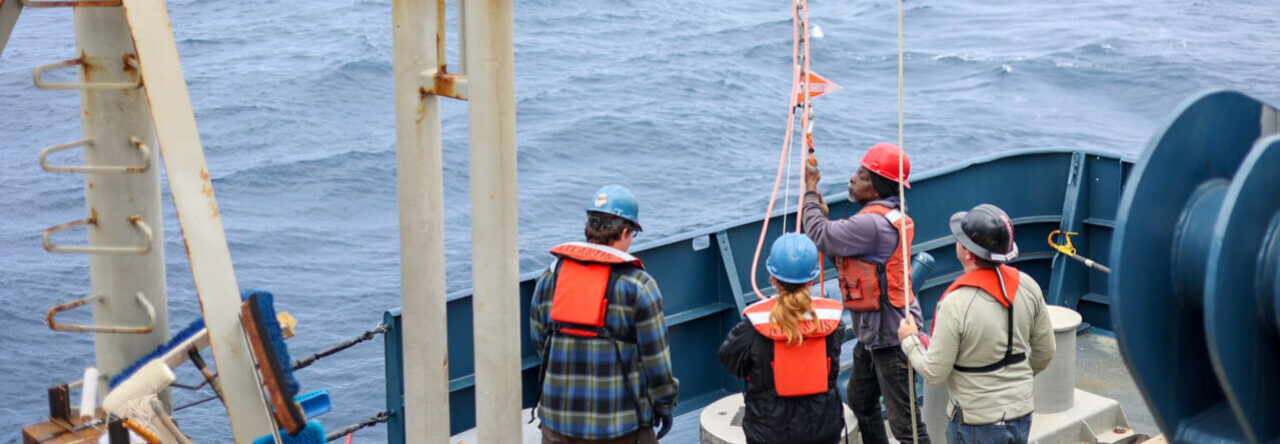
The rest of the cruise was fantastic! I was so excited to help recover the sediment traps and the gas array. Dan gave me a shot at throwing the grappling hook around the floats in the water (which is much harder than it looks) and we eventually got it back on deck.

The two marine technicians on board were amazing resources to learn from too! Trever walked me through the steps for CTD cast deployment and recovery, teaching me all of the hand signals to communicate with the winch. Then, to my surprise, he handed ME the walkie-talkie and said “you try!” That was the highlight of the cruise. I loved stepping into the shoes of a marine technician and communicating with the winch and the bridge to conduct a safe and successful deployment (and then recovery too).

On our way back into port, we watched the most amazing sunrise over Oahu, silhouetting Diamond Head in the distance. The clouds never fail to amaze me in Hawaii.

When we arrived in port on Wednesday morning, the whole team quickly packed up boxes and sensors back into vans to drive back to campus. Hunter and I did our best to help Dan unload all of the equipment and stow it back in the lab on land. We settled into our respective apartments here on the UH campus and went back the next day to continue helping Dan with post-cruise tasks like making new cables and organizing all of the cruise notes.

I cannot wait to keep learning from Dan and Carolina for the next few weeks on land. There are plenty of samples to keep us busy before we prepare for HOT cruise 346 in November!

– Jenn 🙂

Week 1: R/V Kilo Moana, HOT 345

Howdy all,

This first week in Hawaii has already been an invaluable experience in helping me understand the role and responsibilities of a marine tech in contributing to a vital oceanographic time series. 

For the first two days of my internship, I was able to spend some time aboard the R/V Kilo Moana where I got to meet the crew and better understand the ship itself. While loading and preparing for HOT 345 with the science team, I learned how a CTD termination is performed, a basic job requirement for any marine technician. After helping the science team and crew pack for the cruise we were off to Station Kahe the next day to weight test the Hawboldt LARS wench system, perform a Hyperpro cast, CTD cast, and a trace metal cast. Even on the first day of the cruise, I was already being exposed to new scientific equipment and sampling techniques. After performing these preliminary tests and sampling we were off to Station Aloha, the primary sampling site for HOT cruises.

At Station Aloha I was introduced to even more new equipment and sampling techniques while learning about directing deck operations and getting to know my cruise mates better. The cruise was business as usual until there was a malfunction in the Hawboldt hydraulics system forcing the rosette and CTD to be moved to an alternative tension-based wench system that routed through the ship’s A-frame. Unfortunately, soon after this new wench system was set up it also malfunctioned when proof of tension was not maintained for the system, forcing the repair of the original Hawboldt system. This series of events required a new termination and hours of work, wasting valuable ship time. While this was not an ideal situation, it showed that anything can go wrong on a cruise and that complex problem-solving is a requirement for a marine tech. In this way, it was a valuable learning experience for me. 

The rest of the cruise remained relatively uneventful, and I was able to learn about computer networking systems and using Linux from one of the marine techs as well as discuss what a career as a marine tech might look like. We were able to complete our sampling at Station Aloha, the WHOTS mooring, and Station Kaena and return to Honolulu without any other issues. I am excited to continue updating this blog with the new skills and experiences I gain over the next week working with CTD systems and processing data.

Best,

Hunter


Week 1: Getting to the Boat, Voyage from Nome to Dutch Harbor

On the morning of October 4th, I was awakened at 6 am in the Aurora Inn, Nome, Alaska, by our electrician and another technician. We were eager to check the weather and the status of the R/V Sikuliaq, our research vessel, but the fog, wind, and bad weather were definitely not in our favor. We couldn’t even catch a glimpse of the boat on the horizon. With no Wi-Fi in the hotel, we headed to the Polar Cub Café down the street to get online and see if there were any updates. Plus, the café provided a partial view of the dock, where we hoped to spot the ship.

(Sidenote: While at the café, the mooring technician and I almost ordered reindeer meat by mistake. That would have been an adventure.) Despite our efforts and waiting another hour, the boat remained pretty elusive in the fog. We made another attempt to reach it, riding in mud-covered vans (my first time, their second) but the boat still hadn’t arrived. But, we were greeted by a pleasant surprise: we saw beluga whales near the dock, at least four of them! I considered this unexpected wildlife encounter and the $13 spent on the trip definitely worthwhile. 

Returning to the Aurora Inn, we waited patiently for another couple hours, with periodic updates. Finally, the fog started to dissipate and sunlight came out and we spotted the ship approaching the dock from our inn’s windows. The electrician stayed behind to finish some work, but the other technician and I seized the opportunity on our third try. With bags in tow and maneuvering through mud, we embarked on the sketchiest thing I’d ever seen—a 30-foot moving ladder on wheels. It transported us safely onto the boat however. 

Once on board, I quickly took a rapid COVID test and met with my contact, who introduced me to my living quarters and explained my daily responsibilities. The entire ordeal, from our early morning start to boarding, had taken us until around 2 pm. I was ravenous, and my lunch of steak, mac and cheese, and orange juice tasted like the best meal in the world. To cap off the day, I joined the third mate in watching the end of “Young Frankenstein,” which I found hilarious. It was a great first day, and I was relieved to have finally made it on board. My room even had a large porthole, allowing me to enjoy the breathtaking Alaskan sunrises and sunsets.

I had heard rumors of the great food on the ship, and the next morning, October 5th, I eagerly looked forward to breakfast. I was not disappointed. The breakfast tacos with egg, sausage, black beans, and enchilada sauce were the best I’d ever had. I also indulged in steak with scrambled eggs, hash browns, and bacon. It had been a long time since I’d eaten like that, and to make matters worse, the food was unlimited throughout the day. I’m pretty sure I’ve gained a pound or two already from all the fresh blueberry pies, scones, cookies, and snacks.

The following days, the 5th, 6th, and 7th, passed quickly after my initial day. I focused on learning my responsibilities and familiarizing myself with boat procedures, including reading numerous SOPs and safety manuals, studying schematics, and completing paperwork. I had the chance to flush out the CTD, replace some pilons, and work with instrumentation in the ship’s bowels to prepare for the science party. Learning to identify alarms and sounds for irregularities was crucial in the rough seas, and I certainly earned my sea legs. Occasionally, I would visit the bridge to gaze at the horizon, and on my second day, as Los Lonely Boys’ “How Far Is Heaven” played, it felt fitting to witness such a stunning sunrise.

As we sailed toward Dutch Harbor, south of Nome in the Aleutian Islands, the weather warmed, and the snow became less prevalent. Currently, we are offloading gear in Dutch Harbor in preparation for the arrival of the next science party on the 10th, just two days from now. I’m excited to meet them, as I’ve read papers from almost everyone who will be on board. While I probably won’t confess that i’m a huge fan, internally, I’ll be freaking out.

This cruise primarily focuses on deploying and testing an AMOS ice-gateway buoy (heavy), or IGBH, equipped with different ocean and engineering sensors, as well as deploying, operating, and testing an Arctic-capable REMUS 600 AUV. We will also be recovering up to five SGX engineering gliders deployed from an earlier research vessel, the R/V Healy, earlier in the season. Additional glider deployments may also be on the agenda. Lastly, we will conduct over nine shipboard deep CTD casts.

This first week of the trip is really about preparation for the weeks to come, so I will be doing a big photo dump on this post of my little adventures in Nome (aka looking at all the old gold mining equipment), my work station, bridge views, etc. with whatever I have in my camera at the moment. I’ll document my experiences throughout the trip with photos and videos of all the fun things I’ll get to do listed above.

Thanks for reading, and stay tuned for more updates.

Mari 🙂

Week 0: Introduction

Hi Everyone!

My name is Jenn Willson and I am very excited to join the HOTS team this week on the R/V Kilo Moana as a MATE intern. I recently graduated from the University of Washington with a B.S. in Oceanography. In my time at UW, I worked as a research assistant with the Ocean Observatories Initiative where I spent two summers on board the R/V Thompson performing maintenance on the Regional Cabled Array. In my senior year, I worked at the Applied Physics Lab with the NW Environmental Moorings Team where I gained more technical experience. Both of these experiences inspired me to continue learning about marine technology as a MATE intern this fall!

I am incredibly grateful and excited for the opportunity to join the team of the R/V Kilo Moana for two research cruises this October. I’m looking forward to writing all about it on this blog in the coming weeks!

Jenn

Week 0: Pre-Internship Introduction

Hello everyone,

My name is Hunter Adams and I recently graduated from Texas A&M University with a BS in Oceanography and MS in Business. During my time at TAMU, I dedicated three years to researching methane and nitrous oxide concentrations in the northern Gulf of Mexico and participated in multiple research cruises as a result. Additionally, I spent two summers working at Los Alamos National Laboratory, where I studied reduced biogeochemical modeling for the Arctic region. Through these experiences, I’ve developed a special appreciation for ocean research and the importance of shipboard operations in generating consistent datasets for researchers. Outside of studying salty water some of my hobbies include riding motorcycles, spelunking, camping, rowing, and anything that gets me outdoors!

Now, I’m excited to embark on a new adventure by joining the Hawaii Ocean Time-series (HOT) program at the University of Hawaii at Manoa. This opportunity allows me to combine my interests in fieldwork and ocean biogeochemical research while learning the essential skills needed to become a successful marine technician. In just three days, I’ll be on the R/V Kilo Moana in Honolulu to prepare for the upcoming October HOT cruise. I’m excited to finally meet the crew, my internship mentors, and my fellow MATE intern in person after months of planning.

Over the next month, I look forward to keeping you all updated through these blog posts, sharing the incredible experiences and knowledge I gain during this exciting internship!

Special thanks to Dr. Shari Yvon-Lewis, Dr. Chrissy Wiederwohl, Dr. Nicole Jefferey, Maria Osiadacz, Carolina Funkey, Dan Fitzgerald, and everyone who made this all possible.

Week 5: Atlantic Explorer

The schedule of our last few cruises was moved around in response to hurricanes, and I was very lucky to get to go on one extra cruise for this internship. This morning, we finished our one and only cruise mission. In fact, my internship came full circle, because we recovered one of the lost mooring lines from my first cruise with our visitors from NIOZ. The buoy started communicating its position not too long ago, and it turns out that it drifted very far from its deployment site. It took 20 hours from Bermuda just to get to the mooring. Recovery took place this morning, and it’s nice to see the familiar face of these big orange buoys on deck again.
 

One of NIOZ’s buoys

I am also grateful for the two extra days of my internship, since it’s given me more time to work on my personal project. In an earlier post, I had mentioned the project but added no specifics because the whole thing was giving me a headache. By chance, I managed to find a component that was absolutely necessary for the project’s completion, one which I thought we didn’t have. I’m extremely thankful that it showed up just in time.

The project, in summary, was to connect a data logger to a weather transmitter, which senses several meteorological parameters like wind speed, temperature, and humidity, and sends them back to the logger. The sensor had, at some point in the past, been reconfigured to communicate in a way that was incompatible with all other devices on board that we could use to talk to it. There was no way to get through to it until I found an RS-422 to RS-232 converter. The converter takes the sensor signal I can’t read and changes it to one I can. From there, I was able to reconfigure the device’s settings so it could talk to the data logger. I even found a way to deploy it just outside the ship’s bridge.


Weather sensor deployed on ship


Right now, it’s collecting data, and what I’ve seen has been consistent and accurate, so I’m very happy with the state of the project. If I can find time, I will plot the data over the collection period and compare it to data from other ship-board sensors. 

We are currently headed back to Bermuda, and I will depart from BIOS soon afterwards. I am going to wrap up my project and, importantly, document as much of it as I can in case someone else picks up the same weather sensor and needs help communicating with it. I’ll leave some parting words on this blog site once the internship is over and I’ve had some space for reflection.
 

11th & 12th week with jASON/WHOI

Monday, Sept 11th – Sunday, Sept 24th

The first week started off with adding and attaching hydraulic lines to JASON and mounting a frame on JASON’s basket/face which would hold a large crawl profiler. After testing, we were able to launch and attach several profilers to lines at different locations. After completing the attachments, we then would lock into old profilers and recover them for servicing. 

We spent several days transiting back and forth to and from locations to swap out equipment and complete water sampling and visual inspections of hydrothermal vents. During this time, JASON’s main power box (Jetway) began to produce a burning smell. Once inspected, we realized the mount for the large transformer had given out, so the team worked together to remount the transormer using what materials and tools we had at hand. Luckily, it stabilized the system and once testing was completed, we were able to resume diving within a day. 

The water sampling dives continued through until the 12th week. JASON’s last dive was at a depth of 2900 meters, where we connected and tested cables/connectors to junction boxes and then surveyed the surrounding area. Once finished, the team immediately began demobilization. Some of the first tasks were to complete one final post-dive check, drain the vehicle, cut the cable/tether, replace all filters, and remove fiber and power connections. 

Once at port, the demob was in full swing. It only took a few days to disconnect the remaining power, network, and video connections, organize, fill, and load the tool, rigging, and control vans, break down the crane and winch systems, and crane over all equipment, vans, and systems off of the R/V Thompson. It was impressive to see how efficiently the team worked together to complete a full demob in only 2.5 days. 

On Sept. 20th, once everything was loaded off the ship and onto trucks, the team left to head to Portland. We celebrated a successful season by having dinner together and reminiscing on the last few months. I felt honored and priveledged to have been with these amazing individuals, I learned so many things from each one, and I look forward to seeing many of them out at Woods Hole. 


Tip of the Week: “Take notes.”

One of the biggest suggestions I could offer is to make sure you take notes at the end of each day, and even during the day too! There were so many times I would go back, again and again, to verify procedures, hardware, tools, helpful hints, or even small notes to myself as reminders when working this summer. When I would learn a new skill, or replacing thruster seals, or even draining and filling the vehicle, I would refer to my notes to confirm I remembered the steps involved. 

The time out here goes by quicker than you think, and I am grateful for all of it. We have been home a few days now, but we are already checking in on eachother to see how people are adjusting to home life again. This team, the science members, and the ship’s crew were all fantastic! I hope to work with them again someday. 

Best time of my life!!!!  Thank you MATE!!!

Week 4 R/V Neil Armstrong: From the Arctic Back to Woods Hole

09/14/23 – 09/21/23

We just arrived back in Woods Hole! We spent the week transiting and thankfully avoiding Hurricane Lee in the Atlantic. Besides collecting data when we were outside of other country’s EEZs, we haven’t worked on any science operations so the crew has been using the time to catch up on work, start end of cruise reports, or relax. Highlight of the week was playing mario kart.

For personal projects, I cleaned the pesky PC02 filter again (if you don’t clean it periodically, it fills up with marine critters like krill and can get gross real fast, see below), made a sail bag out of old foul weather gear, 3D printed a cover for the cordless phone on the bridge so it won’t fall during a roll, wrote my resume and CV in LaTeX, organized some miscellaneous hardware pieces, helped Emily and Croy prepare for the Starlink installation once we’re docked, and packaged the final science data hard drive using Linux to give to the Chief Scientist.

The PC02 culprit

QOW: What is a marine technician, and what do they do?

The role of a marine technician depends on the ship they’re on and the institution they’re working with. For WHOI, marine technicians are classified as Engineering Assistants and are part of the Shipboard Scientific Services Group (SSG). It’s a unique niche on the ship. They act as a liaison between the ship’s crew and the science party, helping out with science operations and making sure the data that are collected underway are being archived properly. On the Armstrong, the SSGs service the science equipment like the CTD and flow-through system in the lab, and handle any troubleshooting issues with equipment that arise. At least with WHOI, marine technicians sail anywhere from 6-8 months out of the year. That might seem like a lot of time to most folks, but a huge benefit is they may have several weeks off at once. This makes it an attractive lifestyle to those who can handle being away from home for long periods of time and like having extended time and freedom to travel or explore their hobbies more in-depth.

More information here: https://www.whoi.edu/what-we-do/explore/ships/marine-facilities-operations/marine-facilities-operations-support-services/shipboard-technicians/

Week 4: Atlantic Explorer

This week, we wrapped up our cruise with our visitors from WHOI and Stanford. The last couple days went just as well as the rest of the trip, with the scientist successfully collecting data and having a good time doing it. They were barely sleeping, staying up to participate in as many deployments as possible, and somehow managed to carry their level of enthusiasm through to the end of the cruise. 


A group photo with our visitors, MTs, the captain, and two of the crew


Most of the week has been in port, and there’s never a shortage of things to fix before the next cruise. Most notably, we wanted to replace the device which feeds data to winch operators. We tried to do this before the last cruise, but ran into issues the first time using the winch and swapped it back to the old device. Hopefully, we have ironed out those issues this week after installing the new devices again. I spent the first day or two creating documentation for this process, which will hopefully help prevent future headaches with this device.

I have also attached a pinger to the side of the CTD, which we plan on incorporating into our CTD casts in the coming cruises. Several weeks ago, I replaced all 20 of the device’s batteries to prepare it for deployment. Attaching it to the CTD seems conceptually simple, but the pinger weighs 70 pounds and had to be lifted over my head. I probably should have gotten a second set of hands. In any case, it is now held on with 4 hose clamps and a shackle, so I’m confident it will stay put.


The pinger on the CTD


At the end of the working week, another hurricane blew over us, this one more intense than the others. It was a good incentive to stay inside, if nothing else. On Friday, the captain informed us of yet another hurricane on its way, at the time predicted to have a straight track directly over Bermuda. We pushed our cruise departure date up and worked through the weekend. No time to mourn my lost day off, since we had a lot to get done before leaving. In fact, we’re leaving BIOS in only a couple hours.


The prediction we were looking at on Friday. Luckily, the track is now predicted to head off to the east before it reaches Bermuda


I am nearing the end of my time here and have decided to take on one more big project. I would like to document as much as I can in the ship’s internal wikipedia. It houses a lot of information, mostly for MTs, and can be a valuable reference. However, I have found it to be lacking in many areas. The pinger, for example, has never once been documented. When I tried to learn more about the device, like how it has been used in the past, how the MTs want to use it in the future, or even where on the ship it was being stored, there was nothing. For future MTs, and future MATE interns especially, filling in these gaps can be a huge benefit. It would allow them to work independently far more effectively.
 

Week 4 – Haley Holcomb


Last week’s schedule was really hectic, but I had a nice chance to relax as the storm began to hit. This storm was not as severe as the first, but there was definitely lots of wind and some pretty big waves. I spent the first weather day reading and watched Get Out with the crew when I finished my book. The following day, I slept in and caught up on some much-needed rest before meeting the team outside for a deck test. The lead mechanic had used his free time to put a Wario face on Sentry with electrical tape, so that was quite a shock to see as I was waking up. He did a really good job and it made the final deployments all the more exciting. 


On our final weather day, I was getting a bit restless, so I cleaned and organized our mechanical van. We performed yet another deck test, but I asked to watch from inside this time so I could get a better understanding of the reasoning behind the order of operations of the test. 

We decided to move the 24-hour dives from noon and midnight to 9am and 9pm, so we got up early the next day to prepare for a morning dive and did the deck test and pre-dive as the sun rose. Even though we changed the dive schedule, we kept the same watch schedule, so instead of being on watch for the last four hours of each dive, my shift was now the first 3 hours and then the ascent the next day. I asked to watch launch from inside for this dive and learned a lot from that experience. I actually had to leave my watch early this day to register for my fall classes, so I offered to cover some of someone else’s shift instead and started at 6am instead of 8am the next morning. 

I had been watching the software engineer execute the post-dive commands, but I was able to run them myself after my watch that day. We recovered at 9am and planned to launch our last dive of the cruise at 9pm the same day. I was outside for launch and then went back in for another watch shift. The sky was clear for the first time in a very long time, so when I was off at midnight, I went out on the bow to look at the stars before heading to bed. 


Because Sentry was in the water, I got to sleep in again. There was a merch sale in the main lab and I bought an Atlantis sweatshirt (to support the great cause of course) and was given a Sentry T-shirt and some stickers for my first Sentry Team cruise! I relaxed until my night watch and executed the inside post-dive once again. I found myself getting a bit sentimental sending the final commands, but we played some music to celebrate as I recovered the data. 

Today was a very exciting day on the Atlantis, not only because we began our transit back to Astoria, but because a WHOI engineer that many people had worked with on the ship was off to the International Space Station! There was a streaming party for the launch, but I couldn’t participate because we had a lot to do to reconfigure the vehicle for its next cruise. We started the process of removing all of the instruments specific to this cruise, replacing them with what will be needed for the next, and preparing it for shipping. I took off the wings, propellers, and SUPR saddle before cleaning the oil off of the wings and the deck. I also organized the hardware for the saddle once I had disassembled it.  Finally, I removed the strobes, beacons, and iridiums, took out the batteries I had put in them the very first day, disassembled the poles I had also put together, and secured the spares van for our transit. It was funny doing things like this in reverse because it made me realize how much I have learned while I’ve been here. These were the very first tasks I was given and I remember feeling so intimidated, but now I know my way around all of the different components of the vehicle. 


We ended the day by taking a group picture on the bow to commemorate all of the great work that has been done this cruise.


Aside from my Work Plan goals, I committed to the Sentry Team that I would be able to do a push-up when the cruise was over. After moving countless weight stacks and pulling myself up the steep stairs when my legs were too tired, my skills were finally put to the test. Not only can I now perform vehicle maintenance and data recovery and stand watch during dives, but I can also officially do a push-up. One could say I have achieved maximum personal growth on this trip.

We will arrive back in Astoria tomorrow and spend the day packing up the lab and storage vans before heading out for drinks to celebrate all of our hard work. I am very nervous I’ll have bad dock rock after four long weeks at sea. We’re actually going to spend one last night on the boat so that we can oversee the crane picks on Sunday before driving down to Portland. I’ll stay at the airport hotel again and fly back to Santa Barbara on Monday!

I have learned so much about the different career paths I can take in this field and where my interests lie, and I am very thankful to have had this experience before I begin to apply to jobs and grad schools in the coming months. Living on a research vessel can feel a little exhausting and isolating at times, but I am beyond grateful to have been able to take part in this cruise and am very excited for my future in ocean engineering. See you all so soon and thank you so much for reading my blog posts, it meant the world to me! 


Page 22 of 85

Powered by WordPress & Theme by Anders Norén