Author: Haley Holcomb

Week 4 – Haley Holcomb


Last week’s schedule was really hectic, but I had a nice chance to relax as the storm began to hit. This storm was not as severe as the first, but there was definitely lots of wind and some pretty big waves. I spent the first weather day reading and watched Get Out with the crew when I finished my book. The following day, I slept in and caught up on some much-needed rest before meeting the team outside for a deck test. The lead mechanic had used his free time to put a Wario face on Sentry with electrical tape, so that was quite a shock to see as I was waking up. He did a really good job and it made the final deployments all the more exciting. 


On our final weather day, I was getting a bit restless, so I cleaned and organized our mechanical van. We performed yet another deck test, but I asked to watch from inside this time so I could get a better understanding of the reasoning behind the order of operations of the test. 

We decided to move the 24-hour dives from noon and midnight to 9am and 9pm, so we got up early the next day to prepare for a morning dive and did the deck test and pre-dive as the sun rose. Even though we changed the dive schedule, we kept the same watch schedule, so instead of being on watch for the last four hours of each dive, my shift was now the first 3 hours and then the ascent the next day. I asked to watch launch from inside for this dive and learned a lot from that experience. I actually had to leave my watch early this day to register for my fall classes, so I offered to cover some of someone else’s shift instead and started at 6am instead of 8am the next morning. 

I had been watching the software engineer execute the post-dive commands, but I was able to run them myself after my watch that day. We recovered at 9am and planned to launch our last dive of the cruise at 9pm the same day. I was outside for launch and then went back in for another watch shift. The sky was clear for the first time in a very long time, so when I was off at midnight, I went out on the bow to look at the stars before heading to bed. 


Because Sentry was in the water, I got to sleep in again. There was a merch sale in the main lab and I bought an Atlantis sweatshirt (to support the great cause of course) and was given a Sentry T-shirt and some stickers for my first Sentry Team cruise! I relaxed until my night watch and executed the inside post-dive once again. I found myself getting a bit sentimental sending the final commands, but we played some music to celebrate as I recovered the data. 

Today was a very exciting day on the Atlantis, not only because we began our transit back to Astoria, but because a WHOI engineer that many people had worked with on the ship was off to the International Space Station! There was a streaming party for the launch, but I couldn’t participate because we had a lot to do to reconfigure the vehicle for its next cruise. We started the process of removing all of the instruments specific to this cruise, replacing them with what will be needed for the next, and preparing it for shipping. I took off the wings, propellers, and SUPR saddle before cleaning the oil off of the wings and the deck. I also organized the hardware for the saddle once I had disassembled it.  Finally, I removed the strobes, beacons, and iridiums, took out the batteries I had put in them the very first day, disassembled the poles I had also put together, and secured the spares van for our transit. It was funny doing things like this in reverse because it made me realize how much I have learned while I’ve been here. These were the very first tasks I was given and I remember feeling so intimidated, but now I know my way around all of the different components of the vehicle. 


We ended the day by taking a group picture on the bow to commemorate all of the great work that has been done this cruise.


Aside from my Work Plan goals, I committed to the Sentry Team that I would be able to do a push-up when the cruise was over. After moving countless weight stacks and pulling myself up the steep stairs when my legs were too tired, my skills were finally put to the test. Not only can I now perform vehicle maintenance and data recovery and stand watch during dives, but I can also officially do a push-up. One could say I have achieved maximum personal growth on this trip.

We will arrive back in Astoria tomorrow and spend the day packing up the lab and storage vans before heading out for drinks to celebrate all of our hard work. I am very nervous I’ll have bad dock rock after four long weeks at sea. We’re actually going to spend one last night on the boat so that we can oversee the crane picks on Sunday before driving down to Portland. I’ll stay at the airport hotel again and fly back to Santa Barbara on Monday!

I have learned so much about the different career paths I can take in this field and where my interests lie, and I am very thankful to have had this experience before I begin to apply to jobs and grad schools in the coming months. Living on a research vessel can feel a little exhausting and isolating at times, but I am beyond grateful to have been able to take part in this cruise and am very excited for my future in ocean engineering. See you all so soon and thank you so much for reading my blog posts, it meant the world to me! 


Week 3 – Haley Holcomb


As predicted, we did not end up being able to launch last Saturday. The weather was too severe to work with the vehicle out on deck, so I took the time to update my Matlab script for my weather predictions. Since I first wrote it, I have been inputting new data as I receive it each day and therefore making my predictions more accurate as time goes on. As the day progressed, the weather began to subside, enough so that we could do some light work on deck drilling holes into a bracket that would hold the bottles for the SUPR water sampler. The SUPR (Suspended Particle Rosette) sampler consists of a flowmeter, a pump, a valve, and 14 bottles to take individual water samples throughout Sentry’s dive. The pump draws water to be fed into the valve, which has 14 positions for each of the 14 bottles. Because the bottles go into the water full of DI water for neutral buoyancy, the flowmeter is necessary to have record of the amount of water that was collected.

The following day, we were finally ready to prepare for the first dive since the storm had hit. We removed the Nortek to make space for all of SUPR’s components and took off the lead that had been used to account for its weight. I also watched as the lead mechanic replaced a centering spring in one of the wings, which have to be replaced about every 6 dives and are critical to Sentry’s performance. I made two sets of weights, and each weight comprises of 72lbs of steel. There are three of these in each set: two used to descend, and another dropped to ascend. We concluded this busy day with a deck test. It was so exciting to have things back up and running after the storm as downtime seems to pass pretty slowly here.


On the day of the dive, we secured the tubing and flowmeter for SUPR. After some ballasting calculations, we put 8lbs of lead back on before conducting the pre-dive. Because we were launching at midnight, I had some downtime in the afternoon and used it to write a Python script to search through data from the ship so that I could include real-time wind speeds in my Matlab script. The next day, while Sentry was in the water, I started a new book and read until my 8pm watch shift. Because things were going very smoothly, the expedition leader gave me some tasks to keep me busy like estimating where in the tracklines we’d be when it was time to come off bottom and how much battery we would have left when we began that ascent. My shift always takes place during recovery, so I’ll be inside for the post-dive and outside for the pre-dive and launch. I really enjoy being able to see all aspects of the deployment because I do really like the software side of things and get to see how everything connects.


We had a quick turnaround as we recovered at midnight and were launching again at noon the next day. The scientists had collected their samples from the SUPR bottles, so we resecured them to the vehicle before preforming the deck test and pre-dive tasks. Once Sentry was back in the water, I decided to use the time to make my Matlab script more efficient. I had been inputting the new data I collected each day as independent matrices, but as time went on, my script was getting really long and I was having to copy and paste the same loops each morning just to change their variable names to the correct date. I decided to go through the script and stack the data from each day into just a few 3D matrices and use a nested loop to iterate through each day, eliminating many lines of code and greatly reducing the time it takes me to update it each morning. At the end of the night, I finished my book from the previous day and started the first few pages of a new one.  

Because we launched during the day, I had an 8am watch. When I showed up, the mission had just gotten to a point where the previous person on watch had started to command the vehicle to leave its tracklines. Because this is more involved and a mistake could be critical, they decided to stay on until we came off bottom. During this time, I met with the expedition leader to go over my weather project, and he gave me some helpful advice about how to word my outputs to be more clear and concise for a user, and suggested that I begin to include my observations of the actual wave height during the day. I had been making calculations on the offsets between different forecasts for both wind speed and wave height, but the ship only had real-time data for wind speed. Now that I’ll be observing the height of the waves, I will be able to tie it all back to actual conditions and best predict when we can launch. When it was time to ascend, I took watch and stayed inside for the post-dive once again. While I was inside, we found out that a Canadian research vessel is also in the area and we’d have to change our dive schedule because they’ll have an ROV at our dive site. Instead of beginning a 24-hour dive at midnight, we’d launch at 8pm and come off bottom at 6am. We prepared for this quick turnaround by performing the pre-dive right after the post-dive and had a short break before putting the SUPR bottles back on, conducting the deck test, and launching. This was the first time I played a critical role in the launch and it was very nerve wracking, but went well. I had watch from 1:30-4:00am and then met back up with the team a little before 6:00am to prepare for recovery. It was hard to wake up for watch, but after a cup of coffee there was no way I was going to nap before I had to be ready on deck. When we began to ascend, I took over watch again, got breakfast after the post-dive, and finally fell asleep. There is another storm coming in, so we won’t dive again until Tuesday and I’ll have this weekend to catch up on some rest.


Week 2 – Haley Holcomb


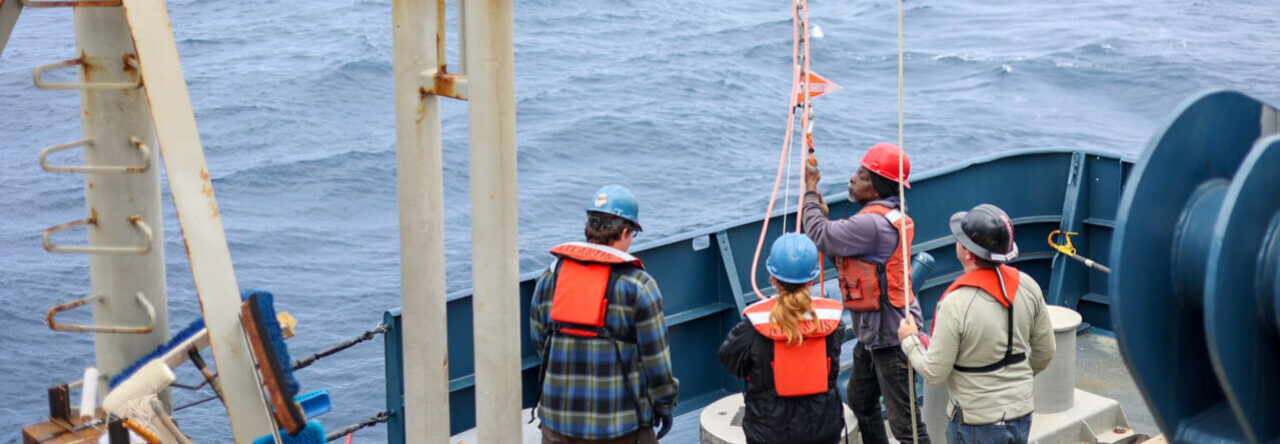
The first of Sentry’s dives was one of two “engineering dives” meant to ensure that all of our instruments were behaving as expected before any scientific data was collected. Before this first dive, I put the remaining skins on the vehicle and dummy cables on its chargers before I watched as the team took it out of its cradle and a crane lowered it into the water. I really hoped to see a whale on this trip and actually got to see one right before this first dive, setting a good precedent for our operations. I reassembled the cradle as Sentry descended and then took my first shift on watch. We have to take note of things like the vehicle’s position, velocity, heading, and battery percentage every fifteen minutes, as well as the time of any abnormal behavior or commands we send to it to be referred to when looking back at the data. When I was relieved from watch, I got to take my first break until Sentry began its ascent. One of the members of the crew was responsible for connecting the forward tagline as the crane pulled the vehicle up from the surface and I got to be involved in the recovery by grabbing the pole from them once this line was secure. During the post-dive maintenance, I comped and bled the servos, junction boxes, and thrusters and replaced one of the burn wires, which are a last-resort method of dropping Sentry’s weights to bring it back up to the surface.  


I helped conduct each element of the deck test before the second engineering dive, which is a test of Sentry’s various components before its mission. I had taken part in this in the previous dive but felt like I was finally able to get a good understanding of everything that was going on. We transmit a specific frequency to each of the two acoustic releases and listen for a chime to indicate that it was received. The drop motors must be visually inspected to ensure that they are free from any wires so that weights can be released without obstruction, and must hold in place when commanded to do so. The servos in the wings can be controlled either by a remote control called a “joybox” or by commands from inside. The joybox is used to back the vehicle up to the side of the boat as it is being recovered so that it can be secured by the taglines and crane. Using each method of control, we command the wings to assume various positions and watch to make sure that they respond to this sequence without exceeding each orientation and that the propellers are spinning in the correct directions. Lastly, we measure the voltage on the burn wires and load the weights. I get so excited when I see marine life and we saw a sunfish while we were conducting these tests! Before each dive, we also go through a pre-dive routine, which involves enabling the iridiums and strobes, unplugging the charging cables, connecting the hoses for the cooling system, putting the vehicle’s skins on, and removing the straps that secure it to its cradle. After we launched, I had my first solo watch shift. Upon recovery, when the vehicle was secured in its cradle, we carried out the post-dive tasks. We return it to shore power, switch it over to ethernet, reconnect the cooling lines to the hoses on the ship, and power off the strobes.


On the day of the first science dive, I got to sleep in for the first time and it felt so nice to be well-rested. I felt like I had begun to fall into a routine with the pre and post-dive so I could be more helpful and perform tasks without instruction. We added a few extra sensors for the scientists and compensated for this change in weight before performing the deck test. Usually, Sentry is used for seafloor mapping, but on this trip, we are collecting various data over hydrothermal vents. It is designed to stay a certain altitude above the seafloor, but for this objective, we wanted to command it to hold a certain depth below the surface instead. Because of this, there were many points where Sentry’s acoustics could not reach the seafloor, and we lost what they call “bottom lock”. The software in the vehicle would then lose its trackline and begin to ascend, so the person on watch had to send a series of commands from the surface to combat this.

The science dives are 24 hours long, so every day we will alternate between having missions from noon to noon and from midnight to midnight. When we launch at noon, my watch shift is from 8am to noon, and when we launch at midnight, my shift will be from 8pm to midnight, so I am always working during Sentry’s ascent. My first watch shift was much more involved than is typical, as was expected due to the constant loss of bottom lock. The team had come up with a solution where we could push the vehicle back towards its trackline with a series of shift commands to keep it inside an envelope of altitude and depth. I lost bottom lock a few times on my shift, but was able to follow this sequence and keep everything under control. At the very end of my watch, the commands to keep depth stopped working, so I was instructed to abort the mission early and went outside to help with recovery. When the vehicle was secure, I came back inside and asked the software engineer if I could watch his post-dive tasks such as securing power and communications and recovering all of the collected data. I was really interested in these “inside operations” and asked to continue to shadow him when I was not needed outside. Once all of the data was downloading, he told me it would be a bit of a long wait, so I went down to the gym for the first time. It was really nice to relieve some stress but, while it does add an element of fun, running on a treadmill while the boat is rolling was very disorienting. I did some yoga as well, but keeping my balance was even harder. When I returned, I helped test a pump for a methane sensor that a scientist wanted to add to the vehicle for the following dive. It wasn’t working on our vehicle power, but she was able to connect it to another one of their instruments and get enough power that way and we deployed again at midnight.  


When the vehicle is in the water, the days are more relaxed. I had been given a project that would allow us to better predict when the weather would be too severe to launch by monitoring the disparities between different forecasts and the actual conditions, so I began to think about how I wanted to execute that. This became more intriguing as we awaited an approaching storm. While I was working, I got a message that someone had seen dolphins outside and ran out in the rain to watch them. There were about seven of them playing right up next to the boat and it was a kind I had never seen before. They were so tiny and cute. I came down to the lab for my 8pm watch shift, but things were really hectic as Sentry was failing to follow its desired path. I watched for a while as this was troubleshot, but they were not confident that their commands were successful, so they aborted early and I eventually took over to monitor the ascent. The weather had started to worsen and the science team still needed to launch a CTD, so this ended up being a good decision all around. Because I was already on watch, I got to carry out the inside operations for recovery and really enjoyed being more involved in the software side of things again. This time, I stuck around as the data came in and it was actually really cool because I got to briefly see each Matlab plot pop up before the successive one did, giving me a much better idea of what the science party is using Sentry to measure.


The next morning, we cleaned up the deck in anticipation of the incoming storm. I decided to do my calculations of the offset between weather reports on Matlab and began to input my data and write that script until the waves began to increase in height and I started to feel seasick. I got off my computer and joined the people working outside, who were preparing for the installation of a water sampler called SUPR. We began some tests, but there appeared to be a ground issue so the scientists took SUPR back inside and we started to set up its tubing. Being outside was not helping much, so I went down to take a nap and woke up feeling a lot better. Because the weather didn’t allow us to launch that day, a few people gathered in the lounge for a movie night.

The wind is continuing to pick up, so we refrained from launching once again today. I started my day by inputting some new data into my weather script and then did my laundry. I returned to the lab to see if I could help anyone, but because SUPR was still being fixed and the weather was so poor, there was no work to be done. I went down to the gym and rejoined everyone for dinner. Tomorrow will most likely be a lot like today, but we hope to launch again when the weather subsides on Sunday.


Week 1 – Haley Holcomb

I made it! After a few delays from the hurricane in California, I flew into Portland and stayed in an airport hotel for the night. The next morning, I met up with the Sentry Team in the lobby to drive down to Astoria together. We stayed one more night in a hotel there before boarding the Atlantis.

The crane we were meant to use broke down, so we had a bit of delay getting our equipment on the boat. I got to watch the team’s software engineer update Alvin’s GUI while we waited, which was really interesting to me because it closely aligned with the work I’d been doing back home. I also unpacked my room and got a tour of the boat. Seeing how big it is really calmed my nerves and I got even more excited for the weeks ahead. To make better use of our time, we ended up carrying a lot of our things onto the ship, but eventually Sentry and the vans made it on with a new crane.

Once we had everything we needed, we unpacked our lab and set up the equipment. My first mechanical task was to connect and test the hoses for Sentry’s cooling system. I also put batteries into the beacons and strobes and cleaned their o-rings. We ended the day with dinner on shore and a quick stop at a department store before returning to the boat for our first night sleeping on board.

The next morning, I wiped our drives and assembled Sentry’s recovery poles. The stores came in, so we formed an assembly line to get the food from the freight elevator to the fridge/freezer/pantry. Everyone on board has some really cool stories from other research cruises and I had a great time chatting with them and getting to know everyone between loads.

When that was finished up, I comped and bled Sentry’s servos, junction boxes, and thrusters. Bleeding for air is necessary because any air in the lines would compress upon descent, potentially allowing seawater into the system. I also installed the wings as well as the beacons and strobes I had assembled the previous day. We took a break from working on the vehicle for an orientation meeting to discuss life on the boat and to meet all of the scientists. Afterwards, my roommate and I secured the van for sea. This turned out to be very hard work with so many heavy boxes, but by the end, I felt like I had finally familiarized myself with the layout of the boat.

We set sail around 10:00 this morning. I was really worried about getting sea sick, but (knock on wood) the water has been relatively calm. My chief complaint is that I wore one of those behind-the-ear patches and must have accidentally touched it and then touched my eyes in my sleep last night because I’ve barely been able to see all day. My pupils are enormous. While I was fine helping with mechanical things, I couldn’t read anything for the life of me and it was very unsettling. 

The electrical engineer on the team taught me how he pots cables and I ballasted Sentry with lead weights. We also participated in a safety orientation and drill for emergency ship abort procedures. I was shown the emergency exit closest to my room, which happens to be through the engine room, so I got to briefly see that. I also installed Sentry’s propellers and learned how to tie up taglines. 

We did a deck test that involved turning the beacons on and off, using a controller to test the propellers/wings, and checking the drop weight triggers. The day culminated in a meeting where the scientists shared their goals for the trip and I have a much better understanding of our mission now. Yesterday was a very long day so we’re turning in early tonight, but we’ll be up bright and early for Sentry’s first dive tomorrow!


Week 0 – Haley Holcomb

Hi! My name is Haley and I’m going to be graduating from the University of California, Santa Barbara in June. I am studying mechanical engineering and am interested in developing underwater vehicles and oceanographic instruments. 

I am flying into Oregon on Monday to meet up with WHOI’s Sentry Team and board the R/V Atlantis. We will be at sea from Wednesday the 23rd until September 17th supporting research on the Endeavour Hydrothermal Vents. We will first collect CTD profiles directly over the two sites to calculate the heat output at each vent and to collect plume samples. Once that data has been recorded, we will deploy AUV Sentry to survey the area around the sites. 

I have gained some experience with this equipment working with the Coastal Oceanography and Autonomous Systems Lab at my school. Our most recent project culminated in a trip to Maryland to conduct field work with our AUV on the Chesapeake Bay. This was my first experience working on a research vessel and I loved every minute of it, but we were only at sea during the day so my trip with the Sentry Team will be my first time living aboard one. I’ll attach some pictures from that trip!

Powered by WordPress & Theme by Anders Norén