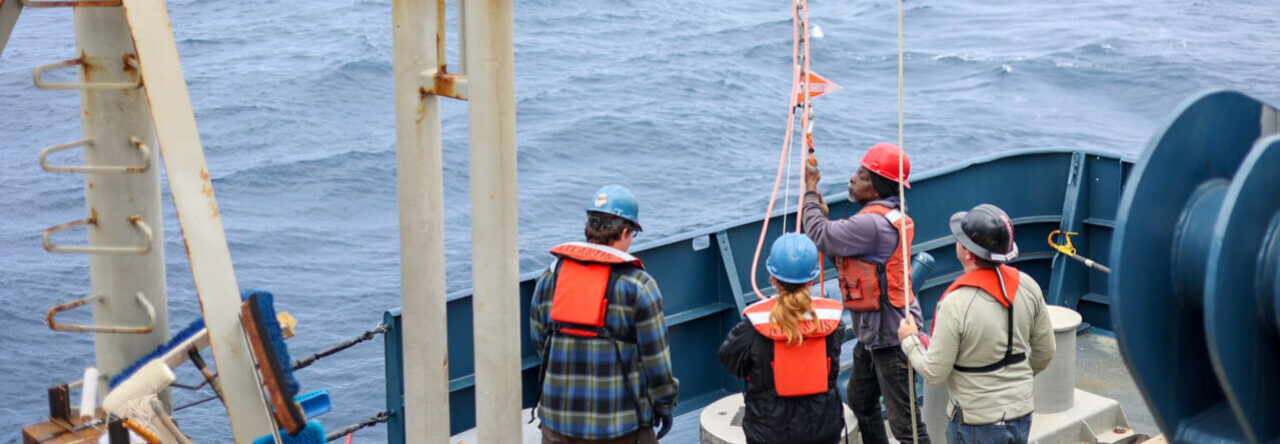
The first of Sentry’s dives was one of two “engineering dives” meant to ensure that all of our instruments were behaving as expected before any scientific data was collected. Before this first dive, I put the remaining skins on the vehicle and dummy cables on its chargers before I watched as the team took it out of its cradle and a crane lowered it into the water. I really hoped to see a whale on this trip and actually got to see one right before this first dive, setting a good precedent for our operations. I reassembled the cradle as Sentry descended and then took my first shift on watch. We have to take note of things like the vehicle’s position, velocity, heading, and battery percentage every fifteen minutes, as well as the time of any abnormal behavior or commands we send to it to be referred to when looking back at the data. When I was relieved from watch, I got to take my first break until Sentry began its ascent. One of the members of the crew was responsible for connecting the forward tagline as the crane pulled the vehicle up from the surface and I got to be involved in the recovery by grabbing the pole from them once this line was secure. During the post-dive maintenance, I comped and bled the servos, junction boxes, and thrusters and replaced one of the burn wires, which are a last-resort method of dropping Sentry’s weights to bring it back up to the surface.

I helped conduct each element of the deck test before the second engineering dive, which is a test of Sentry’s various components before its mission. I had taken part in this in the previous dive but felt like I was finally able to get a good understanding of everything that was going on. We transmit a specific frequency to each of the two acoustic releases and listen for a chime to indicate that it was received. The drop motors must be visually inspected to ensure that they are free from any wires so that weights can be released without obstruction, and must hold in place when commanded to do so. The servos in the wings can be controlled either by a remote control called a “joybox” or by commands from inside. The joybox is used to back the vehicle up to the side of the boat as it is being recovered so that it can be secured by the taglines and crane. Using each method of control, we command the wings to assume various positions and watch to make sure that they respond to this sequence without exceeding each orientation and that the propellers are spinning in the correct directions. Lastly, we measure the voltage on the burn wires and load the weights. I get so excited when I see marine life and we saw a sunfish while we were conducting these tests! Before each dive, we also go through a pre-dive routine, which involves enabling the iridiums and strobes, unplugging the charging cables, connecting the hoses for the cooling system, putting the vehicle’s skins on, and removing the straps that secure it to its cradle. After we launched, I had my first solo watch shift. Upon recovery, when the vehicle was secured in its cradle, we carried out the post-dive tasks. We return it to shore power, switch it over to ethernet, reconnect the cooling lines to the hoses on the ship, and power off the strobes.

On the day of the first science dive, I got to sleep in for the first time and it felt so nice to be well-rested. I felt like I had begun to fall into a routine with the pre and post-dive so I could be more helpful and perform tasks without instruction. We added a few extra sensors for the scientists and compensated for this change in weight before performing the deck test. Usually, Sentry is used for seafloor mapping, but on this trip, we are collecting various data over hydrothermal vents. It is designed to stay a certain altitude above the seafloor, but for this objective, we wanted to command it to hold a certain depth below the surface instead. Because of this, there were many points where Sentry’s acoustics could not reach the seafloor, and we lost what they call “bottom lock”. The software in the vehicle would then lose its trackline and begin to ascend, so the person on watch had to send a series of commands from the surface to combat this.
The science dives are 24 hours long, so every day we will alternate between having missions from noon to noon and from midnight to midnight. When we launch at noon, my watch shift is from 8am to noon, and when we launch at midnight, my shift will be from 8pm to midnight, so I am always working during Sentry’s ascent. My first watch shift was much more involved than is typical, as was expected due to the constant loss of bottom lock. The team had come up with a solution where we could push the vehicle back towards its trackline with a series of shift commands to keep it inside an envelope of altitude and depth. I lost bottom lock a few times on my shift, but was able to follow this sequence and keep everything under control. At the very end of my watch, the commands to keep depth stopped working, so I was instructed to abort the mission early and went outside to help with recovery. When the vehicle was secure, I came back inside and asked the software engineer if I could watch his post-dive tasks such as securing power and communications and recovering all of the collected data. I was really interested in these “inside operations” and asked to continue to shadow him when I was not needed outside. Once all of the data was downloading, he told me it would be a bit of a long wait, so I went down to the gym for the first time. It was really nice to relieve some stress but, while it does add an element of fun, running on a treadmill while the boat is rolling was very disorienting. I did some yoga as well, but keeping my balance was even harder. When I returned, I helped test a pump for a methane sensor that a scientist wanted to add to the vehicle for the following dive. It wasn’t working on our vehicle power, but she was able to connect it to another one of their instruments and get enough power that way and we deployed again at midnight.

When the vehicle is in the water, the days are more relaxed. I had been given a project that would allow us to better predict when the weather would be too severe to launch by monitoring the disparities between different forecasts and the actual conditions, so I began to think about how I wanted to execute that. This became more intriguing as we awaited an approaching storm. While I was working, I got a message that someone had seen dolphins outside and ran out in the rain to watch them. There were about seven of them playing right up next to the boat and it was a kind I had never seen before. They were so tiny and cute. I came down to the lab for my 8pm watch shift, but things were really hectic as Sentry was failing to follow its desired path. I watched for a while as this was troubleshot, but they were not confident that their commands were successful, so they aborted early and I eventually took over to monitor the ascent. The weather had started to worsen and the science team still needed to launch a CTD, so this ended up being a good decision all around. Because I was already on watch, I got to carry out the inside operations for recovery and really enjoyed being more involved in the software side of things again. This time, I stuck around as the data came in and it was actually really cool because I got to briefly see each Matlab plot pop up before the successive one did, giving me a much better idea of what the science party is using Sentry to measure.

The next morning, we cleaned up the deck in anticipation of the incoming storm. I decided to do my calculations of the offset between weather reports on Matlab and began to input my data and write that script until the waves began to increase in height and I started to feel seasick. I got off my computer and joined the people working outside, who were preparing for the installation of a water sampler called SUPR. We began some tests, but there appeared to be a ground issue so the scientists took SUPR back inside and we started to set up its tubing. Being outside was not helping much, so I went down to take a nap and woke up feeling a lot better. Because the weather didn’t allow us to launch that day, a few people gathered in the lounge for a movie night.
The wind is continuing to pick up, so we refrained from launching once again today. I started my day by inputting some new data into my weather script and then did my laundry. I returned to the lab to see if I could help anyone, but because SUPR was still being fixed and the weather was so poor, there was no work to be done. I went down to the gym and rejoined everyone for dinner. Tomorrow will most likely be a lot like today, but we hope to launch again when the weather subsides on Sunday.