
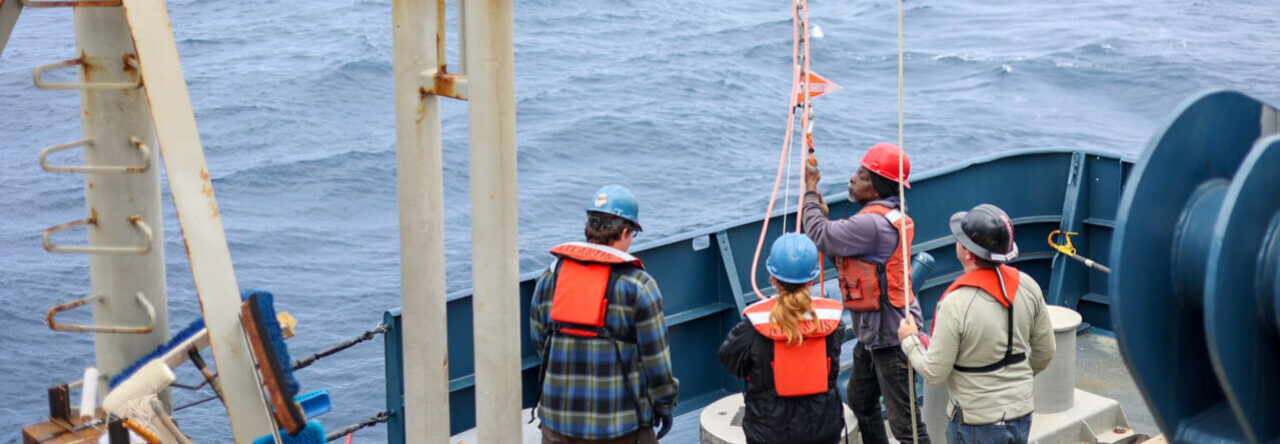
As predicted, we did not end up being able to launch last Saturday. The weather was too severe to work with the vehicle out on deck, so I took the time to update my Matlab script for my weather predictions. Since I first wrote it, I have been inputting new data as I receive it each day and therefore making my predictions more accurate as time goes on. As the day progressed, the weather began to subside, enough so that we could do some light work on deck drilling holes into a bracket that would hold the bottles for the SUPR water sampler. The SUPR (Suspended Particle Rosette) sampler consists of a flowmeter, a pump, a valve, and 14 bottles to take individual water samples throughout Sentry’s dive. The pump draws water to be fed into the valve, which has 14 positions for each of the 14 bottles. Because the bottles go into the water full of DI water for neutral buoyancy, the flowmeter is necessary to have record of the amount of water that was collected.
The following day, we were finally ready to prepare for the first dive since the storm had hit. We removed the Nortek to make space for all of SUPR’s components and took off the lead that had been used to account for its weight. I also watched as the lead mechanic replaced a centering spring in one of the wings, which have to be replaced about every 6 dives and are critical to Sentry’s performance. I made two sets of weights, and each weight comprises of 72lbs of steel. There are three of these in each set: two used to descend, and another dropped to ascend. We concluded this busy day with a deck test. It was so exciting to have things back up and running after the storm as downtime seems to pass pretty slowly here.

On the day of the dive, we secured the tubing and flowmeter for SUPR. After some ballasting calculations, we put 8lbs of lead back on before conducting the pre-dive. Because we were launching at midnight, I had some downtime in the afternoon and used it to write a Python script to search through data from the ship so that I could include real-time wind speeds in my Matlab script. The next day, while Sentry was in the water, I started a new book and read until my 8pm watch shift. Because things were going very smoothly, the expedition leader gave me some tasks to keep me busy like estimating where in the tracklines we’d be when it was time to come off bottom and how much battery we would have left when we began that ascent. My shift always takes place during recovery, so I’ll be inside for the post-dive and outside for the pre-dive and launch. I really enjoy being able to see all aspects of the deployment because I do really like the software side of things and get to see how everything connects.


We had a quick turnaround as we recovered at midnight and were launching again at noon the next day. The scientists had collected their samples from the SUPR bottles, so we resecured them to the vehicle before preforming the deck test and pre-dive tasks. Once Sentry was back in the water, I decided to use the time to make my Matlab script more efficient. I had been inputting the new data I collected each day as independent matrices, but as time went on, my script was getting really long and I was having to copy and paste the same loops each morning just to change their variable names to the correct date. I decided to go through the script and stack the data from each day into just a few 3D matrices and use a nested loop to iterate through each day, eliminating many lines of code and greatly reducing the time it takes me to update it each morning. At the end of the night, I finished my book from the previous day and started the first few pages of a new one.
Because we launched during the day, I had an 8am watch. When I showed up, the mission had just gotten to a point where the previous person on watch had started to command the vehicle to leave its tracklines. Because this is more involved and a mistake could be critical, they decided to stay on until we came off bottom. During this time, I met with the expedition leader to go over my weather project, and he gave me some helpful advice about how to word my outputs to be more clear and concise for a user, and suggested that I begin to include my observations of the actual wave height during the day. I had been making calculations on the offsets between different forecasts for both wind speed and wave height, but the ship only had real-time data for wind speed. Now that I’ll be observing the height of the waves, I will be able to tie it all back to actual conditions and best predict when we can launch. When it was time to ascend, I took watch and stayed inside for the post-dive once again. While I was inside, we found out that a Canadian research vessel is also in the area and we’d have to change our dive schedule because they’ll have an ROV at our dive site. Instead of beginning a 24-hour dive at midnight, we’d launch at 8pm and come off bottom at 6am. We prepared for this quick turnaround by performing the pre-dive right after the post-dive and had a short break before putting the SUPR bottles back on, conducting the deck test, and launching. This was the first time I played a critical role in the launch and it was very nerve wracking, but went well. I had watch from 1:30-4:00am and then met back up with the team a little before 6:00am to prepare for recovery. It was hard to wake up for watch, but after a cup of coffee there was no way I was going to nap before I had to be ready on deck. When we began to ascend, I took over watch again, got breakfast after the post-dive, and finally fell asleep. There is another storm coming in, so we won’t dive again until Tuesday and I’ll have this weekend to catch up on some rest.


