Author: Arianna Johns Page 2 of 3

Astoria Oregon…


So here I am in Astoria Oregon, famous for the movie The Goonies being filmed here. It is a small port town with plenty of bars for libations. I went exploring, walking up and down the main streets for several hours just trying to get a feel for the town. It was disturbingly empty. It seems from what I have been told it is a tourist town that relies heavily on the cruise ship industry. The stores are definitely geared toward a tourist market most definitely. In order to get warmer clothes I had to wait for someone to rent a car and ride in with them across a bridge to a place called Fred Meyers or something similar, which is basically a Walmart with a different name. It seems in my attempt to pack a well rounded selection of clothing for this six month world tour that I neglected to pack enough warm things. Seeing as it was summer I was not assuming 50 degrees and rainy would be that common. Boy was I wrong. So after procuring some more hoodies the couple crew members and I ended up going to a state park nearby. This was awesome. I saw mountains right next to the beach. This has been a wholly unimaginable sight for someone who has spent the vast majority of her life on the east coast in southern states.

So there we were on a beach, yeah we spend all our time on the water and go to it as soon as we get off a boat, if you are drawn to this work it makes sense, but is still slightly comical. There were mountains all around us on, and an old shipwreck sitting on the beach that had all but rusted completely away. Ship wrecks are one of the few things that truly make me shudder when I see them. So I didn’t want to spend much time there. The second most remarkable thing was the sand was a mixture of dark and light sands so the beach took on this Tim Burtonesque type of feel, with the washed up trees from the local logging industry adding a spice of strange contours to the striped sands. People had actually built several small pseudo dwellings that could have been fairy forts or some such magical thing had this actually been a Tim Burton movie.

Then we drove around a bit and found another part of this park that was more wilderness. We started out climbing on old World War II bunkers that were built to help defend the west coast. Then we came to a trail that we decided to walk down. The beauty of this lush green landscape is not something I had seen in months, so it kind of seemed weird and out of place with what my present world is like. There was moss and ferns growing everywhere. The evergreen trees were giants among the leaf bearing trees. They had moss hanging down in large whimsical spirals and sheets that seemed to almost give the trees a monastic look as if these were ancient monks from some elder tribe of people. Then we started getting bit by the largest mosquitoes I have ever gotten bit by. Having been on a boat for several months I didn’t really think about this, plus being a spur of the moment adventure no one brought bug spray. So there we were traipsing through the forest of elder monks donating our blood to their mosquito protectors. I was bitten more than a hundred times easily in the course of our jaunt. The only respite from the plague of buzzing hypodermic terrors I could find was by lighting a cigarette. I had been told years ago by an uncle that smoking helped keep the bugs away, and it did indeed seem to help at least keep them away from my face and hands. The rest of my body did not fare so well.

So if you ever find yourself headed to Astoria might I suggest more warm things than you think you might need and plenty of bug spray if you are planning on enjoying any of the amazing wilderness trails that abound in this area of the world.

The Panama Canal and so much more


Then we sat there. For several minutes we sat, or so I thought. It wasn’t until the top of the lock became visible did I realize we were being lifted by the force of seemingly infinite water being let into the lock. Once I started seeing grass, I nearly panicked. Generally I am one of the most observant people. I was looking at the walls checking for signs of water inlets, anything that might allow for the passage of water from one lock to another that I failed to think that it would make most sense to put the inlet/outlet at the lowest point. I felt slightly foolish for this glaring oversight on my part, but in my defense I have never been through a lock system and have never even seen one that functions. Granted I am from a city which still has many antiquated and useless locks, I have spent days climbing on and in those old locks, but never did I stop and think the GIANT hole at the bottom was where the water transferred from lock to lock. So yeah, once I realized I had missed where the water might be coming in from I glanced down and saw the eddies and frothless water flowing into the lock, raising both our vessels. Again this was a silent happening. The only noise was that of the ships quietly humming from the massive diesel generators that supply their power. Even that was somehow muffled slightly, or so it seemed to me.

As our ship rose, there was a quiet excitement filling the air. Granted I had never seen this, so in my typically nerdy fashion I was more than over joyed at the massive feat of engineering that was going on all around me. To think this 48 mile canal began its life in 1881 by the French and was completed by the United States in 1914. So here I am standing on a ship built in the 1990’s going through a lock system that was nearly 100 years old. The technologic changes that the canal has had to deal with since its construction are nearly unfathomable. By todays shipping standards the locks are too small, so they are constructing a third larger lane for the massive super tankers that share our seas today. Just imagine what the canal will look like in another 100 years, probably nearly the same, with the mystique tempered by the ages and the endurance and grace forged in the massive number of ships that travel through it every year. More than 10,000 ships pass through those locks each year. But this is all information you can get from google. You aren’t reading this for that. It is a fundamentally amazing feat of human will power against insurmountable odds that brought it into existence.

So there we were on our journey to ride through a jungle on a research vessel that has just been floated up 80 something feet through three locks, when out of nowhere my allergies started killing me. I guess late May in the jungle isn’t a place for a woman with horrible allergies. Part of the reason I like being out in the middle of the ocean is that they don’t bother me as much. So with sinuses straining my brain for room I went and took Benadryl to avoid the migraines that so often accompany my allergy attacks. Luckily for me I take enough Benadryl on a regular basis that the sedative side effects rarely ever kick in. So able to breath and with the sun setting in a jungle, I was struck by the surrealism of the journey I was on. This canal was cut through the middle of some of the most inhospitable wilderness that the Americas has. Malaria ran rampant through the camps of the people who worked on the amazing feat. So with that in mind I sat back and watched what wonders were to play out before me.

Lake Gatun was marked by buoy markers to mark the ship lanes. Then as we progressed through the dark wilderness we came to these odd markers. So I had to know what these yellow and green markers set high on the slopes were for. They are a set of four total markers set one atop the other. One set is yellow and to the left of the green pair. I asked the chief mate what they were for. He then explained to me how when we are going into a turn the pilot has to line them up, generally lining up the green ones to ensure that we are in the portion of the channel that is deep enough for ship traffic. These markers are set so that at a distance and the correct course heading they line up one on top of the other.

Then we came to what can only be described as the single most beautiful bridge I have even seen. This bridge called the Centennial Bridge rose up out of the jungle in a glistening light show. At first only one of its two massive supporting towers was visible. With the super bright lights shining delicately off the glistening metal cables and steel beams it was like a shining pinnacle of brilliance in the middle of the jungle. The cables which held up the large roadway shone with a grey brilliance that even the most erudite of painters could not conceive of a color to put to canvas this brilliant. The second tower came into view and the symmetry of this concrete and steel expanse left me awe struck in a way that the rest of the canal had. As we passed under the bridge I was hurriedly taking pictures with my phone. The tiny 8 megapixel machine caught the bridge of the Atlantis and this bridge behind it in near perfect succession, our bridge bisecting that bridge; two modern things of beauty sharing the same space and time on the elder canal in perfect unison.  Then we began passing giant bucket dredge barges that were feverishly digging at the canal in what can only be assumed to be expansion efforts for the next phase of this marvel.  

The hours drove on; we were moving slowly, maybe a maximum of 3 knots, so it was going to take every bit of the twelve hours I was promised it would take. We came up to the next set of locks, this one began our decent to the Pacific Ocean. An ocean I had never previously been to. New adventures were before me. A whole new life of things I have never before seen, as if I haven’t experienced enough wonder and awe to fill a life. We passed a large container ship that was moored to two giant stable mooring platforms. The Atlantic Klipper was slowing its approach as we went into the narrow neck of the lock. Again we were boarded by a group of line handlers; again they worked their coordinated effort in our safe passage. This time the water flowed out of the locks, and slowly the walls began to rise up past our ship. It was midnight or later, so I decided to retire, most of the other non-deck crew had long since gone to their bunks. I decided I should soon sleep for tomorrow was a new day, a new ocean, and a world of possibilities and unimaginable adventures before me. 

Oh what amazing sights we see


When confronted by the sheer magnitude of some things in life I am often left speechless. Not for lack of vocabulary, or lack of knowledge of the structure of written language, but rather some things written seem almost paltry in comparison to the experience. I have seen grand and terrifying things in my life, but none has left me as nearly dumbfounded as the spectacle that is the Panama Canal. Granted this technology is rather old in the scheme of things, bordering on the antiquated when looking at the size of modern super tankers that share the oceans with us, but the fundamental achievement of moving a vessel through up onto what used to be land, through a jungle, then back down to a completely different ocean is a phenomenal feat of human ingenuity, bravery, and will.

Pulling into the staging area, if you will, it is basically a harbor, but the openness of it was much more so than any other harbor I have personally been in yet. We anchored up amongst the other ships, some of which overshadowed our ships nearly three hundred feet by hundreds and hundreds of feet. We were scheduled to begin our maneuvering into the canal at roughly 3:30pm ship time, as to what the local time was I am not too sure. To this day nearly four months into this internship there are two times I concern myself with, one being ship time, because lets be honest you need to know when to eat and sleep in sync with the ship, and then there is good old eastern standard time, which is the time zone basically a majority of people I know and care about reside  in, and well I need to know when not to call them in the middle of the night. So any way the whole thing was set to go at 3:30pm. We were to be in the locks with another ship because by comparison our ship was so small it would have been a waste of space and resources to send it in by itself. So we set in behind the Atlantic Klipper (yes with a K because it was a Russian vessel and that is how it was spelled on the stern of the ship.) I am still not exactly sure the location of the first lock. It kind of appeared out of the aether. I was on deck while we slowly made our way toward it, we crept along at about 2 knots, maybe less. The first thing I remember seeing were the silver mules. Now these mules are actually small trains on rails, but they have kept the moniker of their predecessors, which were, well, flesh and blood mules. Anyway, I was absolutely nerdy giddy in seeing these machinations. I had heard stories about them, and had spent the better part of a week thinking about what they may look like, how they were to keep the boat alined in the middle of the channel,  you know the things most people think about in their down time. I could have looked the information up on the internet and found a definitive answer in about 5 minutes, but why ruin the wonder and surprise. Why not savor the unknown. And much to my surprise they were pretty much how I pictured they might look, because well after all how many different ways can you design a small train with a wire coming out of the side.   

One thing you must know is that before you pull up to the lock a crew of men, in this case there were no females who boarded our vessel, called line handlers board the ship and well handle the line that leads from the mule to the ship. The mule does not really pull the ship along, its sole purpose is to act a mobile spring line and keep the ship centered so as not to allow it to drift into the side of the lock. Some ships like the GIANT ship in the locks next to us have very little room for error, maybe a foot on either side and it is then metal against concrete, and well generally speaking the metal is going to lose that battle because the concrete is old and hardened. So you can imagine most of the time the line handlers and drivers of the mules have a rather daunting task of keeping very large vessels from moving a foot either side to side or front to back. Our small ship by comparison was probably a walk in the park for these guys. They threw a rope from our ship down to a small dingy that was rowed by one person, and another person caught our line. That line was then passed up to another individual waiting next to the mule. This person put the line through a loop in a large wire rope that was coming out of the side of the mule, tied it off, and the line handlers on our ship started pulling the wire rope, across a 10 foot chasm through the small opening in the side of our ship where lines go through. Granted I should probably know what that hole is called, and I might, but the name eludes me at the moment. Anyway they pass the wire rope through that hole and onto a stanchion. The mule then takes up the slack and begins driving forward at the same speed as the ship. There are two teams of line handlers, one in the bow and another at the stern. So this same thing is happening in the rear of the ship as well. The handlers started with the port side of the ship, and then did the starboard side. So we now are tied to four different little locomotives via some wire rope. While all that is going on we are slowly creeping ever closer to the stern of the Atlantic Klipper.       

So there we are behind a large ship, tied to four mules, surrounded by concrete walls, and then they started closing the doors. Now I am not one who is generally claustrophobic, but just the sheer magnitude of what was going on was enough to make me shudder slightly as I saw the last rays of sun cut off when the doors finally, and eerily quietly shut. Now when I say quiet, I am not talking the normal humdrum mechanized quiet that accompanies most things on a ship, I mean actually I could not hear these massive steel doors move at all. There was no thud as they came together, there was no reassuring hiss of hydraulic pressure, nothing, just the sunlight being severed.  When confronted by the sheer magnitude of some things in life I am often left speechless. Not for lack of vocabulary, or lack of knowledge of the structure of written language, but rather some things written seem almost paltry in comparison to the experience. I have seen grand and terrifying things in my life, but none has left me as nearly dumbfounded as the spectacle that is the Panama Canal. Granted this technology is rather old in the scheme of things, bordering on the antiquated when looking at the size of modern super tankers that share the oceans with us, but the fundamental achievement of moving a vessel through up onto what used to be land, through a jungle, then back down to a completely different ocean is a phenomenal feat of human ingenuity, bravery, and will.
Pulling into the staging area, if you will, it is basically a harbor, but the openness of it was much more so than any other harbor I have personally been in yet. We anchored up amongst the other ships, some of which overshadowed our ships nearly three hundred feet by hundreds and hundreds of feet. We were scheduled to begin our maneuvering into the canal at roughly 3:30pm ship time, as to what the local time was I am not too sure. To this day nearly four months into this internship there are two times I concern myself with, one being ship time, because lets be honest you need to know when to eat and sleep in sync with the ship, and then there is good old eastern standard time, which is the time zone basically a majority of people I know and care about reside  in, and well I need to know when not to call them in the middle of the night. So any way the whole thing was set to go at 3:30pm. We were to be in the locks with another ship because by comparison our ship was so small it would have been a waste of space and resources to send it in by itself. So we set in behind the Atlantic Klipper (yes with a K because it was a Russian vessel and that is how it was spelled on the stern of the ship.) I am still not exactly sure the location of the first lock. It kind of appeared out of the aether. I was on deck while we slowly made our way toward it, we crept along at about 2 knots, maybe less. The first thing I remember seeing were the silver mules. Now these mules are actually small trains on rails, but they have kept the moniker of their predecessors, which were, well, flesh and blood mules. Anyway, I was absolutely nerdy giddy in seeing these machinations. I had heard stories about them, and had spent the better part of a week thinking about what they may look like, how they were to keep the boat alined in the middle of the channel,  you know the things most people think about in their down time. I could have looked the information up on the internet and found a definitive answer in about 5 minutes, but why ruin the wonder and surprise. Why not savor the unknown. And much to my surprise they were pretty much how I pictured they might look, because well after all how many different ways can you design a small train with a wire coming out of the side.   

One thing you must know is that before you pull up to the lock a crew of men, in this case there were no females who boarded our vessel, called line handlers board the ship and well handle the line that leads from the mule to the ship. The mule does not really pull the ship along, its sole purpose is to act a mobile spring line and keep the ship centered so as not to allow it to drift into the side of the lock. Some ships like the GIANT ship in the locks next to us have very little room for error, maybe a foot on either side and it is then metal against concrete, and well generally speaking the metal is going to lose that battle because the concrete is old and hardened. So you can imagine most of the time the line handlers and drivers of the mules have a rather daunting task of keeping very large vessels from moving a foot either side to side or front to back. Our small ship by comparison was probably a walk in the park for these guys. They threw a rope from our ship down to a small dingy that was rowed by one person, and another person caught our line. That line was then passed up to another individual waiting next to the mule. This person put the line through a loop in a large wire rope that was coming out of the side of the mule, tied it off, and the line handlers on our ship started pulling the wire rope, across a 10 foot chasm through the small opening in the side of our ship where lines go through. Granted I should probably know what that hole is called, and I might, but the name eludes me at the moment. Anyway they pass the wire rope through that hole and onto a stanchion. The mule then takes up the slack and begins driving forward at the same speed as the ship. There are two teams of line handlers, one in the bow and another at the stern. So this same thing is happening in the rear of the ship as well. The handlers started with the port side of the ship, and then did the starboard side. So we now are tied to four different little locomotives via some wire rope. While all that is going on we are slowly creeping ever closer to the stern of the Atlantic Klipper.       

So there we are behind a large ship, tied to four mules, surrounded by concrete walls, and then they started closing the doors. Now I am not one who is generally claustrophobic, but just the sheer magnitude of what was going on was enough to make me shudder slightly as I saw the last rays of sun cut off when the doors finally, and eerily quiet, shut. Now when I say quiet, I am not talking the normal humdrum mechanized quiet that accompanies most things on a ship, I mean actually I could not hear these massive steel doors move at all. There was no thud as they came together, there was no reassuring hiss of hydraulic pressure, nothing, just the sunlight being severed.  
Staring into the Depths


    I’m sitting on the ATLANTIS in the middle of the Atlantic, with the unique and amazing ALVIN. Yet it is neither of these that mesmerize me. I stare out into the seemingly infinite sea and ponder on my humanity, on my fragility of being a human so utterly out of her element. In the middle of the ocean the creaking of the ship is a constant and begins to fade quietly into the back ground. The constant movement becomes comforting. The occasional thud of the hull from things unknown no longer jostles me. The only thing that terrifies me is the thought of falling overboard. Not so much the fall itself, but the fact that on a transit there is less activity, people go about their daily routines quietly, often times not seeing one another for a day or two. So if I fell overboard I surely would not perish from the fall itself, but from the exposure to the elements. This long dwindling of hope as you see the boat drive on at 12 knots with you floating in the water, hoping only that someone, anyone, saw it happen, and knowing that probably no one did, terrifies me. So as the sun sets, and darkness begins to climb I head inside, for this is a place where the darkness owns all, and no screams would be heard, no splash would be large enough, no matter how fast you could swim it would not be enough. You would slowly meet the sun in the morning on your last day as you faced the elements, and your creator, on the planets terms. We are fragile humans, playing in the realm of giants, out here in the middle of the ocean. I am usually a night person. Anytime I am back on land, and generally during times when science is aboard I love the night. Some people are night people. My grandmother was a night person, and on an evolutionary sense it is only logical to have a certain percentage of people whose circadian rhythms awaken them when the rest of the clan is sleeping. Someone needs to keep a watch out; someone needs to be around to make sure everyone who is asleep can do so safely. I have been that person my whole life; always calling night time my home, always being comforted by the darkness and the inability to see too far. Maybe it has something to do with my poor vision. I am a rather myopic individual, only able to see unaided approximately four inches in front of my face before things become a jumble of color patches and vagary. At night I don’t need to see far. At night things seem at peace, but not out here. The darkness still holds a special place, but it is the ever churning seas whose moans and wet splashes against the hull over ride this peace I normally feel. It is during this time that I can imagine Lovecraftian deities raising up from the bottomless abyss and bringing me to meet their creator.

    Some would ask, why subject yourself to abject fear in the face of nothingness. Because I am human, and the greatest part, to me of being human is the curiosity of the mind. To let it wonder into the dark places that unsettle you in the hopes of bringing back knowledge that can change our fundamental understanding of how this vast ocean works. I can’t speak for anyone but myself, but the thirst for knowledge has driven me most of my life, that thirst to know the unknowable, to ascertain the uncertain. This has driven me to learn how to repair cars, to leave the collision repair industry and pursue an academic degree, to work in a lab, and now to live on boats for six months. Learning is not found only in text books, learning is not found only in the classroom, often times the best learning comes from doing. These are lessons no book can ever teach properly, no teacher can ever test you on, no standardized entrance exam can ever hope to quantify. These are the lessons the ocean chooses to teach you, and the lessons people you work with day in and day out choose to share with you. No one can take those from you; no one can live them but you. So as I stare out into the uncomfortable blackness that stretches before me on this over cast night, I can’t help but wonder on what lessons tomorrow will bring; what simple truths will the new day share with me. Seek out your own path, and maybe one day you too will be staring into the blackness of an overcast night in the middle of the Atlantic wondering, contemplating the mysteries of life.

Whirlwind of Travel


Here I sit comfortably in Boston Massachusetts basically half way through this six month internship. It has been one of the single most difficult, yet rewarding things I have ever undertaken. I have been fortunate enough to quite literally have gone half way around the world. I started in Cape Town South Africa, and then headed east to Uruguay before flying up to Miami Florida. I can say quite confidently that living out of a suitcase is definitely not a lot of fun. The constant going 7 days a week has definitely taken a toll on me mentally. This career path is difficult, yet highly rewarding in that you get to assist with some extremely ground breaking science, and you get to travel A LOT.

Sitting at the precipice of this internship I am getting ready to board the R/V Atlantis. This ship is the home of the deep sea submersibles ALVIN and JASON. Ever since I was a child and ALVIN sent back the first videos of hydrothermal vents and the life they found there I have wanted to see this amazing creation of human ingenuity and science. I am an avid diver, so I do know quite a bit about the difficulties of diving just shallow depths, I cannot say I have much knowledge about the physical demands on instrumentation that can go to the depths ALVIN and JASON both can go. I look forward very much to working with the crew and pilots of these ROVs and learning anything they are willing to teach me. This is definitely a once in a life time chance.

Leaving the WALTON SMITH for the unknown again has been a bit of a challenge. I tend to be the type of person that likes having a rhythm to my life. A certain order of every day and every week occurrences. This has completely been blown out of the water up to this point. Nothing is the same day in and day out. Nothing is constant other than the horizon and being surrounded by water. Half the time the horizon isn’t even constant when you take into account some of the horrible weather I have encountered. Not every day do you get to be on a ship as it is torn away from a dock and hearing the dock lines creak and moan under extreme stress. The ship broke free and we were sitting ducks in the middle of the harbor hoping the two barges that also broke free didn’t collide with our small ship. I also got to see a storm in the Agulhas Current that had waves higher than anything I have ever seen. There were cresting waves higher than the A-Frame on the KNORR. Needless to say the horizon those days looked very different than it normally does.

So yes I am nervous to get onto another ship full of no one I really know. But I am getting much more comfortable with constant change. I have grown so much as a person that it is almost frightening. I have never travelled much, let alone going somewhere by myself, yeah that never happened. EVER. Now I can honestly say I am much more comfortable spending time alone, of being the only person I know in a city, of figuring out how to best pack 6 month’s worth of clothes and sundries in to two suitcases, well one suitcase and one old sea bag that is usually just a laundry bag. My advice is don’t pack anything that can’t do double duty. Make sure you have enough of the important things like hair conditioner, because the salt air will take a toll on your hair, have PLENTY of sunscreen, you will get sun burnt at some point make sure it isn’t as bad as it could have been by re-applying the sunscreen every couple hours if you work on a deck with no shade. Be prepared for some boring times. Though the boring times, usually only last maybe a day or two at the most, those days drag on like nothing you have probably ever experienced. You have been on a small ship for two months working day in and day out, and then suddenly nothing is going on. Relish that day. Embrace the down time, because it really is rather rare.

So here I go again off into the wild blue; me and my two bags and a backpack for my laptop on more adventures and learning in the most unique learning environment ever. I am tired, by body aches, and I am slightly nervous about meeting a whole new crew, but would not trade this experience. It is truly unique.

Wires, wires everywhere!


After running acoustic experiments for the past two weeks with nearly constant noise echoes bouncing off the hull of the ship, the ROV crew that has boarded is eerily quiet in comparison. This is a small Seaeye ROV that weighs little over 160lbs. After a few days of trouble shooting and getting buoyancy issues squared away they are now sitting quietly in front of a monitor doing a small transect with lasers. This whole TREX project has been rather interesting in so many respects, I have seen six, maybe more different science crews over the past month, come, run experiments and leave generally in under a week. There have been so many awesome scientists that I have met, it has made this cruise a real pleasure to work.

I have been spending the better part of most days reading and learning about the fundamentals of data transfer. After all the whole reason these ships exist is to gather data, and the transferring of that data from instruments to computers to scientists needs to be nearly seamless. There are many different options and choices when it comes to which cable needs to be run to where. On this ship there are a plethora of fiber optic outlets. I have two in my berth. Unfortunately most computers don’t have fiber optic inputs built into them so there need to be conversion devices. This is when understanding how the simple RJ-45(Ethernet) plug works, or how an RS232 plug works and how you can wire them for different purposes and what each pin does. Rather than bore you with the detail of a pin-out diagram in word form I will just say that it can be a fundamentally fascinating thing to realize that all data is functionally electricity. From the instruments generally measuring changes in voltage and sending that down the line, to the very transmission of ideas from neuron to neuron, it all takes electricity. So in essence and to not go overboard on philosophical musings as I am known to do, obtaining data and processing data is nothing but a giant physical, electrical circuit.

Once the data reaches the end user, it is up to them and their software how best to interpret it all. We all work with and around computers now. They are so ubiquitous in our everyday world that being without the internet is now a massive inconvenience and even a hindrance of productivity. Now realize that all this data transferring back and forth is primarily across wire. Granted we as a society are advancing our wireless data transfer at an exponential rate and this trend will likely continue long into the future. But fundamentally the data will begin and end at some type of terminal be it the instrument collecting the data or the computer processing it, and wires will at some point be connecting these things together. So a vital part of keeping science going on a ship is understanding the most basic unit and how it works across these wire. The electron will be doing the brunt of the work, and it travels across these wires at the speed of light. Every pin on a connector has a purpose, and if it is not connected with where it needs to be information transfer ceases, science grinds to a halt, and many people will not be very happy. 

The Sounds of Silence


Sometimes science is best not learned in a laboratory or in a class room. Not everyone can memorize and regurgitate information, and a lot of times let’s face it that information for information’s sake seems mostly useless in the scope of thing. Out in the middle of the ocean I have started learning thing about salinity gradients and how fish migrate diurnally to avoid predation. These are thing I learned before in oceanography courses. Out here though I get to see how the salinity gradient changes over the course of a day, where the oxygen minimum zone shifts as night fall progresses. Through doing countless CTD casts I have seen these plots, time and time again, and now I have begun to grasp the relevance of fresh water input through rain events in a saline environment.

On this portion of the long term experiment in the Gulf of Mexico off the coast of Panama City Beach we have scientist looking at several types of acoustic data. Most have been interested in the data in horizontal planes in relation to the sea floor, and looking at reverberation effects due to various environmental factors. However we now have a group that are looking perpendicularly through the water column and seeing the type of life using acoustic technology. This has allowed me to see first-hand a phase shift in ambient noise, and what they believe to be caused by vertical migration of various animals. This is not the first time it has been noticed evidently, but it is still really cool none the less.

Since this experiment is being done in relatively shallow water, 20m being about the maximum depth at times all the engines need to be shut off for different reasons, and we are set adrift at the mercy of the current and waves. While being adrift for a short period of time is not too bad, once it has gone on for hours and you are caught in a trough of 7 to 10 foot waves, things start to get a little uncomfortable. Swivel chairs turn into fun time rides for about 30 seconds, until you are forced to lock your legs under a desk just so you can conduct some form of normal business. The AC units have to be turned off at some points because their cooling outlet drains right on top of the down facing sonar and causes data to be lost, so it often can get a little warm inside the ship. This unfortunately means a lot of down time for the crew, which can be a good thing and bad. About half way through the first week everyone starts getting kind of bored and cranky.


Unexpected knowledge comes in handy

Uruguay, how can I say this, was not exactly a vacation resort. It was a working industrial port. The city of Montevideo was less than aesthetically pleasing on the best day, yet was a nice enough for a non-Spanish speaking American to not feel too terribly uncomfortable. 

Don’t bight off more than you can chew.

Walking onto the KNORR was one of the single most intimidating things I could have ever done. Having not been out of the country except to Bermuda, which if you ask a world traveler from the US doesn’t count. I had no clue what to expect of South Africa. First let’s start with the Johannesburg Airport. It is completely insane. It was the single most confusing place I have ever had the misfortune to step. People luckily spoke enough English I was able to find my plane in the Fugue state that only an international overnight flight can put you in. I landed delicately later that evening in Cape Town knowing only that some random stranger should have a sign with my name, and the ships name on it. He did, which made the rest of the evening uneventful and not really worth recounting save the fact that I rode with the Chief Engineer back to the vessel.

    So there I was with one suitcase, an olive drab sea bag, and my 72 hour backpack. Everything I needed for the next six months had to be in there, if it wasn’t, I hope I won’t need it. I saw the KNORR which is an impressively weathered (in the good way) ship dimly lit with sodium lights and slight haze that smelled sweetly of diesel fuel. I was getting ready to spend the next month and a half aboard the ship that found the HMS TITANIC! The concept really didn’t sink in for quite some time about how unique of an experience this was going to be.

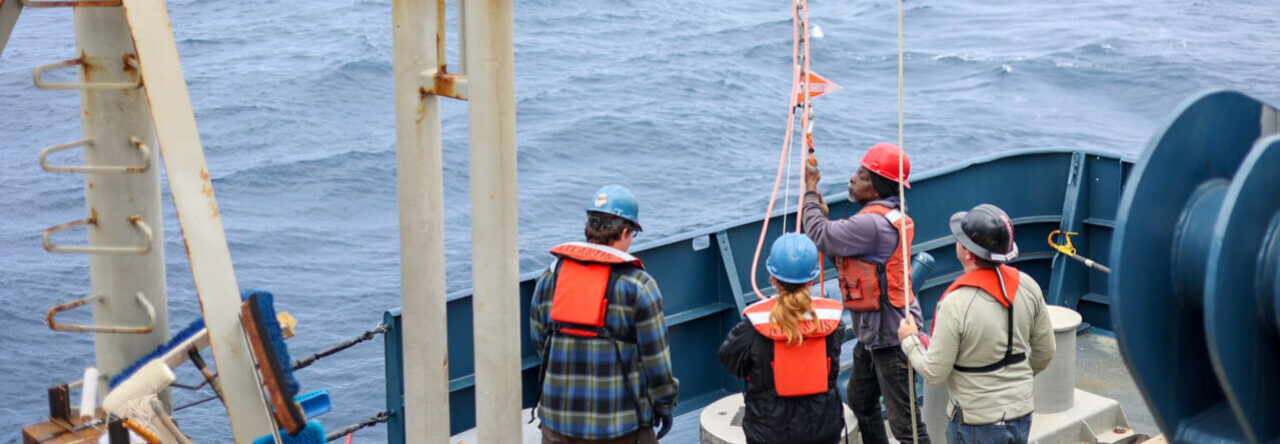
    The science operation we were going to be conducting was the last of a time series studying the Aghullas current under Dr. Lisa Beal from the University of Miami. During the mooring recovery ops we are scheduled to do several, 40+, CTD casts. My main duty during the day was deck leader of the CTD casts. Basically aboard the KNORR there are 4 people working to deploy and recover the CTD. The most important person being the winch operator, who is in charge of lifting this several thousand pound (KNORR has a very heavy rosette for enabling deep casts) and getting it over the side safely. There are then the tag line operators whose job is to keep the CTD from swinging while it is being delicately maneuvered over the side of the deck. Then there is me, with the rather odd title of deck leader. Basically I just watched and made sure no one was doing anything wrong that would get them injured or killed. I told the winch operator when to start the initial test descent, and well that’s about it. Until things go bad, and when they go bad it happens very quick. And one day it did. The seas were rough, but no horribly so. The wind was blowing maybe 20kts and the seas were a little rolly but nothing that should endanger anyone. The CTD came out of the water and instantly started spinning. One of the line tenders hooked the line and started pulling the CTD in. The second line tender was having difficulty with the pelican hook, which is on a pole roughly 12 feet long, so you can imagine how ungainly that is in the best of times. She couldn’t hook it, and the CTD started swinging side to side as we took a large wave. The line that was attached went slack as the CTD came careening back toward the ship. The attached line jumped over the struggling tender’s body and now she was in the bight of the line. I grabbed the line and screamed her name right as the CTD swung out and the line went taught slamming into the side of her neck. During instances like this time has an odd way of slowing down so each heart beat feels like an hour. I saw the rope hit her neck; I had grabbed it hoping I could keep it from completely looping around her neck. Her head went sharply and suddenly to the left as the line attached to CTD and tugger went taught. Her hard hat was knocked off her head. I ran up to her yelling her name several times, not sure if in the three feet I needed to traverse, she would slump over dead. My heart was racing; I grabbed the pelican hook pole and told her to get back to the safe area. I pulled the CTD and finished the op in the standard way. This was also the final CTD recovery of the trip, so all hands were on deck watching this rather ceremoniously. After I called the bridge to inform them the CTD was safely in the hanger and the ship could get underway again I went to my bunk and cried for 20 minutes. The girl was fine, completely unphased by the situation. She didn’t have to see it from my angle.

      I have seen many things in my 34 year life. Not a lot scares me. Getting caught in the bight of a working rope is one of them. I was confronted with the power of what we work with every day. You never know what the sea has in store for you. She is ever changing. She is beautiful. She is violent. She is unforgiving. You can’t wonder what if, or how could we have handled this differently in a situation like that. It happened; split second reflexes are the difference between life and death. Being able to work through the adrenaline, and not succumb to its more irrational effects is paramount to resolving life or death situations. 

The Winds of Change


I got to Miami in another red eye flight fugue. Exhausted and relatively confused from the cab ride I walked onto a new ship, this time, the Walton Smith. I was greeted by Dennis who is to be my new mentor on this leg of my journey in the world of the Marine Technician. He gave me exactly enough time to unpack my gear and told me it was time to get to work. I began by assembling a strange contraption called a MOCNESS. This bizarre device gets its name from being a Multiple opening and closing net and environmental sensing system…Basically it looks like a series of nets strung together on four bars. You can open different nets at different depths in order to sample the plankton at those different depths. Luckily I had read the manual to this device prior to boarding the Smith knowing that I would be dealing with this thing. I didn’t however expect to be assembling it less than 2 hours after landing back in the United States, after one of the most torturous flights I have ever taken.

I spent the next week assembling this device, assembling a CTD and repairing the niskin bottles on its rosette. We then left on a four day transit to Gulf Port Mississippi, where the science party would board. We arrived at night, rather uneventfully. The next morning the Science party would begin to load their gear, and we were scheduled to depart that Thursday.

The science party began unloading their three 20 foot long uhauls at around 10am. The seas in the harbor were a little rough, but nothing that should hinder work. Around noon everyone broke for lunch. The small mess deck was crowded with around 20 people hungrily eating a skillfully prepared lunch. We are lucky to have a rather wonderful chef aboard this small crowded vessel. I ate quickly, and retired to my bunk to get away from the crowd of new people that were rather raucous. The winds rather noisily began to pick up. I was reading more about the MOCNESS and its operational procedures when I felt the ship lurch hard to port. The wind began picking up and howling in a very unsettling frequency that can only be likened to the feral growling of a dire hound. The ship shuttered hard nearly throwing me out of my top bunk. Luckily for me my reflexes were quick enough to avoid the 5 foot fall onto the floor.

Startled and hyper alert I stumbled out of my berth greeted by the scene of scientist bracing themselves in door frames and several holding on for dear life to the nearest stable surface. I made my way through the throngs of unnerved people to the port holes in the galley. There I was greeted with the ship facing bow to the dock. For a second I wasn’t sure if this was a dream and I was safely asleep back home, then I heard the loud shuttering snap of our bow line giving way in the strong gusts of wind. We broke free of the dock and were headed for the rocks and old parts of the pier that were next to where we were docked less than 5 minutes prior.  A load creaking noise echoed through the ship. I made my way quickly to the fan tail to see if I could lend hand to the crew who were outside dealing with god knows what.

I was greeted with a howling wind and waves of nearly 7 feet high in the harbor. For a brief moment my heart sank as I looked around at the chaos of packing crates being tossed about and the wind blowing plastic lids quickly overboard. Then I heard one of the deck hand shout something that delicate ears should not hear. I spun in place and was confronted with the image of a massive barge on a collision course for our small aluminum ship. Thanks to the quick response of the Captain he had long ago, minutes, started the engines and had our ship under complete control. He motored us out of the way of this multi-ton barge which then careened side long into a large container ship that was parked near us. The barge scraped the whole side of the ship and finally came to rest on the rocks that nearly spelled the end of our science expedition.

We spent the next several hours in the middle of the harbor being thrown around like a cork in a giant Jacuzzi. Having seen the near doom of our small 96 foot ship twice in one day, I was relieved when the small storm finally passed us by enough to allow us to retie to the dock. After the hour or so of being bounced around in port I was more than happy to get on land and help crane the rather massive ROTV’s(remotely operated towed vehicles) out of the Uhaul trucks and on our small deck.

This time the power and fury of the ocean humbled an entire boat of people. We collectively saw the speed with which things can go from normal and mundane, to unforgettable when attempting to study the majesty that is the ocean. This time the ocean forgave our humanness, our fragile nature, our gung-ho attitude for the science which drives each and every one of us on a research vessel. This time we all gave thanks that none of the large instruments were being craned over to the ship when she broke loose. We gave thanks that no one was hurt. We gave thanks that our ship is captained by a very capable and knowledgeable individual. I gave thanks that I was here to witness this very rare event, and its successful conclusion. Science being conducted on the water is never a simple and straight forward thing. We are always at the mercy of the weather, the currents, and the ever changing tide of events that can spell disaster in seconds. 

Page 2 of 3

Powered by WordPress & Theme by Anders Norén