Walking onto the KNORR was one of the single most intimidating things I could have ever done. Having not been out of the country except to Bermuda, which if you ask a world traveler from the US doesn’t count. I had no clue what to expect of South Africa. First let’s start with the Johannesburg Airport. It is completely insane. It was the single most confusing place I have ever had the misfortune to step. People luckily spoke enough English I was able to find my plane in the Fugue state that only an international overnight flight can put you in. I landed delicately later that evening in Cape Town knowing only that some random stranger should have a sign with my name, and the ships name on it. He did, which made the rest of the evening uneventful and not really worth recounting save the fact that I rode with the Chief Engineer back to the vessel.
So there I was with one suitcase, an olive drab sea bag, and my 72 hour backpack. Everything I needed for the next six months had to be in there, if it wasn’t, I hope I won’t need it. I saw the KNORR which is an impressively weathered (in the good way) ship dimly lit with sodium lights and slight haze that smelled sweetly of diesel fuel. I was getting ready to spend the next month and a half aboard the ship that found the HMS TITANIC! The concept really didn’t sink in for quite some time about how unique of an experience this was going to be.
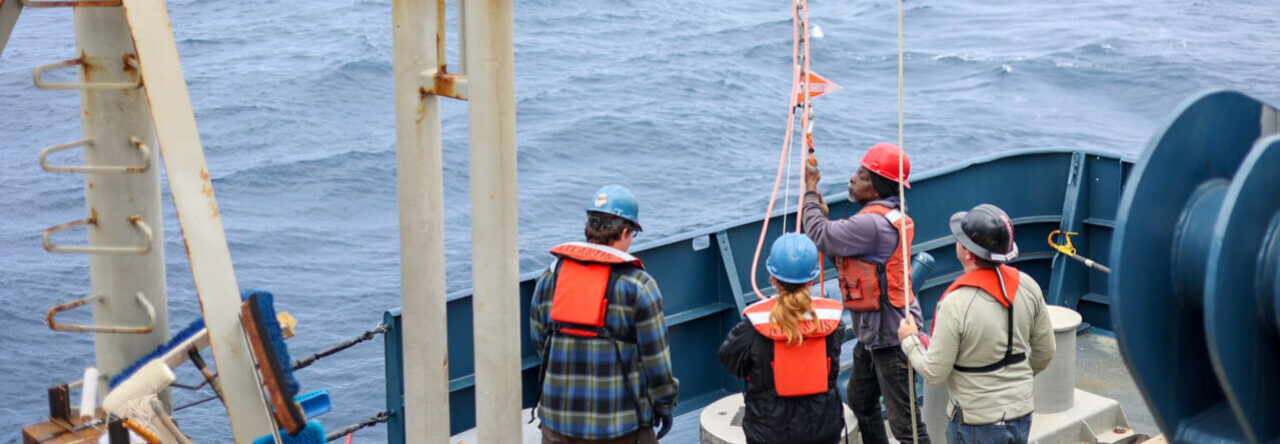
The science operation we were going to be conducting was the last of a time series studying the Aghullas current under Dr. Lisa Beal from the University of Miami. During the mooring recovery ops we are scheduled to do several, 40+, CTD casts. My main duty during the day was deck leader of the CTD casts. Basically aboard the KNORR there are 4 people working to deploy and recover the CTD. The most important person being the winch operator, who is in charge of lifting this several thousand pound (KNORR has a very heavy rosette for enabling deep casts) and getting it over the side safely. There are then the tag line operators whose job is to keep the CTD from swinging while it is being delicately maneuvered over the side of the deck. Then there is me, with the rather odd title of deck leader. Basically I just watched and made sure no one was doing anything wrong that would get them injured or killed. I told the winch operator when to start the initial test descent, and well that’s about it. Until things go bad, and when they go bad it happens very quick. And one day it did. The seas were rough, but no horribly so. The wind was blowing maybe 20kts and the seas were a little rolly but nothing that should endanger anyone. The CTD came out of the water and instantly started spinning. One of the line tenders hooked the line and started pulling the CTD in. The second line tender was having difficulty with the pelican hook, which is on a pole roughly 12 feet long, so you can imagine how ungainly that is in the best of times. She couldn’t hook it, and the CTD started swinging side to side as we took a large wave. The line that was attached went slack as the CTD came careening back toward the ship. The attached line jumped over the struggling tender’s body and now she was in the bight of the line. I grabbed the line and screamed her name right as the CTD swung out and the line went taught slamming into the side of her neck. During instances like this time has an odd way of slowing down so each heart beat feels like an hour. I saw the rope hit her neck; I had grabbed it hoping I could keep it from completely looping around her neck. Her head went sharply and suddenly to the left as the line attached to CTD and tugger went taught. Her hard hat was knocked off her head. I ran up to her yelling her name several times, not sure if in the three feet I needed to traverse, she would slump over dead. My heart was racing; I grabbed the pelican hook pole and told her to get back to the safe area. I pulled the CTD and finished the op in the standard way. This was also the final CTD recovery of the trip, so all hands were on deck watching this rather ceremoniously. After I called the bridge to inform them the CTD was safely in the hanger and the ship could get underway again I went to my bunk and cried for 20 minutes. The girl was fine, completely unphased by the situation. She didn’t have to see it from my angle.
I have seen many things in my 34 year life. Not a lot scares me. Getting caught in the bight of a working rope is one of them. I was confronted with the power of what we work with every day. You never know what the sea has in store for you. She is ever changing. She is beautiful. She is violent. She is unforgiving. You can’t wonder what if, or how could we have handled this differently in a situation like that. It happened; split second reflexes are the difference between life and death. Being able to work through the adrenaline, and not succumb to its more irrational effects is paramount to resolving life or death situations.