I got to Miami in another red eye flight fugue. Exhausted and relatively confused from the cab ride I walked onto a new ship, this time, the Walton Smith. I was greeted by Dennis who is to be my new mentor on this leg of my journey in the world of the Marine Technician. He gave me exactly enough time to unpack my gear and told me it was time to get to work. I began by assembling a strange contraption called a MOCNESS. This bizarre device gets its name from being a Multiple opening and closing net and environmental sensing system…Basically it looks like a series of nets strung together on four bars. You can open different nets at different depths in order to sample the plankton at those different depths. Luckily I had read the manual to this device prior to boarding the Smith knowing that I would be dealing with this thing. I didn’t however expect to be assembling it less than 2 hours after landing back in the United States, after one of the most torturous flights I have ever taken.
I spent the next week assembling this device, assembling a CTD and repairing the niskin bottles on its rosette. We then left on a four day transit to Gulf Port Mississippi, where the science party would board. We arrived at night, rather uneventfully. The next morning the Science party would begin to load their gear, and we were scheduled to depart that Thursday.
The science party began unloading their three 20 foot long uhauls at around 10am. The seas in the harbor were a little rough, but nothing that should hinder work. Around noon everyone broke for lunch. The small mess deck was crowded with around 20 people hungrily eating a skillfully prepared lunch. We are lucky to have a rather wonderful chef aboard this small crowded vessel. I ate quickly, and retired to my bunk to get away from the crowd of new people that were rather raucous. The winds rather noisily began to pick up. I was reading more about the MOCNESS and its operational procedures when I felt the ship lurch hard to port. The wind began picking up and howling in a very unsettling frequency that can only be likened to the feral growling of a dire hound. The ship shuttered hard nearly throwing me out of my top bunk. Luckily for me my reflexes were quick enough to avoid the 5 foot fall onto the floor.
Startled and hyper alert I stumbled out of my berth greeted by the scene of scientist bracing themselves in door frames and several holding on for dear life to the nearest stable surface. I made my way through the throngs of unnerved people to the port holes in the galley. There I was greeted with the ship facing bow to the dock. For a second I wasn’t sure if this was a dream and I was safely asleep back home, then I heard the loud shuttering snap of our bow line giving way in the strong gusts of wind. We broke free of the dock and were headed for the rocks and old parts of the pier that were next to where we were docked less than 5 minutes prior. A load creaking noise echoed through the ship. I made my way quickly to the fan tail to see if I could lend hand to the crew who were outside dealing with god knows what.
I was greeted with a howling wind and waves of nearly 7 feet high in the harbor. For a brief moment my heart sank as I looked around at the chaos of packing crates being tossed about and the wind blowing plastic lids quickly overboard. Then I heard one of the deck hand shout something that delicate ears should not hear. I spun in place and was confronted with the image of a massive barge on a collision course for our small aluminum ship. Thanks to the quick response of the Captain he had long ago, minutes, started the engines and had our ship under complete control. He motored us out of the way of this multi-ton barge which then careened side long into a large container ship that was parked near us. The barge scraped the whole side of the ship and finally came to rest on the rocks that nearly spelled the end of our science expedition.
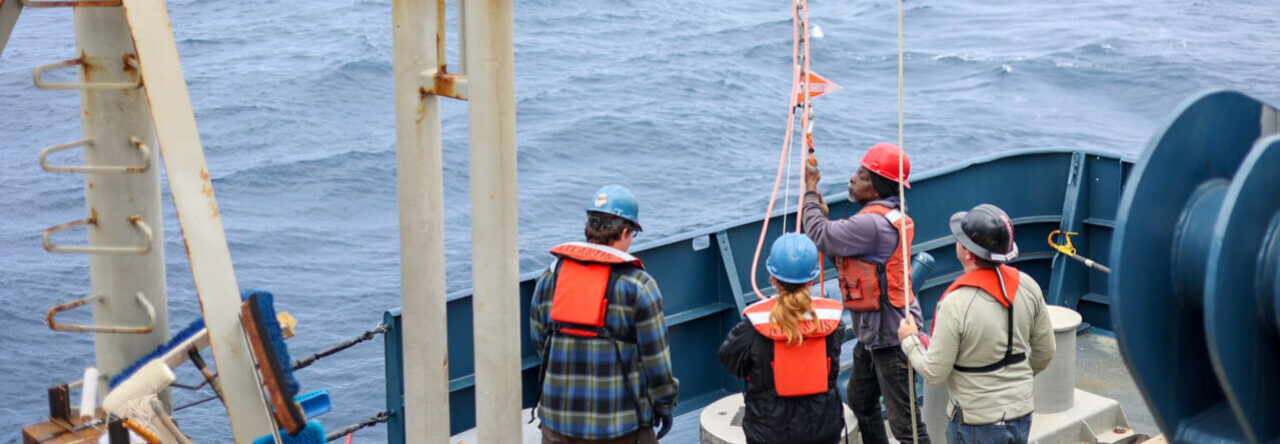
We spent the next several hours in the middle of the harbor being thrown around like a cork in a giant Jacuzzi. Having seen the near doom of our small 96 foot ship twice in one day, I was relieved when the small storm finally passed us by enough to allow us to retie to the dock. After the hour or so of being bounced around in port I was more than happy to get on land and help crane the rather massive ROTV’s(remotely operated towed vehicles) out of the Uhaul trucks and on our small deck.
This time the power and fury of the ocean humbled an entire boat of people. We collectively saw the speed with which things can go from normal and mundane, to unforgettable when attempting to study the majesty that is the ocean. This time the ocean forgave our humanness, our fragile nature, our gung-ho attitude for the science which drives each and every one of us on a research vessel. This time we all gave thanks that none of the large instruments were being craned over to the ship when she broke loose. We gave thanks that no one was hurt. We gave thanks that our ship is captained by a very capable and knowledgeable individual. I gave thanks that I was here to witness this very rare event, and its successful conclusion. Science being conducted on the water is never a simple and straight forward thing. We are always at the mercy of the weather, the currents, and the ever changing tide of events that can spell disaster in seconds.