
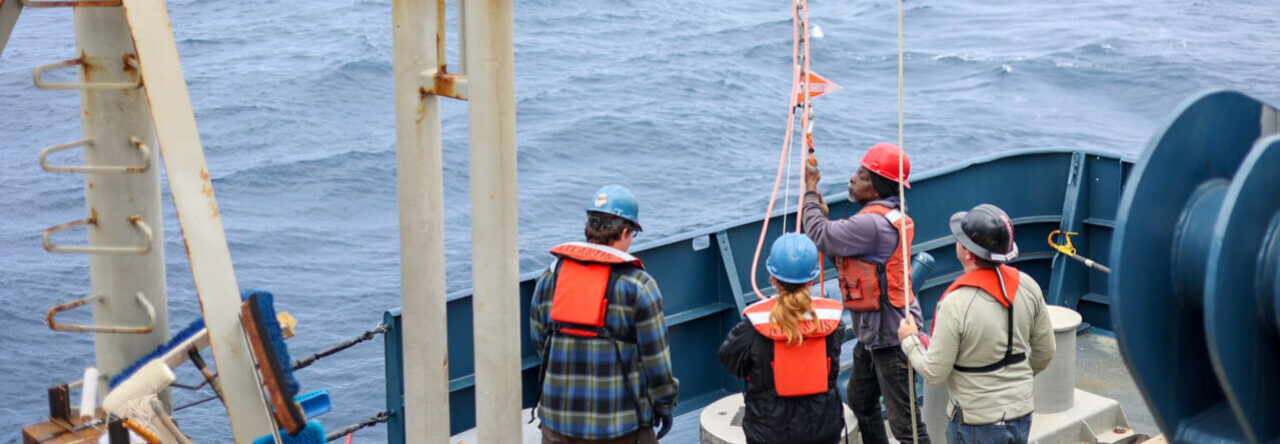
After running acoustic experiments for the past two weeks with nearly constant noise echoes bouncing off the hull of the ship, the ROV crew that has boarded is eerily quiet in comparison. This is a small Seaeye ROV that weighs little over 160lbs. After a few days of trouble shooting and getting buoyancy issues squared away they are now sitting quietly in front of a monitor doing a small transect with lasers. This whole TREX project has been rather interesting in so many respects, I have seen six, maybe more different science crews over the past month, come, run experiments and leave generally in under a week. There have been so many awesome scientists that I have met, it has made this cruise a real pleasure to work.
I have been spending the better part of most days reading and learning about the fundamentals of data transfer. After all the whole reason these ships exist is to gather data, and the transferring of that data from instruments to computers to scientists needs to be nearly seamless. There are many different options and choices when it comes to which cable needs to be run to where. On this ship there are a plethora of fiber optic outlets. I have two in my berth. Unfortunately most computers don’t have fiber optic inputs built into them so there need to be conversion devices. This is when understanding how the simple RJ-45(Ethernet) plug works, or how an RS232 plug works and how you can wire them for different purposes and what each pin does. Rather than bore you with the detail of a pin-out diagram in word form I will just say that it can be a fundamentally fascinating thing to realize that all data is functionally electricity. From the instruments generally measuring changes in voltage and sending that down the line, to the very transmission of ideas from neuron to neuron, it all takes electricity. So in essence and to not go overboard on philosophical musings as I am known to do, obtaining data and processing data is nothing but a giant physical, electrical circuit.
Once the data reaches the end user, it is up to them and their software how best to interpret it all. We all work with and around computers now. They are so ubiquitous in our everyday world that being without the internet is now a massive inconvenience and even a hindrance of productivity. Now realize that all this data transferring back and forth is primarily across wire. Granted we as a society are advancing our wireless data transfer at an exponential rate and this trend will likely continue long into the future. But fundamentally the data will begin and end at some type of terminal be it the instrument collecting the data or the computer processing it, and wires will at some point be connecting these things together. So a vital part of keeping science going on a ship is understanding the most basic unit and how it works across these wire. The electron will be doing the brunt of the work, and it travels across these wires at the speed of light. Every pin on a connector has a purpose, and if it is not connected with where it needs to be information transfer ceases, science grinds to a halt, and many people will not be very happy.