Author: Amitav Mitra

Week 4 on Healy – Near the end of HLY1901

The week began with CTD casts along the shelf and slopes north of Alaska, along a line designated NNE. Although we were in deeper waters, the scientists cut the casts off at 300m in order to save time. In another move to save time, every other cast was CTD only, meaning that they did not take water samples using the Niskin bottles on the way up. This definitely saved time, cutting the CTDs from roughly one hour from deployment to recovery to only 30 minutes. One really interesting observation during the CTDs was the presence of Atlantic water on the bottom of the ocean. The CTD graph would show a drop in temperature down the water column until the CTD reached the bottom. At the sea floor, the temperature would rise along with the salinity. This warmer water, kept at the bottom by it’s higher density, turns out to be water from the Atlantic, transported over Russia according to the scientists.

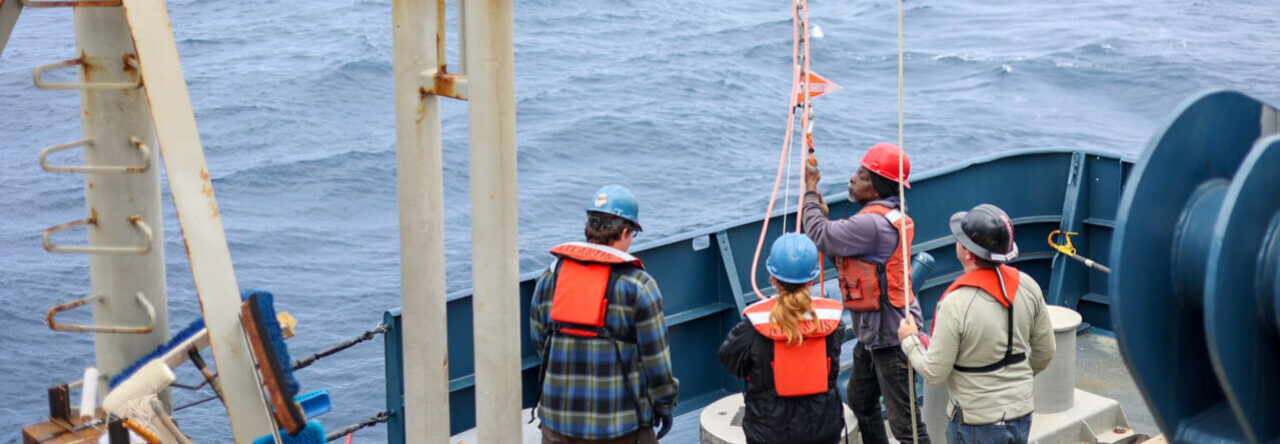
Because we’re working on a Coast Guard ship, the marine technicians here don’t get to do any of the deck work. The CTD deployment and recovery, along with the A-frame and winch handling, is all performed by the Healy’s deck and engine crew. Although I haven’t been able to take part in any of the deck work, I’ve watched how the Coast Guard operates their machinery and I’ve been impressed with their communication skills. The deck crew uses clear hand signals to inform the winch operator, and the bridge, deck crew, and winch operator all utilize radio to ensure that the operation goes smoothly. 

During my shifts this week I’ve only seen a few issues. One of the bottles on the deep 3000m cast failed to fire. The CTD rosette uses an electromagnet to release tension on the lanyards holding the bottle open, allowing the bottle to close on command and capture water. After the deep cast, we cleaned the firing ring and troubleshot the bottle, and this time it fired properly. Another issue we encountered was when the CTD pump didn’t turn on at first. The pumps can be selected to turn on manually, or automatically when they detect a certain salinity level when they enter the water. We believe that the intake hose had some air trapped in it, which stopped the pump from starting. Moving the CTD through the water column cleared the issue. 

One project I’ve taken on for the Healy’s deck department has been writing a program to analyze the winch data. The program works to read the raw binary data transmitted daily by the winch sensors and return the day’s highest tension and the times that the winch reached a certain tension level or above. The difficulty is making the program efficient, since the data files are so huge. The sensors record data 20 times per second, and the files consist of one day’s worth of data. The program has to read 1.7 million lines of data, so it can take some time to load the results. 

Yesterday (Aug 18) we recovered 3 Japanese moorings. They were in fairly shallow water, so the process didn’t take too long. The ship navigates to the mooring location and then one of the Japanese scientists will transmit a wakeup code to the mooring release via a transducer that they lower over the side of the ship. After locating and communicating with the releases, they will transmit the release code while the Healy and it’s small boat look for the floats to surface. The Coast Guard then hauls the mooring on board, removing sensors along its lines piece by piece. 

Today is the 19th, so the scientists will only be on board for five more days. It’s been a great experience to see them all working so hard around the clock. It’s also really encouraging to see so many people passionate about their work and the marine environment. Since I’m not getting off with them in Nome, I’ll miss having them on board for the post-cruise transit back to Dutch Harbor.

Week 3 on Healy – HLY1901

The week began back off the coast of Nome where we got to watch the C-130 cargo plane drop spare parts for the engineers. It was amazing watching the operation – the plane dropped a flare then circled around to drop a box right by the flare. The Healy’s small boat then deployed and retrieved the package. Unfortunately, the spare CTD unit that was shipped from San Diego was delayed, so we stayed several extra hours offshore for it to arrive. Then we left Nome and the science mission was underway again.

I’ve been on the 0000-1200 shift along with Austin, a UNOLS tech pool technician. He’s been great to work with and I’ve learned a lot from him. I appreciate his background in electronics and data acquisiton, and he’s taught me all about each of the instruments and their software. He’s also shown me pictures from his various trips across the world as a technician, and through them I’ve developed a greater respect for the job. 

After leaving Nome, Austin and I performed a deck test of the new CTD. Our main concern was ensuring that the pressure reading in air was not way off, like the previous fish. First, Austin showed me how to create a new configuration file for the CTD software. This file includes the sensors that are included on the CTD, along with the values of each of their various constants and offsets. With the new config file created, we conducted the deck test by plugging the new CTD into the deck box, from which it receives power and to which it transmits data. The new CTD had an in-air pressure reading of 0.6db, which was encouraging. With the new CTD working, we repackaged it to be used as the spare. 

The remainder of the week was very standard, without any major issues besides a mooring recovery failure. One of the JAMSTEC (Japanese Agency for Marine-Earth Science and Technology) moorings was unable to be recovered due to biofouling on the releases. Despite this, we managed to finish the 3rd DBO (distributed biological observation) line this week, and pushed north towards our goals in deeper water north of Alaska. On the transit to our northern stations, we rendezvoused with a saildrone in order to recalibrate it remotely. These large autonomous drones are 24 feet long, with an 8 foot draft and 16 foot sail.

I’m excited to begin the northern portion of the mission, because we will start to enter deeper water and recover more moorings. As we go farther north, the weather has been getting colder and the days longer. In a few days we will do our one deep CTD of the cruise (due to the lost days we won’t have time for more than one deep cast), and the scientists plan on shrinking styrofoam cups. 

Week 2 on Healy – Kodiak to Nome and Science

After a couple days exploring the beautiful island of Kodiak and transferring crew members and technicians, the Healy set off for Nome on Monday, July 29th. Our goal was to reach Kodiak on August 2nd, that Friday. For the most part, luckily, our transit cruise was uneventful. Apart from a few strange data acquisition readings which we cleared up, nothing major broke down or caused us trouble. Along the way, Roy, a former intern now working as a technician, taught us how to perform CTD wire terminations. I found the terminations to be tricky, and I spent a lot of time working on redoing mine. 

The termination is performed on the .322 EM (electro-mechanical) wire. There are two outer layers of wire which have to be un-layed to reveal three conducting wires inside insulation. You have to be careful when un-laying the wire and cutting away the insulation, because the wire must be re-layed and you can’t cut or damage the conducting wires. 

During the transit, I familiarized myself with the navigation displays. I uploaded all of the science party’s waypoints to each of the various navigational displays in the computer lab and the scientists’ work stations, then practiced uploading ice imagery. The Coast Guard purchases the imagery from a third party, which we then reproject and upload into the navigation systems. The reprojection step ensures that the imagery is properly overlayed onto whichever chart your software is using. Once overlayed onto our chart in the computer lab, we send the chart to the bridge’s computers using a remote terminal. 

As we approached Nome, we received weather reports of a major low pressure system moving in. On the morning of the 2nd, the anticipated science onload date, the Healy held position outside of Nome to assess the conditions. Because the crew transfer would be conducted with the Healy’s small boats, the weather made it too challenging and we were forced to turn back to ride out the storm. We traveled south again and crossed northwest over the top of St. Lawrence Island, then headed back for Nome two days later to try again on Sunday, August 4th. 

After finally loading the scientists on Sunday, we cruised towards the first of the DBO (distributed biological observation) lines planned for this cruise. Despite their extended stay in Nome and the lost time, the scientists were all happy to be underway and moved quickly to set up their labs. Unfortunately, however, one of the technicians noticed that both the original and the spare CTD were giving erroneous pressure readings above water. After some inspection it was determined that the units had come back from calibration with the manufacturer with large pressure value offsets, and so the data we had collected was possibly compromised, at least in terms of the pressure readings. 

Now, instead of moving to the second DBO line, we are moving back to Nome where the technicians have arranged another spare to be sent. We will load the spare via small boat and then continue the DBO line afterwards. Again, the scientists have taken the setbacks with good spirits, and even made the most of it. The chief scientist added some more stations to the second DBO line in order to map the currents in the region better. The goal with these new CTD stations is to get more data on the Alaska Coastal Current and the Bering Sea. In addition, the Coast Guard will be sending a C-130 cargo plane to airdrop some spare parts for the engineers. It will be pretty exciting to see a huge military cargo plane fly overhead and parachute some supplies into the water. 

Week 1 on Healy – Seattle to Kodiak

My first week on board Healy went by quickly. After an early morning flight to Seattle from New York, I spent the first day taking a tour of the ship and getting familairized with the layout of the ship. Luckily, I have had experience working on ships before which made navigating the ship much easier. After a few confusing hours getting lost in the various passageways I developed a pretty good sense of how to get around. 

The first leg of my journey was from Seattle to Kodiak, Alaska. This leg is just a transit, and apart from the other technicians none of the other science party members were on board. My daily routine during this transit cruise has been fairly constant. I get up around 0630 to eat breakfast with the other technicians, then work with and learn from them throughout the day. 

Since the Healy is a Coast Guard vessel, things run differently than on other civilian UNOLS research vessels. Whereas on civilian ships the marine techs will do most of the deck work involved with science operations, on the Healy it’s all performed by crew. From what I’ve learned from the marine technicians who have spent time on the Healy, this means that the focus of their work is centered more around the instruments and ensuring they are properly displaying, storing, and backing up data to the lab computers. 

One of the main components of science instrumentation I learned about in my first few days was the Science Seawater System (SSW). The ship’s engineering control center operates pumps which take in seawater to pass through the SSW system. The system is comprised of two stations, one located on the port side by the engineering spaces, and the other in the bio laboratory in the main science lab area. From the intake pipe the water gets diverted into a manifold which runs pipes to various instruments. One instrument is the fluorometer, which detects fluorescence in the water and can help determine the biological activity in the water. Other instruments measure temperature, salinity through conductivity, the flow rate of the water through the system, and CO2 levels in the water. All this information is then displayed on the lab computers, and it is the marine technicians’ job to ensure that the data is being properly logged and displayed and that the instruments are calibrated. 

One of the most interesting tasks I’ve worked on so far has been learning how to provide the multibeam and echosounder instruments with proper sound speed data. The multibeam and echosounder use sound to map out the seafloor, with the multibeam operating in a wide swath on either side of the ship and the echosounder mapping directly underneath the ship. Because they use sound, the instruments need to know the speed of sound in the water they’re in, since sound speed differs based on the medium in which it’s traveling. The speed of sound through the water depends on the temperature and conductivity, which is what the marine technicians work to find and provide to the instruments. When there is no current temperature and salinity profile, you use an archived version. Otherwise, you would deploy a CTD (conductivity, temperature, depth) instrument or an XBT (expendable temperature instrument) and measure the salinity and temperature as a function of depth. After you’ve collected the data, a sound speed program calculates the speed of sound in the water you’re in and the seafloor mapping instruments can function properly. 

I also spent a lot of time working with Mary, a Scripps Institute technician who taught me a lot about the ship’s network and data acquisition software. Through her, I learned a lot about the IT side of a marine technician’s work. One project we worked on, along with another technician Austin, was to install and wire a new serial splitter in one of the server racks in the computer lab. This splitter took data in from a hull temperature sensor and diverted it out to two computers in the lab. It took some trial and error, because it turned out that one of the computers required bi-directional control in order to communicate with the sensor itself and request temperature readings. After getting all the fiber optics and serial connections properly managed, we labeled the cables and created diagrams for future use. 

Since we are still in transit to the science mission, we have only been maintaining the instruments and troubleshooting. We just left Kodiak to head for Nome, where we will pick up the science party and transition into the standard 12 hour shifts alongside the actual marine technicians. It will be a lot of work, as the scientists will be running more or less continuous experiments, but I’m excited to see the real work that technicians perform when supporting science. 

Pre-Internship Introduction

Hello everyone, my name is Amitav Mitra and I will be joining the USCG Healy in Seattle next week as a MATE intern. For the next five weeks I’ll be onboard working with and learning from the technicians as we sail north into the Arctic Circle. 

I have spent time at sea as a deck cadet at a state maritime academy, where I was working to earn my 3rd Mate’s license while studying electrical engineering. I am privileged to have the opportunity to sail on the Healy this summer, and I am excited to learn about the work that marine technicians perform. This internship provides me with the opportunity to learn new skills and practice old ones, all while supporting scientific research in the Arctic.  

I look forward to providing updates in the coming weeks as the cruise progresses, and I thank everyone who has helped me get this far!

-Amitav

Powered by WordPress & Theme by Anders Norén