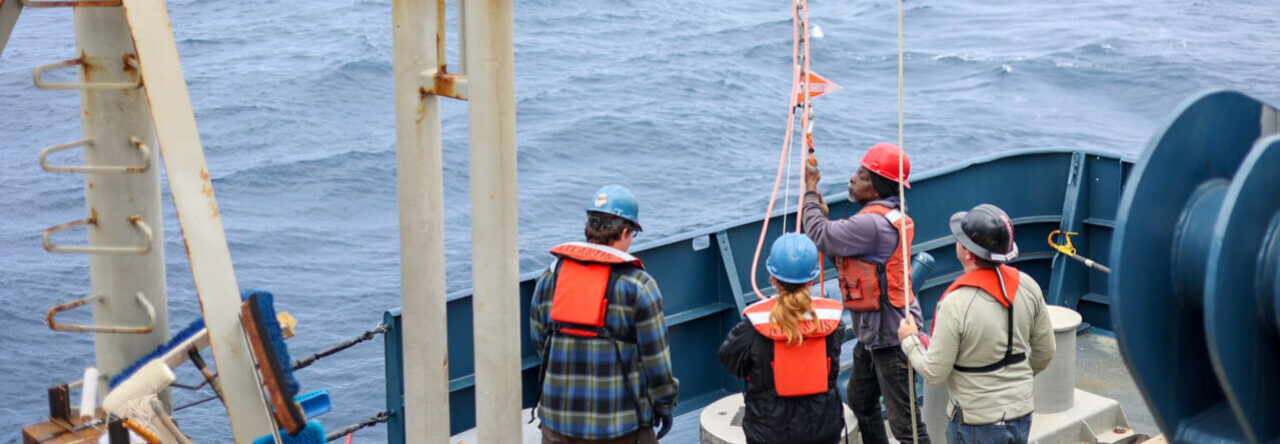
The week began back off the coast of Nome where we got to watch the C-130 cargo plane drop spare parts for the engineers. It was amazing watching the operation – the plane dropped a flare then circled around to drop a box right by the flare. The Healy’s small boat then deployed and retrieved the package. Unfortunately, the spare CTD unit that was shipped from San Diego was delayed, so we stayed several extra hours offshore for it to arrive. Then we left Nome and the science mission was underway again.
I’ve been on the 0000-1200 shift along with Austin, a UNOLS tech pool technician. He’s been great to work with and I’ve learned a lot from him. I appreciate his background in electronics and data acquisiton, and he’s taught me all about each of the instruments and their software. He’s also shown me pictures from his various trips across the world as a technician, and through them I’ve developed a greater respect for the job.
After leaving Nome, Austin and I performed a deck test of the new CTD. Our main concern was ensuring that the pressure reading in air was not way off, like the previous fish. First, Austin showed me how to create a new configuration file for the CTD software. This file includes the sensors that are included on the CTD, along with the values of each of their various constants and offsets. With the new config file created, we conducted the deck test by plugging the new CTD into the deck box, from which it receives power and to which it transmits data. The new CTD had an in-air pressure reading of 0.6db, which was encouraging. With the new CTD working, we repackaged it to be used as the spare.
The remainder of the week was very standard, without any major issues besides a mooring recovery failure. One of the JAMSTEC (Japanese Agency for Marine-Earth Science and Technology) moorings was unable to be recovered due to biofouling on the releases. Despite this, we managed to finish the 3rd DBO (distributed biological observation) line this week, and pushed north towards our goals in deeper water north of Alaska. On the transit to our northern stations, we rendezvoused with a saildrone in order to recalibrate it remotely. These large autonomous drones are 24 feet long, with an 8 foot draft and 16 foot sail.
I’m excited to begin the northern portion of the mission, because we will start to enter deeper water and recover more moorings. As we go farther north, the weather has been getting colder and the days longer. In a few days we will do our one deep CTD of the cruise (due to the lost days we won’t have time for more than one deep cast), and the scientists plan on shrinking styrofoam cups.