The week began with CTD casts along the shelf and slopes north of Alaska, along a line designated NNE. Although we were in deeper waters, the scientists cut the casts off at 300m in order to save time. In another move to save time, every other cast was CTD only, meaning that they did not take water samples using the Niskin bottles on the way up. This definitely saved time, cutting the CTDs from roughly one hour from deployment to recovery to only 30 minutes. One really interesting observation during the CTDs was the presence of Atlantic water on the bottom of the ocean. The CTD graph would show a drop in temperature down the water column until the CTD reached the bottom. At the sea floor, the temperature would rise along with the salinity. This warmer water, kept at the bottom by it’s higher density, turns out to be water from the Atlantic, transported over Russia according to the scientists.
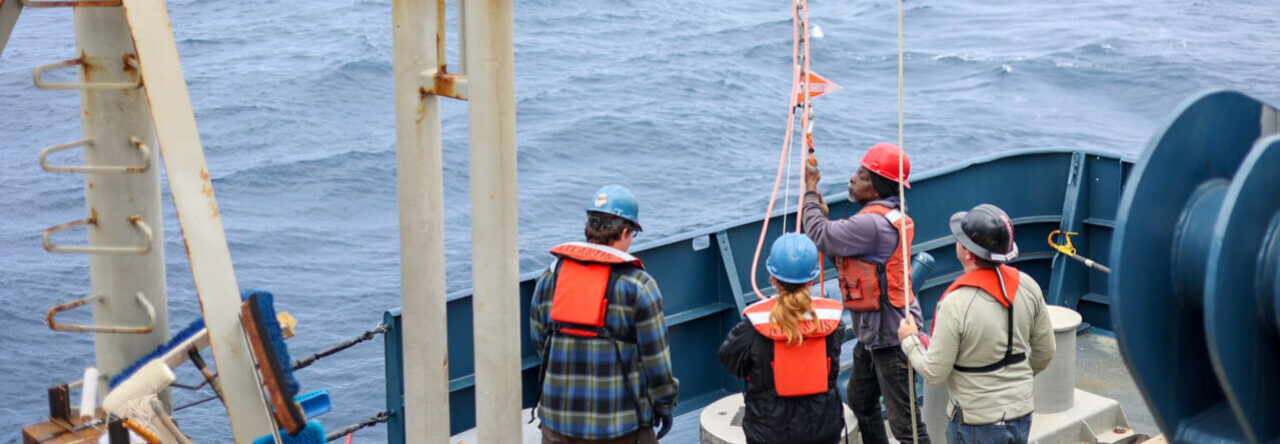
Because we’re working on a Coast Guard ship, the marine technicians here don’t get to do any of the deck work. The CTD deployment and recovery, along with the A-frame and winch handling, is all performed by the Healy’s deck and engine crew. Although I haven’t been able to take part in any of the deck work, I’ve watched how the Coast Guard operates their machinery and I’ve been impressed with their communication skills. The deck crew uses clear hand signals to inform the winch operator, and the bridge, deck crew, and winch operator all utilize radio to ensure that the operation goes smoothly.
During my shifts this week I’ve only seen a few issues. One of the bottles on the deep 3000m cast failed to fire. The CTD rosette uses an electromagnet to release tension on the lanyards holding the bottle open, allowing the bottle to close on command and capture water. After the deep cast, we cleaned the firing ring and troubleshot the bottle, and this time it fired properly. Another issue we encountered was when the CTD pump didn’t turn on at first. The pumps can be selected to turn on manually, or automatically when they detect a certain salinity level when they enter the water. We believe that the intake hose had some air trapped in it, which stopped the pump from starting. Moving the CTD through the water column cleared the issue.
One project I’ve taken on for the Healy’s deck department has been writing a program to analyze the winch data. The program works to read the raw binary data transmitted daily by the winch sensors and return the day’s highest tension and the times that the winch reached a certain tension level or above. The difficulty is making the program efficient, since the data files are so huge. The sensors record data 20 times per second, and the files consist of one day’s worth of data. The program has to read 1.7 million lines of data, so it can take some time to load the results.
Yesterday (Aug 18) we recovered 3 Japanese moorings. They were in fairly shallow water, so the process didn’t take too long. The ship navigates to the mooring location and then one of the Japanese scientists will transmit a wakeup code to the mooring release via a transducer that they lower over the side of the ship. After locating and communicating with the releases, they will transmit the release code while the Healy and it’s small boat look for the floats to surface. The Coast Guard then hauls the mooring on board, removing sensors along its lines piece by piece.
Today is the 19th, so the scientists will only be on board for five more days. It’s been a great experience to see them all working so hard around the clock. It’s also really encouraging to see so many people passionate about their work and the marine environment. Since I’m not getting off with them in Nome, I’ll miss having them on board for the post-cruise transit back to Dutch Harbor.