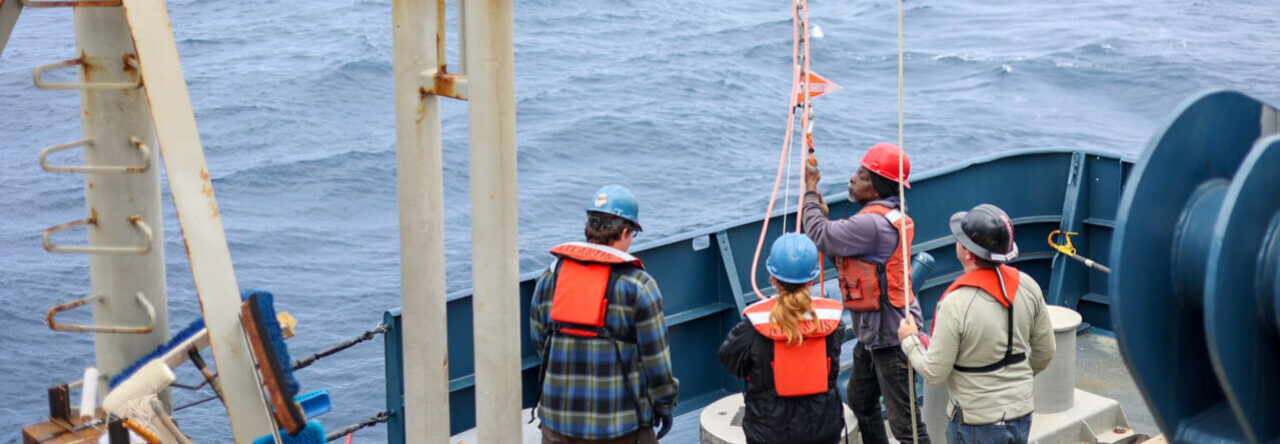
After a couple days exploring the beautiful island of Kodiak and transferring crew members and technicians, the Healy set off for Nome on Monday, July 29th. Our goal was to reach Kodiak on August 2nd, that Friday. For the most part, luckily, our transit cruise was uneventful. Apart from a few strange data acquisition readings which we cleared up, nothing major broke down or caused us trouble. Along the way, Roy, a former intern now working as a technician, taught us how to perform CTD wire terminations. I found the terminations to be tricky, and I spent a lot of time working on redoing mine.
The termination is performed on the .322 EM (electro-mechanical) wire. There are two outer layers of wire which have to be un-layed to reveal three conducting wires inside insulation. You have to be careful when un-laying the wire and cutting away the insulation, because the wire must be re-layed and you can’t cut or damage the conducting wires.
During the transit, I familiarized myself with the navigation displays. I uploaded all of the science party’s waypoints to each of the various navigational displays in the computer lab and the scientists’ work stations, then practiced uploading ice imagery. The Coast Guard purchases the imagery from a third party, which we then reproject and upload into the navigation systems. The reprojection step ensures that the imagery is properly overlayed onto whichever chart your software is using. Once overlayed onto our chart in the computer lab, we send the chart to the bridge’s computers using a remote terminal.
As we approached Nome, we received weather reports of a major low pressure system moving in. On the morning of the 2nd, the anticipated science onload date, the Healy held position outside of Nome to assess the conditions. Because the crew transfer would be conducted with the Healy’s small boats, the weather made it too challenging and we were forced to turn back to ride out the storm. We traveled south again and crossed northwest over the top of St. Lawrence Island, then headed back for Nome two days later to try again on Sunday, August 4th.
After finally loading the scientists on Sunday, we cruised towards the first of the DBO (distributed biological observation) lines planned for this cruise. Despite their extended stay in Nome and the lost time, the scientists were all happy to be underway and moved quickly to set up their labs. Unfortunately, however, one of the technicians noticed that both the original and the spare CTD were giving erroneous pressure readings above water. After some inspection it was determined that the units had come back from calibration with the manufacturer with large pressure value offsets, and so the data we had collected was possibly compromised, at least in terms of the pressure readings.
Now, instead of moving to the second DBO line, we are moving back to Nome where the technicians have arranged another spare to be sent. We will load the spare via small boat and then continue the DBO line afterwards. Again, the scientists have taken the setbacks with good spirits, and even made the most of it. The chief scientist added some more stations to the second DBO line in order to map the currents in the region better. The goal with these new CTD stations is to get more data on the Alaska Coastal Current and the Bering Sea. In addition, the Coast Guard will be sending a C-130 cargo plane to airdrop some spare parts for the engineers. It will be pretty exciting to see a huge military cargo plane fly overhead and parachute some supplies into the water.