Tag: ThomasGThompson

Land Ho! – 07

It is hard to believe, but my final day aboard the Thomas G. Thompson makes for a total of 50 days. I am so very grateful, and have been blessed so abundantly to be a part of the awesome crew even for a while. Before we do some reminiscing, lets see how the last week has been.

Oh yeah, monsoon! Thailand can receive around 15 feet of precipitation in a year, which makes for some pretty rainy days at sea. The most important thing I brought with me on this cruise was my foul weather gear, and my great sense of style as you can see. No matter what the latest fashion tips may say, high-vis is always in fashion. The neon colors you may be used to seeing on constructions sites or warning labels have an important purpose- you can’t miss them! Highly visible colors such as neon orange, yellow, green or pink ensures that you are seen. In worst case scenarios, such as falling overboard, you are clearly distinct from the endless waters so you can be rescued quickly. So, you can always catch me on deck, in my glowstick cosplay- also known as my foulies. My rain jacket and pants kept me dry and toasty on all of the misty mornings and downpour afternoons.

The science team and crew worked tirelessly through the rain. To study monsoons is to endure the storms! Our final days of science consisted of VMP, or the vertical microstructure profiler, CTD, weather balloons, and scanfish operations. The winds and increasingly high seas made for a tumbling time on deck, and made operations run longer than normal. Taking the extra time to practice safe working tactics prevents injuries and accidents. It is better to lose an hour to work through things slower, than to lose days for an injury on deck!

On one sunny afternoon, we were greeted by some playful dolphins bow riding! The glare on the water makes them a bit difficult to see, but there were around 10 of them playing in the wake of the ship. We determined them to be Tursiops aduncus, or Indo-Pacific Bottlenose dolphins. Though this cruise was focused on meteorology, it was exciting to be visited by a bit of biology during our trip. Biology is my first love, and has been my main focus. Though I am enjoying and learning a lot about the other aspects of marine science, it is lovely to have the comfort of the incredible creatures of the ocean grace us on our journeys! (Advancement unlocked: Echolocation)

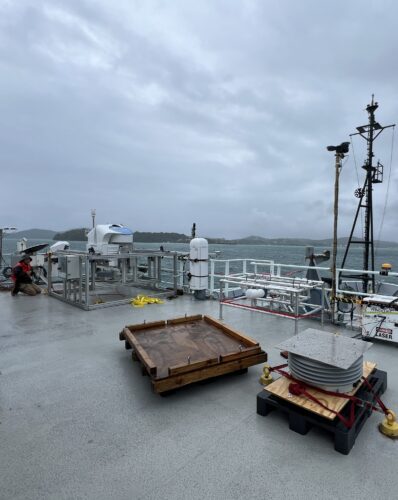
Science has officially concluded for this cruise, and we began our transit back into port. The next couple of days involved removing all of the scientific equipment and devices that had been installed around the ship. This is no small task! In the above picture, science requested my help to remove some wires from the MCT. A lot of them, as a matter of fact! Though it looks like a tangled mess of spaghetti, it is a sense of controlled chaos that eventually comes together. We snipped zip ties, unplugged the devices and sorted out the cables with time. Cables have been bundled and stored in their appropriate boxes for shipping or storing, and the MCT sealed up to prevent any water from dripping in.

One of the larger deconstructions was a LIDAR on the forward 02 deck. It had been set into a gyroscopic mount for the duration of the cruise, which meant a more difficult time dropping it back onto deck. The ABs, captain, and the science crew all converged to develop a plan. Using many lines, hands, and some precautionary foam bricks, we were able to lower it onto deck in about 2 hours time. The master rigging skills of AB Brian (pictured above, climbing the frame) were invaluable to the operation. I find careful procedures such as these to be oddly beautiful, almost in a mathematic sense. A well thought out plan and attentive hands make for easy work!

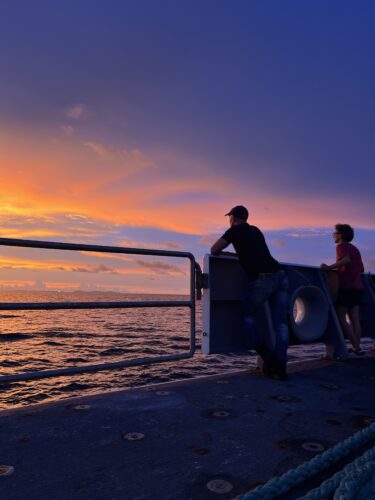
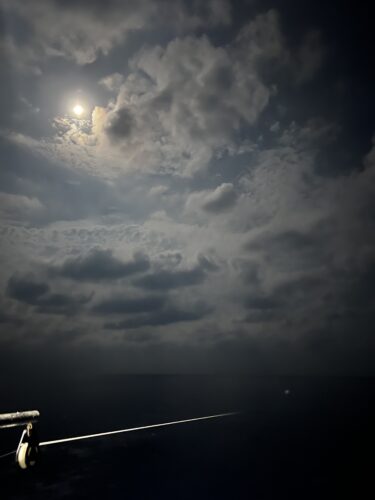
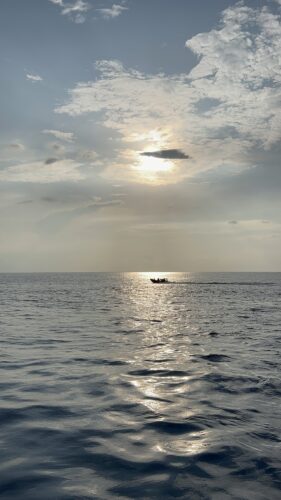
For our final night at sea, God painted the sky with a lovely sunset to send us homewards! Our cruise, though there were many bumps and bruises, has been a success. We have just set our anchor back in the port of Phuket, Thailand, and everyone is busy at work preparing for their journeys home. Laptops packed and memories made, shipping labels slapped on every crate and palette. The data has been collected, and the scientists are eager to return to their labs for processing. The ships crew is cleaning, storing, and readying the vessel for the next science party to come aboard. Science never sleeps, and the R/V Thomas G. Thompson is bound to go to sea again shortly.

A sincere thank you to the crew, captain, and science parties for allowing me to join them on this cruise. I hope that I have been a helpful and optimistic force for their work, and that I can cross paths with them once again in the future. As I make my own way home, I will set out for another adventure in a few short weeks. Thank you so much for reading along, and following my journey across the world. To the other UNOLS interns this season, fair winds and following seas to you! Shout out to Maria and the entire UNOLS team for making my dreams reality!

I want to extend a special thanks to my brilliant educators that inspire me to this day;

Jason Rogers, for sharing his dazzling love of invertebrates and indomitable spirit. (The variety of marine worms truly is inspiring). Jacqui Degan, for never once losing enthusiasm and for pushing us all for greatness. Shawna Rowe, for great kindness and diligence unfailing. Joel Clem, for unwavering faith in our abilities and a patient heart. Nathan Whited, for generosity and constant cheerfulness through tough times. Brian Bradley, for taking the time to teach in every moment, and encouraging our curiosity always. Brian Jeno, for holding us to high standards and working tirelessly. (And for not sinking the R/V MarTech with us aboard when Blue and I ran over the Sidescan Sonar. Sorry again.) Crew and captain of the R/V Cape Hatteras, for putting up with our student shenanigans, and welcoming all of us for incredible cruises. Much love to my Marine Tech Club family and classmates.
Buoy Blues – 06 – Micah B.

Today makes 42 days on the R/V Thomas G. Thompson. As the monsoons close in and the winds pick up, it is safe to say it has been a complete and total whirlwind! 

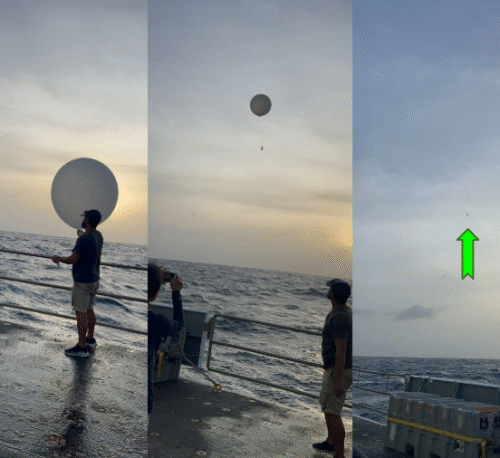
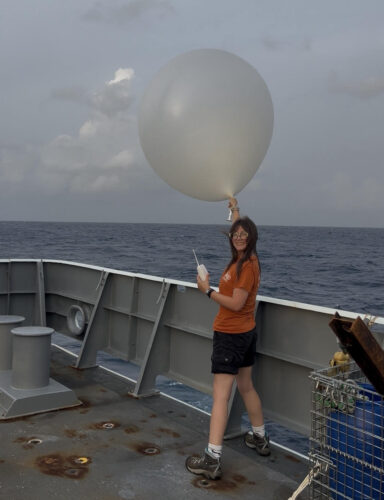
This research cruise is focused on gathering meteorological data. The use of weather balloons allows the science group to record various data through the atmosphere. The giant balloon is filled with helium, and attached to the bottom is a spool of wire with an instrument known as a Radiosonde. The instrument package measures atmospheric parameters such as pressure, temperature, humidity, wind speed, and wind direction. This information is sent back to the scientists via radio signals. Our highest balloon yet rose to 27.5 KM! The team releases a new balloon every few hours, for continuous data streams. I was able to release one as well! 

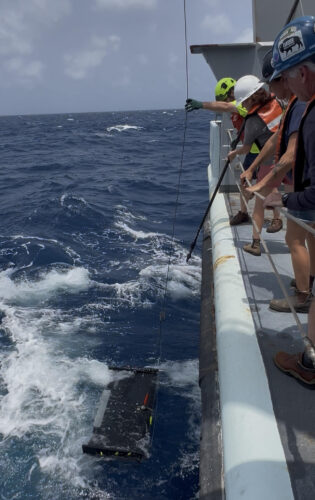
As well as atmospheric data, the science group is interested in oceanographic profiles. This device, called a Scanfish, is towed behind the boat for days at a time. It swims up and down through the water column, and collects profiling data. Deploying the device means all hands on the stern, working to get it over the back smoothly. 

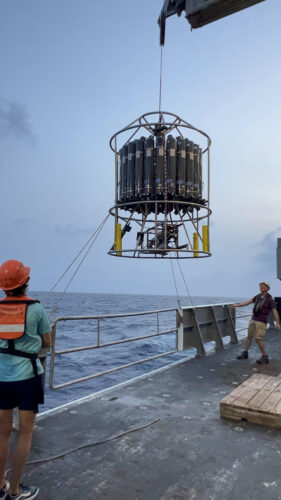
Another data source is the CTD. This is one of the most used pieces of equipment on board a research vessel! This science group is interested in water samples as well, so the large bottles you see will be full once we retrieve the device. The role of the marine technician in this deployment is mainly to operate the hydroboom, which is a horizontal crane of sorts. It can carry an enormous amount of weight, and carries the payload up to 10 feet off the side of the ship. The marine tech also communicates with the bridge and the winch operator, ensuring that the deployment goes smoothly. The scientists are responsible for the control of the CTD electronically, and triggering the bottles to close at whatever depths they want water samples from. 

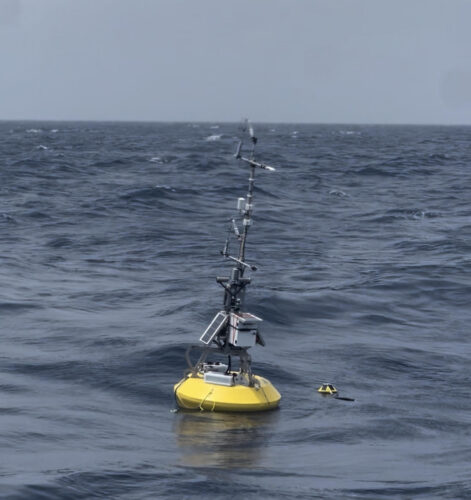
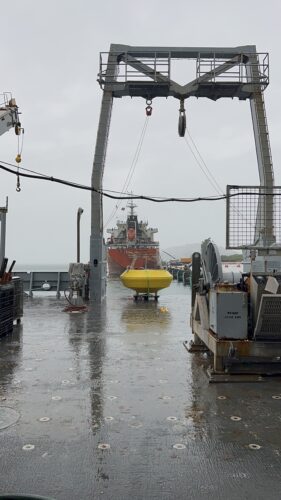
It has finally come time that the buoy on deck can be deployed! This specific buoy is experimental, meaning it is the first of its exact kind. The configuration of instruments is hopeful to provide insight into the air-sea interface, having both air and water sensors attached. This also means, however, that no one is sure exactly how the buoy will behave, or if it will be successful at all. Deployment was a slow, and very careful process. Once the buoy was in the water, all we could do was wait and see.

Our buoy has proven to be a bit cantankerous! After less than 24 hours in the water, the electrical systems onboard the buoy began to fail. The buoy is equipped with several large batteries that are charged by 3 solar panels, yet all charge had been lost. Either the solar panels were not functioning properly, or the equipment on board was too demanding for the batteries to keep up with. We decided it was the best option to recover the buoy, and see if repairs could be made on board. Every day spent at sea can be very expensive, so there is no time to waste. Science must go on! 

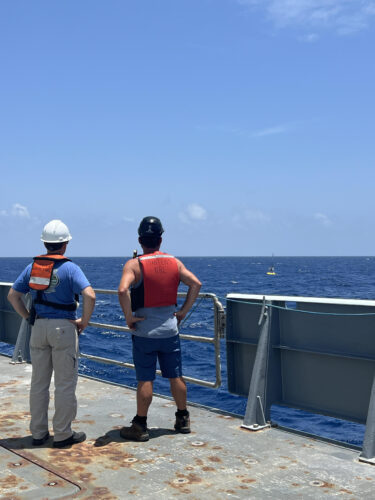
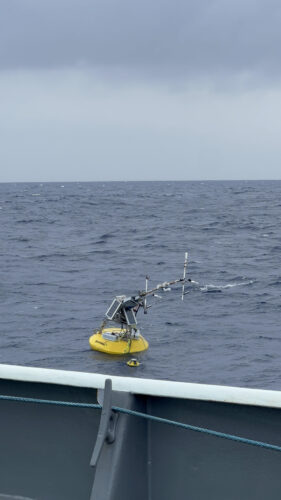
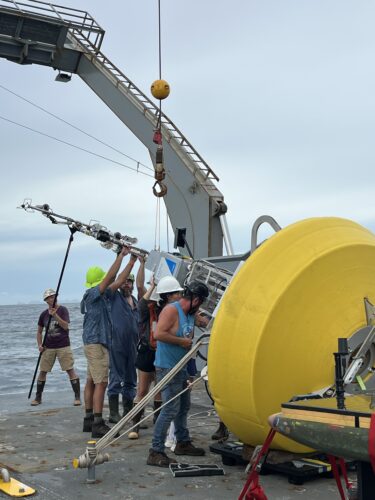
The team was able to repair the electrical issues within the buoys system, and redeployed successfully. For several days, we received good data from the buoy with no signs of further electrical issues. In the meantime, we worked on other operations in the area. We continued to tow the Scan fish, with occasional stops for CTDs, and other data collection. Once it was time to revisit the buoy, disaster had struck. As soon as the buoy was in sight, we could see that the mast was broken. Sadly, there is no telling exactly how it happened, but the most likely culprit is simply weather conditions. The seas and winds have been very high, and the aluminium mast was under much stress. Trying to recover any equipment that is broken is unpredictable at best. The captain of the ship gathered the crew and scientists, and preformed a risk assessment of the potential recovery operation. With the uncertainty, and possible loose pieces that could come off at any point, there were concerns and discussions about the safety of such an operation. We were able to find solutions to our concerns, and decided that recovery was possible. We very slowly approached the buoy, and after two attempts and nearly 3 hours, were able to safely recover the equipment. 

At sea, there are an infinite amount of problems and solutions you can encounter. It is important to keep an open mind and to think outside of the box when performing research! This week has proven to me that there are always work arounds and more chances to be had. Though the buoy is officially out of commission for this cruise, theres no doubt that it will float again, eventually. The beauty of an experiment such as this, is that it will only improve from here. The scientists now know the weak points, and how to improve it for its next deployment!

The rain here is picking up, so as we all don our foulies and our rain boots, we wish you luck on all of your endeavors! Stay safe and stay dry out there sailors.

Micah Barton – God Bless – 06/11/2025

Bay of Bengal – 05 – Micah B.

Tomorrow marks one month spent aboard the R/V Thomas G Thompson! I am beyond blessed to have such an incredible opportunity to sail through the Bay of Bengal, chasing storms and deploying equipment throughout this warm and ancient ocean. I am always amazed by how things come together with such a vast array of personnel, all coming from different backgrounds, educations, and experiences. I am inspired by their stories, and for the pursuit of knowledge. I am excited to let my ambition go unchecked and see where it can take me!

Leg two of this research cruise has been a bumpy start, in more ways than one. Learning how to navigate complex shipping schedules, crowded dock space, and working with immigration has proven frustrating at times. And then came the rain! Monsoon season here in Thailand is beginning, with some regions getting up to 3 meters of rain annually. Rain introduces new complications, but also brings data along with the low pressure systems. Meteorological information is what we are seeking, after all. 

Everyone involved is responsible for their part, including the marine technicians on board. The first few days may be our busiest ones, all going according to plans (spoiler alert: it never does!). Techs and ABs are responsible for getting the science crew, and all the gear they bring, settled onto the ship as quickly and smoothly as possible. The decks fill quickly with equipment and instruments. 

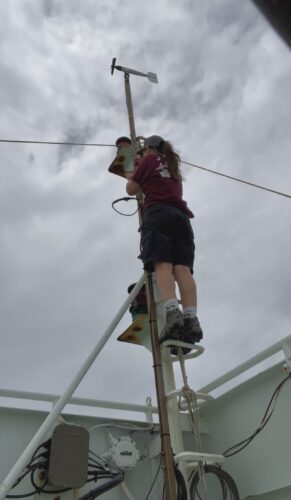
The Thomas G. Thompson is by far the largest ship I have sailed on. She is outfitted with oceanographic and meteorological sensors in every nook and cranny. On the very top deck, known as the 05 or the flying bridge, we replaced an anemometer, or a ‘wind bird’. It is a lofty feeling to be climbing a ladder so far above the sea, being able to look out on the vast expanse of blues! There’s me on the ladder (Hi me!). Leg one of this scientific mission was smooth sailing, both in terms of the unusually calm seastate, and the workflow.  Now, after about 10 days in port, back and forth between dock and anchor, we are underway! We finally received the shipments we were waiting for, and finished our mobilization phase on the dock.

Now, the science can begin! We are deploying weather balloons equipped with radiosondes every 6 hours. The balloon will rise into the stratosphere, and using the attached sensor, measure parameters such as temperature, humidity and wind speed. This information is vital for understanding weather patterns. Look at ’em go!

“toil and turn under the sun,

c’mon Greenhorn! work’s just begun;

heave the anchor, tie the lines,

now sailing feel the winds divine;

a sailors job’s a rotten one,

when waves crash and thunder drums;

make way through twisted course like vines,

’til you again see brave coastlines;

dream not yet of landlocked loves,

lest the days escape and hands be dumb;

barely from the harbors brine,

sail out to sea just one more time”

Each time the ship comes to port, personnel board and disembark from their hitch. Some may spend weeks at sea, while others months. The time away from home can be both adventurous and at the same time draining. With each sea going person I meet, I come more to the understanding of this balance.

We have just about 3 weeks to deploy the buoy, drifters, weather balloons, CTD/UCTD casts, gliders and more! The increasing swell of the sea can make deck operations difficult and unsafe. We work with the captain and the science team to adapt plans that best suit everyone’s needs. So we’ll be here, watching the weather and deploying balloons! Catch you on the next setting sun, scallywags…

Micah Barton – God Bless – 05/30/2025

Science While Underway – 03

Today marks my 13th day aboard the R/V Thomas G. Thompson. What a fantastic whirlwind so far! The science crew onboard has gotten up to a little bit of everything, and it has been a privilege to be a part of the action. This cruise has had its fair share of deployments, recoveries, troubleshooting,  and deck operations under the searing  sun.

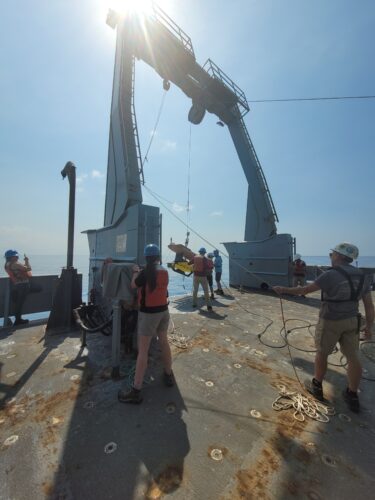
The ABs and the Marine Technicians aboard have a special role to play while assisting the scientific crew with their mission. Safety of both people and gear is of the utmost priority when working on the deck. With the help of the experienced crew, the science team can rest assured that their gear will get into the water with no incident. Using the A-frame, a large winch powered lift on the stern, we can pick up large gear and deploy it into the water. As the Marine Tech intern, I was allowed to operate the A-frame for a few deployments (That’s me at the controls in the photo, hi me!). We helped the science team deploy 4 wave gliders and 3 sea gliders, as well as countless wave drifters. Each instrument has a specific purpose, and measures a different ocean parameter. The data collected by this equipment is vital to oceanographic research and works towards the scientists ultimate goals. 

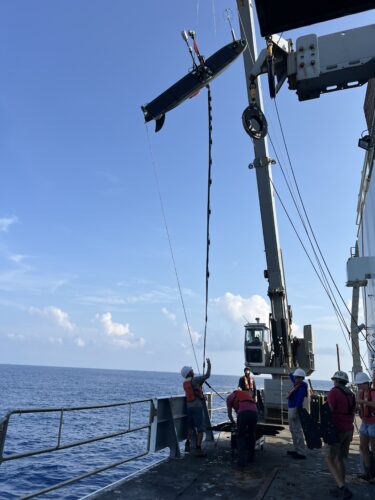
Another aspect of research at sea is troubleshooting. One of the wave gliders that we had previously deployed was having some issues, according to the software connected. The science team made the decision to bring the glider back on board, and attempt to repair it. This time, we used the starboard side crane to retrieve the drifter from the water. In this situation, as you can tell from the photo above, there are many moving parts that everyone on deck must be aware of in order to avoid accidents. We work slowly and thoroughly, talking through each phase of the operation so that everyone is aware of what is going to happen. Through patience, team work and coordination, the drifter was recovered successfully! The science team got well under way with their repairs, and we re-deployed it. 

Science never sleeps on board, not when there is data to be collected! Arguably, what we have done the most of is UCTD operations. This is a device that is towed behind the ship, and collects sea water parameters as we move, such as conductivity, temperature, and water depth. We pulled the UCTD for up to 6 hours straight, for several days. This operation requires two people on deck at all times, meaning we had to work in shifts to ensure that everyone was able to rest fully. Often times, we would pull the probe through the night, and into the wee hours of the morning. We’re willing to do anything for the data! 

As the first leg of this research cruise is coming to a close, we are all still busy as ever. Breaking down equipment, preparing for port call, and getting the ship ready for the next set of scientists is no easy task! Though it is sad to see the first round of scientists move on to their next mission, the next group will need our help to get their scientific mission underway. So, it’s a good thing we’re here to help!

Micah Barton -God Bless – 05/13/2025

Powered by WordPress & Theme by Anders Norén