Category: R/V Marcus G. Langseth Page 4 of 10

Week 1: June 9th to June 17th

June 9, 2024:

  • Flew from SF to NY, arriving at 3pm (about 5:30 hours)

  • Journeyed to the boatyard near 168 Flushing Ave, NY.

  • Settled into a boat, toured, and met crew members.

  • Went to Walgreens for last minute purchases and slept very well.

Flew from SF to NY, arriving at 3pm (about 5:30 hours)

Journeyed to the boatyard near 168 Flushing Ave, NY.

Settled into a boat, toured, and met crew members.

Went to Walgreens for last minute purchases and slept very well.

June 10, 2024:

  • Met in the supervisor’s office at 7am.

  • Assisted in stress testing a new winch cable wire.

  • Had downtime and enjoyed really good food.

  • Spent evening onboard, contacting family.

Met in the supervisor’s office at 7am.

Assisted in stress testing a new winch cable wire.

Had downtime and enjoyed really good food.

Spent evening onboard, contacting family.

June 11, 2024:

  • Departed dock at 1am for anchorage and fueling.

  • Attended 7am meeting; 

  • Volunteered to take the night shift (12am-12pm).

  • Worked with roommate Eddie (other mate intern) on securing crates and boxes.

  • Met with the science crew and learned about their work and what exactly they are trying to prove with the data they are collecting.

  • Prepared ship for departure from fueling barge;

  • Was concerned about seasickness.

Departed dock at 1am for anchorage and fueling.

Attended 7am meeting; 

Volunteered to take the night shift (12am-12pm).

Worked with roommate Eddie (other mate intern) on securing crates and boxes.

Met with the science crew and learned about their work and what exactly they are trying to prove with the data they are collecting.

Prepared ship for departure from fueling barge;

Was concerned about seasickness.

June 12, 2024:

  • Worked from 7am to 12pm on pCO2 monitor.

  • Participated in ship-wide drills for fire and abandon ship procedures.

  • Only worked about 6 hours since I was switching to night shift. 

  • Rested in the cabin after; prepared for night shift.

Worked from 7am to 12pm on pCO2 monitor.

Participated in ship-wide drills for fire and abandon ship procedures.

Only worked about 6 hours since I was switching to night shift. 

Rested in the cabin after; prepared for night shift.

June 13, 2024:

  • Started night shift at 12am.

  • Assisted with CTD trigger test and monitored computer screens.

  • Assisted senior technicians with adding more weight to the multicorer and primed it for deployment.

  • Controlled winch operations and assisted with retrieval.

  • Worked on drafting protocols for working on the new winch with Joseph (another tech).

Started night shift at 12am.

Assisted with CTD trigger test and monitored computer screens.

Assisted senior technicians with adding more weight to the multicorer and primed it for deployment.

Controlled winch operations and assisted with retrieval.

Worked on drafting protocols for working on the new winch with Joseph (another tech).

June 14, 2024:

  • Night shift activities included rounds on the vessel and ensuring equipment security.

  • Spotted basking sharks near the boat in the early morning!! 

  • Participated in deploying multi corners; experienced a minor incident with equipment.

  • Successfully retrieved samples, including a brittle star.

Night shift activities included rounds on the vessel and ensuring equipment security.

Spotted basking sharks near the boat in the early morning!! 

Participated in deploying multi corners; experienced a minor incident with equipment.

Successfully retrieved samples, including a brittle star.

June 15, 2024  –   June 16, 2024:

  • Lots of downtime working a night shift and while heading to the new station.

  • Spent most of time monitoring computer screens.

  • Spent a couple hours with the the 2 and 3 mate in the bridge while they stood night watch  

Lots of downtime working a night shift and while heading to the new station.

Spent most of time monitoring computer screens.

Spent a couple hours with the the 2 and 3 mate in the bridge while they stood night watch  

June 17, 2024:

  • The night was not very eventful but in the morning we noticed the sea floor had a lot of seamounts so it was decided to pause the transit and start a back and forth grid search for flatter ground.

  • Technical difficulties popped up so a lot of time was spent on that. 

The night was not very eventful but in the morning we noticed the sea floor had a lot of seamounts so it was decided to pause the transit and start a back and forth grid search for flatter ground.

Technical difficulties popped up so a lot of time was spent on that. 

IN CONCLUSION:

I am having a wonderful time.! The food is delicious and the beds are really comfortable. Everyone is super nice and the work is very enjoyable and fulfilling. I’m excited to get to the next station to do more work!


Duva Week 1: Departure and First Station

Week One on the Langseth!

We had a busy start to the week as we prepared to depart from the Brooklyn Navy Yard. We faced some potential delays (engine parts, science gear), but ultimately decided to make our first, near-shore station (which was initially intended as a test site for our gear) a full research station. After completing work there, it was decided to proceed to the next station (rather than returning to NY to pick-up parts). So, the next land we see will be Iceland!

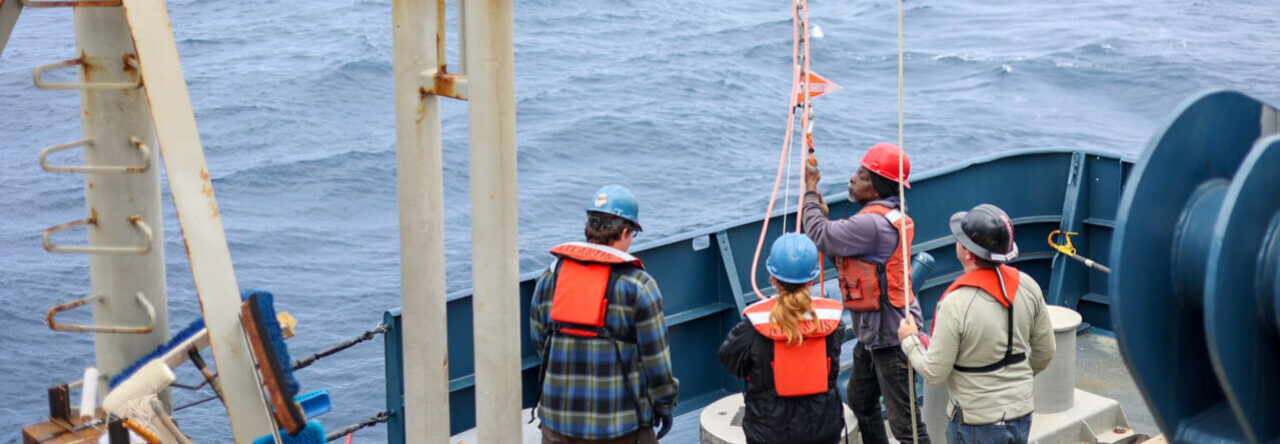
The new Okeanus winch passed its stress test, and we made a valiant effort at calibrating the Rugged Controls winch sensor as best we could. We finished rigging up the multi-corer and CTD/Niskin Rosette, then proceeded to make our first cast for cores! This site was relatively shallow at 2240m, and it takes about 45 minutes for the corer to reach the ocean floor at this depth.

The collection of the cores is controlled by the winch operator; once the corer’s feet land on the seabed, more cable is paid out to release the plastic core tubes into the sediment and gather the sample. We spent several days coring, with the science crew also working long hours to get all the samples processed appropriately. All of their work needs to be done in oxygen-free environments (nitrogen-filled glove boxes) so as not to alter the chemistry of the sediment.

After the science crew was happy with the amount mud/pore water we collected, we switched the winch cable to the CTD/Rosette and sent that over. It was cool to watch the CTD take a profile on the descent and then to fire the Niskin bottles to close at various depths on the way back up.

Driving the winch to land the multicorer on the seabed and assembling the CTD and using its software program (SeaSave) were some of my favorite tasks this week.

Since being in transit, I have also spent some time in the bridge standing watches. I learned a lot about the systems on board and the maritime field in general by talking with the deck crew and officers.

Today (Monday 6/17) we set our clocks forward by an hour to -3 UTC…the cities of Halifax and Buenos Aires both work as a correct time zones.

I am feeling very grateful that the ship has an awesome kitchen and steward team. We have been eating well, thanks to John and Insuk. In addition to the science party, the marine techs, and the kitchen and steward crew, the engine room and deck crews have also been working hard. It has been exciting to see how all these teams come together to make for a successful day.

Also, basking sharks and dolphins!

Thanks,

Eddy

Introduction Ayse Macknight

Hey Y’all! My name is Ayse (“I-Sha”). Right now I am gearing up for my upcoming internship on the R/V Marcus Langseth, and I couldn’t be more excited! A little information about myself, I studied Oceanography and Scientific Diving at Cal Poly Humboldt. I have been very fortunate to experience many different jobs and I like to keep busy. I have worked on the R/V Coral Sea since 2019 and have loved every minute of it. I have had many different positions on the vessel but my main ones would be, the Student Research Assistant for Zooplankton Ecology Lab,  NOAA Cruise Assistant, Class Teaching Assistant, and Deckhand.

In my free time, I enjoy being outside and reading. 

Introduction – Chaii Layne-Neubauer

Hello Everyone,

My name is Chaii Layne-Neubauer and I am one of the interns about to sail with the R/V Marcus G. Langseth on its next voyage from New York to Iceland! To introduce myself, I grew up on the beaches of California and in the deserts of Arizona. I got my Bachelor’s in Mechanical Engineering from the University of Arizona and then worked as a test engineer for Caterpillar for a time. Recently, I’ve been pursuing working in the marine research world so this opportunity has been a dream for me. This will be my second research cruise, the first being aboard the R/V Sally Ride working with a water sampling team for Scripps where I learned the ropes of CTD deployment and fluorometer readings. In my freetime I enjoy cooking, fishing, taking apart (and sometimes putting back together) cars and a good horror flick. I cant wait to begin this new adventure so keep an eye out for updates from me on the weekly!

Duva Week 0: Introduction

Hi!

My name is Eleanor “Eddy” Duva and I will be joining the R/V Langseth crew as a UNOLS MATE intern next week for a research cruise in the North Atlantic.

I graduated from the University of Vermont (UVM) and then spent some time working and living aboard sailboats. In the past year, I began working as a fisheries technician and vessel crew on UVM’s R/V Marcelle Melosira. I am looking forward to learning from all the folks on the Langseth crew, and particularly interested in learning about sediment coring gear and how they manage CTD data.

Outside of work, I like to be outside, read, and make stained glass pieces.

Week 5: Land and the End of an Adventure in Site

5/25/2024 – 5/28/2024


At the time this blog was posted I had already been home for a couple of days, but I realized even though only three days were left between my last blog post and our arrival in New York City I still needed to finish telling my story. 


Saturday 5/25, was spent putting my carpentry skills to work. I had to fix a sliding door with a bad roller and ceiling tiles that fell out of the ceiling in the Tech Shack.


Monday 5/27, we arrived in Long Island Sound and spotted land for the first time since Cape Town. Although it was very foggy all day, we could barely see the land and eventually it started to rain. We spent the day cleaning the Gun Shop, Tech Shack, Rack Room, and cleaned an air gun for display. Visitors will be coming to the ship a few days after we dock so everything needed to look polished and clean.


The morning of Tuesday 5/28, the fog finally lifted and we were able to see the magnificent New York City skyline in the distance. That morning we rendezvoused with the pilot boat and began making our way to the Hudson River. As we passed under the Verrazano Bridge, connecting Brooklyn to Staten Island, and were able to see Manhattan’s imposing skyscrapers and the beautiful Statue of Liberty in the distance getting ever closer I started to get emotional. At that moment, I found myself thinking about the countless number of people who have made this same journey up the Hudson River in search of a better life in the United States of America to include some of my ancestors. After passing the Statue of Liberty and Ellis Island, we went under the Brooklyn Bridge and Manhattan Bridge to finally arrive at our destination, the Brooklyn Navy Yard. 


I am grateful for the opportunity to be aboard the R/V Marcus G. Langseth during this transit and would like to thank all of my mentors and crew who were able to teach me about being a marine technician and about life at sea. To anyone that has been following my journey and may be interested in this line of work, I encourage you to look into and apply for the UNOLS-MATE at Sea Technical Internship Program.


Thank you so much for following my UNOLS-MATE experience!


Week 4

Hey everyone, Ray here giving you my final blog post about my transit across the Atlantic Ocean on the R/V Marcus G. Langseth. This past week has been a time of deep reflection as I consider the next steps of my career. I feel that it is important to convey just how much of an experience this internship as been, and how many doors it really opens up for me in the future. Today around 9:30 A.M, our ship anchored 10 nautical miles off the coast of New York. Tomorrow we will set sail into Brooklyn Navy Yard after the harbor pilot boards our boat, and directs us through the channels. After that, International Customs will come on board to verify our passports and we are then free to hit the gangway. Along this journey I have came across a lot of mentors who are smart, hardworking, and genuinly great people. One of these mentors I met is Khalif. Khalif is an intelligent muslim, I call him Habeeb. Khalif wasted no time in acquainting me with life at sea and opening my eyes to various offshore career paths. Khalif taught me about valuable life lessons and principles, and he portrayed a role of the big brother I never had. I also found out he lives about 2 miles away from me. With how big the ocean is, the world is still so small.

Thank you for tuning into my blog posts on this adventure! 


Week 4: Land on the Horizon

5/18/2024 – 5/24/2024


When this blog is posted we will be 3 days away from NYC. This adventure so far has been one of the hardest and most rewarding educational experiences of my life. But, with our final destination looming over the horizon the consensus is the same amongst the entire crew, we are ready to see land!


The morning of Saturday 5/18, was spent inventing all of the bad air gun parts and securing them on pallets. These parts will be either repaired and used on future seismic missions or sold for scrap.


The highlight of Sunday 5/19, was that it was the calmest day that we have had the entire transit thus far. To be far, we have been very fortunate to have not much bad weather on our transit, but that day the water was like glass. The water was so clear and so calm that I was able to see Atlantic flying fish before they leap out of the water and the shimmering pillars of sunlight that faded away into the seemingly endless void that is the Atlantic Ocean’s depths.


The morning of Monday 5/20, was filled with the science team working together and cleaning the entire Main Lab space. The lab was in need of a “spring cleaning” and we were all able to make the lab look better than it has looked in a long time.

Believe it or not, Monday was also my birthday! I still went to work and had all of my daily duties to perform, but I don’t think I could have asked for a better gift than the incredible sunset that night.


Tuesday 5/22 was spent working in the Rack Room. This is where all of the computer systems scientific, navigational, networking, ect are stored. I was tasked with stripping wires, attaching connectors, and connecting them to their respective terminals. I also attempted to organize the maze of networking cables. That was a real challenge!


Stay tooned for my final blog as we get closer to NYC.

Week 3 “Seas the Day”

Hey everyone, Ray here, giving you an update on my third week across the Atlantic Ocean on the R/V Marcus G. Langseth. As we move farther away from the equator and closer to New York, the temperature and humidity have dropped dramatically. For my third week, I have been assigned a multitude of tasks. One of my tasks this week was to work with Josh, our chief source mechanic, to test the continuity of the wires within the octoblocks of the arrays and trace them back to our junction box while verifying our resistance with a multimeter. Our vessel has four arrays that trail hundreds of meters off the stern via large cables, (streamers).These arrays consist of various components that transmit the data collected by the hydrophones from the sound waves emitted by the air guns, which reflect off the ocean floor. Within the arrays, there are components called octoblocks. Essentially, an octoblock acts as a sensor placed along the array to receive different signals such as DI/PI (Depth Indication and Pressure Indication), GPS signals, NFHS (Near Field Hydrophone Signals), and other types of data being collected.
Another task I have been assigned is testing the strength and continuity of our large collection of Ethernet cables, which seem to have accumulated into the thousands over time. I used a network and cable tester that also measures the length of the cables by measuring their resistance. After a long workday, we are always exhausted but are still eager to enjoy the sunsets every evening on the bow of the vessel. Almost every sunset on the ocean is a humbling experience, to say the least.

Here are some pictures of my week; stay tuned for my final blog post in 7 days!


WEEK 3 – Be Here Now, Because You Are

Retrospect on the deck of the R/V Langseth, with the vast expanse of intense blue of the ocean stretching out before me, I can’t help but reflect on the journey that led me here. This Marine Technical internship with the US Academic Research Fleet, in collaboration with Columbia University, has been a long-awaited milestone in my career. Months of preparation and hard work have culminated in this moment.

As we learn daily maintenance of the scientific and navigational systems that are crucial for seismic research, I feel a deep sense of accomplishment and gratitude. Every task, no matter how small, contributes to the larger mission of scientific discovery. Being at sea, surrounded by the relentless rhythms of the ocean, I find a sense of peace and purpose.

It’s hardly appropriate to keep saying …but sometimes I really can’t believe that I’m here. If you really think about it, how many actual times can you send your family this when they want something. Kidding, I love you idiots. 


It goes without saying that I’m a part of something very unique. And without the support of my home university and the various programs offered to me, I would have never been able to have the financial freedom to leave for a transcontinental internship at-sea or weeks on end. I have so much gratitude for that – to all you out there at the University of Southeast Ketchikan Maritime Center and the folks at the STEP Grant offices, THANK YOUUU! I have never felt more supported as a student and I wanted to show how thankful I truly am. (Special shoutout to Professor Boss, Professor LaBarge, Lisa, Angie, Jensen, and Deepwater Bill!)

With the support and guidance of the UAS Maritime Center, this experience was able to happen and is more than just a professional achievement; it is a personal journey of growth and learning. I think of the words of great authors who have inspired me along the way, and I realize that this experience is a chapter in my own story, filled with challenges, triumphs, and the boundless curiosity that drives me forward. And this doesn’t come without failure. To thrive, we must sustain the internal human operation – because who you are when things aren’t going great…matters a great deal. “We are what we pretend to be, so we must be very careful what we pretend to be.” (Vonnegut)

This trip has been a significant retrospective and introspective – on many things beyond academia. I think that’s why it has so much meaning, it’s taught me a lot about myself and who I get to be. As the days pass and we continue our research, I am grateful for the opportunity to be a part of something so meaningful. And as I look ahead, I know that this experience will shape the path I take in the future, guiding me toward new horizons and endless possibilities. And if I’m lucky, it’ll be the first step I ever took to make the biggest life change that I never thought possible in a three-dimensional state of mind.

Here’s to the 3rd week on the road…

-Rachael

Page 4 of 10

Powered by WordPress & Theme by Anders Norén