We’re done with dives! Yesterday was the last Alvin dive of the cruise and we’re heading back to Astoria, Oregon to drop off the scientists before we go on our transit to San Diego for offloading. Most of the week has felt relatively routine by now – getting Alvin ready for dives in the morning, turning on various beacons and radio devices, cleaning camera lenses, refilling CO2 scrubbers, etc. so I’m going to be recapping some notable highlights. Hard to believe we’re already done with dives and switching to a new schedule right as I was getting the hang of things!
The variety of people on board the Atlantis has been pretty interesting to talk to. Since our professions and backgrounds are so different, it’s been fun to chat with scientists, maritime crew, and educators about their roles on and off the ship.
Every time Alvin returns from a dive with the bio box used for collecting organism samples, it’s always entertaining to see what fruits the depths have yielded for us that day. In this picture, they’re mostly tube worms with bacterial growths (the white fuzzy parts).
horrifying creatures of the deep, as usual
Some students from Arizonan schools have sent in decorated Styrofoam cups for the sub to bring down to the seafloor. Due to the extreme water pressure (more than 200atm at over 2000m of depth) that’s down there, the cups end up getting squashed into these cute Shrinky Dink-like crush cups. I made one for myself on Monday, and the result is in the pic below. I’m quite fond of it.
Little alien I drew on a crush cup
On the final dive, I got to ride on the small boat that retrieves the swimmers. It was a nice feeling to be out on the water on a smaller dinghy, and I got some new POVs of the dive procedure. All in all it was quite entertaining, and I feel like I got a better understanding of the diving process from all roles.
Alvin and Atlantis, taken from the small deployment boat
It’s not all work out here anyway – there’s also plenty we do to keep morale high during monotonous hours when work feels stressful. Once when the seas were calm and the sun was out, the galley moved out onto the front deck for lunch to grill burgers and hot dogs. I really wasn’t expecting something like this, so it was a nice change of pace to rewind with a soda and chat with the crew.
we like having fun sometimes and by fun i mean a truly absurd number of grilled burgers
benefits of being in the middle of the ocean with literally nothing
A silly picture of me in the sub helping pilots run end-of-cruise maintenance checks. Learning about all the procedures and failsafes built into the sub was very intriguing.
Joyous whimsy
This evening, another pod of dolphins came to visit the bow of the ship again! There’s no way to really tell if they were from the same pod, but they were of the same species at least. It felt like there were a lot more than last time – I’m taking it as a sign of good luck and safe voyages seeing as they also greeted me when I came out to the ocean for the first time.
Dolphins on our way back!
Offloading at Astoria and transit starts tomorrow, so that’s what my next update is going to be about. See you soon!
It has been a busy second week. This week I finally got to see the launch and recovery process of Alvin, which was amazing. The weather was ideal at first, with very calm seas—almost flat for the first couple of days, which is uncharacteristic of the Juan de Fuca Ridge. Later on, the swell returned to double digits, which took some getting used to. Nevertheless, I had the opportunity to get my hands dirty with the pre- and post-dive operations alongside the mechanical team.
Most mornings during pre-dive, I helped flush the lines of any air or water with either Carnation, hydraulic, or Brey oil, depending on the system. This ensures proper pressure compensation in the junction boxes that house the electronics for the ballast systems, communications, etc. Brey oil, I learned, is used instead of Carnation to prevent arcing in electrical boxes that draw more current. I also helped load the sub after the pilot finished their pre-dive checks inside the sphere. During this time, I handed down CO₂ scrubbers, towels to remove condensation, blankets for comfort (since it gets quite cold), and lunch for the pilot and observers.
The sphere is very well taken care of. Before each dive, all passengers must shower and wear clothing made of natural fibers to ensure safety. Synthetic materials can be flammable and may wedge themselves in the window seals, which play a crucial role in maintaining the pressure boundary. Even when the hatch is inspected in the morning, the person conducting the inspection must be free of oil and dirt to maintain cleanliness. After the sub is launched, we scrub the hangar and refill the oil containers so that everything is ready for any evening maintenance.
Post-dive operations can be a little fast-paced. As soon as the Launch Coordinator indicates the sub is secured on deck, we quickly rinse down the entire sub to prevent corrosion, cover the windows, and remove access panels to begin inspections. I always do a general “mech inspection,” which involves walking around the sub and checking for any loose bolts, wiring, or abnormalities. This past week we had water intrusion issues with the port main ballast blow box. We spent a few late nights draining and pressure testing the box, as well as testing the check valve and bladder for leaks. Unfortunately, we still haven’t found the culprit, but hopefully by the next update I’ll have an answer.
Additionally, there was water in the port thruster—which is bad, but also good for me, because I got to help take it apart. First, we swapped the motor for a ready spare so the sub was dive-ready, then made the repairs. We drained the motor of hydraulic oil, replaced a damaged O-ring and crane seal, and then carefully refilled the motor. This was fun but tedious, since every bit of air introduced into the system has to be removed. You wouldn’t think it would be much, but it is—so we had to slowly fill the motor using a tube while shaking it to release all the air.
All in all, it was a great week. I was able to watch the recovery process from the bridge and see the captain’s role in retrieving the sub, and I even got to check out some of the critters scientists collected in a bio box from the hydrothermal vents!
It feels kind of odd to say that it’s only been two weeks since I left, but I found that being on a vessel tends to screw up your sense of time. I’m sure the other members of the crew agree with me.
We’ve had a total of five dives so far, and dredged up plenty of interesting things. The dives for yesterday and the day before were cancelled due to unfavorable weather conditions, but it went somewhat back to normal today so we got to have a pilot-in-training dive, albeit the deployment was later than usual.
There’s a wide variety of samples that we collect on this specific cruise – sometimes we take water samples of the hydrothermal vents using isobaric gas-tight samplers (IGTs) which help keep contents pressurized when the scientists are doing experiments on the nitrogen-cycling properties of the microbes in the water. Sometimes we also bring up freaky little creatures like tube worms and this scale worm in the picture below!
A scale worm we dredged from the Endeavour hydrothermal vents
Depending on what kind of samples we want to collect, naturally we would have to change tools for the job. The basket in front of the HOV Alvin typically holds all the equipment needed to complete the dive objectives of the science team for a dive, and it is our duty as the maintainers and technicians of Alvin to swap these out as needed per dive.
Us handling a Universal Fluid Obtainer (UFO) on the basket
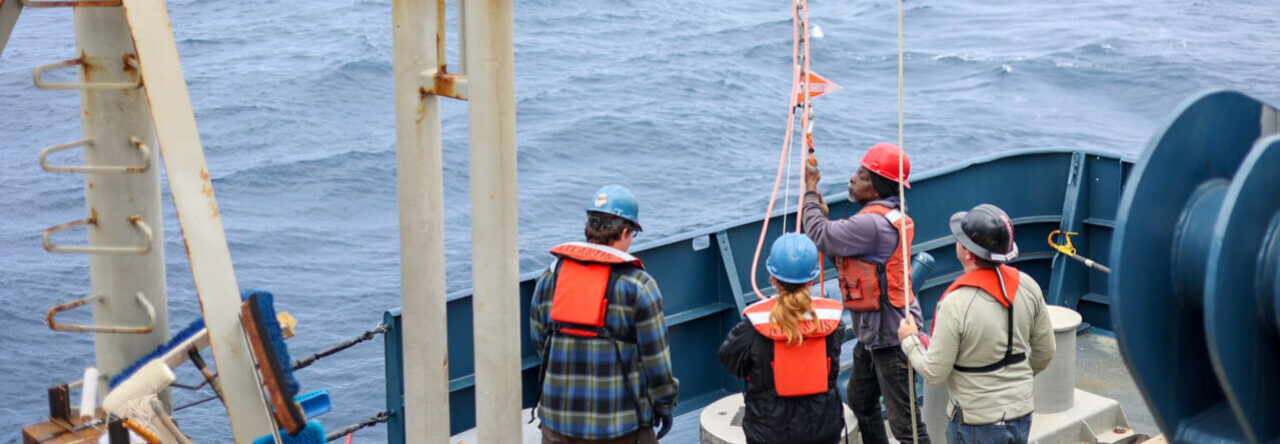
As an intern, my daily routine usually consists of getting up early start helping the team with pre-dive checks – making sure that cameras are striped, calibrated and properly cleaned, ensuring parts on the HOV are secured, refilling CO2 scrubbers, etc. We roll Alvin out on the tracks leading to the A-Frame at the aft of the ship, where we attach stacks of ballasting weights to it and put the pilot and observers in before we send it into the water.
Sending Alvin out using the hydraulic-powered A-Frame
Once the HOV is in the water, swimmers on a smaller boat will go to it and do some last minute checkups like unhooking safety lines and verifying communications are good to go. The phone the swimmers use to talk to the passengers of the sub is actually not waterproof, so while they’re verifying comms they also have to be very careful not to get it wet. The design is kind of counterintuitive, but the fact that the phone does not need to be powered independently makes the drawbacks worth it. Still, it is pretty comedic to see the swimmers make their way back to the little boat raising what looks like an old landline phone above them the whole time.
Almost done with deployment. Boat and swimmers.
After the sub goes down, we have someone in the top lab to monitor GPS position and to maintain communications with it every so often. Us interns usually take this time to clean up our messes from the morning of deployment, and then it’s time to muck around until we get the signal to get ready for retrieval.
swabbin timeBringing him back in
During retrieval, we finish up with post-dive tasks like hosing down the sub to wash off the saltwater and securing him back in the hangar for safety and in case bad weather starts rocking the boat around. We usually get some sort of report from the pilot about equipment or components that didn’t work so well and may need to be fixed or replaced, and our evenings are pretty much occupied with post-dive and fixing up the sub for tomorrow’s dive.
Of course, if the weather conditions are unsafe for swimmers or pilots we may have to call off some of our dive days. The swells were pretty big yesterday and the day before that, and we used the time not diving to finish up any maintenance that we’ve been putting off – fixing of lasers, replacement of important wires to the propellers that route inside the sub, things like that.
The weather’s getting a little rougher…
I’m learning lots of things out here. I haven’t needed to do any of this in my daily work, but the crew and the Alvin team taught me a whole array of knot-tying techniques which I’m sure is going to come in handy someday…? During downtime I also try to see what the other departments are up to, like bothering the scientists in the lab to find out what they’re doing with the water samples we bring them, or pestering the bridge about navigation. It’s been lots of fun, but it’s also starting to feel like I already spent a month or two at sea. Time is not real on this vessel.
I just wrapped up my first week with the Alvin Team, and it’s been amazing in more ways than one. Upon arriving in Oregon, I finally got to meet the team in person. Everyone has been wonderfully patient and kind, showing me the ropes of both their operations and, of course, the engineering behind Alvin. I also met the crew of the RV Atlantis during a Labor Day picnic and cookout they hosted on the dock before we set sail.
This week, I was introduced to the sub and its critical systems. Since Alvin hadn’t been operated for about a month, we spent three days on maintenance, which I was able to observe and help with when possible. Some of the tasks I participated in included ensuring pressure compensation in the junction boxes and tubing that house communication cables, pressure testing the check valves on the main and variable ballast systems, and installing the seawater filter for the variable ballast. I also learned how the team inventories and stores spare parts, as well as the strict protocols for replacing them. Their attention to detail is remarkable—every component must meet precise standards, and even the slightest thread damage can make a part unsuitable for dive operations. I also witnessed the installation process of the batteries; they provide 120 volts to the sub. We rolled out Alvin to expose a hatch between the tracks in the hangar that allows access to the hold where the batteries are stored and maintained. The batteries were lifted into the sub using hydraulics.
In preparation for the first engineering dive, I helped remove the coral-cutting claw from the robotic arm and replace it with a three-pronged gripper more suitable for this expedition, collecting high-temperature water samples at hydrothermal vents. We also held the “weight party,” where we stacked steel plates to aid Alvin’s descent on the Juan de Fuca Ridge. Unfortunately, our first dive was canceled after a recovery buoy detached from a Canadian mooring line. Since we were nearby, the RV Atlantis was asked to recover it, which we did.
Even so, I’ve already learned so much about plumbing and mechanics in just one week, and I’m excited to see the data and pictures that Alvin collects after all our dives are complete!
Week 1 is already over, and it still feels kind of surreal to be out here. There have been so many exciting things and interesting people that I’ve encountered that it’s difficult to recount them all in one post without boring everyone who reads this, so I’ll show the most important things.
I met up with the Alvin team after flying down to Portland from Seattle, where we drove down to Newport where the Atlantis was docked together as a group. When we got there, I got to take a quick tour of the premises. As someone who’s never been on a research vessel, the Atlantis felt pretty average from the outside but was way bigger on the inside – rooms and halls were pretty spacious to move around in. Onboard amenities were much more fleshed-out than I thought they would be (there was a punching bag in the science hold?!), and the galley cooks up meals way better than I ever did in my entire college career. Shoutout to the cooks who greet me by name every meal.
First time seeing the Atlantis!I WILL be wailing on this punching bag during my time off
As for the HOV Alvin itself, it was also pretty big – maybe the size of a small whale or an orca perhaps. During our pre-cruise maintenance and housekeeping work I got to walk around the top of the sub and climb into the sphere where the pilot sits. Alvin recently got a refitting recently with an ergonomic seating area, and I have to say it was decently comfortable in there.
Me with the HOV Alvin in the upper portion of the hangar.This is one of the submarines of all time.
Most of my work on the sub has been checking in on little things like searching for air or water bubbles in the tubes of oil inside the HOV or draining said oil from junction boxes in the front so that we can wire scientific instruments to the electronics systems. I helped with loading provisions and stores to feed us during the cruise onto the ship and checked the windows on the sub for scratches or blemishes. The two most exciting events that I helped out with were replacing one of the fridge-sized lead acid batteries and distributing and stacking steel plates which will eventually be used for ballasting.
To access the batteries in the first place, we had to move Alvin forward in its hangar to operate a crane that would open the hatch in the floor that led to the room with the battery in it, which was process that took a little time to complete. The battery that was supposed to go into the Alvin didn’t come with a casing on it, so part of our duties during the pre-cruise was to get the casing off the old battery and slide it onto the new one – main issue being that the casing is basically filled with oil. One aspect of this job I learned very quickly was that literally everything is covered in oil since it helps mitigate the effects of pressure in the deep ocean, and that I should give up on the prospect of having any unstained clothes on this cruise.
One of Alvin’s lead acid batteries returning to its designated slot via hydraulic lift.
The stacked steel plates are used for the sub used as ballast to control its buoyancy underwater, and it dives down or resurfaces by jettisoning some amount of these steel plates that we attach to it. As such, we had to prepare several stacks since every dive would have at least 3 stacks of plates weighing more than 300 pounds per stack. Picking up these rusty steel plates all morning was a decent workout for my forearms. I also got rust all over my clothes, but I brought all the clothes whose safety I didn’t care about so it was expected. It’s for that grimy mechanical engineer aesthetic anyway.
Fellow MATE intern and coworkers chatting during the weight party.
We left Newport yesterday on the 5th. Due to the size of the vessel the boat rocks pretty slowly, which is nice to fall asleep to but kind of annoying when you’re doing fine, detailed work with small instruments and tiny probes. It’s better than the smaller boats I’ve been on though. Seeing the vast expanse of water on every side of you with nothing to keep you company except the ship and the gray clouds overhead feels kind of surreal. Liminal, even.
The views of Newport, Oregon.
I lied about that last part, actually. There were other things keeping us company – there was a massive pod of dolphins that swam up to the ship as it was traveling to our dive site, and they were just frolicking and being silly on either side of the ship and under the bow, racing the ship and jumping around. We guessed that they were Pacific white-sided dolphins based on their coloring and our location. Genuinely one of the most breathtaking experiences I’ve ever had.
My poor attempts at capturing the moment.
I’ve been having a lot of fun the last few days, and I expect to have even more fun when we actually get around to Alvin dives tomorrow. It’s around 9pm when I post this, and I do have to wake up at 5am for deployment preparations, so I’m going to leave it at that for the time being. Will update next week.
Hello everyone! I’m Katie Wade, a recent Ocean Engineering graduate from the Florida Institute of Technology. Soon I’ll be heading to Oregon to join the WHOI Alvin Team on the RV Atlantis for a research cruise along the Juan de Fuca Ridge, where I’ll be working as a Mechanical Engineering Intern.
I grew up in Merritt Island, Florida, which fostered a deep love, respect, and curiosity for the ocean. For me, nothing beats a day on the water, so I’ve always hoped to blend fieldwork into my career. I never expected that pursuit would lead to such an incredible adventure—I’m deeply grateful to the Alvin Team and the MATE Program for this opportunity.
During my undergrad, I spent two years at the Center for Corrosion and Biofouling Control (CCBC), where I worked in a multidisciplinary environment that deepened my understanding of how marine life intersects with engineering. I also helped design and build an ROV as part of a team project, which inspired me to pursue underwater robotics. So, I’m excited to continue growing both my ecological knowledge and technical skills on this cruise to become a better engineer!
Here are some pictures of me with other students from the CCBC and working on deck the RV Hogarth during a marine field project last summer.
Hi! My name is Aidan Lee, and I am one of the interns working with the electrical team of the HOV Alvin through Woods Hole Oceanographic Institution on the R/V Atlantis in early September. I’ll be boarding in Newport, Oregon after meeting with the team in Portland, and I’m excited to get to meet everyone there! I graduated with my bachelor’s degree in Electrical and Computer Engineering at the University of Washington in Seattle, and joined a remotely operated vehicles robotics team competing in the MATE ROV Competition during my time as an undergraduate. I’m looking forward to seeing what ways my technical skills from developing ROVs can apply to the HOV Alvin at sea!
Below I’ve included a few pictures of me, some of which are during the 2025 MATE ROV Competition in Alpena, Michigan. I’ve got friends on the team who have previously been MATE interns who speak very highly of the program, so I want to make the most of my experience here.
I will be back with another update in approximately another week or so. See you guys then!
On the 1st of July, we completed our final dive operation and started on post cruise tasks. Instead of rolling the sub all the way back into the hanger, we rolled to the middle of the deck and pulled off all the skins (large fiberglass panels that cover the exterior systems). Laying all of the skins on the deck of the ship, we began spraying down every inch of the submersible with a special titanium safe detergent solution. We used large scrub brushes to clean the syntactic foam surfaces and the removed skins. After the cleaning, we reinstalled most of the skins and rolled the sub back inside the hanger.
The Alvin submersible getting a thorough post cruise cleaning.
The next morning, we arrived back in Dutch Harbor and continued our post cruise duties. One of my roles during this period was to prepare all of the sub’s hydraulic and oil compensated systems for hibernation. This involved hooking up a vacuum pump to every junction box reservoir and hydraulic system one at a time. I then slightly drain down the fluid level in each volume. For humidity sensitive systems, such as the 2 main junction boxes, I would replace the oil as it was drained with nitrogen gas, ensuring no humid air would be introduced into the new atmosphere. Draining down these systems ensures temperature changes during transit and other expeditions will not build excess pressure inside the delicate boxes.
Beautiful morning arriving back into Dutch Harbor
Port side Main junction box (left), and battery contactor box (Right), both drained down a few inches.
Once all systems were prepared, we installed the huge blue car-style canvas cover, ensuring Alvin would stay nice and clean while not being used.
Alvin under the big cover.
The day of July 3rd, we finished tidying up all of the Alvin work spaces and buttoned down the equipment that won’t be used for a while. We then spent the next few hours cleaning our rooms and packing up all of our belongings, getting ready to disembark the Atlantis. In the early afternoon, I disembarked for the last time and got a ride to the grand Aleutian hotel! The Alvin team and I didn’t fly out of Dutch Harbor until the 5th, so we had a few days to explore the breathtaking landscape.
After we left Dutch Harbor on the 5th, we landed in Anchorage. I stayed another two days there with a few members of the Alvin team, exploring the area.
The following section is basically a photo album of my favorite pictures and fondest memories, including my adventures in Dutch harbor and anchorage.
Work in progress photo of my hand painted helmet!
The 2 most incredible dive day sunrises.
An awesome picture taken by Lance Wills. The picture shows the Alvin submersible being brought in by the tow line. The person standing at the right corner of the ship is me watching the recovery!
A silly picture of Myself, Alex on the left and Colten on the right. Two members of the ship’s crew.
Mt Cleveland left and Mt Carlisle right, two of the incredible volcanos that make up The Islands Of The Four Mountains.
One of the Aleutian islands emerging from the fog during a rainstorm.
Moving onto my land based adventures, there were many! From hiking to the summit of one of the Aleutian mountains to hanging out around a bonfire with some of the incredible folks that call Dutch Harbor home.
3 photos I captured from the peak of Amaknak Island Unalaska.
An incredible view and a snowmelt pond near one of Unalaska’s peaks.
A few of my favorite rock stacks I made on a beach in Dutch harbor.
Sitting around a bonfire behind the Norwegian Rat Saloon, after the cruise.
Resting in a meadow after a hike in anchorage, with some of the Alvin team. Wren, Molly, Janna, and Nick.
Two more pictures from our adventures in Anchorage.
Lastly here is a photo of me! This photo was taken the night we first arrived in Dutch harbor after the 11 day transit from San Diego.
This adventure has been one of the most incredible experiences of my life. The opportunity to work on the Alvin team as a mechanical technician, even for a month, is something truly unique and an adventure I won’t soon forget. Thank you for reading my blog posts! I hope you enjoyed my adventure, because I certainly did!
Since my last post, I have concluded my technical internship aboard the R/V Atlantis. Now that I’m back home, I can take some time to update my blog and tell the story of Alvin Dive operations.
Departing Dutch harbor on June 15, we set sail further west along the Aleutian chain.
Pilot boat pacing alongside the Atlantis waiting to pick up the Pilot.
Arriving at our first dive location on the 15th a few miles off Bogoslof island, my job was to arrange the science basket by installing and moving around push cores and bio quivers, attaching Niskins, and securing bio boxes. I would meet with the Alvin Pilots frequently, getting feedback on equipment position and making changes to ensure the instruments were in optimal positions for the robotic arms to access.
Science basket prepared for first dive operation
The morning of the 16th at 5:30am, we started completing the first pre-dive checklists of the expedition. My role as a mechanical technician that morning was to top off all of the compensated volumes on the vehicle. These are oil filled volumes that enclose various critical systems including the main junction boxes, battery contactors, and solenoids. There were 3 main types of oils that I would top off: bray, carnation, and hydraulic. Topping off these volumes included plugging in a portable pump sprayer, with the desired oil, into one of the the fill ports on the vehicle and connecting a drain bottle to the opposite end of the system. I would then lightly pressurize the system, monitoring the fluid entering the drain bottle, ensuring there were no air or waters pockets within the system. This process was repeated for each of the 14 main oil compensated volumes on the port and starboard side of the sub.
Taking a short break from pre-dive tasks to watch this breathtaking sunrise over the Bering Sea.
My morning tasks would vary by day. Sometimes I would polish and inspect the windows while other days I would spend most of the pre-dive making basket adjustments, ensuring all the sample collection devices were arranged how the science team and pilot preferred.
Testing the port side manipulator to ensure all joints are functioning properly.
Next, we would roll the sub out onto the back deck, and install the drop weights. These six weights are the main form of major buoyancy adjustment. All six attached allows the sub to descend fast, release two weights to achieve neutral buoyancy, and release an additional two weights to ascend to the surface. The last two weights are reserved to allow additional weight loss, in case extra buoyancy is needed to resurface. These weights are installed using specially designed hand carts that lift them using a hand-crank style forklift mechanism.
Installing steel drop weights alongside Alvin Mechanical Technician, Wren Sakai.
Deploying The Submersible
After all pre-dive checks are completed and signed off, the sub is attached to the LARS (launch and recovery system). The sub is attached to the LARS by several points: a tail line to prevent rotation, a main line wrapped around a titanium T-shaped lifting point, and a large hook that actuates downwards, locking into the lifting T. The pilot and scientific observers enter the submersible, and the hatch is sealed. Two divers are positioned on top of the submersible, and the vehicle is lifted off the deck of the ship. Once the vehicle is over the water, the main line is tightened, allowing the hook to release the vehicle. The main line then lowers the vehicle into the water. Once the sub is floating, the swimmers detach the main line and the tail line, allowing the sub to drift away from the ship. After some final checks, the basket support lines are removed, and the sub is ready to dive. The work boat picks up the swimmers, and the sub floods its ballast tanks, allowing the vehicle to begin sinking.
LARS moving into position to be hooked up to the Alvin sub.
Recovery Operations
After the science dive, we would stage the deck for recovery one hour before the sub surfaced. This included ensuring the tow line was ready to be deployed, and laying out various tools such as drills used to loosen the subs panels and drain bottles for fluid inspection.
The recovery would begin by first lowering the work boat into the water off the side of the ship. The work boat then cruises ahead of the ship to meet the Alvin sub as it surfaced. The boat drops off two swimmers who prepare the vehicle for recovery. When the vehicle is ready to be picked up, one swimmer stays on the sub while the other swimmer boards the work boat. The boat drives back to the ship and positions itself behind the Atlantis, as the ship slowly approaches the sub. We then lower the rear lifelines and prepare to throw the tow line to the work boat. Passing the tow line to the work boat was sometimes my role during the recovery. Once the sub was halfway past the ship, I would toss the heavy rope and floating hook to the work boat. The heavy rope attached to the center-back of the ship would pay out line, and I would monitor the amount of line remaining while communicating with the recovery coordinator. The work boat then intercepts the submersible as the tow line swimmer dives off the work boat, attaching the tow line to the back of the sub. The swimmers then deploy a sea anchor, a sort of underwater parachute secured to the submersible. This allows the sub to be held in tension behind the ship as it is reeled in like a big fish. Once the sub is directly behind the ship, the tail line is lowered and attached to the sub, soon followed by the main line. The sub can then be lifted out of the water and the swimmers dive off the side of the sub to be recovered by the work boat.
Swimmers diving off Alvin as it’s lifted from the water.
One of my frequent jobs was to remove the tow line from the back of the sub after it had been lifted over the deck and as it was being lowered. I would then immediately move into post dive tasks.
One of the Alvin technicians, Scott, removing the tow line as the sub is being lifted onto the deck
Post Dive
Once the sub landed on deck, the Alvin team and I would move in with pins to secure any remaining weights, install life lines, rinse down the sub with fresh water, and place protective covers over the windows.
Me rinsing down the windows and cameras post dive.
The work boat being lifted out of the water right after recovery.
During the majority of post dives, I would sit beside the sub right after it landed on deck and check every oil volume for traces of water intrusion. I would plug a waste bottle into 19 different oil volume drain lines, one at a time, and inspect for water or abnormalities. During this time, the scientists and pilot climb out of the sub and are welcomed by an applaud from the crew and science team. We then roll the sub back into the hanger and finish an extensive list of post-dive inspections and tasks. My usual job was working the scientists. I assisted in removing various equipment and samples from the basket, so the scientists can begin their analysis and packaging of specimens.
My perspective of checking compensated volumes for water.
This formed the pattern that most days followed with the occasional excitement where I would be asked to repair or inspect components that had failed during the dive. These tasks meant anything from reinstalling damaged mounting brackets on the science basket to disassembling and re-compensating large brushless thruster and hydraulic motors.
One of the large brushless motors partially disassembled and filled with WD40 to drive out any possible moisture.
The 18 day science expedition proved to be a big success! Despite several dive days being canceled due to weather conditions, we were still able to accomplish nearly all of the 13 dives we set out to complete.
Keep an eye out for one more blog update describing the post cruise activities including preparing the Alvin for its next few months of rest and even the non-work related adventures I was able to go on while in Alaska.
Today is day 17 aboard the R/V Atlantis! After 11 days on the pacific ocean, we have finally arrived in Dutch Harbor, but I’m getting ahead of myself. Let me start from the beginning. Boarding the ship, I was immediately met by a welcoming team who I would soon realize are some of the coolest, most genuinely passionate and skilled engineers in the world.
Forewarning this post has lots of pictures.
Walking back to the R/V Atlantis at night, with the backdrop of the San Diego skyline.
I spent the next several days working closely with the Alvin team, preparing the submersible and its supporting work spaces for the transit cruise ahead. These tasks included everything from organizing and cleaning the machine shop to assisting with the removal and inspection of Alvin’s viewport windows.
Cleaning and inspection of Alvin’s starboard forward window.
Leaving port in San Diego.
On Sunday, June 1st, we set sail on our journey to Dutch Harbor. Within 24 hours of leaving San Diego, we were greeted by 3 days straight of rough, unforgiving, turbulent ocean. Turning wrenches while getting covered in hydraulic fluid and fighting to keep your balance in 20 foot seas really tests your grit. The only escape from this constant roller coaster happened at night. The loud banging of waves crashing against the boat, the roar of the engines, and the shifting of every secured item in the ship trying to escape, formed a loud symphony, aggressively rocking you to sleep.
This sleep was occasionally disrupted by being thrown into the wall of your bunk by a large wave, or, in my case, the horrible sound of a gallon of bleach finding its way out of a cabinet in my room, flying through the air, and exploding against the opposite wall! Needing to evacuate your room at 3am because of a chemical spill is a rude awakening, one I will never forget.
Despite the challenges, this transit cruise was one of the most incredible experiences of my life so far. Having the opportunity to put my skills to the test in such a demanding environment is extremely rewarding.
Here are a few notable pictures I took during transit.
Here are 2 photos captured from the same angle. The first shows the back of the ship being pushed well above the horizon. The second picture shows the large swell as it continued on its journey.
Here is a picture of the rough unforgiving ocean captured from a hydro lab port side window.
This is a small part of the variable ballast hydraulics system featuring the accumulator, one of the many systems I have done maintenance on during transit.
A beautiful 10pm sunset off the port side. The first calm water in days.
Breathtaking view as we crossed over the Aleutians into the Bering Sea.
A perfectly cold and beautiful morning, arriving in Dutch Harbor, Alaska.
Since arriving in Dutch Harbor, the Alvin team has been hard at work preparing the submersible for the upcoming dive expedition. However, the convenient midnight sunset allows plenty of daylight for exploring this breathtaking new scenery after work.
Preparing to install Alvin’s Ballast tanks.
The view from Fort Schwatka on Amaknak Island, featuring Broad Bay, and Fort Learnard on the far cliffs.
This opportunity has been incredible so far, and it’s just the beginning. Tomorrow June 15, we will be departing on our 18 days of dive operations, exploring what lies bellow the surface of this breathtaking place!