Category: R/V Hugh R. Sharp Page 2 of 9

Week Three – Breaker Fixed

Welcome back. This week has been very interesting, we got a lot accomplished. I’ll start with the good news, the circuit breaker was ordered and has finally been installed and tested. The boat is operational and the crew is busy preparing for the last leg of the mission. The marine technician’s director mentioned that there may be an extension of our internship and another mission for us to get more time at sea.  This was great news and it felt like maybe our luck had turned around.

This week we have been busy finishing the keel pods that we prepared for painting last week. Alex and I painted the pods with blue anti-fouling paint, it took several days to get all the sides painted and touched up but we did a great job and they look fantastic. The next step will be setting up the sensors and attaching them to the pods so they are ready to insert into the keel. We also helped to troubleshoot the hydrophone system. The technicians were not receiving a data readout on the computer but they could hear underwater sounds in the attached headphones so we determined the data wasn’t being transmitted to the computer. After tracing the circuit out and testing a few connections we came to the conclusion that the new Windows operating system may be causing the issues with data transfer. The lead tech is emailing SoundGuard, the company that makes the hydrophone software, to see if the problem is related to software compatibility.


Thanks for checking in, 

Jake the Intern

Week Two – Still Stuck in Lewes

Welcome back, don’t worry I haven’t gone anywhere. We have been delayed due to a circuit breaker issue. The issue has caused the first leg of the mission to be scrapped. Alex, the other intern, and I have been given tasks to work on while we are stuck at port. 

This operation issue has been a big letdown, and with the first leg of the mission being scrapped, we will be spending the first three weeks of our internship at port. Thankful there are great and friendly people who work with us and have helped us continue to learn even stuck at port. The big project we have been working on this week is sanding and preparing the keel pods to be painted. 

Alex and I had to get safety glasses and respirators so we could scrap and sand off the old paint from the pods. The pods are made of aluminum and need to be coated in marine antifouling paint. The antifouling paint helps to prevent barnacle buildup while under the water. In an effort to be more environmentally friendly, the direct John Swallows had us gather and vacuum up all the paint chips and dust to keep it from running into the bay.

The issues with the circuit breaker have been very disappointing and the time lost at sea even more so but I am still trying to make the best of the situation and learn from the wise and friendly staff here. I also purchased an old bike so I could ride around and explore more of Lewes.

Until next time, 

Jake the Intern

Week One – Stuck at port

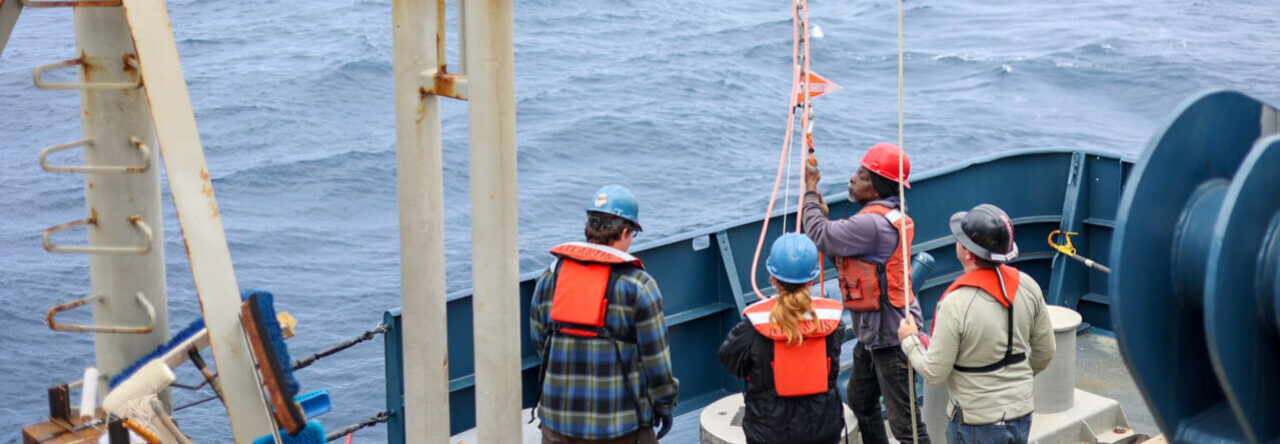
The first week has been a wild ride. When I arrived the crew and the lead scientist were in the process of mobilizing the operation. I helped with loading equipment and food supplies. The crew has been very welcoming and friendly to me. Above is a picture of Huxley, he taught me how to crip a cable loop on the end of a steel cable. We were scheduled to leave port last Saturday but as we were in the process of taking off there was an issue with the breaker for the bus coupler that sends power to the drives. The engineers have been working hard to solve the issue but now we are waiting for a replacement part from Italy. The hope is that the part will be here before this weekend and we will be off on the mission. 

This unfortunate event has allowed me time to see the town of Lewes, Delaware. I have explored the state park and visited several beaches. My favorite place has been the “conch hole” as I like to call it. Pictured above is that area and me holding one of the conch snails. I have never seen live conch snails and there are so many of them. They are very interesting to me, some are even larger than my fist. I found out that they can live up to 30 years. 

I am very excited to get underway and hope that the engineers are able to get the ship back up and operational. 

Until next time, Jake the Intern

Week 2 aboard Hugh R. Sharp

Hello again everyone! I hope you are all doing well. it’s been quite an exciting and eventful time since my last update. In the past twelve days, I have been exposed to many new and interesting things about the Sharp, its crew and equipment, and the logistics of setting up this type of survey.

Let’s start from the beginning. On May 9th I landed in Salisbury Maryland, and was greeted by the oceanographic manager for the University of Delaware’s Earth, Ocean & Atmosphere College. He drove us roughly an hour to Lewes, Deleware where the Hugh R. Sharp is docked. We got our first tour of the vessel and the surrounding area and were shown where we would sleep for the night. 

The Hugh, pre-mobilization: 

The following day we met most of the operational crew and started the process of loading up everything we needed for the survey. The Habcam and wet lab were hauled on the R/V using a huge crane, and I helped set up and secure a few things with help from the techs onboard. It was a pleasure to work alongside such professionals and I was in awe of how much they were able to get done in one afternoon. They were extremely accommodating and even asked us if we wanted anything specific for the grocery list (I wanted some minestrone soup and trail mix).

Hugh R. Sharp (left) alongside the Delriver (right): 


On the eleventh, we got to meet most of the science team (the rest of them would arrive at a later date) and had fun crimping 1/2″ steel cable. It would be the secure point between the LCI 90 port wench system and the Habcam. This wench would be used to slowly lower the Habcam in the water column once it was time for deployment. It took us a couple of tries to get it right, as the cable was pretty oily and hard to handle. 

One of the crimps that didn’t make the cut (didn’t have a long enough “tail”): 


I also learned a lot more about the different functionalities and sensors that the Habcam is equipped with. It’s a really unique piece of hardware that has port/starboard sides-scan transducers and a forward-facing BlueView sonar (plus a multitude of other oceanographic sensors). I’ve actually had some experience working with this sonar and it’s one of the most advanced I’ve seen so far, it’s got an extremely quick refresh rate to the point where you’re basically seeing objects in real-time in a 180-degree swath. 

BlueView mounted to the front of the Habcam for obstacle avoidance: 

The next day was for shopping! The generous folk at UDEL paid for any necessities we forgot to bring and got us a complete set of high-quality wet gear! The awesome thing is that we get to keep our stuff even after the survey is over. The wet gear will keep us warm and dry during the long days on the dredge shoveling scallops and what-have-you. Once we got back from our shopping trip we helped restock the R/V with all the groceries they got for the survey ($3,600 worth of food!).

Then, May 15th rolls around. The big day! We donned our immersion suits (I volunteered to do it for the safety drill, it was pretty heavy and hot) and went over the process of the abandon ship protocol. After several briefs, we prepared to leave the dock at 1600. We had a twelve-hour steam directly to the first fisheries station and I signed up for the night shift (2400-1200). This is where stuff turned downhill. The vessel’s breaker that routed power to the drivers (which powered the thrusters) had a mechanical failure due to years of wear and tear from the movement of the ocean. Everyone who could help immediately went to work to diagnose and remedy the issue, I stood by watching the troubleshooting process, and tried to learn as much as I could without getting in the way. 

After a couple of days of being dead in the water and the engineers working late into the night, they found the issue and discovered there was practically no way to fix it without getting a completely new breaker. The breaker we needed was only made in Italy of all places, and they immediately ordered a new one with expedited shipping. This brings us to the current day! Since the part that we need will roughly take a week to arrive, I have been spending time exploring and hanging out in the beautiful city of Lewes, Deleware. The crew has also taken us around town and showed us all the cool spots and sights to see, so I’ve been having lots of fun. 

Though I am a little saddened that we will miss the first leg of the trip, I understand that these things happen and it’s better we discovered it now at port instead of being several miles offshore! Plus we still have the whole second leg of the trip, where we get to stop by Woods Hole, Massachusetts and I’m really excited for that! Anyways, that’s it for now! thanks for reading and I’ll be here again next week to update you all on how it’s going, take care and have a good one! 

– Alejandro Dominguez 


Intern Introduction

Hello everyone! 

My name is Alejandro Dominguez and I’m a third-year student at Northwestern Michigan College. I am currently pursuing an associate’s and bachelor’s degree in marine technology, and I plan to graduate with my associates in the spring of next year. 

When I have some free time from college and work, I like to spend it doing stuff outdoors. Morel hunting, bird watching, hiking, camping, and so on, as long as it’s out in nature! 

I was originally drawn to the program because of this. The promise of hands-on work with oceanographic equipment on the Great Lakes was all I needed to hear before I signed up! 

Three years later I would be writing my first blog to introduce myself as an intern aboard the Hugh R. Sharp for its annual sea-scallop survey! It’s almost surreal as I would have never imagined myself to reach this point. I leave tomorrow morning and I’m extremely humbled and grateful for this once-in-a-lifetime opportunity. I owe it all to my instructors and peers at NMC, as well as the extremely kind and generous people at UDEL (Maria I’m talking about you!). 

I can’t wait to tackle this adventure with my fellow classmate and friend, Jacob Stremlow who will also be an intern aboard this survey! 

Thanks for taking the time to read this, and be on the lookout for weekly blog posts from Jacob and me about the sea-scallop survey aboard the Hugh R. Sharp! 

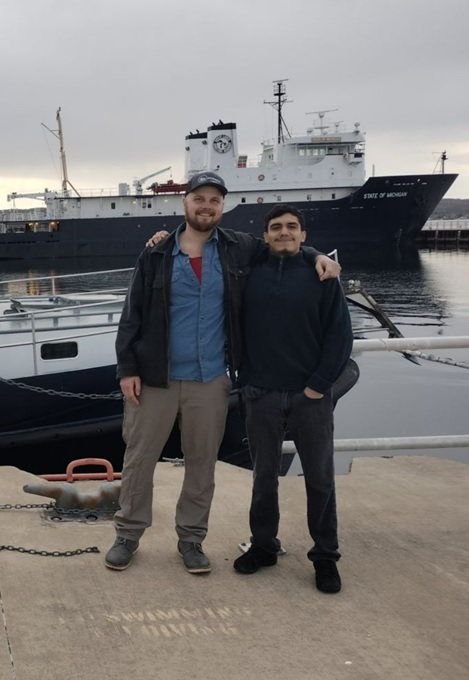
Jacob (Left) and me (Right) outside GL Campus 


Introduction

Hello,

It is a great honor to be selected for this internship opportunity. I am a full-time student at Northwestern Michigan College pursuing a Bachelor’s Degree in Marine technology and will be graduating this Summer with an Associate Degree in Applied Sciences with a focus on Marine Technology. The ROV and robotics side of marine technology are my favorite subjects but I’m also very interested in sonar and bathymetry. I have always had a great appreciation for the lakes and oceans. I enjoy learning about marine habitats and marine biology. To say that I am excited to get out on the R/V Hugh R. Sharpe is an understatement, I can barely contain my excitement.


Achievements

  • • Dean’s List Award from Fall 2021- Fall 2022
  • • 4.0 GPA in Marine Technology courses

Activities

  • Working on cars, tractors, and motors
  • Enjoying/learning about nature and animals
  • Creating/repairing circuits and electronics 
  • President of the NMC Rotaract Club 2021(sub-group of Rotary International)
  • Rotary International Exchange Student – Germany

R/V Sharp week 4

Operations during leg 3 consisted of Habcam Operations and dredging along with troubleshooting down systems with the ship’s marine techs. 


From the technician side of things, Habcam operations are very low maintenance. My tech duties consisted of Habcam deployment and recovery, backing up data, and monitoring the ship’s sensors. Because my tech duties were very low maintenance I was able to assist the NOAA Fisheries science party with piloting the Habcam and image annotation. 


Dredging operations during this leg were very high tempo compared to leg 2. A full dredge typically takes about 1 – 1 ½ hours and we were completing 4-5 dredges per 6-hour shift This meant I was typically busy and on my feet which was great compared to Habcam operations which can be mundane (if everything goes correctly). During dredging operations, my job is to help secure and dump the dredge and then I shovel the contents of the dredge to the sorters from the science party. 


During my watch, I noticed the ship’s CTD computer was unresponsive. I went to reset the computer but the computer was not able to power up. I then removed the computer from the rack and opened it up and found no signs of damage in the power supply or motherboard. One of the ship’s marine techs used a pinout of the power supply along with a multimeter to test if the power supply was powering the motherboard. He found that no power was reaching the motherboard so I swapped the power supply with one from an identical spare computer and we still were not able to power up. Then we decided that the failure was either in the hard drive which would be bad because we had non-backed up data in there or it was in the motherboard. To test this I connected the CTD hard drive to the spare computer. The computer powered up and was able to read the CTD hard drive. Immediately after we restored function we made multiple copies of everything on the hard drive so if it failed we would have a backup. 


Other than a weather delay and some down computer systems operations for leg 3 went very well and we were able to conclude operations one day early. After dredging operations were finished we steamed to Woods Hole and offloaded the science party and all of their equipment including the Habcam. During demobilization, I helped with crane operations by tying and handling a tagline to help guide loads like the Habcam and dredges in the correct orientation for transport. I also helped detach the recovery ramps for the Habcam and dredge and along with the other MATE intern helped secure them to the deck using ratchet straps. After everything was secured we steamed back to the R/V Sharps homeport Lewes Delaware and we demobilized the science van and the dredge table along with some other equipment. 

I had an amazing experience aboard the R/V Sharp. I got to experience what life is like aboard a Research Vessel at sea for a month from playing cards during downtime with my scientist buddies to hectic dredging and demobilization operations. The crew from the marine tech to the ship’s engineers did a great job at answering my frequent questions and I am incredibly thankful to the NOAA and WHOI techs who allowed me to work with them during troubleshooting on the Habcam. I was able to learn a lot about everything from seamanship skills like tying knots and securing equipment to software troubleshooting and wire tracing to find lost signals and troubleshooting advanced marine equipment like the Habcam. I’m proud I was able to make a real contribution to this science mission.

Week 4 R/V Sharp

This week started the last leg of the survey as we headed out of Woods Hole and back out to sea. We started with habcamming briefly reverting back to a 12 on 12 off schedule to better assist the science team with the habcam and with annotating the pictures from the habcam. While it was mostly more of the same with the species seen through the habcam we did see plenty of younger scallops, more than were in leg one I believe. After a few days of habcam we went right into dredging once more in which we managed around 5 dredges per shift, though these dredges were smaller than dredges on the previous leg. Near the end of the dredging, the CTD winch stopped being able to rewind itself in the middle of a cast so the crew was forced to pull it back by hand, and we stopped doing CTDs after that as it wouldn’t have worked as well without the automatic rewinder. Dredging itself, minus the increase in loads done and the decrease in what was being brought up, was more of the same with the exception that halfway through dredging the net had to be switched out and replaced with a newer net as the previous one had some damaged links and was no longer completely safe to be using. It also had to be set up with a rock chain on it to prevent very large rocks from being brought up to the surface, rocks were brought up but nothing that couldn’t be brought to the side and thrown back into the sea. Other than those instances the final leg went by as usual dredging and collecting any scallops that came up with it until it was over. We took the scientists back to Woods Hole where they disembarked and took both the habcam and the dredging nets as well as several other items from the ship that they used over the course of the cruise. It was then an uneventful cruise back to Delaware where we took apart the rest of the machines and facilities used during the survey and stayed on the ship able to relax until the next day when the other intern and I would fly back. I really enjoyed this survey and I would be happy to do it again if I ever got the chance. I learned a lot of practical skills involved in working on a boat and I had a good time overall.

Week 3 R/V Sharp

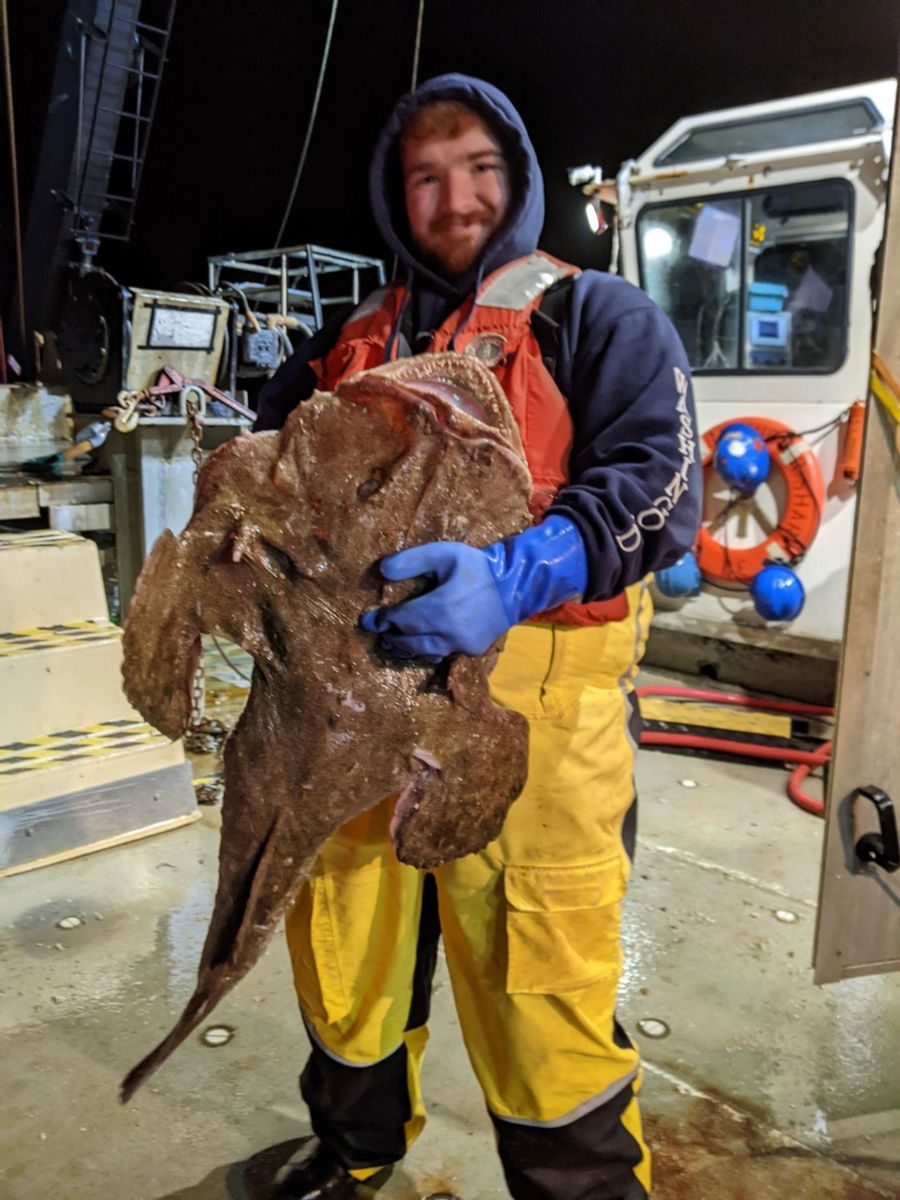
This week we finished up leg 2 in its entirety both in dredging and habcamming. We started by briefly switching from dredging to habcamming in order to take pictures of the ocean floor and determine scallop numbers from that as well. I assisted in annotating some of the obtained pictures, many of which this time included seeds which are basically baby scallops that require special markings different from regular scallops. This continued for a few days and then we got right back to dredging. The loads often varied between what made up the majority of the catch sometimes it was sand dollars and other times it was groups of barnacles or shell fragments. The sizes also varied, sometimes it was a very small load that only took about five minutes to massive loads that could take up to thirty minutes and needed help getting all of the catch out of the bag. In between these different dredges, we would take a device called a CTD which we would prep and send down to nearly the ocean floor to measure the salinity, temperature, oxygen level, and fluorescent level along the water column occasionally taking water samples from the bottom. I was typically in charge of setting up the winch camera and watching the data, communicating with the winch operators when it was close to the bottom and when to bring the CTD back to the surface. I also sometimes helped wash it down with fresh water to keep salt from building up on the CTD. We continued this schedule,(finding many interesting species like the biggest monkfish I had ever seen), until around Saturday where we once again docked at Woods Hole to bring on the last round of supplies and replacement scientists for the third and final leg of the survey. I have been very much enjoying this voyage and I have been learning many practical skills such as how to transfer data and identify many of the native species. I hope to learn even more on the final leg.


WEEK 3: R/V Sharp

Week three primarily consisted of dredging. My current shift is 6 hours on and 6 hours off. Depending on the dredge load it can be very physically challenging. After the load is dropped on the dredge table I shovel the contents to the sorters. Some very heavy dredge loads result in upwards of 30 minutes of shoveling. Typically on a productive day we can achieve 4-5 dredges per 6 hour shift. I have also become relatively confident with the CTD casts: during these I prep the CTD by taking off all plugs and caps from the pumps and sensors communicate with the science watch chief so I know the station number and cast number then I communicate with the engineer with the bottom depth and I watch the sensors and make sure they are functioning as expected. When the CTD reaches the bottom water bottles are popped that collect a water sample and we recover the CTD. We then secure it in the ship and flush the system and hose it with freshwater. 

On the steam back to port the WHOI technation discovered that a connection to the Habcams electronics bottle was damaged to the point of failure. At port the NOAA tech and I inspected the Habcams electronics bottle and blown connector. Because there were no blown fuses we came to the conclusion that the issue was caused by a short circuit within the connector caused by a water intrusion or insulation breakdown. He also taught me to look for signs of arc damage within a connector which can indicate a breakdown in the insulation. After the problem was diagnosed I assisted the NOAA team with reconnecting the electronics bottle and testing system power. 

Overall I had a great time and learned a lot this week. I got experience troubleshooting the R/V sharps computer systems and helped fix an issue with a gyro signal transmission with my mentor and I got time with the NOAA team troubleshooting the Habcams electronics system. The dredge work was very rewarding and fun. I am also excited about all of the contacts I have made. I have met some awesome people from NOAA and WHOI who I hope will be great future references. 

Page 2 of 9

Powered by WordPress & Theme by Anders Norén