Hello again everyone! I hope you are all doing well. it’s been quite an exciting and eventful time since my last update. In the past twelve days, I have been exposed to many new and interesting things about the Sharp, its crew and equipment, and the logistics of setting up this type of survey.
Let’s start from the beginning. On May 9th I landed in Salisbury Maryland, and was greeted by the oceanographic manager for the University of Delaware’s Earth, Ocean & Atmosphere College. He drove us roughly an hour to Lewes, Deleware where the Hugh R. Sharp is docked. We got our first tour of the vessel and the surrounding area and were shown where we would sleep for the night.
The Hugh, pre-mobilization:

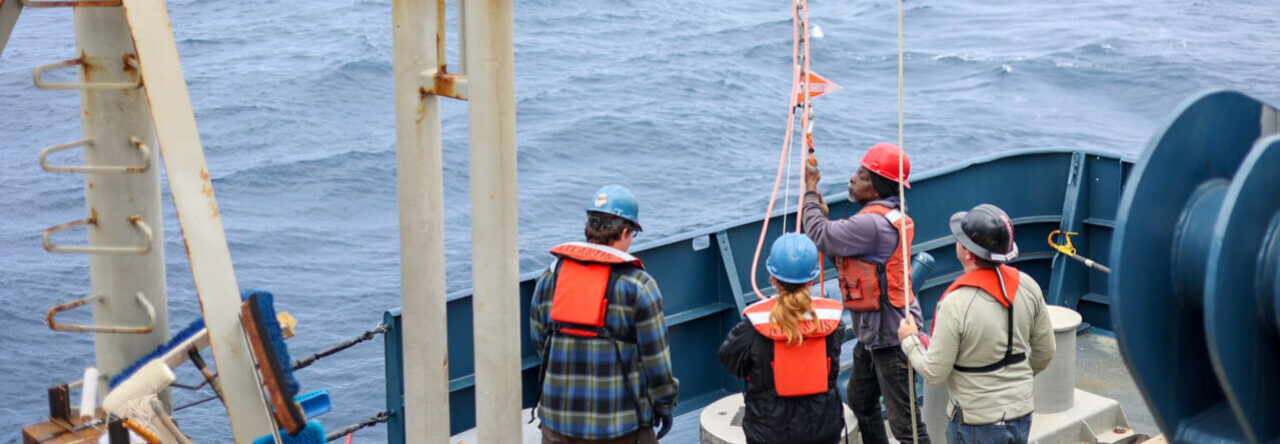
The following day we met most of the operational crew and started the process of loading up everything we needed for the survey. The Habcam and wet lab were hauled on the R/V using a huge crane, and I helped set up and secure a few things with help from the techs onboard. It was a pleasure to work alongside such professionals and I was in awe of how much they were able to get done in one afternoon. They were extremely accommodating and even asked us if we wanted anything specific for the grocery list (I wanted some minestrone soup and trail mix).
Hugh R. Sharp (left) alongside the Delriver (right):

On the eleventh, we got to meet most of the science team (the rest of them would arrive at a later date) and had fun crimping 1/2″ steel cable. It would be the secure point between the LCI 90 port wench system and the Habcam. This wench would be used to slowly lower the Habcam in the water column once it was time for deployment. It took us a couple of tries to get it right, as the cable was pretty oily and hard to handle.
One of the crimps that didn’t make the cut (didn’t have a long enough “tail”):

I also learned a lot more about the different functionalities and sensors that the Habcam is equipped with. It’s a really unique piece of hardware that has port/starboard sides-scan transducers and a forward-facing BlueView sonar (plus a multitude of other oceanographic sensors). I’ve actually had some experience working with this sonar and it’s one of the most advanced I’ve seen so far, it’s got an extremely quick refresh rate to the point where you’re basically seeing objects in real-time in a 180-degree swath.
BlueView mounted to the front of the Habcam for obstacle avoidance:

The next day was for shopping! The generous folk at UDEL paid for any necessities we forgot to bring and got us a complete set of high-quality wet gear! The awesome thing is that we get to keep our stuff even after the survey is over. The wet gear will keep us warm and dry during the long days on the dredge shoveling scallops and what-have-you. Once we got back from our shopping trip we helped restock the R/V with all the groceries they got for the survey ($3,600 worth of food!).
Then, May 15th rolls around. The big day! We donned our immersion suits (I volunteered to do it for the safety drill, it was pretty heavy and hot) and went over the process of the abandon ship protocol. After several briefs, we prepared to leave the dock at 1600. We had a twelve-hour steam directly to the first fisheries station and I signed up for the night shift (2400-1200). This is where stuff turned downhill. The vessel’s breaker that routed power to the drivers (which powered the thrusters) had a mechanical failure due to years of wear and tear from the movement of the ocean. Everyone who could help immediately went to work to diagnose and remedy the issue, I stood by watching the troubleshooting process, and tried to learn as much as I could without getting in the way.
After a couple of days of being dead in the water and the engineers working late into the night, they found the issue and discovered there was practically no way to fix it without getting a completely new breaker. The breaker we needed was only made in Italy of all places, and they immediately ordered a new one with expedited shipping. This brings us to the current day! Since the part that we need will roughly take a week to arrive, I have been spending time exploring and hanging out in the beautiful city of Lewes, Deleware. The crew has also taken us around town and showed us all the cool spots and sights to see, so I’ve been having lots of fun.
Though I am a little saddened that we will miss the first leg of the trip, I understand that these things happen and it’s better we discovered it now at port instead of being several miles offshore! Plus we still have the whole second leg of the trip, where we get to stop by Woods Hole, Massachusetts and I’m really excited for that! Anyways, that’s it for now! thanks for reading and I’ll be here again next week to update you all on how it’s going, take care and have a good one!
– Alejandro Dominguez