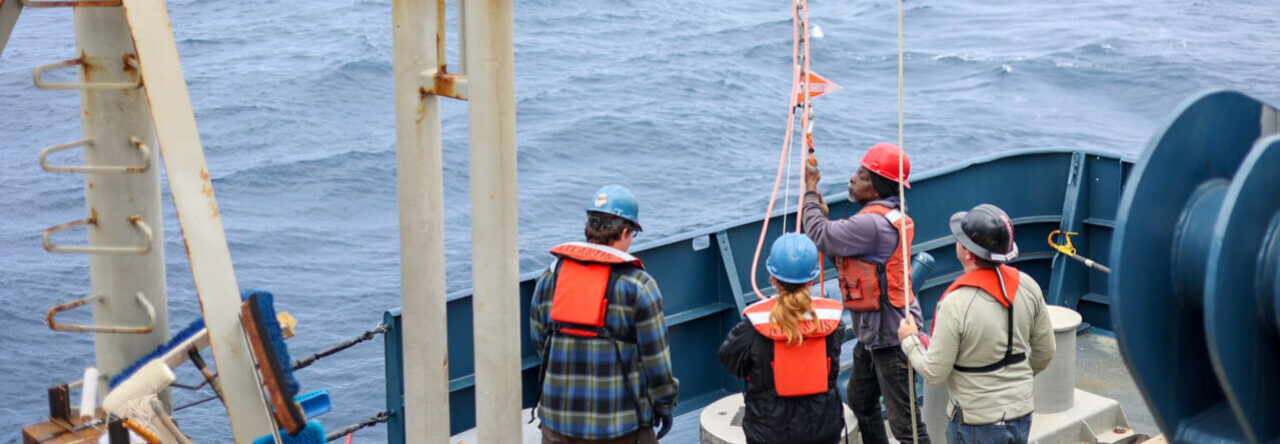
Operations during leg 3 consisted of Habcam Operations and dredging along with troubleshooting down systems with the ship’s marine techs.
From the technician side of things, Habcam operations are very low maintenance. My tech duties consisted of Habcam deployment and recovery, backing up data, and monitoring the ship’s sensors. Because my tech duties were very low maintenance I was able to assist the NOAA Fisheries science party with piloting the Habcam and image annotation.
Dredging operations during this leg were very high tempo compared to leg 2. A full dredge typically takes about 1 – 1 ½ hours and we were completing 4-5 dredges per 6-hour shift This meant I was typically busy and on my feet which was great compared to Habcam operations which can be mundane (if everything goes correctly). During dredging operations, my job is to help secure and dump the dredge and then I shovel the contents of the dredge to the sorters from the science party.
During my watch, I noticed the ship’s CTD computer was unresponsive. I went to reset the computer but the computer was not able to power up. I then removed the computer from the rack and opened it up and found no signs of damage in the power supply or motherboard. One of the ship’s marine techs used a pinout of the power supply along with a multimeter to test if the power supply was powering the motherboard. He found that no power was reaching the motherboard so I swapped the power supply with one from an identical spare computer and we still were not able to power up. Then we decided that the failure was either in the hard drive which would be bad because we had non-backed up data in there or it was in the motherboard. To test this I connected the CTD hard drive to the spare computer. The computer powered up and was able to read the CTD hard drive. Immediately after we restored function we made multiple copies of everything on the hard drive so if it failed we would have a backup.
Other than a weather delay and some down computer systems operations for leg 3 went very well and we were able to conclude operations one day early. After dredging operations were finished we steamed to Woods Hole and offloaded the science party and all of their equipment including the Habcam. During demobilization, I helped with crane operations by tying and handling a tagline to help guide loads like the Habcam and dredges in the correct orientation for transport. I also helped detach the recovery ramps for the Habcam and dredge and along with the other MATE intern helped secure them to the deck using ratchet straps. After everything was secured we steamed back to the R/V Sharps homeport Lewes Delaware and we demobilized the science van and the dredge table along with some other equipment.
I had an amazing experience aboard the R/V Sharp. I got to experience what life is like aboard a Research Vessel at sea for a month from playing cards during downtime with my scientist buddies to hectic dredging and demobilization operations. The crew from the marine tech to the ship’s engineers did a great job at answering my frequent questions and I am incredibly thankful to the NOAA and WHOI techs who allowed me to work with them during troubleshooting on the Habcam. I was able to learn a lot about everything from seamanship skills like tying knots and securing equipment to software troubleshooting and wire tracing to find lost signals and troubleshooting advanced marine equipment like the Habcam. I’m proud I was able to make a real contribution to this science mission.