Category: Vessel/Laboratory Page 42 of 89

Day 18

It has been 18 days since I began living on the R/V Atlantis. We are now off the coast of Guatemala. It is hot and humid outside making the shipping containers on board ovens and hard to work out of.

Since my last post we have put in a lot of work into the Bio Analytical Lab on board. It was filled to the ceiling with boxes and containers with a small walkway. We cleared it out and sanded down the walls. I painted and then worked on the floors. Next was building workbenches and finally today we assembled tons of chairs. There is still tons of work to do in that lab, along with all the others, but a lot of progress has been made. We have also installed some science fridges in the Bio lab and Hydro lab. 

Now we are in warmer waters it is common to see dolphins and tons of flying fish. Captain has tried to go fishing and he caught a tuna, but a shark got to it before he did. We even saw a Mahi Mahi and Capt tried to get him but no luck. There has also been lots of bioluminescent plankton in the waves of the ship at night which has been beautiful to just stand there and watch. 

Not much else has happened in the past few days, we are all working towards getting everything set up. We are also getting ready to pass through the Panama Canal which is still scheduled for August 3rd. 

Until next time


Oil from building benches

Fellow Interns, Bella and Cherisse building the bench

2nd Week at Sea (Anacortes, WA to SF, CA)

Before we sailed into the bay area to drop off Robbie (SSSG), Catie (SSSG), Jennifer (Lead Scientist), and Aaron Berry (Kongsberg), we ran a test on the EK 80, multibeam, and sonardyne USBL acoustic navigation system.

***EK 80 data***                                            ***Multibeam data***

Thursday, we passed under the Golden Gate Bridge and arrived in San Francisco Bay. We said our goodbyes to all those leaving the vessel and got to work. Grace and I started clearing out the bio lab and setting up monitors with raspberry pi in all the labs displaying real-time information (sea temp, latitude, longitude, speed, etc.). As we left San Francisco, we sat on the deck and enjoyed the beautiful sunset.

***Golden Gate Bridge***                               ***City Skyline***

The rest of the week, as we cruised the Pacific Ocean, we cleaned, unloaded lab equipment, and started to set up the labs.

Week 2: Methane Seeps!

Has this been a whirlwind of different events! Much different than the boats I’m used to back in Alaska!

Meeting everyone that is involved with the program was fun, everyone has been so warm and generous with their knowlegde and specialty. Very sad when I learned that most of the key crew we would be shadowing would be leaving us when reaching San Francisco, so I took as much time being present for most of the calibrations and testing they were doing for the equipment on board. One person I got to work close to was the chief scientist Jennifer Johnson, who was overlooking calibrations with the EK80. Not only did I help her log some of her testing over an oceanic shelf area off the coast of washington at 3am, but we also had the opportunity to view methane seeps off the coast of Oregon! It was very exciting for me because using this equipment goes hand in hand with what I hope to do for future research explorations and having someone there who was passionate in her field and allowed me to shadow her made a world of a difference to me.

Since the other crew members disembarked, we are near Cancun in Mexico. It is balmy and sunny than what I’m used to, but I am enjoying the work I’m putting into the preparations for the boat before we arrive to Woods Hole. I also saw flying fish for the first time! Looked like shining skipping stones as the fluttered out of the ships way.

Working with Jennifer watching for noise disturbances during EK80 calibrations

Deploying a XBT

One of the 2 methane seeps we observed off the coast of Oregon. We viewed it with the EK80 and the multibeam aboard, very exciting to note the differences and similarities between the 2 equipments!

Day 12

It has been 12 days since I first stepped foot on the R/V Atlantis. Since my previous blog post (7 days ago) a lot has happened and we are moving fast. Currently, we are off the coast of Mexico-we passed the border early this morning. The weather difference between here and off of Washington is drastic in the best way. Regardless, it has remained overcast for more days than not, and we have had only a light rain once or twice. 

On day 5 we had deployed the Sonardyne Compatt 6 Transponder beacon to 100ft to test if it correctly communicated to the deck unit on board the ship. The next day we deployed it again, but this time with the accessories. By this I mean we secured the beacon in a large yellow float, and attached a chain to the bottom of the beacon that was attached to a 300lb weight(picture below for reference). When it was deployed it sank to the bottom of the ocean and began transmitting information. At the bottom of the beacon was an acoustic release, which means that when we want the transponder to resurface the next morning, we send it a signal and the beacon will release the chain and weight that is holding it down and it will begin to rise. The water was so deep, it took the float 40 minutes to reach the surface! 

Along with testing the transponder, we also tested the new multibeam system while we were still off the coast of Washington/Canada. The ship has been equipped with a new EM124 Multibeam that was mounted permanently on the hull of the Atlantis. Thanks to my time at Cape Fear I have had recent experience with different sonars and multibeam data before this. We spend over a day doing a patch test for the multibeam, running lines back and forth to determine the correct calibrations. The lines were 1500 meters apart and the swath of the multibeam was over 1600 meters! Ultimately this means the sonar was mapping 1600 meters of the sea floor every few seconds. And then half way through the patch test the technician changed the swath width from 30 degrees to 140 degrees and the swath width increased to 12,000 meters! It was crazy to see. The software we used to view the real time data was SIS version 5.6.0.441. The software not only showed us the normal data from the multibeam, but it made a 3D image of the data in real time too, and it even mapped the intensity of the scatter back which showed us something similar to what a side scan sonar would show. It was really interesting to be able to observe this process and I am so glad I was able to experience it. On top of the patch test for the multibeam, before we ran a line we had to launch an XBT. An XBT is a torpedo shaped device that measures temperature, sound speed, and salinity. The device is dropped into the water and sinks deep into the water(1800 meters in 3 minutes). It is attached to a thin line of plastic and copper which runs into a wire on deck that feeds real time information to a deck unit. When the XBT has reached max depth, we break the thin line of copper and plastic and bring in the launcher, but leave the XBT into the sea. This was a new piece of equipment to me and I enjoyed learning and launching it. 

On day 10 we reached San Francisco around 0800. It was my first time seeing SF or California for that matter. We stayed in the bay anchor down until around 1900. We had 5 crew leave the ship by small boat that morning and we had a food order coming in that evening, mostly fresh fruit and veggies. We passed Alcatraz and tons of landmarks that the crew pointed out to me. The city looked huge, and it was a lot colder than I expected SF to be during the summer. I wish I could have seen more but I am happy to be able to say I have sailed under the Golden Gate Bridge!

On the days in between, I have been cleaning the labs, troubleshooting, setting up monitors, fixing printer problems and getting to know the ship and crew better. I start my mornings on the bridge and end the day in the movie room with some of the crew. I have seen seals and dolphins in the SF Bay, wales offshore up north, seen tuna jumping about, and some areas filled with jellyfish. I am grateful to be able to spend time on the R/V Atlantis and work directly with WHOI crew, and I am looking forward to the Panama Canal! They are estimating we will arrive there on August 2nd. 

Until next time-


—Balancing Act- standing on a stepstool while on a rocking ship! 

—Launching the XBT off the stern of the ship.

—Deploying the Sonardyne Compatt 6 Transponder 

—View from the bridge looking back

—The Golden Gate Bridge

—Alcatraz

— Sunset

—Coast of California

1st Week at Sea

Here is a quick summary of my first week on the RV Atlantis. I boarded my flight from California to Seattle, WA, early in the morning.

***View from the plane as it descended to Seattle, WA***


Once I landed, I hopped on the bus and headed to Anacortes, (a snappy four-hour ride), and arrived at my hotel. My fellow interns, Grace and Cherisse, and I explored the quaint town and dined at one of the local restaurants.

***Picture of the R/V Atlantis***


The following morning, we boarded the ship and met Allison Heater, an SSSG, our lead during our internship. We were shown to our rooms in the science berthing, also known as “the snake pit.” It sounds scary; however, my room is very very nice. After settling in, we toured the 274 ft vessel, the R/V Atlantis: mess, the many labs…we were introduced to the lead scientist Jennifer Johnson and the rest of the SSSG: Robbie Laird, Chris Grinder, Larry George, and Catie Graver. We continued our exploration of the ship since it would be our home as we make our way to Woods Hole, Massachusetts. 

***A-frame test, it lifted 100,000 lbs for 10 minutes***


As we readied to depart Anacortes, we spent the next few days prepping the ship. I helped secure the vessel for sea. Friday morning, I watched our departure on the bridge as we left Anacortes. Soon after leaving port the Chief Mate, PJ, scheduled a safety drill to go over how to use Emergency Escape Breathing Devices, EEBA., and we practiced putting on an immersion suit. The next few days were dedicated to testing/calibrating scientific equipment: the EK 80 and multibeam.

***Test path for the multibeam***

Day 5

Today is day 5 on the R/V Atlantis. I boarded the ship Monday morning at the shipyard in Anacortes, Washington. I made it to town easily and enjoyed the plane ride here! It was a cool experience with great views. We started Monday off with a tour of the ship and unpacking our bags in the Science Berthing hall, also known as the ‘snake pit’. I was introduced to what felt like tons of new faces and was honestly in awe by the size of the vessel. Within a few hours of boarding I took the time to walk around and familiarize myself with the ships layout, safety plans, and escape routes. Thankfully that helped me learn my way around quickly. I met the SSSG team, they will be acting as our mentors during the cruise. Everyone on board is very friendly and open to answering questions or talking about their work or interests. In the past 5 days I still don’t think I have met everyone since everybody is on different schedules. I have enjoyed listening to their stories and experiences, and what they like about Woods Hole and the Atlantis. 

We left the shipyard at 0900 Thursday, July 16th. The Captian invited the interns to watch us depart from the bridge and that was an unforgettable experience and view as a crowd of people on the docks and surrounding ships bid farewell to the Atlantis. SInce we left the shipyard we have spend most of our time in Puget Sound up until a few hours ago. Now (1600) we are heading towards the open ocean! 

Since boarding the ship Monday I have spend most of my time shadowing the SSSG team. I have watched them troubleshoot, work on wifi connection problems, work on patch pannels and tons more. In addition to that, I have soldered wires, made color-coordinated ethernet cables for the patch panels, installed desktops, downloaded programs and files, and cleaned the Hydro Lab. I have observed a deployment of a Sonardyne Compatt 6 Transponder to test its connections and readings, and I have observed real time data from the hull mounted multibeam sonar from the computer lab. Readings from the multibeam should be coming in 24/7 during this whole trip so I am looking forward to seeing the different terrains we pass over. While the ship was in the shipyard, it was completely stripped clean dry to its bones. New equipment was installed, maintence was done and new painting, flooring, and many other things were done to the Atlantis. In the past few weeks they have been working on hauling everything back on board and putting the ship back together just enough to cruise. This means the multiple labs, office spaces, and more common spaces are piled high with boxes and containers. The labs specifically are basically storage spaces. Ultimately the goal of this cruise is to both return the Atlantis to Woods Hole, and get it close to ready for a science expedition. This means having all the labs set up, all electrical wiring completed and the computer terminals in place, desks, shelving, and chairs assembled together and everything inside deep cleaned and some spaces even painted. I admit it is a lot to do and I am a little skeptical of how much willl actually get done. Electrical work isnt exactly my background, however I am looking forward to learning all I can. Besides, who knows when you’ll need to make a custom length ethernet cable on whim. It’s a skill, like all, that I am glad to have. 

In total my first impressions of the ship and its crew is overwhelmingly amazing and I am looking forward to the rest of the cruise. It is hard to believe that 5 days have already passed, feels like only 1 or 2 days ago I boarded the ship..

Until next time-


Week 1: Predeparture

Hello Everyone!

My name is Cherisse Figueroa and I am a recent graduate from Humboldt State University where I majored in Oceanography.

I am beyond excited to be a part of this amazing opportunity to work alongside establish scientists aboard the R/V Atlantis, especially in the field that I am personally most interested in: deep sea science. What my long term goal is to contribute to this new and unknown area of the ocean, primarily focusing on complex communities that form on hydrothermal vents or whale falls. Being chosen for this expedition, not only do I work alongside people who have done exactly what I want to do, I get hands on experience with the equipment and lifestyle I will hopefully one day be able to use myself in my professional future!

For the past year, I have been able to keep myself pretty busy working in the commercial fishing industry in Alaska boarding fishing vessels in the Bering Sea. I have been out at sea for most of the year, only coming to land for short periods of time. My position aboard the vessels is to do at-sea biological sampling and data entry for the vessel aboard and aiding in the preservation of sustainable fishing in one of the most healthy and controlled oceans in the world. It is physically tiring, working in some of the most trecherous weather conditions, and no WiFi, but I love my job and what I can do for better fishing practices.

Speaking of being at sea for most of the year, I recently disembarked my last vessel I was on for the past 3 months 4 days ago and now will be boarding the Atlantis is 3. Good thing I won’t lose my sea legs!

See you soon!

Introduction

Hi! My name is Bella, and I am excited to begin my internship aboard the R/V Atlantis.  I am flying out to Washington to meet the crew and the other interns where we will begin our cruise down the California coast through the Panama Canal to our final destination Woods Hole Massachusetts. While on the ship I will work with the marine technicians.

A little about me: I attend California Maritime Academy in Vallejo California double majoring in Marine Engineering Technology and Oceanography.  I enjoyed two summers at sea experiences thus far.  The first, my freshman year with my school where we traveled to Samoa, Solomon Islands, Saipan, and Hawaii and then with MSC on the USNS Fall River, and our ports included the Philippines, Australia, Timor-Leste, and Indonesia.  During both of these cruises, my focus was engineering.  My interest in engineering began in middle school when I discovered my love of robotics.  I competed in FIRST robotics and Botball in both middle and high school.  I enrolled in my high school’s CTE Engineering Pathway and was the only girl to graduate my year as a completer. 

I look forward to sharing stories on this journey and hope it will encourage other girls to think about careers in science and technology.  I also am looking forward to getting out of the desert heat!  I live in the Coachella Valley and this summer has been like an infernal – days over 120 degrees and humid.  The upside the beautiful sunsets we enjoy.

Sailing off on a New Horizon

Good Evening Everyone! 

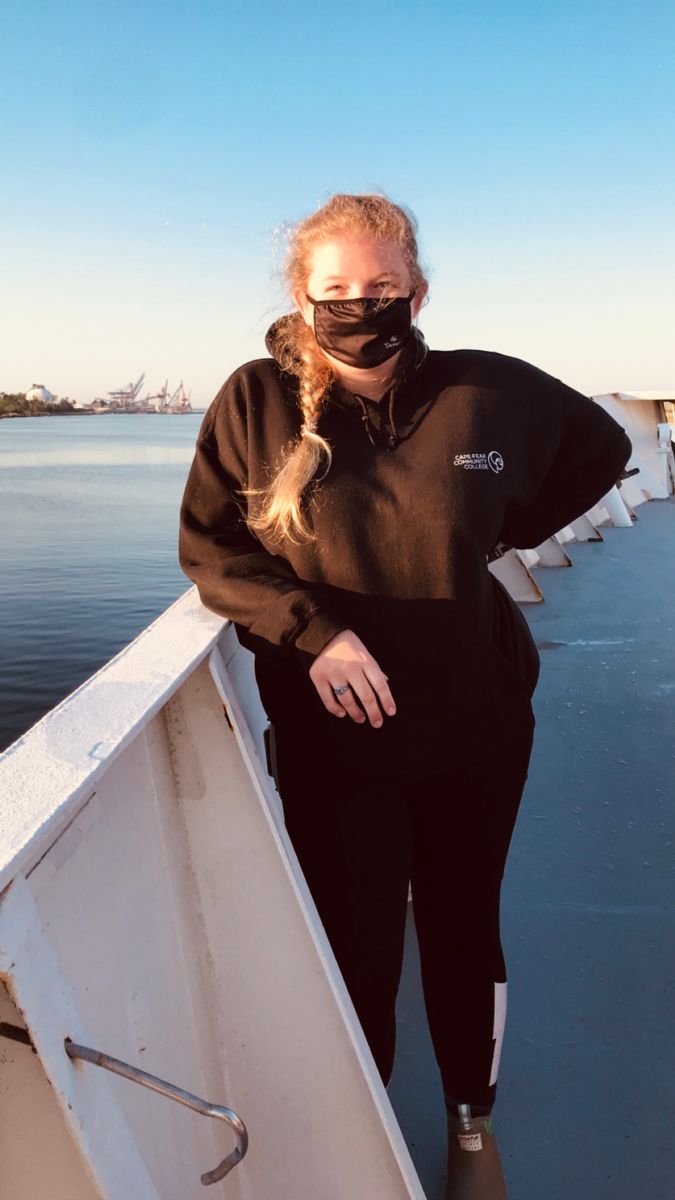
This is my first official post since being accepted as a MATES At-Sea Intern! My name is Grace Fulton and I will be boarding the R/V Atlantis in 12 short days to embark on a 4-5 week cruise from Washington to Massachusetts. I am a recent graduate of Cape Fear Community College in Wilmington, North Carolina. From Cape Fear I recieved an Associate in Applied Sciences in Marine Technology and an Associate’s degree in General Education. I have had some experience going offshore on a research vessel, the R/V Cape Hatteras, for 5 straight days and nights. However 5 days seems like a small amount of time compared to 5 weeks. That said I am so excited to begin this internship. Growing up on the East Coast I have never been further north than Washington, D.C. and not been further west than the Appalachian Mountians of NC. I am looking forward to traveling to Seattle, excited to see the Panama Canal and looking forward to landing in Woods Hole, Massachusetts. Im also excited to be sailing in the Pacific Ocean and watch the sun set on the water’s horizon for the first time! I am looking forward to meeting the two other interns and learning from them, as well as the ships crew. I know this is going to be an incredible adventure! 

Wish me luck for my first time flying in a plane!!! 

Until next time


Week 35 & 36: On The Walton Smith

We had another hurricane developing in the caribbean and it was projected to hit Miami. So we were preparing the ship to go up the river on Friday. On Friday morning we started up the engine and generators but we were not getting any power from them. We had to start troubleshooting the system to find the problem. After a few hours we narrowed it down to the exciter windings inside the generator. We checked everything else just to confirm we checked all the diodes in the rectifier and they all looked good. This took use most of the day so we were not going to be able to fix the generators in time to get shelter from the storm. So the next morning we had 2 tug boats come and tow us up the river to merrill stevens shipyard. We then did not have power close by so we needed to make a 200 foot shore power cord which took a few hours. Because the cord was so long we had to reduce the power to the ship so we would not overload the cord. We finished around 9pm. The next morning I got up and took apart both generators on my own. I removed exciter windings from both generators. The winding did look bad, they were burnt and had melted parts, which was a good sign for us that we found the problem. If this had been one generator it would have not been that strange but because it was both it was strange because they are on separate systems. A few weeks back lightning struck close by to where the ship was normally docked and it fried some of the dock lights. So it is possible lightning blew our generators. There was also a load test performed on the part of the grid our boat is normally plugged in. This could have also caused damage by overloading our system. We got two new exciter windings ordered. I checked the shore power cord pretty often to see how many amps we were drawing to make sure we would not get overloaded. There was a section of the cord where there were two parts plugged together where I could have access to the individual weirs. This was very good for testing. But as I was checking the weirs I discovered another major problem with the ship’s power. I found that we had a large amount of electricity flowing through the ground weir which should have no electricity going through it. I told Don the head engineer so we started to trace everything to figure out why electricity was going through the ground. It took a few days but with the help of a tech we found that the ship’s isolation transformer had been burnt out in the past and it was just bypassed and weird back together around it. With this being done the neutral was weird to the ground for some reason. In the meantime we got the new exciter windings. Don and I installed them together. We then fired up the gens and they both worked. But then one of our big breakers broke so we had to fix that. Then we had another issue that was preventing power getting to our system. It took use another day but we evenly found a problem with the electronics. Once the generators were up and running we got off shore power. We will not be able to use the shore power again till we fix the isolation transformer. The fact that the isolation transformer was not connected is another reason electricity got by to burn out the generators to start with. We then went back down the river to our normal dock on Saturday. 

Page 42 of 89

Powered by WordPress & Theme by Anders Norén